
If you search for BACB initial competency, the most important first step is to identify the document. The current BACB resource called the Initial Competency Assessment Packet is associated with assessing Registered Behavior Technician (RBT) skills. It is not the BCBA certification exam, not a generic BCBA fieldwork form, and not a substitute for reading the current handbook.
Table of Contents
- What Is the BACB Initial Competency Assessment?
- Who Is the Packet For?
- What Skills Does the Initial Competency Packet Cover?
- What Is the Difference Between a Client Assessment and Role-Play?
- Who Is Responsible for the Assessment Record?
- How Should You Prepare Before the Assessment?
- How Is Initial Competency Different From BCBA Fieldwork?
- What Mistakes Create Problems?
- How Should You Study the Term for a BCBA Exam?
- Where Should You Verify the Current Packet?
- FAQ: BACB Initial Competency
- Final Takeaway
- Take the Free BCBA Mock Exam
- References
The packet matters because it turns a broad statement such as “the applicant can perform ABA tasks” into observable task demonstrations, assessment types, initials, records, and a responsible assessor’s attestation. This guide explains how to read the packet at a planning level. The official BACB packet and handbook remain controlling if a summary differs from the current version.
What Is the BACB Initial Competency Assessment?
The BACB Initial Competency Assessment is a structured evaluation of an RBT applicant’s ability to perform specified behavior-analytic tasks. The packet shown in the current BACB resource hub is effective January 1, 2026. It is designed to be completed in full for consideration, with the responsible assessor signing the final attestation.
The word initial signals that this is an entry assessment. It is different from a recertification competency assessment, ongoing supervision, a local employer checklist, or a university skills lab. A local checklist may be useful for training, but it does not automatically replace the BACB document.
Because the search phrase is short, people sometimes assume it refers to a BCBA candidate’s first competency review. For a BCBA candidate, the relevant planning documents are usually the BCBA Handbook, supervised-fieldwork requirements, supervision records, and the certification application materials. Confirm the certification level before downloading a form.
Who Is the Packet For?
The current packet is an RBT competency resource. The BACB’s supervision and training page places it under “Assessing RBTs” and identifies the role of qualified certificants who can conduct the assessment, subject to the applicable requirements. A BCBA may encounter the packet as a responsible assessor, trainer, supervisor, or employer representative, but that role does not turn the packet into a BCBA fieldwork requirement. Before arranging an assessment, verify four basics:
- the certification level and application pathway;
- the effective date and version of the official packet;
- the responsible assessor’s current qualification and supervision-training status; and
- the organization, client, role-play, and record conditions required by the packet.
Those checks prevent a common administrative failure: completing a well-designed local evaluation and discovering that the BACB needs a different current form, signature, or assessment condition.
What Skills Does the Initial Competency Packet Cover?
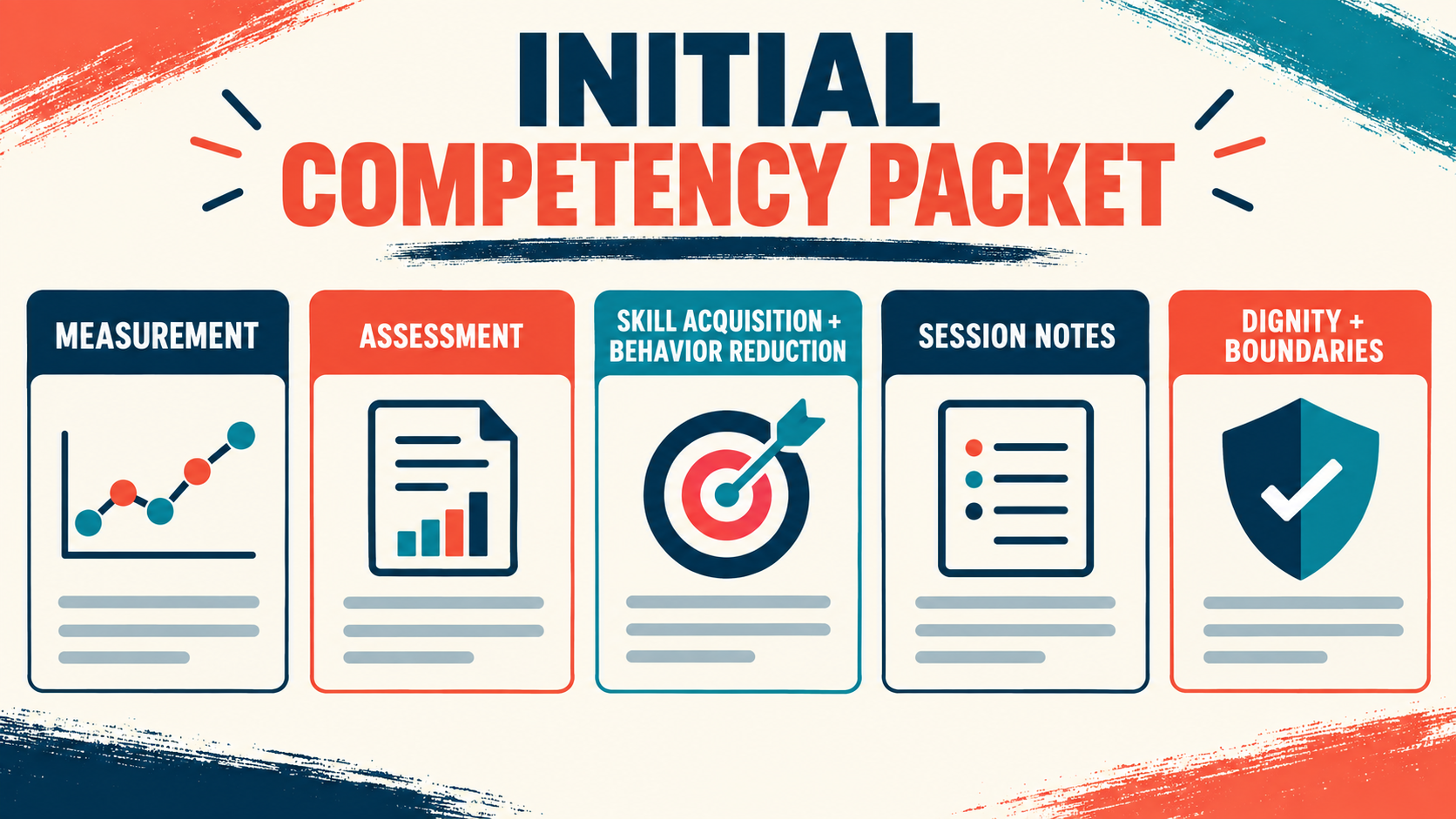
The 2026 packet organizes 19 task items across several broad areas. The exact form should be read directly, but its structure makes the competency logic clear: measure accurately, assess behavior, implement skill-acquisition and behavior-reduction procedures, document sessions, protect client dignity, understand supervision, and seek clinical direction when needed.
| Packet area | Examples of what is demonstrated | Evidence to watch for |
|---|---|---|
| Measurement | Continuous and discontinuous measurement, plus entering data and updating graphs. | Operational definitions, accurate recording, correct calculations, and a graph that matches the data. |
| Assessment | Preference assessment and ABC data collection. | Objective observation, correct sequence, privacy, and accurate recording of the relevant events. |
| Skill acquisition and behavior reduction | DTT, naturalistic teaching, chaining, shaping, discrimination training, prompting, and prompt fading. | Fidelity to the written plan, safe implementation, correct prompting, and timely clinical direction. |
| Professional conduct | Objective session notes, client dignity, professional boundaries, supervision knowledge, and clinical-direction examples. | Specific examples, de-identified records, respectful language, and knowing when to ask the supervisor. |
What Is the Difference Between a Client Assessment and Role-Play?
The packet permits different assessment types for many tasks, including work with a client or role-play. That does not mean every task can be completed in any way a local program chooses. Read the row for the task and note whether the packet requires a specific condition. The packet also identifies a subset of skill-acquisition and behavior-reduction tasks that must be demonstrated with a client.
A client demonstration shows performance in an actual service context, with the safeguards and consent requirements that govern that setting. A role-play can assess whether the applicant can perform a procedure in a simulated situation without exposing a client to unnecessary practice trials. Neither label alone proves competence; the assessor still has to observe the defined task and complete the required record. For study notes, write down the difference between:
- task performance: whether the applicant performed the specified procedure;
- assessment type: whether the observation used a client, role-play, interview, or another permitted method; and
- attestation: whether the responsible assessor signs that the required items were demonstrated.
Who Is Responsible for the Assessment Record?
The official resource identifies a responsible assessor who is accountable for the assessment and signs off on it. Some tasks may be delegated to qualified and proficient assistant assessors or trainers, but delegation does not remove the responsible assessor’s oversight or signature responsibility. Check the current packet for the qualification, relationship, training, and record-retention conditions.
That distinction is useful for BCBAs who support RBT applicants. A supervisor should not treat a packet as a quick form to initial while someone else informally observes. The assessment needs a plan for who will observe each task, what evidence will be retained, how assistant assessors are documented, and how the responsible assessor verifies the completed packet.
How Should You Prepare Before the Assessment?
Preparation should follow the packet’s task language, not a generic list of ABA vocabulary. Read every task, identify the behavior that must be demonstrated, and rehearse the exact data or session note that would show the task occurred. Ask the responsible assessor which tasks require a client demonstration and which can be assessed through role-play or interview.
- Download the current packet directly from the BACB resource hub.
- Make a task-by-task checklist without changing the packet’s wording.
- Review measurement definitions, data sheets, graphing conventions, and written programs.
- Practice explaining client dignity, boundaries, supervision, and clinical direction in concrete examples.
- Confirm the assessment type and scheduling conditions with the responsible assessor.
- Keep only the de-identified records and signatures permitted by the organization and BACB materials.
How Is Initial Competency Different From BCBA Fieldwork?
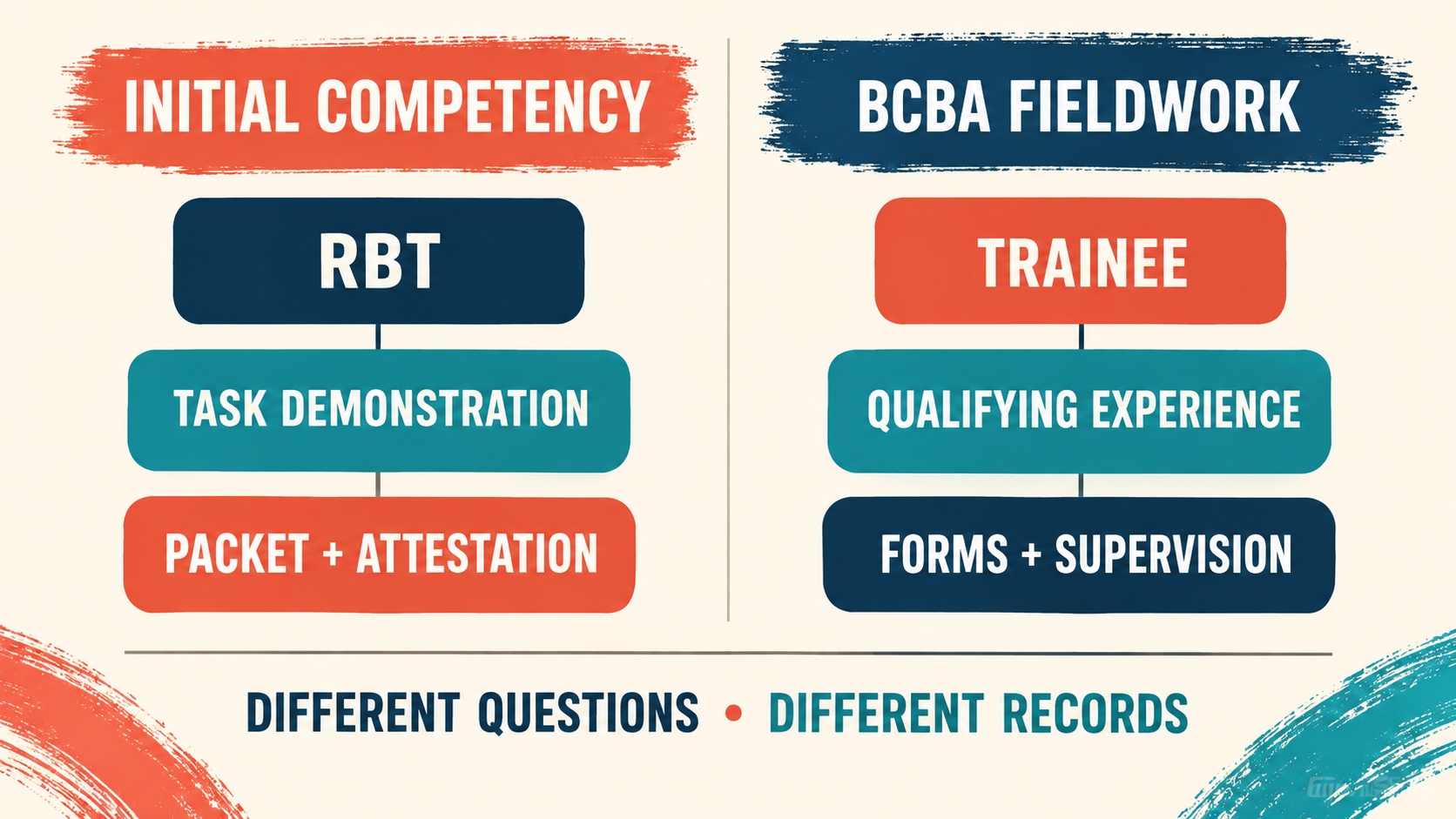
Initial competency is a structured demonstration of RBT task performance. BCBA fieldwork is a supervised professional-development pathway in which a trainee accumulates qualifying experience, receives supervision, documents activities, and meets the current pathway requirements before applying. The two can occur in the same organization, but they answer different questions.
| Question | Initial competency | BCBA pathway |
|---|---|---|
| Who is the learner? | Typically an RBT applicant completing the current packet. | A trainee pursuing BCBA certification through an approved pathway. |
| What is being shown? | Demonstrated performance on specified entry-level tasks. | Qualifying coursework, supervised fieldwork, supervision, and application evidence. |
| What is the main record? | The official initial competency packet and attestation. | Fieldwork forms, activity records, supervision records, and the certification application. |
| What does it not prove? | It does not equal a BCBA credential or replace the applicable examination and application requirements. | Fieldwork alone does not replace the current BCBA application and examination requirements. |
For BCBA study, this distinction is high value. A question that asks which document evaluates RBT task performance is not asking for a fieldwork verification form. A question about a trainee’s monthly supervised hours is not answered by the RBT initial competency packet. For additional BCBA scenario practice, use the free BCBA mock exam. Keep the certification level visible in your notes so a familiar form name does not pull you toward the wrong answer.
What Mistakes Create Problems?
- Downloading an old packet or a local checklist instead of the current BACB version.
- Assuming that a BCBA credential makes every assessor automatically eligible for every role.
- Counting a conversation about a procedure as a demonstration of the procedure.
- Using a role-play when the packet specifies a client demonstration for that task.
- Leaving the assessment type, initials, dates, or attestation incomplete.
- Uploading a packet or sharing client information without following privacy and record-handling requirements.
If a task was not observed correctly, the defensible response is to ask the responsible assessor how to correct the process. Do not backfill an attestation from memory or relabel a different activity as the required demonstration.
How Should You Study the Term for a BCBA Exam?
Because “BACB initial competency” is a navigational phrase, the exam skill is entity discrimination. Identify the credential level, the purpose of the document, the person responsible for the assessment, and the evidence required. Then separate the packet from the BCBA exam, BCBA fieldwork, RBT ongoing supervision, and recertification competency.
- Ask whether the stem names RBT, BCaBA, BCBA, or a general employee.
- Look for the words initial, recertification, fieldwork, or examination.
- Match the answer to the official document, not to a local employer form.
- Choose the answer that preserves the responsible assessor’s oversight and signature role.
- Reject an answer that treats a competency packet as proof of certification.
Where Should You Verify the Current Packet?
Start with the BACB’s Supervision, Assessment, Training, and Oversight page, then open the linked RBT Initial Competency Assessment Packet. Use the current RBT Handbook for RBT certification requirements and the BCBA Handbook if your question is actually about the BCBA pathway.
Official pages can change their document links or effective dates. Record the access date and version shown on the packet you use. A third-party explanation can help you understand the form, but it should not replace the current BACB document.
FAQ: BACB Initial Competency
Is BACB initial competency a BCBA requirement?: The current phrase most directly points to the RBT Initial Competency Assessment Packet. BCBA candidates should use the BCBA Handbook and supervised-fieldwork requirements for their own pathway. How many tasks are in the current RBT packet?: The current packet presents 19 task items across measurement, assessment, skill acquisition and behavior reduction, and professional conduct. Verify the version and exact instructions in the official packet before preparing.
Can an assistant assessor complete some items?: The BACB resource explains that some tasks may be delegated to qualified and proficient assistant assessors or trainers with oversight from the responsible assessor. The responsible assessor remains accountable for the assessment and sign-off.
Final Takeaway
BACB initial competency is best understood as a current RBT competency-assessment search, not as a generic BCBA fieldwork or exam term. Find the official packet, confirm its effective date, map each task to the permitted assessment type, document the responsible assessor’s oversight, and keep the packet separate from BCBA pathway records. That is the cleanest way to study the term and avoid sending the wrong document into an application workflow. For targeted review, use our BACB initial competency practice questions to apply the concept in exam-style scenarios.
Take the Free BCBA Mock Exam
If you want a low-pressure way to check your recall, use the free practice resource below. Take the Free BCBA Mock Exam



