
A BCBA retake application is the BACB step that follows an unsuccessful BCBA examination attempt. It is separate from booking the next Pearson VUE appointment. The current BCBA Handbook says candidates in the applicable BACB jurisdiction may take the examination up to eight times during the authorization period, with at least 30 days between appointments, but your BACB account and current handbook control the exact deadline and next action.
Table of Contents
- What Is a BCBA Retake Application?
- What Happens After an Unsuccessful Attempt?
- How Is the Retake Application Different From the Exam Appointment?
- How Much Time Is Between BCBA Exam Attempts?
- What Fees Should You Check?
- How Should You Use the Retake Window?
- What If You Need Testing Accommodations?
- How Do Deadlines Affect a Retake?
- What Mistakes Should You Avoid?
- How Should You Study the Retake Process for the BCBA Exam?
- FAQ: BCBA Retake Application
- Final Takeaway
- Quick Review Checklist
- Take the Free BCBA Mock Exam
- References
The practical sequence is simple to describe but easy to mishandle: review the result, wait for the retake application to appear in the BACB account, submit the application and required fee, receive authorization, then schedule and pay for the next examination appointment through Pearson VUE. Treat the administrative step and the study step as two connected but separate plans.
What Is a BCBA Retake Application?
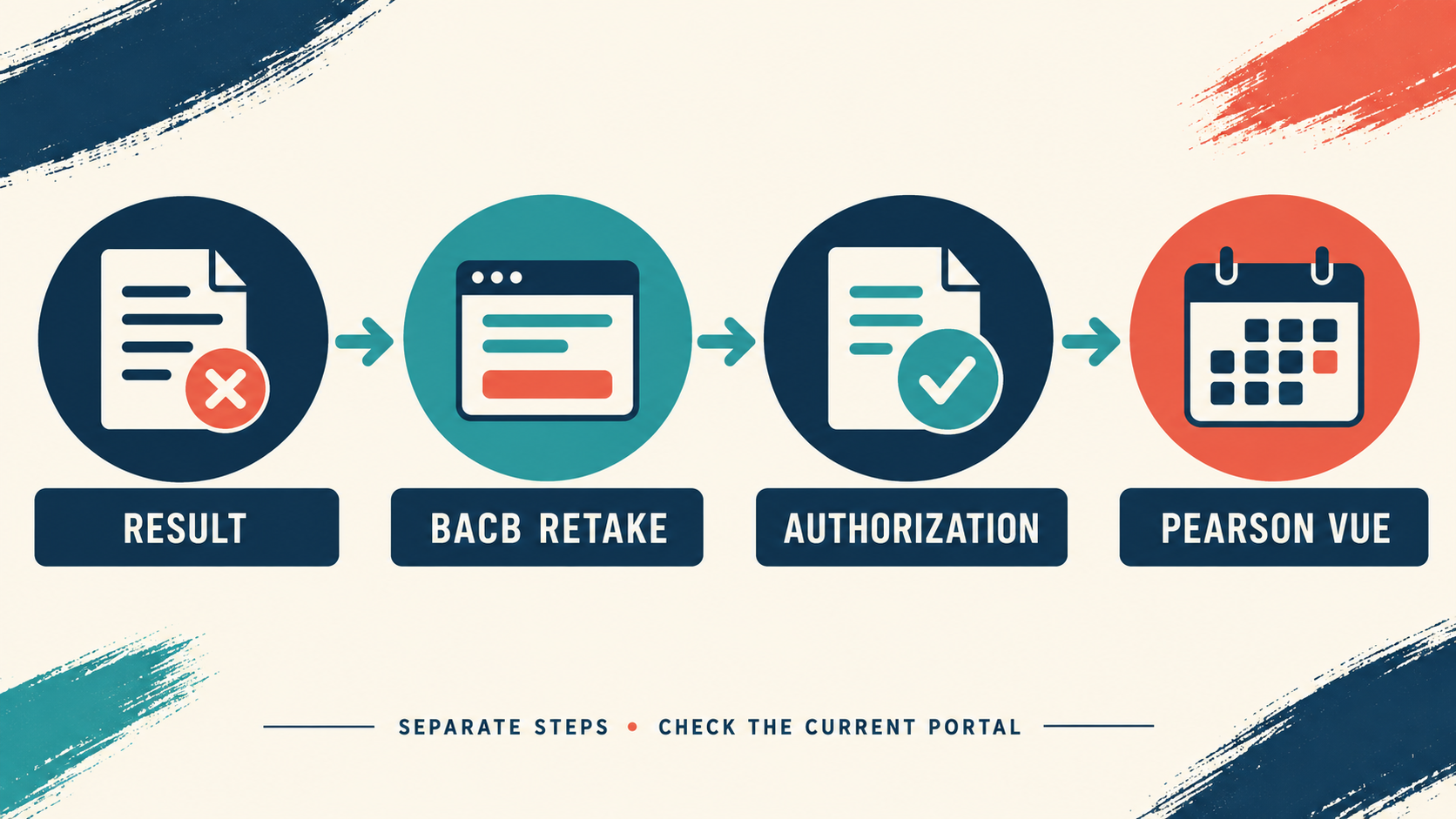
The retake application is not a new initial certification application. It is the application used after an unsuccessful examination attempt when the candidate remains within the applicable examination authorization period. The current handbook lists an examination retake application fee and explains that each retake requires a new retake application and a new examination appointment fee.
The application exists on the BACB side of the process. Pearson VUE handles the appointment side. That distinction helps explain why a candidate may see one action in the BACB portal and another in the Pearson account. Do not assume that paying for a testing appointment automatically submits the BACB retake application.
If the portal does not show the expected option, read the most recent result notice and current handbook first. Then use the BACB contact route for a case-specific account question. A third-party timeline cannot see your authorization status, exam history, or document flags.
What Happens After an Unsuccessful Attempt?
Results are provided at the examination site under the current examination process. After an unsuccessful result, the candidate should record the date, preserve the result information, and wait for the retake workflow to become available in the BACB account. The exact display timing and portal instructions can change, so use the notice and current account rather than an old screenshot.
- Read the result and confirm that the result is recorded for the correct candidate account.
- Review the current BCBA Handbook and the retake information that appears in the BACB portal.
- Submit the examination retake application and the current BACB retake fee.
- Wait for the retake authorization or instructions needed to schedule.
- Schedule the next appointment through Pearson VUE and pay the current examination appointment fee.
- Use the available interval for targeted review, practice, and a realistic readiness decision.
This sequence is a planning map, not an automatic guarantee of authorization. If the candidate’s application approval, authorization period, accommodation request, or account status has changed, the portal and BACB support response take priority.
How Is the Retake Application Different From the Exam Appointment?
| Step | Responsible system | What to confirm |
|---|---|---|
| Retake application | BACB account | The application option, current fee, authorization period, and any account instructions. |
| Exam appointment | Pearson VUE account | Candidate ID, authorization, appointment availability, location, and examination fee. |
| Accommodation | BACB and Pearson instructions | Whether the existing approval carries forward or a new request or documentation is needed. |
| Study plan | Candidate and study resources | Domain-level errors, practice conditions, timing, and a readiness criterion. |
Keeping these steps separate prevents two common errors: scheduling a new appointment before the retake application is authorized, or assuming that the BACB retake fee covers the Pearson VUE appointment.
How Much Time Is Between BCBA Exam Attempts?
The current BCBA Handbook states that candidates may take the examination up to eight times during the applicable authorization period, with at least 30 days between appointments. Your BACB account contains the candidate-specific testing deadline. The waiting period is a minimum; it is not a recommendation to schedule immediately.
Use the interval for diagnosis. A candidate who needs more than 30 days to repair a weak domain should not choose an appointment merely because the calendar allows it. On the other hand, an extended delay can create deadline risk or allow study routines to lose momentum. The right decision is based on the current authorization window, evidence from practice, and the candidate’s constraints.
What Fees Should You Check?
Fees change, and BACB fees are described as nonrefundable and nontransferable in the handbook. The current 2026 handbook page available in the research review lists an examination retake application fee of $140 and an examination appointment fee paid to Pearson VUE of $125. Verify both amounts in the current handbook and portal before paying; do not treat this article as a price quote.
Also check cancellation and rescheduling rules with Pearson VUE. A missed or changed appointment can create a separate fee issue. Keep the receipt, confirmation number, appointment date, and candidate ID in one private administrative folder.
How Should You Use the Retake Window?
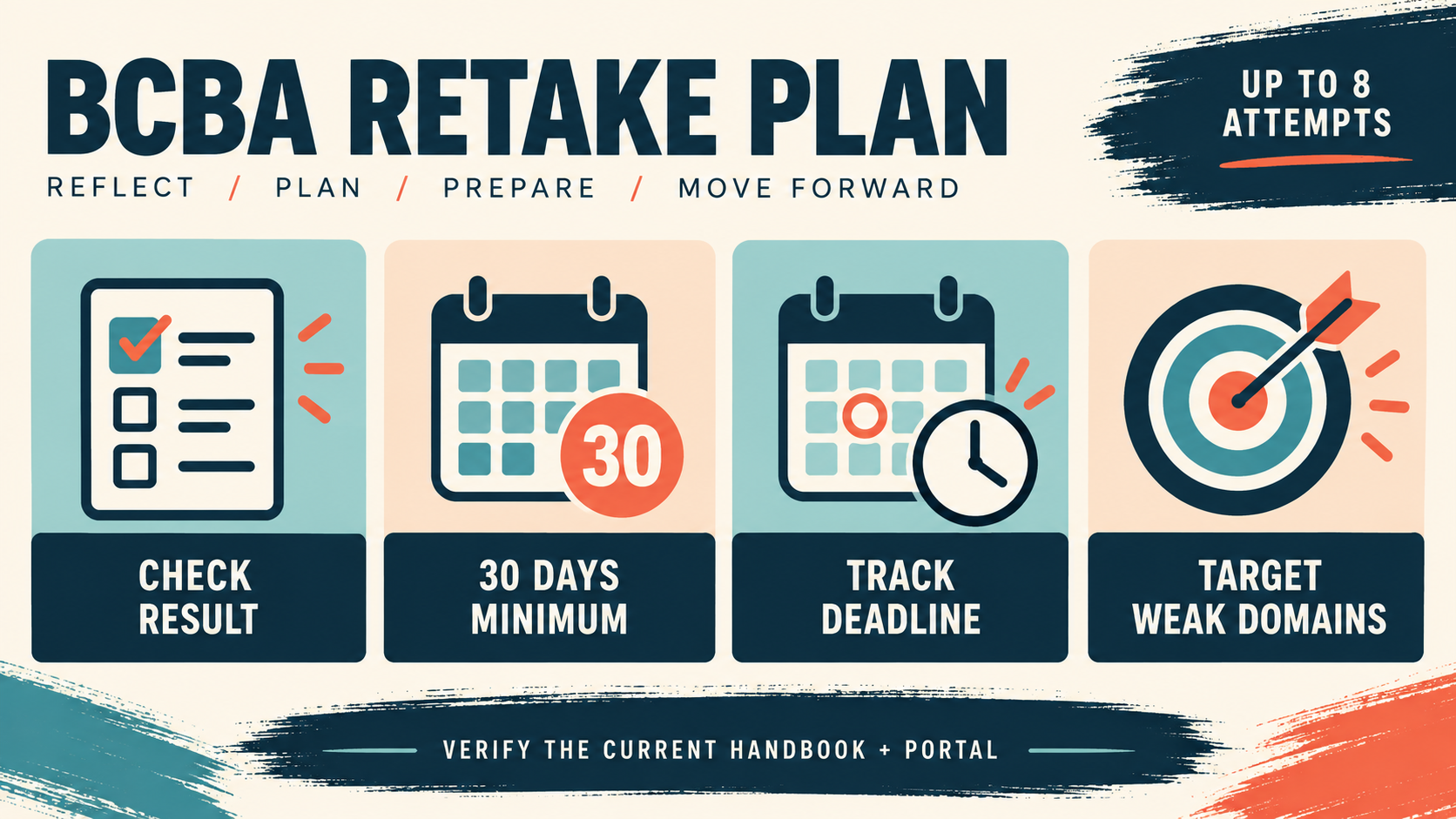
The retake window is most valuable when it turns a result into a targeted plan. Do not simply repeat the same full-length practice test every day. Start with the candidate’s score report or result information, identify the content domains that need the most work, and compare errors by concept, stimulus conditions, and question wording.
- Concept error: the definition, principle, or procedure was not understood.
- Discrimination error: two similar concepts, such as prompting and stimulus fading, were confused.
- Application error: the concept was known but not applied to the scenario’s facts.
- Measurement error: the candidate selected an answer without checking the operational definition, numerator, denominator, or data pattern.
- Test-process error: timing, reading speed, or changing an evidence-supported answer created avoidable misses.
Build practice around the error pattern. If the problem is application, use short scenarios and explain why the nearest distractor is wrong. If the problem is measurement, work through the calculation and decision rule on paper. If the problem is timing, add timed blocks gradually rather than treating speed as a substitute for understanding. For additional scenario practice, you can use the free BCBA mock exam. Treat any practice score as one data point, not as a guarantee of the official result.
What If You Need Testing Accommodations?
Accommodation requests follow their own documentation and scheduling process. Do not assume that an approval from an earlier appointment automatically transfers to a retake. Review the current BACB accommodation instructions and any separate email or portal message, then follow the Pearson VUE scheduling directions that apply to the approved accommodation. If a disability-related need, medical change, or documentation question affects scheduling, contact the appropriate official support channel early. Avoid putting sensitive medical details into a public study forum or an unverified form.
How Do Deadlines Affect a Retake?
The handbook provides an authorization period and the BACB account shows the candidate-specific deadline. A retake application does not create an unlimited new authorization window. Before paying, check how many attempts remain, the last permitted testing date, and whether an administrative issue must be resolved first.
The 2027 transition adds another reason to verify dates. A candidate’s pathway, application approval, and the requirements under which the application is reviewed can affect what documents and rules apply. Do not infer transition treatment from an exam date alone; read the official transition guidance and the candidate’s BACB account.
What Mistakes Should You Avoid?
- Confusing the BACB retake application with the Pearson VUE appointment.
- Scheduling before the retake application is authorized.
- Ignoring the 30-day minimum between appointments.
- Paying an old fee copied from a prep group or outdated handbook.
- Using all available attempts without a domain-level remediation plan.
- Assuming an accommodation, candidate ID, or deadline carries forward without checking.
- Letting practice scores replace the official result or portal instructions.
How Should You Study the Retake Process for the BCBA Exam?
For a process question, sort each fact into one of four buckets: result, BACB application, Pearson VUE appointment, or study plan. Then identify the timing rule. A strong answer will usually mention the new retake application, the minimum wait, the authorization window, and the separate appointment process.
- Read the candidate’s result and current handbook section.
- Check the BACB portal for the retake application and deadline.
- Confirm the current retake and appointment fees before payment.
- Wait the required interval and schedule through the correct system.
- Use practice data to decide what to study before choosing the appointment date.
FAQ: BCBA Retake Application
Do I need a new retake application after every unsuccessful attempt?: The current handbook says each examination retake requires a new retake application and a new examination appointment fee. Check the candidate’s portal for the available action after the result is posted.
Can I take the BCBA exam again after 30 days?: The current handbook describes at least 30 days between examination appointments. You must also remain within the applicable authorization period and complete the retake and scheduling steps.
Does the retake application reset my two-year window?: Do not assume that it does. The candidate-specific authorization period and deadline appear in the BACB account. Read the current handbook or contact BACB for a case-specific answer.
Final Takeaway
A BCBA retake application is the BACB administrative step after an unsuccessful examination attempt; it is not the same as the Pearson VUE appointment. Check the current handbook and portal, submit the retake application, observe the minimum waiting period, schedule through Pearson VUE, and use the intervening time for targeted remediation. The safest plan keeps current official instructions ahead of old screenshots, forum advice, and generic timelines. For targeted review, use our BCBA retake application practice questions to apply the concept in exam-style scenarios.
Quick Review Checklist
Use this final checklist to turn BCBA retake application into exam-ready reasoning. The goal is not to memorize a label in isolation; it is to identify the relevant evidence and explain why the best answer fits the scenario. Key ideas to review:
- State the central definition or decision point for BCBA retake application in your own words.
- Identify the detail that makes BCBA retake application different from its closest related ABA term.
- Separate the observable facts in a scenario from assumptions that are not supported by the facts.
- Write one example and one nonexample so you can recognize the concept in a new setting.
Exam application checks:
- Ask what the question is actually requesting before comparing the answer choices.
- Mark the antecedent, response, consequence, or other evidence that supports the selected answer.
- Look for a distractor that describes a related process but does not answer the specific question.
Final self-check:
- Explain how you would verify the interpretation with clear observations or data.
- Change one detail in the scenario and decide whether your answer should change.
- Give a one-sentence rationale that a supervisor or study partner could evaluate.
Take the Free BCBA Mock Exam
If you want a low-pressure way to check your recall, use the free practice resource below. Take the Free BCBA Mock Exam



