
Directional stimulus prompting is an ABA teaching arrangement in which an added feature of the stimulus display directs attention toward the relevant stimulus or response option. A practitioner might alter position, highlight a feature, point toward an item, or change the movement or salience of a cue. The goal is not to make the added cue permanent. The goal is to help the learner respond correctly while control is transferred to the intended discriminative stimulus.
Table of Contents
- What Is Directional Stimulus Prompting?
- How Is a Stimulus Prompt Different From a Response Prompt?
- What Does Directional Prompting Look Like in a Trial?
- Which Examples Can Count as Directional Stimulus Prompts?
- How Do You Fade a Directional Stimulus Prompt?
- How Do You Measure Whether Stimulus Control Transferred?
- What Errors Can Create Prompt Dependence?
- How Does It Relate to DTT and Generalization?
- How Should You Answer a BCBA Exam Question?
- FAQ: Directional Stimulus Prompting
- Final Takeaway
- Take the Free BCBA Mock Exam
- References
The exact phrase can be confusing because “directional stimulus prompting” also appears in unrelated technology and prompt-engineering searches. This article uses the phrase in an applied behavior analysis context. It also makes an important distinction: a directional cue added to the stimulus arrangement is not automatically the same as a verbal, model, or physical response prompt.
What Is Directional Stimulus Prompting?
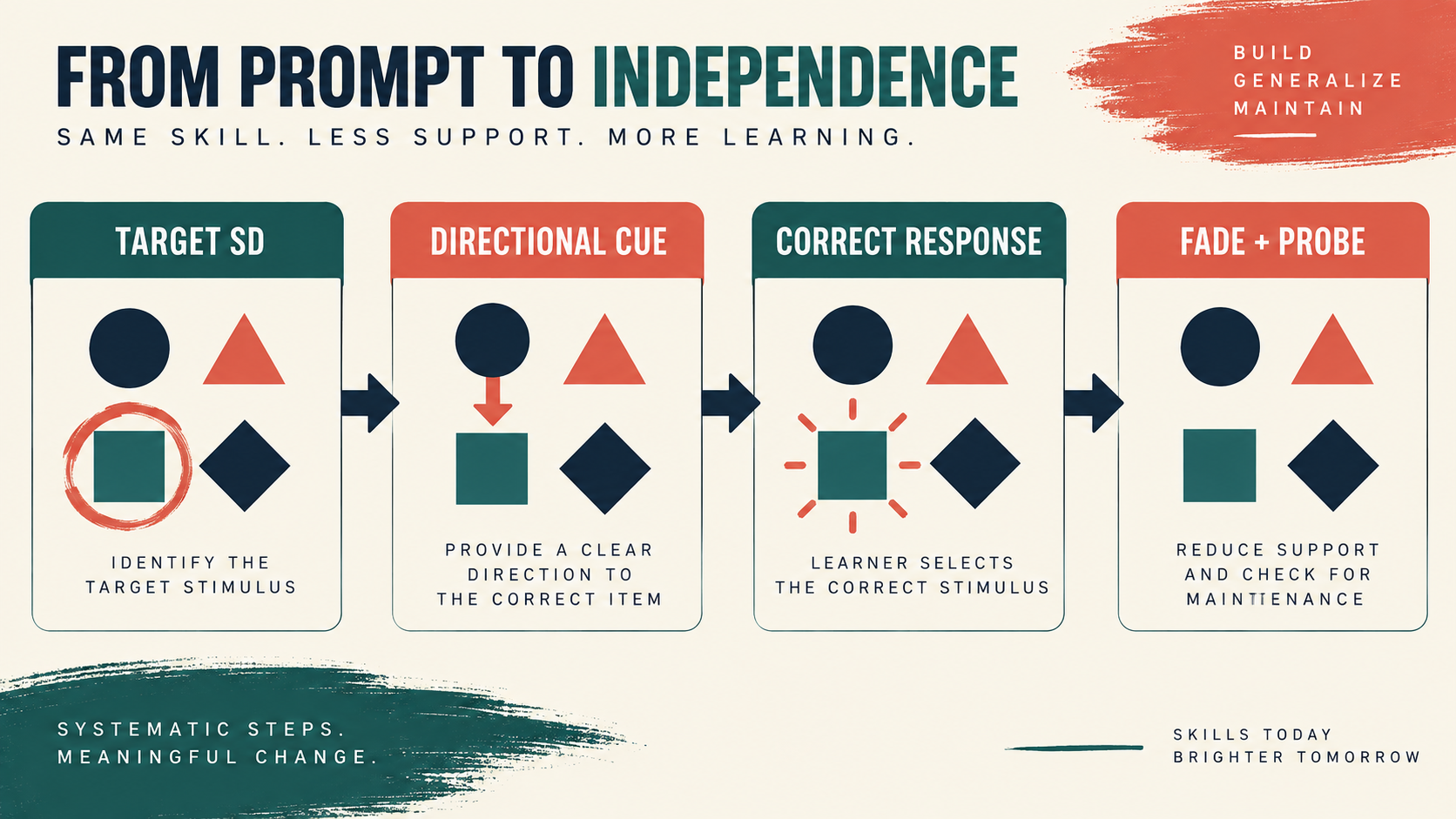
A stimulus prompt changes the stimulus field so that a correct response becomes more likely. A directional stimulus prompt specifically makes the relevant feature, item, location, or relation easier to notice. For example, if a learner is selecting a picture from an array, the instructor may temporarily place the target in a more salient position or use a brief visual marker to direct attention toward the relevant feature.
“Directional” describes the function of the added cue in the teaching arrangement: it points the learner toward what to attend to. It does not mean the learner is being physically moved, and it does not mean that every gesture is a stimulus prompt. Classification depends on what changed, when it changed, and whether the added event controls the learner’s responding. For study purposes, ask three questions:
- Was the stimulus display, stimulus feature, or spatial arrangement changed?
- Was the learner’s response physically or verbally guided instead?
- Is the added cue scheduled to fade so the intended SD controls responding?
How Is a Stimulus Prompt Different From a Response Prompt?
Both prompt families can increase correct responding, but they alter different parts of the teaching arrangement. A stimulus prompt changes what the learner sees or attends to. A response prompt adds assistance that guides the behavior itself. The boundary is determined by the operation, not by the label used in a program book.
| Prompt type | What changes | What to measure |
|---|---|---|
| Directional stimulus prompt | A feature, position, movement, contrast, or marker in the stimulus field directs attention. | Independent accuracy when the added cue is absent, plus errors and prompt level. |
| Verbal response prompt | The instructor says or models part of the response, such as the first sound or word. | Independent vocal response, latency, and whether the learner waits for the model. |
| Model prompt | The instructor demonstrates the response for the learner to imitate. | Imitation with the model absent and the response under the target SD. |
| Physical response prompt | Contact or guidance changes the learner’s movement toward the correct response. | Independent responding, prompt intrusiveness, safety, assent, and fading criteria. |
What Does Directional Prompting Look Like in a Trial?
Imagine a receptive-identification program with three pictures. The target SD is “Touch the cup.” At baseline, the cup can appear in any position and no extra cue is added. During teaching, the practitioner may temporarily make the cup more salient or arrange the display so the target feature is easier to discriminate. The learner touches the cup, receives the programmed consequence, and the prompt is recorded.
A defensible trial description records more than “prompted.” It identifies the target SD, the stimulus change, the response, the prompt level, the consequence, and whether a later probe occurred without the directional cue. This is how a supervisor can tell whether the cue helped the learner contact the relevant stimulus or merely produced repeated selection of one location.
- Present the target instruction or SD and the relevant stimulus array.
- Add the planned directional stimulus prompt without changing the target response definition.
- Allow the learner an opportunity to respond, using the least intrusive support that is effective.
- Reinforce the correct response according to the individualized teaching plan.
- Record whether the response occurred with the prompt, without it, or after an error-correction sequence.
- Probe the skill under the intended stimulus conditions so transfer is visible in the data.
Which Examples Can Count as Directional Stimulus Prompts?
Examples are easier to classify when the added event is described precisely. Possible stimulus-prompt arrangements include a temporary positional advantage, a highlight or contrast that makes a feature stand out, a brief movement toward the relevant item, or a visual marker that directs attention. These examples are not automatically correct for every learner or target. The program must define the prompt and its fading rule.
- Positional: temporarily placing the target in a predictable or more salient location, then rotating positions as control transfers.
- Feature-based: exaggerating or highlighting a relevant color, shape, edge, or component before gradually returning it to its natural form.
- Gestural or directional: pointing toward or orienting attention to the relevant stimulus without physically moving the learner’s body.
- Movement-based: briefly changing the motion or presentation timing of the relevant stimulus so it is easier to detect.
A pointing gesture can be classified differently depending on the teaching arrangement. If it is an added event in the stimulus field that directs attention, it may function as a stimulus prompt. If the practitioner uses a gesture as a response cue or physically guides the response, it may be better described as a response prompt. Write the topography and timing instead of assuming that “gesture” settles the classification.
How Do You Fade a Directional Stimulus Prompt?
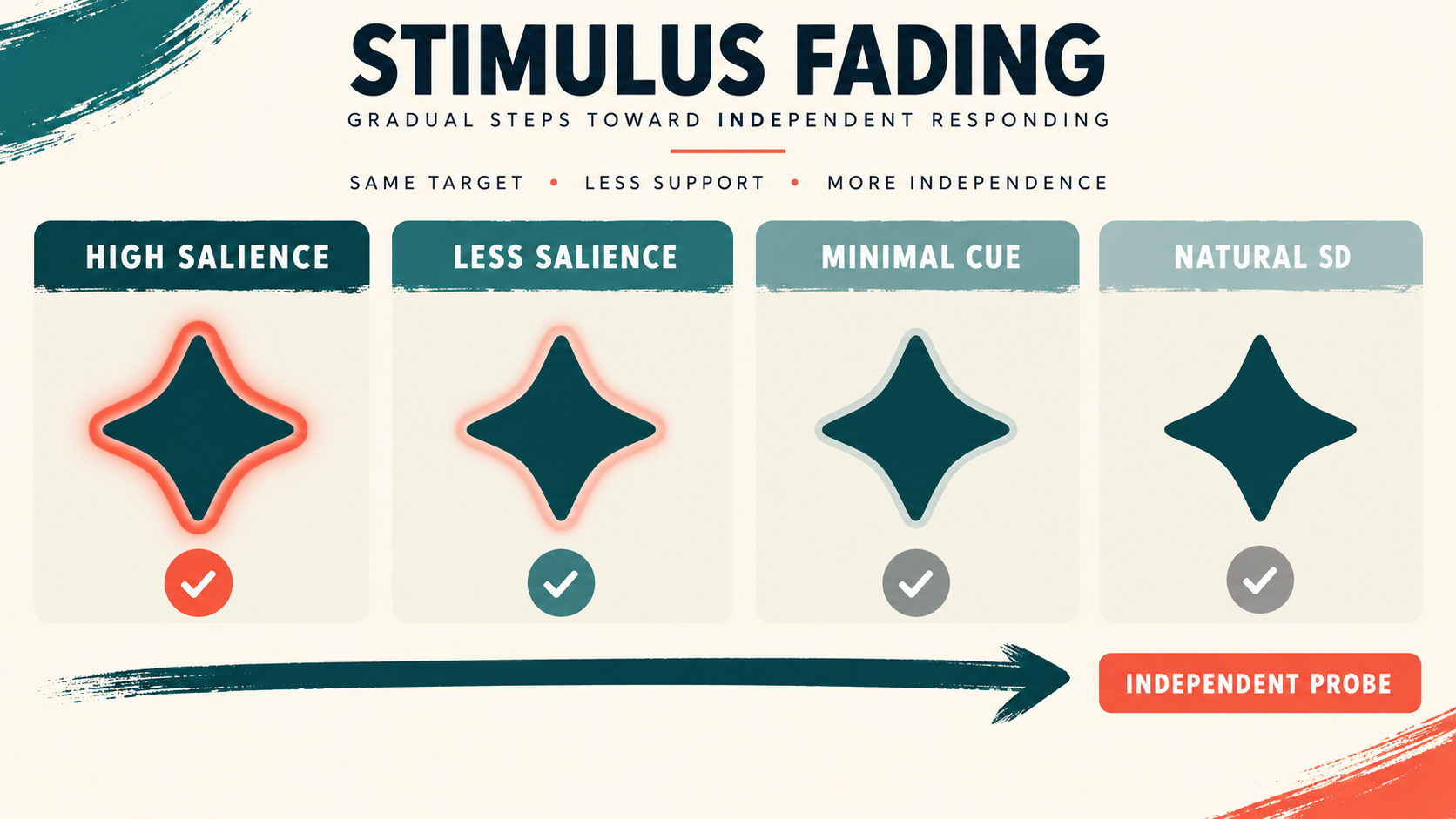
Fading means systematically reducing the added support while preserving the opportunity for the learner to respond to the intended SD. A useful plan specifies what dimension will change: location, size, contrast, movement, duration, distance, prompt delay, or the number of stimulus features altered. “Fade as tolerated” is too vague for reliable implementation.
For example, a plan might move from a strong visual highlight to a smaller highlight, then to a less contrasting marker, and finally to the natural stimulus display. Another plan might use a prompt delay so the learner has an opportunity to respond to the SD before the directional cue appears. The correct sequence depends on baseline performance, error patterns, prompt intrusiveness, and the learner’s preferences and assent.
Do not rotate positions mechanically if the learner has not learned the relevant discrimination. Position rotation is useful when the learner is selecting a location rather than the target feature, but it should be paired with data that show what is controlling responding. The goal is not merely to make every position occur; it is to make the intended stimulus relation predictive of reinforcement.
How Do You Measure Whether Stimulus Control Transferred?
The key test is independent responding under the target stimulus conditions. If correct responding remains high only when the directional cue is present, the prompt has not yet been faded enough. If performance falls after fading, check whether the discrimination, motivating operation, response definition, reinforcer, or prompt history needs review. Do not label the learner “prompt dependent” without inspecting the teaching arrangement and data.
| Data field | Question it answers | Warning sign |
|---|---|---|
| Independent accuracy | Does the response occur when only the intended SD is available? | Accuracy drops as soon as the directional cue is removed. |
| Prompt level and latency | Is less support needed, and does the learner respond within the planned interval? | The learner waits for the cue or repeats a location-based response. |
| Error pattern | What feature or relation is controlling the error? | Errors cluster around position, color, instructor movement, or a repeated prompt. |
| Generalization probe | Does the response occur with new exemplars, people, settings, or natural cues? | Performance is accurate only with the trained display and the original prompter. |
For scenario questions, remember that acquisition with a prompt is not the same as independent mastery. A data path that contains prompted accuracy but no unprompted probe cannot show that stimulus control transferred.
What Errors Can Create Prompt Dependence?
Prompt dependence can emerge when the added cue is more salient than the intended SD, when fading is delayed, when the prompt is delivered after an unnecessarily long wait, or when the prompt is accidentally paired with reinforcement more reliably than the target stimulus. A learner may also memorize a position or a sequence instead of discriminating the relevant feature.
- Using the same position for the correct item across trials.
- Changing multiple stimulus dimensions at once, so the fading step cannot be interpreted.
- Calling a response prompt a stimulus prompt because both are described as “pointing.”
- Skipping no-prompt probes and counting prompted responses as independent.
- Fading according to a calendar rather than performance and error data.
- Continuing a prompt that increases effort, discomfort, or refusal without a documented review.
How Does It Relate to DTT and Generalization?
In discrete-trial teaching, a directional stimulus prompt can be embedded in the antecedent arrangement of a trial. That can support early correct responding, but the trial should still make clear which stimulus is intended to control the response. Prompt fading and transfer procedures then reduce the added cue. Generalization is a later or related question: does the learned relation survive changes in exemplars, people, settings, materials, and natural cues?
Do not treat generalization as proof that transfer occurred. A learner might generalize a prompted location routine, or respond to a practitioner’s gesture in several settings, without responding to the intended SD independently. Test the controlling relation directly and then plan generalization probes that match the functional goal.
How Should You Answer a BCBA Exam Question?
The current BACB content outline places stimulus and response prompting, prompt fading, stimulus control, discrimination, and generalization in related but distinguishable competencies. When a question uses “directional stimulus prompting,” identify what the added event changes before selecting a procedure.
- Underline the stimulus or response that is being modified.
- Ask whether the cue changes the array or guides the learner’s movement or vocal response.
- Find the answer that includes a plan to fade the added support.
- Look for data on independent responding under the natural or intended SD.
- Reject an answer that confuses prompted accuracy with stimulus-control transfer.
For more scenario practice, use the free BCBA mock exam. The useful study habit is to explain why a procedure changes the stimulus arrangement, the response, or both.
FAQ: Directional Stimulus Prompting
Is a directional stimulus prompt the same as a gesture prompt?: Not always. A gesture may function as a stimulus prompt when it changes what the learner attends to, or as a response prompt when it cues or guides the response. Describe its timing, topography, and effect on the teaching arrangement.
Does a directional stimulus prompt have to be faded?: If the goal is independent responding under the intended SD, the added directional support must be systematically reduced or otherwise transferred. The plan and criteria should be individualized and data based.
What is the biggest exam trap?: The common trap is calling any added help a stimulus prompt. First decide whether the prompt changes the stimulus field or directly guides the response, then look for the fading and independent-probe evidence.
Final Takeaway
Directional stimulus prompting temporarily directs attention toward the relevant stimulus feature, item, or relation. It is distinct from directly prompting the response, and it should be defined by observable changes in the teaching arrangement. A complete plan names the prompt, measures prompted and independent responding, fades the added cue, and probes whether control has transferred to the intended SD. For targeted review, use our directional stimulus prompting practice questions to apply the concept in exam-style scenarios.
Take the Free BCBA Mock Exam
If you want a low-pressure way to check your recall, use the free practice resource below. Take the Free BCBA Mock Exam



