
What Is the BACB Code of Ethics?
The BACB Code of Ethics is the professional standard for behavior analysts. It outlines enforceable rules for ethical conduct in service delivery, research, and supervision. For BCBA candidates, understanding this code is not optional—it is a core requirement for certification and ongoing practice.
Practice this concept
Table of Contents
- What Is the BACB Code of Ethics?
- Core Ethical Principles You Must Know
- Applying the Ethics Code: Worked ABA Examples
- Exam Relevance and Common Traps
- Quick Checklist for Ethics Mastery
- Summary: Your Ethics Roadmap
The code applies to all Board Certified Behavior Analysts (BCBAs), Board Certified Assistant Behavior Analysts (BCaBAs), and Registered Behavior Technicians (RBTs). It covers areas such as client welfare, informed consent, data integrity, and professional boundaries. The current version is the Ethics Code for Behavior Analysts (effective January 2022), which replaces the 2016 Professional and Ethical Compliance Code.
To succeed on the BCBA exam, you must be able to identify violations, apply principles in scenarios, and distinguish between correct and incorrect actions. This guide breaks down the essential components with practical examples.
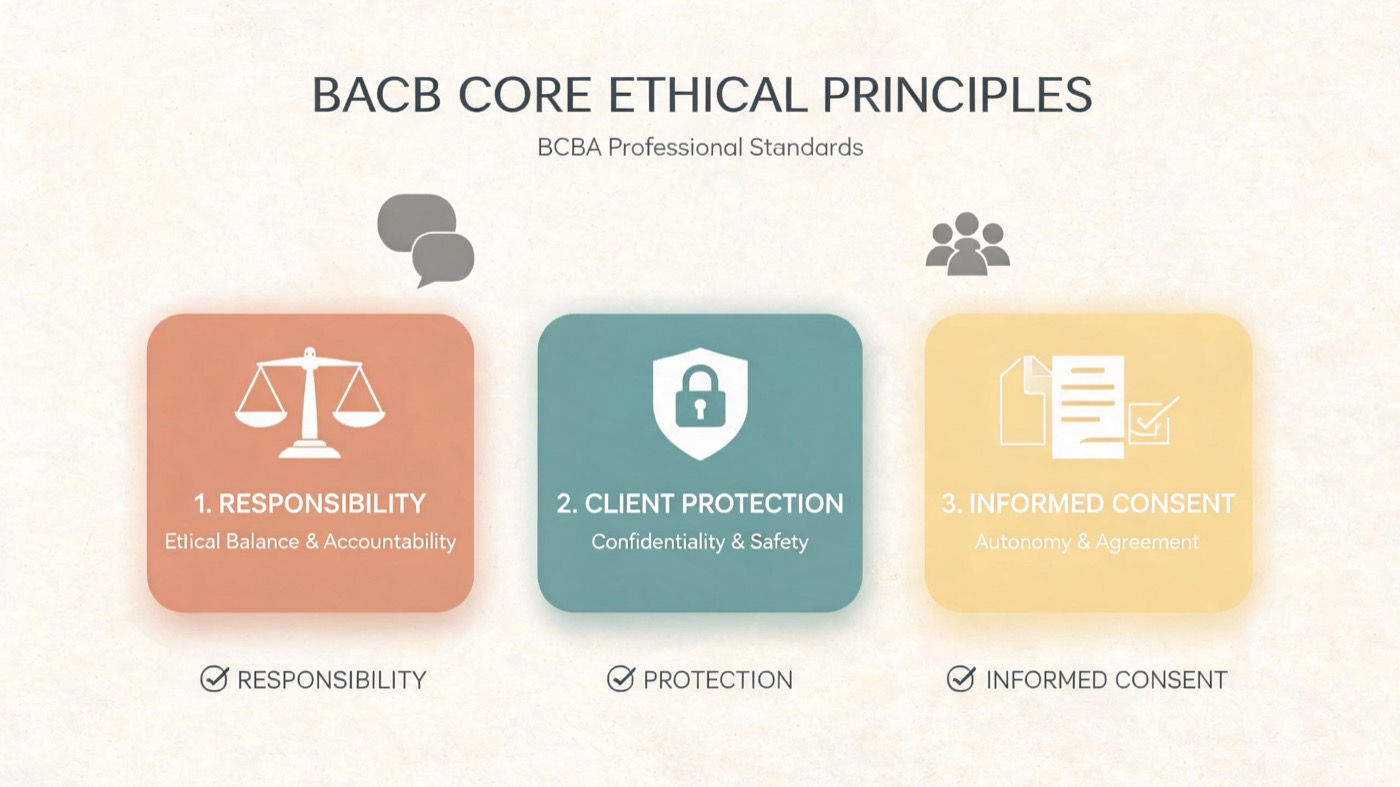
Core Ethical Principles You Must Know
The BACB Code is built on six core principles. These principles guide decision-making and help you evaluate your own conduct. Here they are, with exam-relevant explanations:
- Beneficence: Act in the best interest of the client. Always prioritize client welfare over personal or organizational interests.
- Nonmaleficence: Do no harm. Avoid interventions that could cause physical or emotional harm. This includes using least restrictive procedures and monitoring for side effects.
- Fidelity and Responsibility: Build trust through honesty, reliability, and accountability. Maintain professional relationships and avoid conflicts of interest.
- Integrity: Be honest and transparent in all professional activities. This includes accurate data reporting, truthful representation of credentials, and avoidance of fraud.
- Competence: Only provide services within your scope of training and experience. Engage in continuous education and seek supervision when needed.
- Justice: Treat all clients fairly and equitably. Ensure access to services without discrimination based on race, culture, or disability.
On the exam, you will be asked to apply these principles to realistic scenarios. Pay attention to subtle differences—for example, beneficence focuses on doing good, while nonmaleficence focuses on avoiding harm. Mixing these up is a common error.
Applying the Ethics Code: Worked ABA Examples
Seeing the code in action helps solidify your understanding. Below are three common ethical dilemmas presented in an ABC format (Antecedent-Behavior-Consequence) with hypothesized function. Each includes the correct ethical action.
Example 1: Informed Consent in a School Setting
- Antecedent: A teacher requests a behavior intervention plan for a student, but the parent has not been fully informed of the procedures.
- Behavior: The BCBA begins the intervention without obtaining signed consent, assuming it is minor.
- Consequence: The parent discovers the intervention and files a complaint, leading to a legal and ethical violation.
- Function: Avoidance of conflict (the BCBA wanted to avoid a difficult conversation).
- Ethical approach: Always obtain informed consent before starting any intervention. Provide complete information about procedures, risks, and alternatives. Document consent in the client file.
Example 2: Dual Relationship with a Client’s Family
- Antecedent: A client’s family offers a holiday gift to the BCBA as a thank you.
- Behavior: The BCBA accepts the gift to maintain a positive rapport.
- Consequence: The gift creates a sense of obligation and blurs professional boundaries.
- Function: Social approval (the BCBA values being liked).
- Ethical alternative: Politely decline the gift and explain the professional boundary. If acceptable per organizational policy, accept only token items (< $10) and disclose to supervisor.
Example 3: Data Fabrication
- Antecedent: A supervising BCBA pressures a colleague to show rapid progress in a client’s data.
- Behavior: The colleague falsifies some data points to meet performance expectations.
- Consequence: The client receives an inappropriate intervention, and the colleague faces disciplinary action and career damage.
- Function: Escape from performance demand.
- Ethical approach: Always report accurate data. If you feel pressured, document the request and seek supervision or report through the appropriate chain of command. Integrity is non-negotiable.
For more examples, see our guide on ethics in ABA practice.
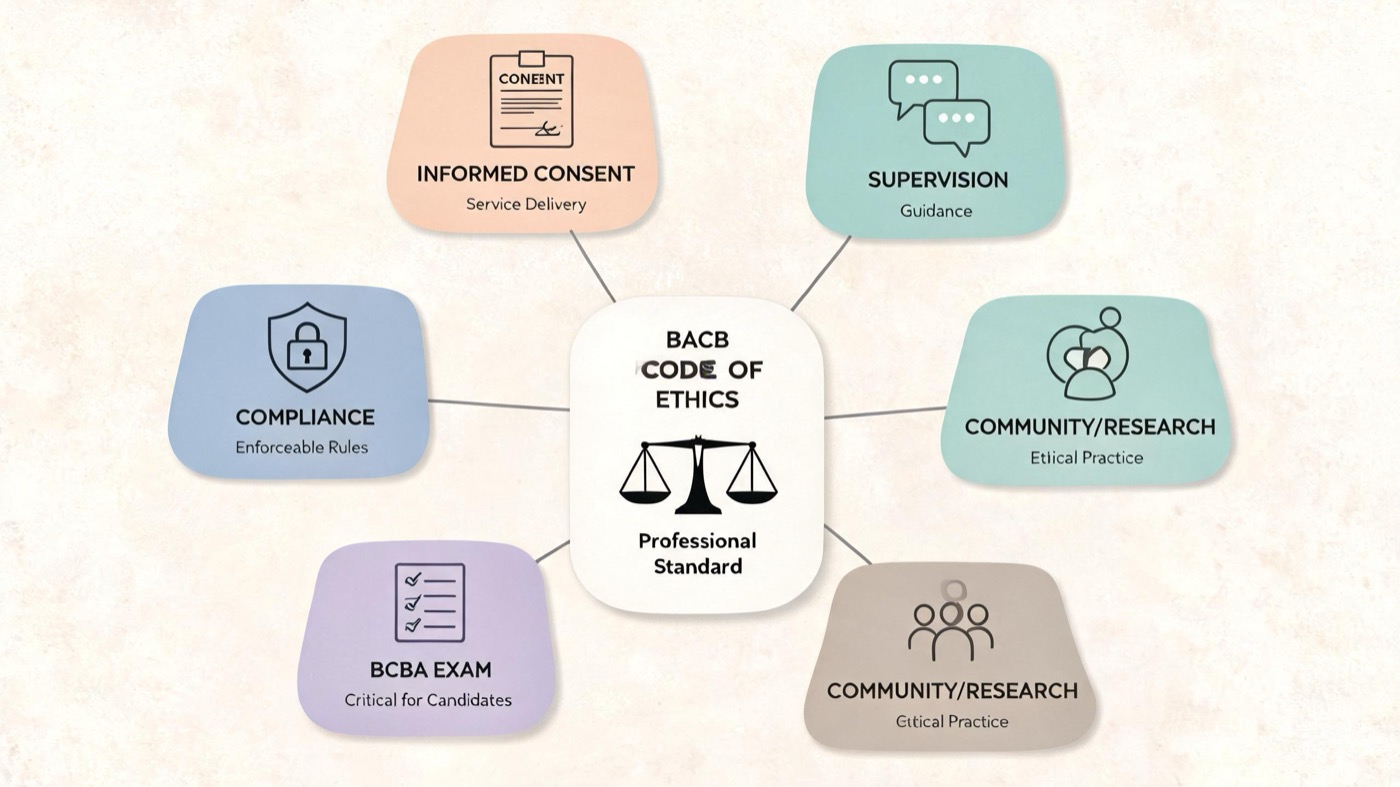
Exam Relevance and Common Traps
The BCBA exam tests ethics through scenario-based questions. You are given a situation and must identify the correct action, the violation, or the principle that applies. Here is what to expect:
How the BCBA Exam Tests Ethics
- Identify which core principle is most relevant to a scenario.
- Determine whether an action is ethical or unethical.
- Select the best next step in an ethical dilemma.
- Recognize violations of the BACB Code.
Common Traps to Avoid
- Confusing beneficence with justice: Beneficence is about doing good for the client; justice is about fairness. Read carefully.
- Forgetting mandated reporting: If you suspect abuse or neglect, you must report to appropriate authorities—even if the client or family objects.
- Accepting gifts: Even small gifts can create dual relationships. Know your organization’s policy and the BACB’s stance.
- Overstepping competence boundaries: Do not provide services you are not trained for. Refer to another professional or seek supervision.
Study trap questions from our free BCBA mock exam to practice.
Quick Checklist for Ethics Mastery
Use this checklist to prepare for the ethics portion of the exam and for real-world practice:
- Review the full BACB Ethics Code (available at BACB website).
- Understand each core principle and its application.
- Practice with scenario-based questions from reliable prep materials.
- Identify your own ethical blind spots—ask for feedback from supervisors.
- Memorize key definitions: beneficence, nonmaleficence, fidelity, integrity, competence, justice.
- Know the steps for resolving ethical dilemmas (e.g., consult the code, seek supervision, document).
- Review examples of dual relationships and boundary crossings.
- Be aware of mandated reporting requirements in your jurisdiction.
Summary: Your Ethics Roadmap
The BACB Code of Ethics is the foundation of responsible behavior analysis. By mastering the core principles, practicing with realistic examples, and avoiding common exam traps, you will be well-prepared for the ethics questions on the BCBA exam. Remember, ethical practice is not just about passing a test—it is about protecting clients and upholding the integrity of the field.
For a deep dive into the 6th Edition Task List, check out our BACB Task List guide. Good luck with your studies!
Complete BCBA Exam Prep
Turn this topic into exam-day practice
Practice concepts in context with five full-length 6th Edition mock exams, two bonus practice exams, a 6th Edition study guide, and key-term flashcards—all in one $120 USD package.
Get the $120 All-in-One Prep Pack
Review everything included on the product page before ordering. No pass guarantee is implied.



