
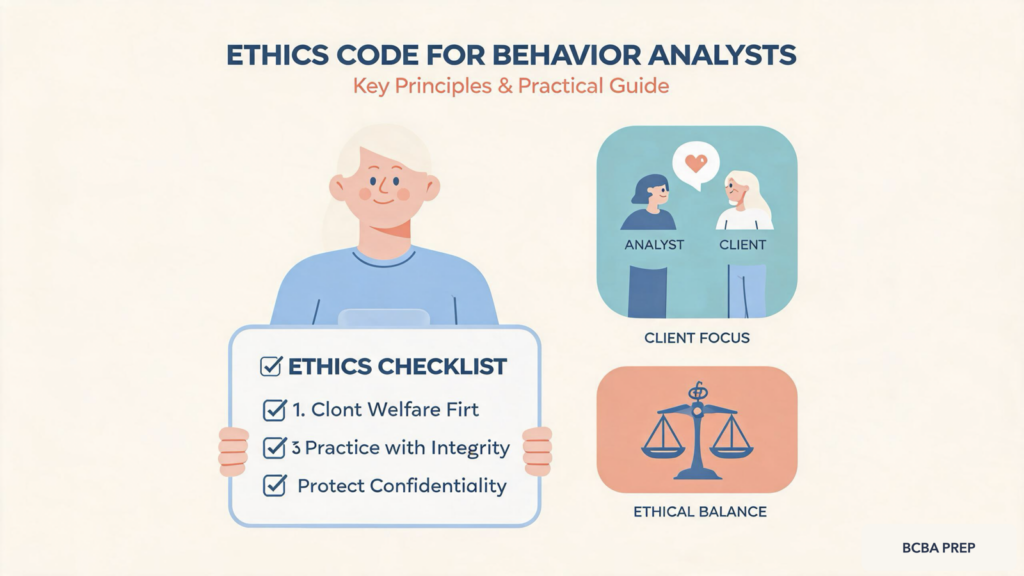
The ethics code for behavior analysts is the foundation of professional practice in applied behavior analysis. For BCBA candidates, understanding this code is not just about memorizing rules—it is about applying ethical decision-making to real-world scenarios. This guide breaks down the key principles, provides concrete examples, highlights common exam traps, and offers a quick checklist to help you prepare for the BCBA exam. Whether you are reviewing for the test or seeking a refresher, this article will equip you with the essential knowledge you need.
Table of Contents
- What Is the Ethics Code for Behavior Analysts?
- Core Principles of the Ethics Code
- Applying the Ethics Code: Worked Examples
- Exam Relevance: How Ethics Questions Appear on the BCBA Exam
- Quick Checklist for the Ethics Code
- Summary: Ethics Code for Behavior Analysts
What Is the Ethics Code for Behavior Analysts?
The ethics code for behavior analysts refers to the BACB Ethics Code for Behavior Analysts, a set of enforceable rules and guiding principles that all certificants must follow. The current version became effective in 2022 and replaces the 2014 Professional and Ethical Compliance Code. The code is organized into six main sections, including core principles, responsibilities to clients, responsibilities to the profession, and more. For the BCBA exam, you must know both the broad principles and the specific standards that apply to common practice situations.
Practice this concept
After reviewing the ethics code, practice with BCBA ethics questions with answers and explanations.
Overview of the BACB Ethics Code
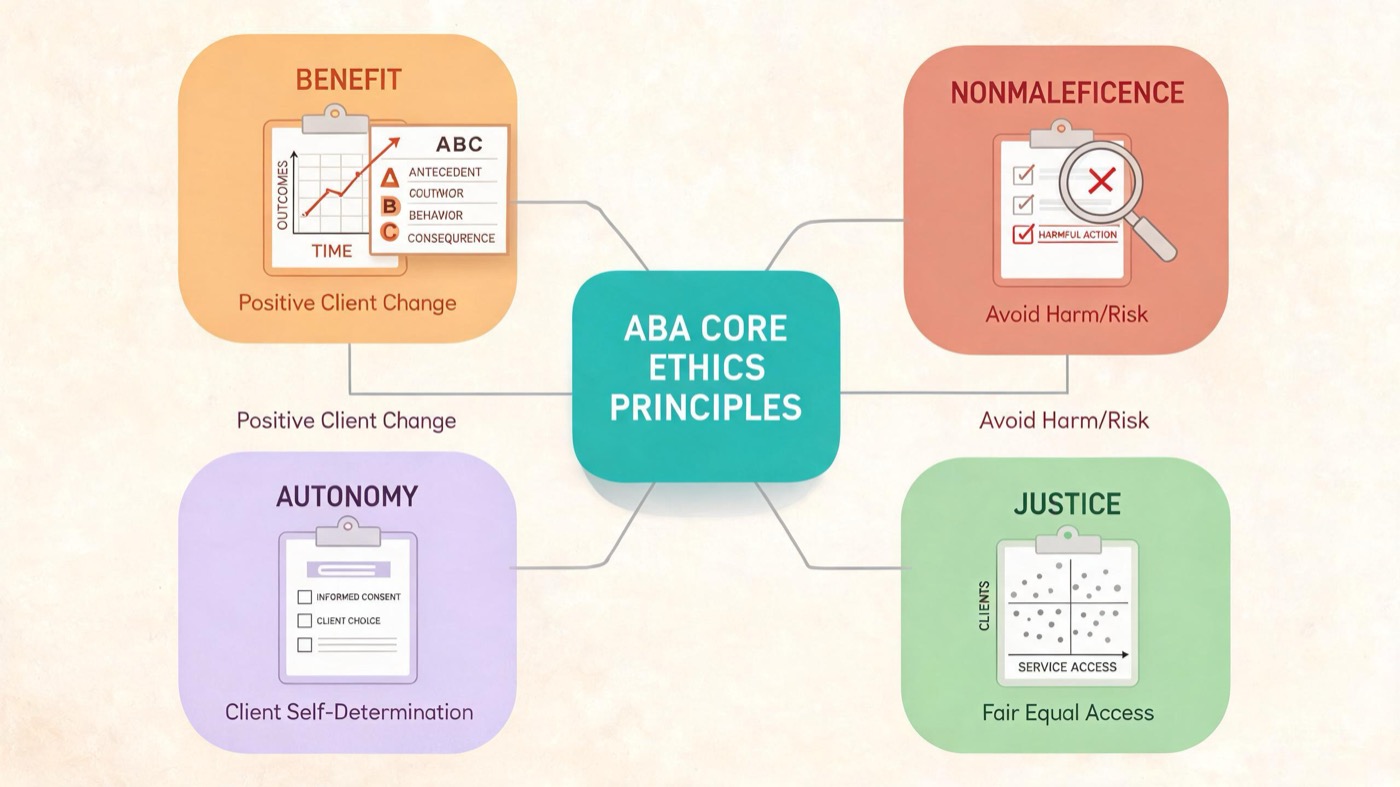
The BACB Ethics Code is built on a framework of four core principles: benefit, do no harm, integrity, and justice. These principles are not just abstract ideals; they are reflected in every standard. The code also includes a responsibility to client welfare, competence, and confidentiality. On the exam, you will be asked to identify which principle or standard applies to a given scenario, so it is crucial to understand how each principle translates into practice.
Core Principles of the Ethics Code
Understanding the four core principles is essential for both ethical practice and exam success. Each principle guides specific behaviors and decisions.
Benefit and Nonmaleficence
Benefit means designing interventions that produce meaningful, positive outcomes for clients. Nonmaleficence means avoiding harm. For example, a behavior analyst should choose a function-based intervention that reduces challenging behavior without using aversive procedures. If a client engages in self-injury maintained by escape, the analyst might teach a functional communication response (e.g., requesting a break) rather than using punishment, which could cause physical or emotional harm.
Integrity and Justice
Integrity involves being honest, transparent, and adhering to professional standards. For instance, data falsification (altering data to show progress) is a clear violation of integrity. Justice requires fair and equitable treatment of all clients. An example of a justice violation would be selecting clients based on personal preference (e.g., only accepting cases with high insurance reimbursement) rather than need. Both principles are frequently tested on the exam.
Video Study: Ethics / Professional Conduct
Watch: BCBA Ethics Practice Questions: Documentation, Consent, and Risk
Use this scenario-based lesson to reinforce the professional judgment points and exam distinctions covered in this article.
Prefer a second pass? Open this lesson on YouTube.
Applying the Ethics Code: Worked Examples
To master the ethics code, practice applying it to realistic scenarios. Each example below includes an ABC analysis (antecedent-behavior-consequence) with a hypothesized function to help you think like a behavior analyst.
Example 1: Informed Consent
Scenario: A parent refuses to sign a consent form for a functional behavior assessment (FBA) because they are worried about the time commitment. The BCBA is under pressure from the school to start services quickly. Antecedent: School administrator requests immediate start. Behavior: BCBA considers conducting the FBA without signed consent. Consequence: Avoids conflict with the school (negative reinforcement—escape from pressure). Ethical issue: Violates the standard on informed consent (Standard 2.11). The correct action is to discuss the parent’s concerns, provide clear information about the FBA, and wait for consent before proceeding.
Example 2: Dual Relationships
Scenario: A supervisor asks a BCBA to babysit for their child on weekends, offering to write a strong recommendation later. Antecedent: Supervisor’s request and implied reward. Behavior: BCBA agrees to babysit. Consequence: Gains supervisor’s approval (social reinforcement). Ethical issue: This creates a dual relationship (Standard 1.06) that could compromise objectivity and lead to exploitation. The BCBA should politely decline and consider reporting the supervisor if the pressure continues.
Example 3: Data Fabrication
Scenario: An intern discovers that a senior BCBA has been altering data to show client progress that did not occur. The intern is afraid to report it because the senior BCBA might retaliate. Antecedent: Intern observes altered data. Behavior: Intern does nothing. Consequence: Avoids potential conflict (negative reinforcement—escape). Ethical issue: Data fabrication violates integrity (Standard 4.09). The intern has a responsibility to report the violation through appropriate channels (Standard 1.07).
Example 4: Competence and Scope of Practice
Scenario: A BCBA is asked to provide feeding therapy for a child with a history of aspiration, but the BCBA has no training in feeding disorders. Antecedent: Parent’s request and lack of other providers. Behavior: BCBA accepts the case. Consequence: Avoids disappointing the parent (negative reinforcement). Ethical issue: The BCBA is practicing outside their scope of competence (Standard 3.01). The correct action is to refer the client to a qualified specialist or seek supervised training.
Exam Relevance: How Ethics Questions Appear on the BCBA Exam
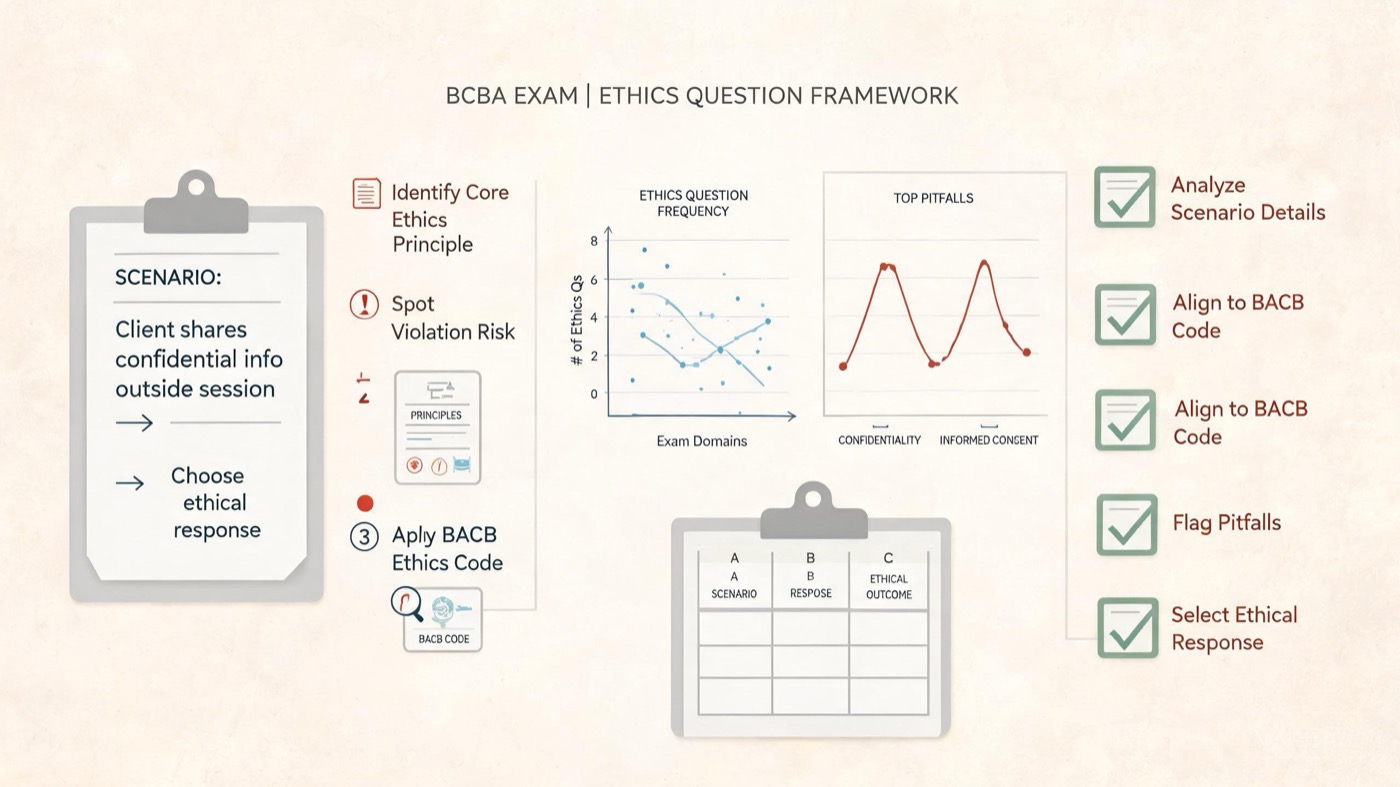
Ethics questions on the BCBA exam often present a scenario and ask you to identify the most appropriate response. They may also test your ability to distinguish between core principles, recognize ethical violations, and apply the code to real-world situations.
Common Exam Traps
Watch out for these frequent pitfalls:
- Misreading mandatory vs. permissive language: Words like “must” indicate a requirement, while “should” suggests a recommendation. Test writers often use ambiguous phrasing to trip you up.
- Confusing principles: For example, mixed up nonmaleficence (avoid harm) with beneficence (do good). Remember: nonmaleficence is about preventing harm, while beneficence is about active benefit.
- Overlooking client assent: Even if a parent gives consent, the child’s assent (agreement) must be obtained when appropriate. Exam scenarios often test this subtle distinction.
- Ignoring the hierarchy: Some questions ask what to do when two ethical standards conflict. The BACB code provides guidance on prioritizing client welfare and safety above other considerations.
Sample Practice Prompts
Try these scenario-based questions:
Prompt 1: A BCBA realizes they made an error in a previous session that could have affected the client’s progress. According to the ethics code, what should the BCBA do first?
Answer: Disclose the error to the client or caregiver (Standard 2.15). Integrity requires transparency, even when it is uncomfortable.
Prompt 2: A BCBA is asked by a friend to provide behavior analysis services for their child, outside of the formal work setting. Which core principle is potentially at risk?
Answer: Integrity and avoidance of dual relationships. The BCBA should decline to maintain professional boundaries.
Quick Checklist for the Ethics Code
Use this checklist for last-minute review before the exam or when preparing for supervision sessions:
- Review the four core principles: benefit, nonmaleficence, integrity, justice.
- Memorize key standards related to informed consent, confidentiality, dual relationships, and data integrity.
- Practice applying the code to case scenarios; focus on identifying the function of unethical behavior (e.g., escape, social reinforcement).
- Familiarize yourself with the BACB’s reporting and enforcement procedures, including responsibilities to report violations.
- Use ethics in aba practice bcba exam guide for additional examples and explanations of common exam questions.
- Review the official BACB code document at the BACB website for the full text and updates.
Summary: Ethics Code for Behavior Analysts
The ethics code for behavior analysts is not just a set of rules—it is a framework for making sound decisions that protect clients, maintain public trust, and uphold the integrity of the field. For BCBA candidates, mastery of the code is essential for both the exam and professional practice. By understanding the core principles, analyzing scenarios with an ABC lens, and avoiding common traps, you can approach ethics questions with confidence. For further preparation, explore additional resources such as 5 things you need to know about the BCBA exam and official BACB materials. Ethical practice is a journey, not a destination; commit to continuous learning and self-reflection as you advance in your career.
Complete BCBA Exam Prep
Turn this topic into exam-day practice
Practice concepts in context with five full-length 6th Edition mock exams, two bonus practice exams, a 6th Edition study guide, and key-term flashcards—all in one $120 USD package.
Get the $120 All-in-One Prep Pack
Review everything included on the product page before ordering. No pass guarantee is implied.



