
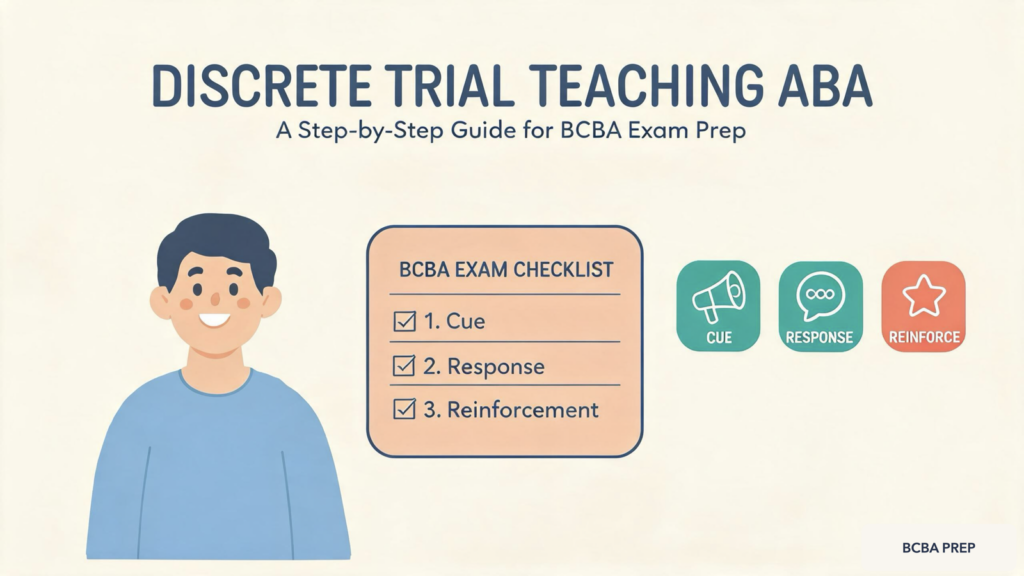
What Is Discrete Trial Teaching in ABA?
Discrete trial teaching (DTT) is a structured instructional method used in applied behavior analysis to teach new skills. It breaks complex skills into small, teachable steps and uses repeated trials with clear antecedents and consequences. DTT is particularly effective for learners with autism and is a core competency tested on the BCBA exam.
Table of Contents
- What Is Discrete Trial Teaching in ABA?
- Step-by-Step Walkthrough of a Discrete Trial Teaching Session
- BCBA Exam Relevance: What You Need to Know
- Discrete Trial Teaching Quick Checklist
Each discrete trial consists of five distinct components. Understanding these components is essential for both implementation and exam success.
The Five Components of a Discrete Trial
- Discriminative stimulus (SD): The instruction or cue that signals the opportunity to respond (e.g., ‘Touch dog’).
- Prompt: An extra cue or assistance delivered to increase the likelihood of a correct response (e.g., pointing to the correct picture).
- Response: The learner’s behavior following the SD (e.g., touching the dog card).
- Consequence: The reinforcer or corrective feedback delivered immediately after the response (e.g., praise and a token).
- Inter-trial interval (ITI): A brief pause (2–5 seconds) between trials to signal the end of one trial and the start of the next.
For example, a therapist might present a picture of a dog (SD), say ‘Touch dog,’ and if the child touches it, they receive a sticker (consequence). After a short pause, the next trial begins.
How DTT Differs from Natural Environment Teaching
Natural environment teaching (NET) uses the learner’s ongoing interests and natural routines to teach skills in context. In contrast, DTT is highly structured, with the therapist controlling the SDs and reinforcers. On the BCBA exam, you must distinguish when to use each approach: DTT is ideal for acquisition of new, difficult skills, while NET promotes generalization and maintenance.
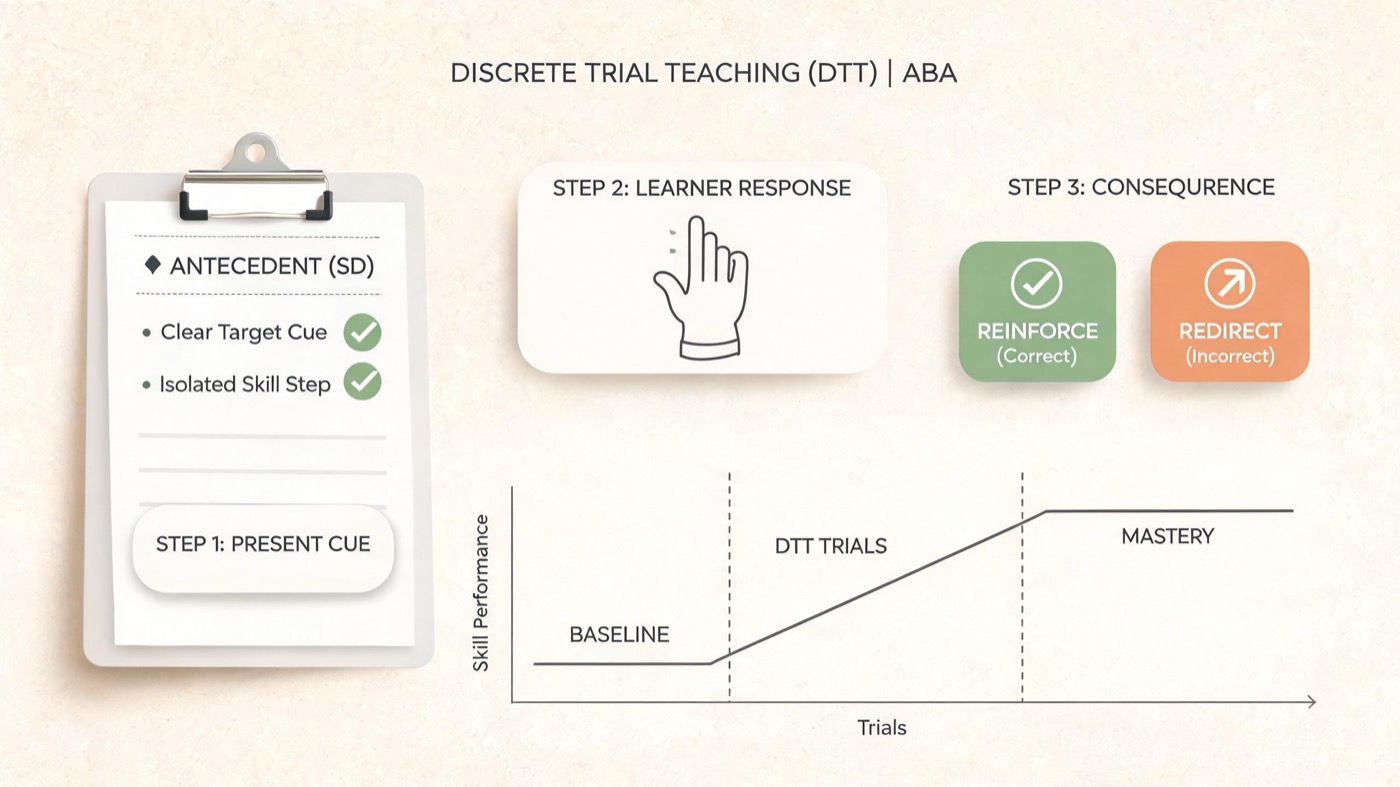
Step-by-Step Walkthrough of a Discrete Trial Teaching Session
Let’s apply DTT through three realistic ABA examples. Each includes the ABC data and common exam traps to reinforce your analytical thinking.
Worked Example 1: Requesting a Toy
Client: 4-year-old with autism. Target behavior: mand ‘ball.’ Function: tangible access. The therapist gains attention, presents a ball and says ‘Say ball’ (SD). The child echoes ‘ball’ (response), and the therapist delivers the ball (consequence). A common exam trap is prompt dependence: if the therapist always prompts, the child may not respond to the SD alone. Fade prompts systematically.
Worked Example 2: Identifying Colors
Client: 5-year-old. Target: tact ‘red.’ Function: access to tokens. The therapist places a red and a blue card on the table and says ‘Which one is red?’ (SD). The child points to red (response), receives a token (consequence). A common trap is failing to vary the SD; always saying ‘Which one is red?’ in the same tone may lead to rote responding. Randomize instruction delivery.
Worked Example 3: Motor Imitation
Client: 3-year-old. Target: imitate clapping. Function: social reinforcement. The therapist models clapping and says ‘Do this’ (SD). If the child does not respond, the therapist physically prompts clapping. Correct responses earn enthusiastic praise (consequence). A common trap is reinforcing prompted responses equally; differential reinforcement is needed to fade prompts.
For additional DTT strategies, see our guide on DTT implementation.
BCBA Exam Relevance: What You Need to Know
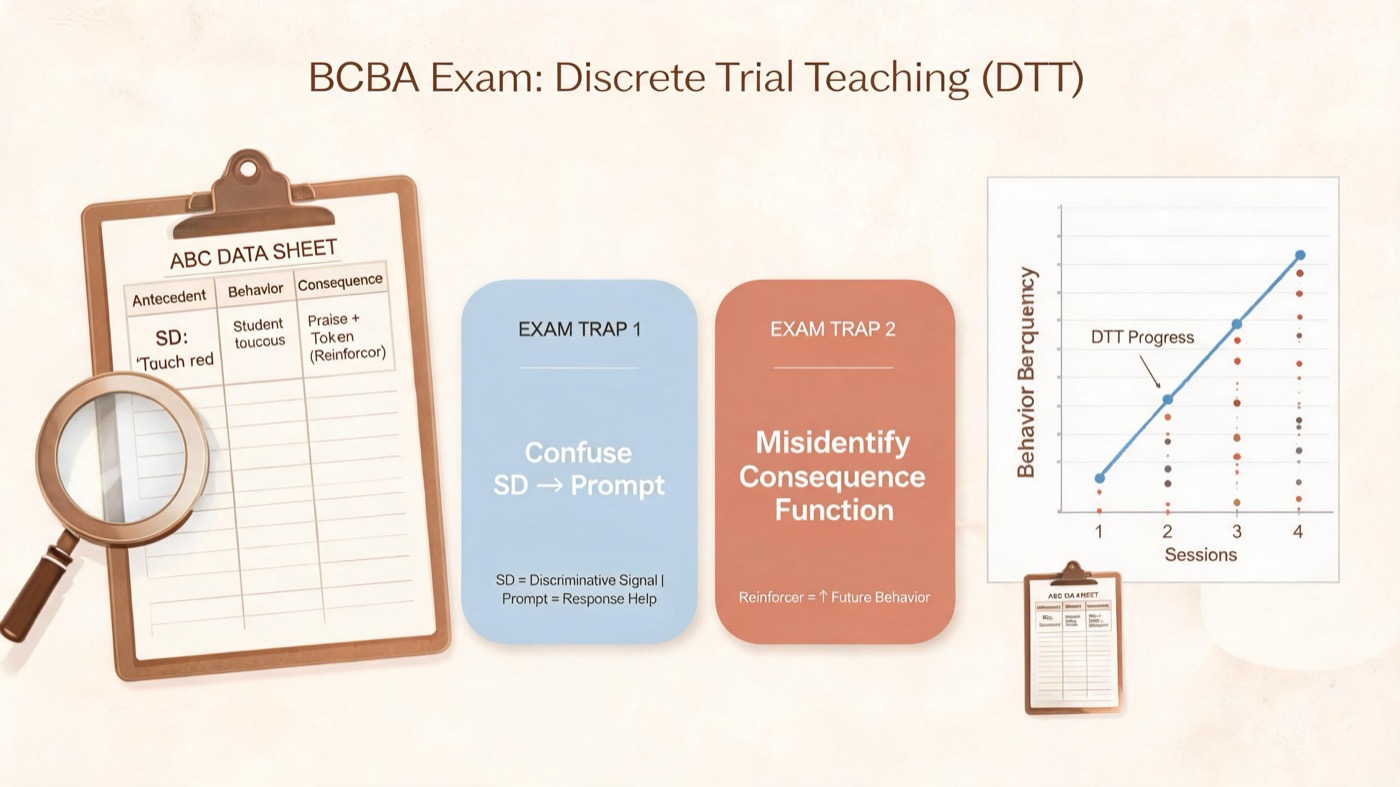
The BCBA exam frequently tests DTT concepts in both discrete and scenario-based questions. You must be able to identify the SD, prompt, consequence, and function of the target behavior. Let’s examine two key areas: common traps and self-testing prompts.
Common Exam Traps and How to Avoid Them
- Confusing DTT with NET: If a scenario describes a child-led activity using natural reinforcers, it’s NET, not DTT.
- Misidentifying the SD: The SD is the instruction that signals reinforcement is available. Not every verbal statement is an SD; it must evoke the target response.
- Ignoring the inter-trial interval: The ITI is crucial for distinguishing trials; forgetting it may lead to errors in identifying trial boundaries.
To master these nuances, review our BCBA exam prep guide and practice with mock scenarios.
Practice Prompts for Self-Testing
Test your understanding with these exam-style questions:
- Scenario 1: A therapist presents a flashcard, says ‘What animal is this?’, and the child says ‘Dog’. The therapist says ‘Good job!’ and gives a sticker. What is the SD? Answer: ‘What animal is this?’
- Scenario 2: During a DTT session, the child is not responding to the SD. The therapist immediately provides a verbal prompt. What procedural error might occur? Answer: Prompt dependence if prompts are not faded.
- Scenario 3: A teacher uses DTT to teach color identification but does not pause between trials. Which component is missing? Answer: Inter-trial interval.
Discrete Trial Teaching Quick Checklist
Use this checklist when designing or evaluating a DTT session. It also serves as a study aid for the BCBA exam.
- Define the target skill in observable, measurable terms.
- Select an appropriate SD that is clear and consistent.
- Plan a prompt hierarchy (e.g., least-to-most) to ensure learner success.
- Arrange a potent reinforcer for correct responses.
- Deliver the consequence immediately after the response (within 2 seconds).
- Insert a 2–5 second inter-trial interval between trials.
- Collect data on correct, prompted, and incorrect responses.
- Fade prompts systematically to promote independent responding.
- Rotate and vary targets to prevent rote responding.
- Plan for generalization by using different stimuli and settings.
By following this checklist, you’ll be well-prepared to implement DTT effectively and answer related exam questions confidently. For more practice, access our free BCBA practice questions.
Additional resource: The BACB’s task list and published research on DTT provide evidence-based guidelines for practitioners. Refer to the BACB website for the most current standards.
Complete BCBA Exam Prep
Turn this topic into exam-day practice
Practice concepts in context with five full-length 6th Edition mock exams, two bonus practice exams, a 6th Edition study guide, and key-term flashcards—all in one $120 USD package.
Get the $120 All-in-One Prep Pack
Review everything included on the product page before ordering. No pass guarantee is implied.



