
What Is the BCBA Ethics Code?
The BCBA ethics code is a set of enforceable rules that guide professional conduct for Board Certified Behavior Analysts. Published by the Behavior Analyst Certification Board (BACB), it defines core principles and specific standards for ethical behavior in practice, supervision, research, and training. For exam candidates, understanding this code is crucial—ethical scenarios can make up a significant portion of the BCBA test items.
Practice this concept
Use these BCBA ethics practice questions to check whether you can apply the code in a scenario.
Table of Contents
- What Is the BCBA Ethics Code?
- Key Ethical Principles Every BCBA Candidate Must Know
- Applying the Ethics Code to Exam Scenarios
- Quick Checklist: Remember These for Exam Day
- Summary: Mastering the BCBA Ethics Code
- References
Ethics questions often require more than rote memorization. They test your ability to apply the code to real-life dilemmas. For example, you might be asked to identify the most appropriate action when a client refuses treatment. The goal is to internalize the core ethical principles so you can choose the best answer under pressure.
Why the Ethics Code Matters for Your Exam
The BACB Ethics Code appears throughout the 6th Edition Task List under several domains. A strong grasp of ethical reasoning can boost your score and, more importantly, prepare you for responsible practice. Many candidates find that practicing with ethics in ABA practice scenarios helps solidify these concepts.
Structure of the Code: Core Principles and Standards
The code is organized around six core principles: beneficence, nonmaleficence, autonomy, justice, fidelity, and integrity. Each principle is supported by specific standards that detail expected behaviors. For instance, the standard on informed consent derives from the principle of respect for autonomy. Familiarizing yourself with this structure makes it easier to locate relevant standards during the exam.
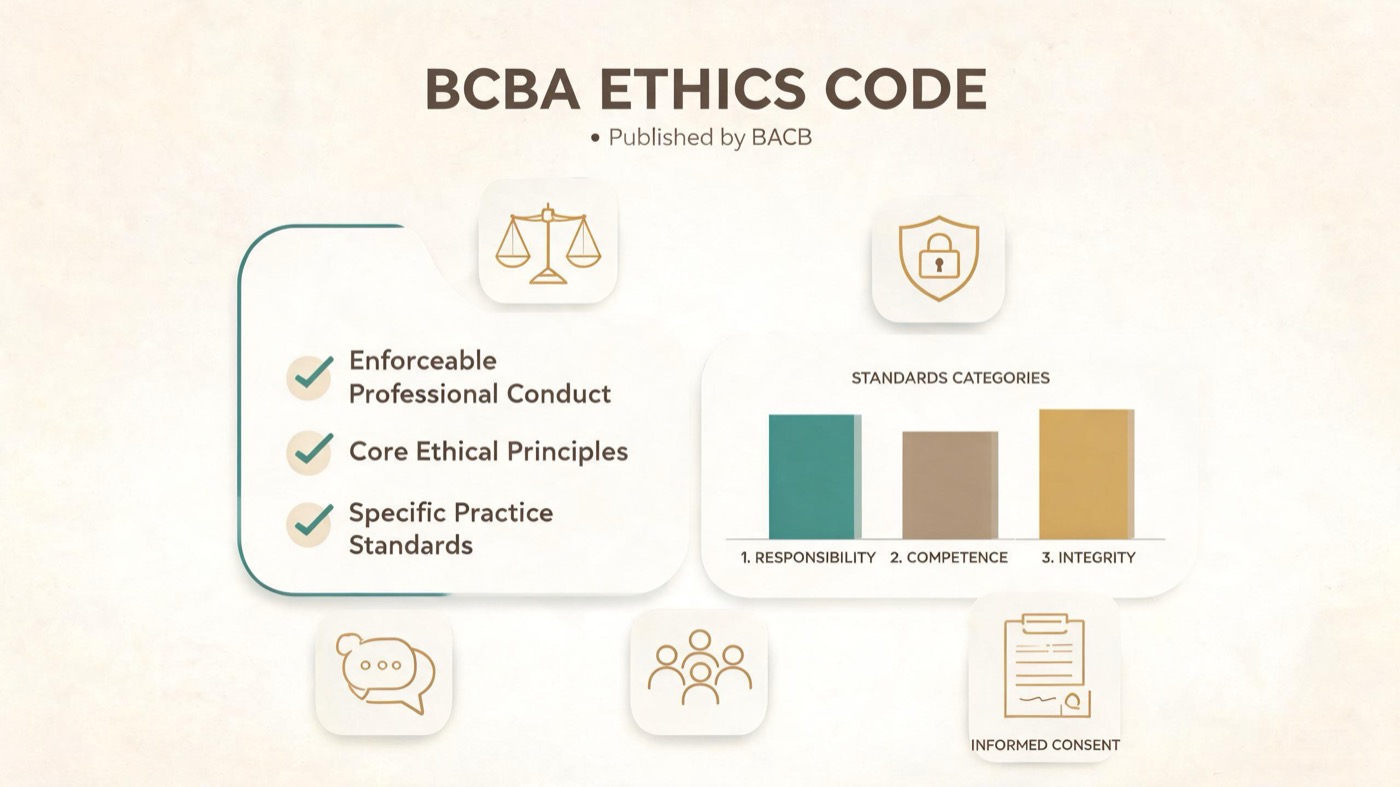
Key Ethical Principles Every BCBA Candidate Must Know
The core principles form the foundation of the BCBA ethics code. Below we break down two critical ones with practical ABA examples.
Beneficence and Nonmaleficence in Behavioral Interventions
Beneficence means acting in the client’s best interest; nonmaleficence means avoiding harm. In ABA, this often arises when choosing between intrusive and less intrusive interventions.
Example: A client engages in self-injury (SIB) to access tangibles. The function is access to items. An ethical dilemma: should you use restraint to block SIB, or implement functional communication training (FCT)? The ethical choice is FCT, as it respects autonomy and reduces harm without coercion. The hypothesized function (access to tangibles) leads to teaching a replacement behavior (requesting).
Integrity and Transparency with Clients and Stakeholders
Integrity involves honesty and preventing conflicts of interest. Transparency requires clear communication about services, risks, and benefits.
Example: A parent requests a treatment that lacks evidence (e.g., sensory integration therapy for autism). Ethically, you must explain why it is not supported, discuss potential risks, and offer alternatives based on evidence-based practice in ABA. Documenting this conversation is essential to maintain transparency.
Applying the Ethics Code to Exam Scenarios
Exam questions often present a brief scenario and ask you to select the most ethical response. Here are two worked examples that illustrate common test patterns.
Worked Example: Ethical Dilemma with a Client’s Right to Refuse Treatment
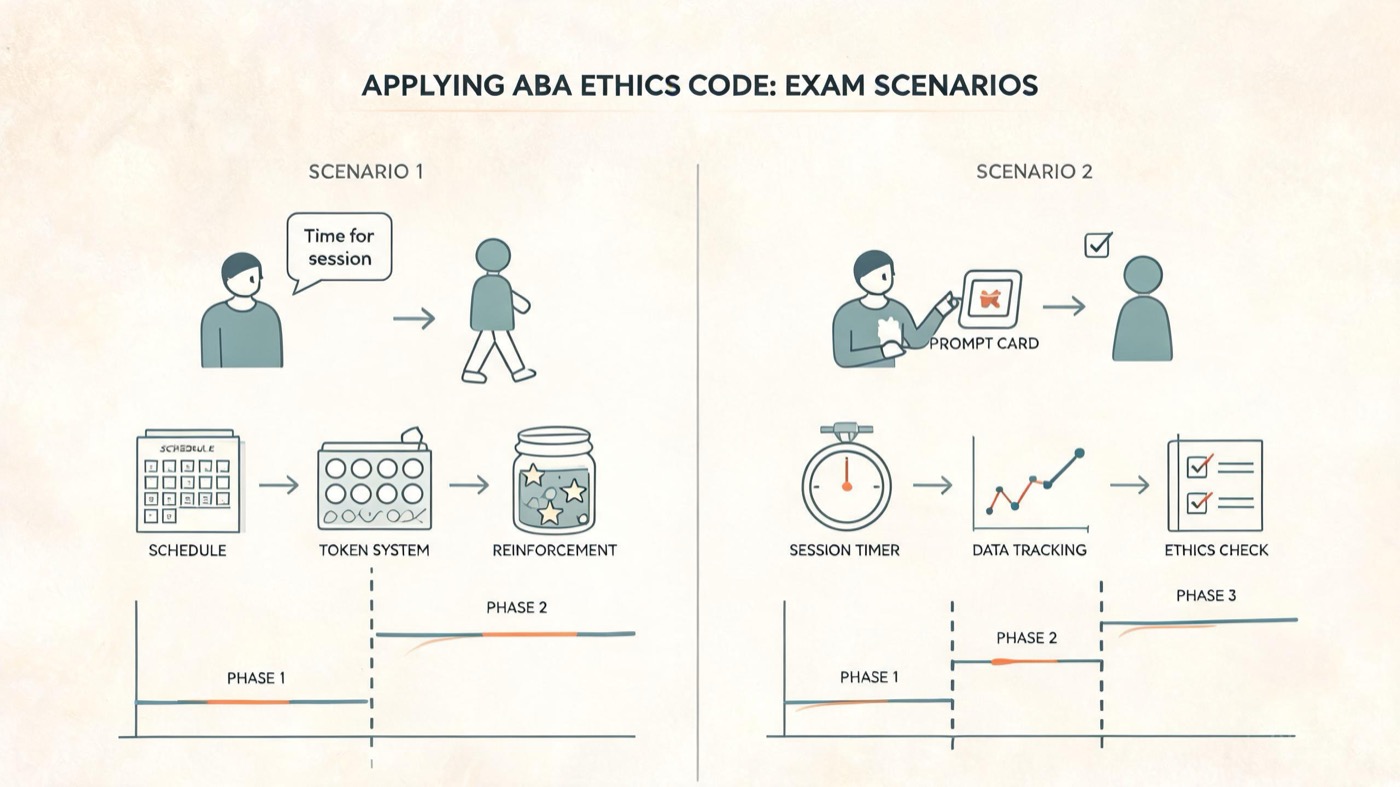
ABC Analysis: Antecedent: therapist says “time for session,” client says “no” and leaves the room. Behavior: client leaves. Consequence: no access to reinforcement. Ethical principle: respect autonomy. The right to refuse treatment is protected under the ethics code. A common exam trap is thinking you can force participation or use aversive contingencies. Correct approach: implement a preference assessment to identify motivating variables and adjust the session accordingly.
Common Exam Traps: Dual Relationships and Conflicts of Interest
Dual relationships occur when you have a professional and a personal relationship with a client or stakeholder. Exam questions often blur these boundaries.
Example: Your supervisor asks you to tutor their child after hours. This is a dual relationship because the supervisory relationship creates a power imbalance. The hypothesized function might be social approval, but ethically you must decline and refer the family to another provider. Document the decline to maintain integrity.
Additional trap: Accepting gifts from clients. Even small gifts can create conflicts of interest. The code advises discussing gift policies in the service agreement.
Another Worked Example: Confidentiality and Information Sharing
Scenario: A parent of a minor client asks for data from a session that also involves another parent (who has custody). The ethical principle is fidelity—being loyal to all parties. The correct action is to obtain written consent from the other parent before sharing data. A common mistake is assuming the requesting parent has unilateral access. Always check the consent forms on file.
Quick Checklist: Remember These for Exam Day
Use this concise checklist as a last-minute review before the exam.
- Identify the principle at stake (e.g., autonomy, nonmaleficence).
- Look for dual relationships or conflicts of interest.
- Consider the client’s rights (refuse treatment, confidentiality).
- Choose the least intrusive ethical intervention.
- Document all ethical decisions and communications.
- When in doubt, consult the code or a supervisor.
- Remember that data sharing requires consent from all stakeholders.
- Avoid assuming a parent can access information without consent.
Summary: Mastering the BCBA Ethics Code
Mastering the BCBA ethics code is essential for both exam success and professional practice. We covered its structure (core principles and standards), key principles with examples, application to exam scenarios, and common traps. The quick checklist provides a mental framework for test day. For deeper practice, consider using BCBA mock exams to test your ethical reasoning skills. Remember, ethical competency is a hallmark of a skilled behavior analyst. Good luck!
References
Complete BCBA Exam Prep
Turn this topic into exam-day practice
Practice concepts in context with five full-length 6th Edition mock exams, two bonus practice exams, a 6th Edition study guide, and key-term flashcards—all in one $120 USD package.
Get the $120 All-in-One Prep Pack
Review everything included on the product page before ordering. No pass guarantee is implied.



