
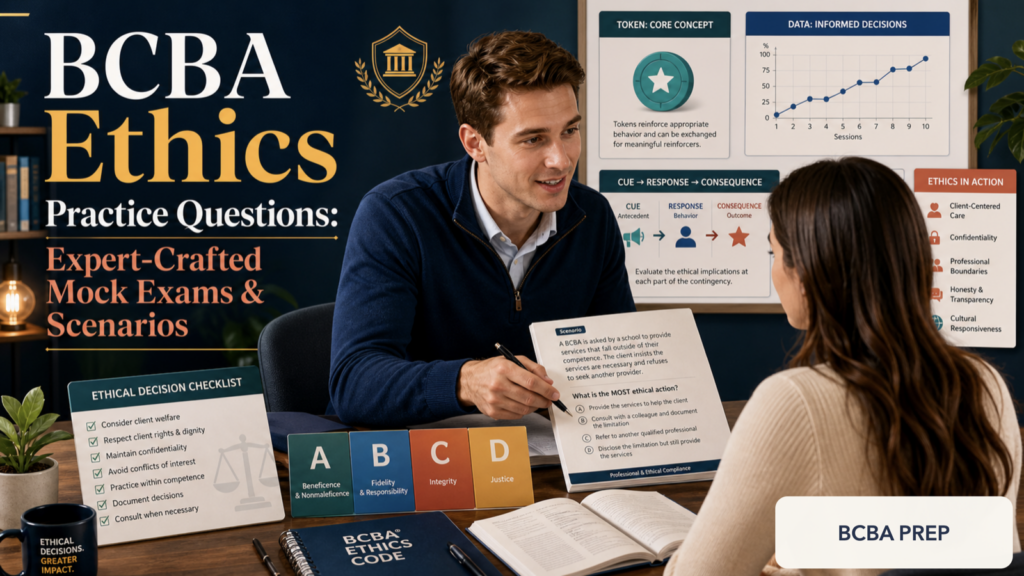
Master the BACB Ethics Code with Realistic Practice
Prepare for the BCBA exam with scenario-based ethics questions that mirror real-world challenges. Each question tests your knowledge of the BACB Ethical Code and your ability to apply it in complex situations.
Table of Contents
- Master the BACB Ethics Code with Realistic Practice
- 5 Ethics Scenarios for BCBA Practice
- Common Ethics Traps on the BCBA Exam
- Ethics Review Checklist for BCBA Exam Prep
- Test Your Ethics Knowledge with a Free Mock Exam
- BCBA Ethics Practice Questions – FAQs
- References
Our expert-crafted mock exams include detailed answer explanations, common traps, and study checklists to help you identify gaps and boost your confidence.

5 Ethics Scenarios for BCBA Practice
Review each scenario and choose the best ethical response.
Question 1: Informed Consent
Scenario: A BCBA is asked by a parent to start discrete trial training immediately to address severe aggression. The parent has verbally agreed but has not signed any consent forms. The BCBA is eager to help.
Prompt: What should the BCBA do?
- A. Begin treatment immediately with verbal consent to prevent harm.
- B. Wait for signed consent before starting any intervention.
- C. Start intervention while mailing the consent form.
- D. Use telehealth to get verbal consent recorded.
Correct Answer: B
Why This Answer Is Correct: Code 2.01 requires written informed consent before service delivery. Verbal consent is insufficient.
Why the Other Options Are Wrong:
- A: Starting without written consent violates Code 2.01.
- C: Mailing forms does not constitute obtained consent; intervention must wait.
- D: Telehealth still requires written or electronic documented consent.
Exam Trap: The urgency of aggression may tempt you to prioritize safety over consent, but ethical codes require written consent first.
Question 2: Multiple Relationships
Scenario: A BCBA is invited to a client’s family wedding. The family insists it is just a social event and will not affect services. The BCBA feels flattered.
Prompt: What is the BCBA’s best course of action?
- A. Attend the wedding to maintain a good relationship.
- B. Decline the invitation due to potential multiple relationship.
- C. Attend but set boundaries during the event.
- D. Seek supervisor approval and then attend.
Correct Answer: B
Why This Answer Is Correct: Code 1.06 prohibits multiple relationships that could impair objectivity or exploit the client. Attending blurs professional boundaries regardless of intent.
Why the Other Options Are Wrong:
- A: Attending creates a dual relationship, even if well-intentioned.
- C: Boundaries are difficult to maintain in a social setting.
- D: Supervisor approval does not override the code; avoiding is safest.
Exam Trap: Avoid rationalizing that ‘just this once’ is okay. The code prohibits any situation that could lead to exploitation or loss of objectivity.
Question 3: Data Fabrication
Scenario: A BCBA is under pressure to show progress for a funding renewal. The data from the last two weeks do not show improvement. The BCBA considers adding a few extra data points to meet goals.
Prompt: What should the BCBA do?
- A. Add the extra points to secure funding for continued services.
- B. Report the actual data and adjust the intervention.
- C. Remove the poor data points to show progress.
- D. Delay the report until data improves.
Correct Answer: B
Why This Answer Is Correct: Code 4.08 prohibits fabricating or altering data. The BCBA must report accurate data and modify the intervention as needed.
Why the Other Options Are Wrong:
- A: This is data fabrication and violates ethical standards.
- C: Removing data misrepresents outcomes and is unethical.
- D: Delaying the report without reason is dishonest.
Exam Trap: Pressure from funding sources can lead to ethical shortcuts. Always prioritize honesty in data reporting.
Question 4: Right to Effective Treatment
Scenario: A BCBA works with a client who has limited progress. The BCBA’s supervisor suggests switching to an unvalidated therapy that has anecdotal reports of success. The BCBA is unsure.
Prompt: What should the BCBA do?
- A. Try the unvalidated therapy since anecdotal reports are positive.
- B. Continue with current evidence-based intervention and advocate for its integrity.
- C. Use a combination of validated and unvalidated approaches.
- D. Refer the client to another provider.
Correct Answer: B
Why This Answer Is Correct: Code 2.01(a) requires the use of evidence-based interventions. Unvalidated therapies should not replace or be added to effective treatments without scientific support.
Why the Other Options Are Wrong:
- A: Anecdotal reports are not sufficient evidence.
- C: Mixing validated and unvalidated methods is still unethical if unvalidated component lacks support.
- D: Referral may be appropriate but only after exhausting ethical options.
Exam Trap: The client’s right to effective treatment (Code 2.01) overrides supervisor pressure to try unproven methods.
Question 5: Confidentiality and Risk of Harm
Scenario: A BCBA learns during a session that the client’s caregiver recently hit the client. The caregiver asks the BCBA not to report it. The client is in immediate danger of further harm.
Prompt: What should the BCBA do?
- A. Respect the caregiver’s request and keep it confidential.
- B. Report the incident to child protective services as required by law.
- C. Discuss with a colleague to decide what to do.
- D. Warn the caregiver that future incidents will be reported.
Correct Answer: B
Why This Answer Is Correct: Code 2.03 allows disclosure of confidential information when required by law or to protect the client from harm. Mandatory reporting laws override confidentiality.
Why the Other Options Are Wrong:
- A: Maintaining confidentiality would violate mandatory reporting laws.
- C: Discussing with a colleague delays necessary action and may breach confidentiality.
- D: Warning but not reporting leaves the client at risk.
Exam Trap: When there is immediate risk, the BCBA must act promptly to protect the client, even if it means breaching confidentiality.
Common Ethics Traps on the BCBA Exam
Watch for these ethical pitfalls that test writers embed in scenarios:
- Confusing ethical urgency with clinical urgency – ethical rules must be followed regardless of pressure.
- Assuming verbal consent is sufficient for extended interventions.
- Rationalizing multiple relationships as ‘harmless’ social interactions.
- Failing to distinguish between evidence-based and pseudoscientific interventions.
- Overlooking mandatory reporting obligations when client safety is at risk.
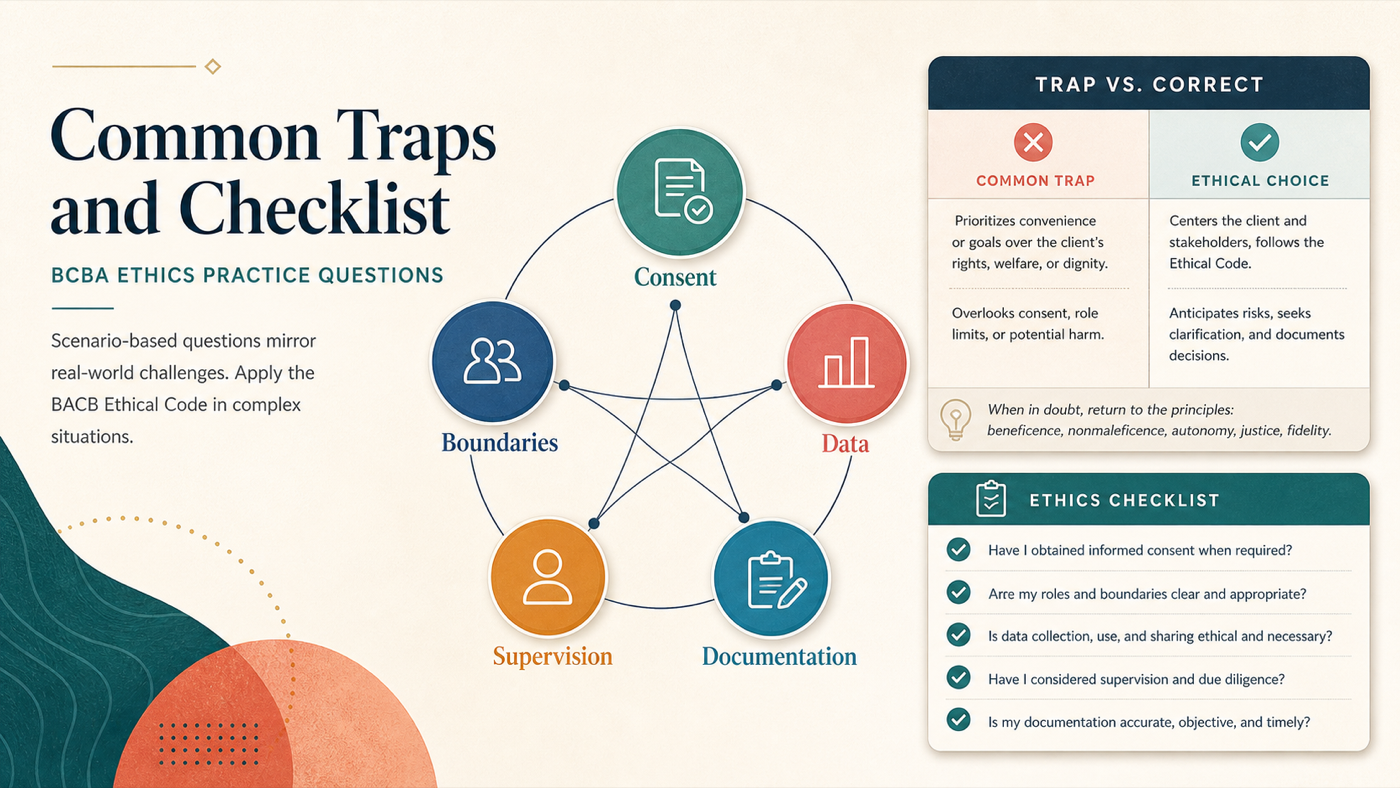
Ethics Review Checklist for BCBA Exam Prep
- Review BACB Code 2.01 (Informed Consent) thoroughly.
- Know the exceptions for confidentiality (e.g., risk of harm).
- Practice distinguishing multiple relationships from unavoidable social contacts.
- Memorize the requirement for data accuracy and avoidance of fabrication.
- Understand the client’s right to effective, evidence-based treatments.
Test Your Ethics Knowledge with a Free Mock Exam
Ready to apply these concepts under exam conditions? Our free BCBA mock exam includes 50 ethics scenario questions with detailed answer rationales.
Take the Free BCBA Mock Exam
Click below to access your free BCBA ethics practice test now and track your progress!
Video Study: Ethics / Professional Conduct
Watch: BCBA Ethics Practice Questions: Documentation, Consent, and Risk
Use this scenario-based lesson to reinforce the professional judgment points and exam distinctions covered in this article.
Prefer a second pass? Open this lesson on YouTube.
BCBA Ethics Practice Questions – FAQs
Q: How many ethics questions are on the BCBA exam?
A: Approximately 15–20% of the exam covers ethics, but questions are integrated throughout the content areas.
Q: Are these practice questions based on the 2022 BACB Code?
A: Yes, all scenarios reflect the current 2022 BACB Ethical Code and standards.
Q: Do you provide explanations for correct answers?
A: Absolutely. Each question includes a rationale for the correct answer and why other options are incorrect.
References
Next step for BCBA exam prep
Turn this topic into exam-day practice
You have reviewed the key ideas. Take a full-length practice test to see what you can apply under exam conditions, then use your results to choose your next study step.
Take the Free BCBA Mock Exam
Continue with Five Full-Length Mocks — $99
Start with the free mock if you are still measuring your readiness. No pass guarantee is implied.



