
ABA reimbursement rates by state are not one national number. The useful answer depends on the payer, state program, service code, provider level, unit definition, fee-schedule type, and effective date. A rate table can be helpful, but a copied number without its source can be dangerous. Medicaid fee-for-service, Medicaid managed care, TRICARE, and commercial insurance may use different documents and payment rules. This guide shows how to research and compare rates responsibly. It is educational information, not a billing guarantee, legal opinion, payer contract, or substitute for a state agency’s current fee schedule. Table of Contents
Table of Contents
- What Are ABA Reimbursement Rates by State?
- Why Do ABA Rates Vary So Much?
- Which Payer Are You Researching?
- How Should You Research Rates by State?
- Which Codes and Units Must You Confirm?
- How Can You Compare a State Rate Table Fairly?
- How Is TRICARE Different From State Medicaid?
- What Should You Verify Before Using a Rate?
- What Does a Safe Rate-Research Workflow Look Like?
- How Does Reimbursement Research Connect to BCBA Work?
- ABA Reimbursement Rates by State FAQ
- Take the Free BCBA Mock Exam
What Are ABA Reimbursement Rates by State?
ABA reimbursement rates by state are the amounts or payment rules used by a specific payer for a covered applied behavior analysis service in a specific jurisdiction. A “rate” might be a fee-for-service amount, a maximum allowed amount, a negotiated contract rate, a case rate, a per-diem amount, or a value calculated from units. Those formats are not interchangeable.
The first useful question is not “What is the ABA rate in my state?” It is “Which payer, program, code, provider type, setting, and effective period am I asking about?” Without that scope, two accurate numbers can appear to contradict each other while describing different services.
- Payer: state Medicaid, Medicaid managed care, TRICARE, commercial insurance, or another program.
- Service code: the code and descriptor that identify the service being priced.
- Provider level: BCBA, BCaBA, technician, qualified health professional, or another category named by the payer.
- Unit: 15-minute unit, hour, visit, day, monthly amount, or a different definition.
- Effective date: the period when the document applies, not merely the date someone uploaded it.
Why Do ABA Rates Vary So Much?
State programs use different benefit designs, fee schedules, provider classifications, and managed-care arrangements. A state may publish a fee-for-service schedule for some codes while the actual claim is administered through a managed-care plan. Another state may list a code but require a separate policy for coverage, authorization, place of service, or provider enrollment. Labor costs, state budgets, legislative decisions, and rate methodology can also contribute to differences.
Do not turn a state-to-state comparison into a ranking of “best” states for providers. A higher posted amount may come with different units, authorization limits, documentation, credential tiers, or non-billable responsibilities. A lower number in a comparable table may reflect a different service or a different rate year. Compare the full rule set, not only the number in the largest font.
Which Payer Are You Researching?
Start a research note with the payer category and keep the categories separate. A state Medicaid page is not evidence of a commercial insurer’s contracted rate. A federal TRICARE maximum allowed table is not the same document as a state Medicaid fee schedule. A provider’s own contract or remittance advice may control a specific claim even when a public schedule exists.
| Payer or program | Best starting source | Common comparison trap |
|---|---|---|
| State Medicaid FFS | State Medicaid agency fee schedule and billing policy | Treating a published FFS amount as the rate for every managed-care plan. |
| Medicaid managed care | Plan contract, provider manual, authorization policy, and state guidance | Assuming the state’s FFS table controls a plan’s negotiated payment. |
| TRICARE | Current Defense Health Agency or TRICARE rate publication | Mixing a federal maximum allowed amount with a state Medicaid amount. |
| Commercial insurance | Provider agreement, plan policy, fee schedule, and claim guidance | Using a public benchmark as though it were the provider’s contract. |
How Should You Research Rates by State?
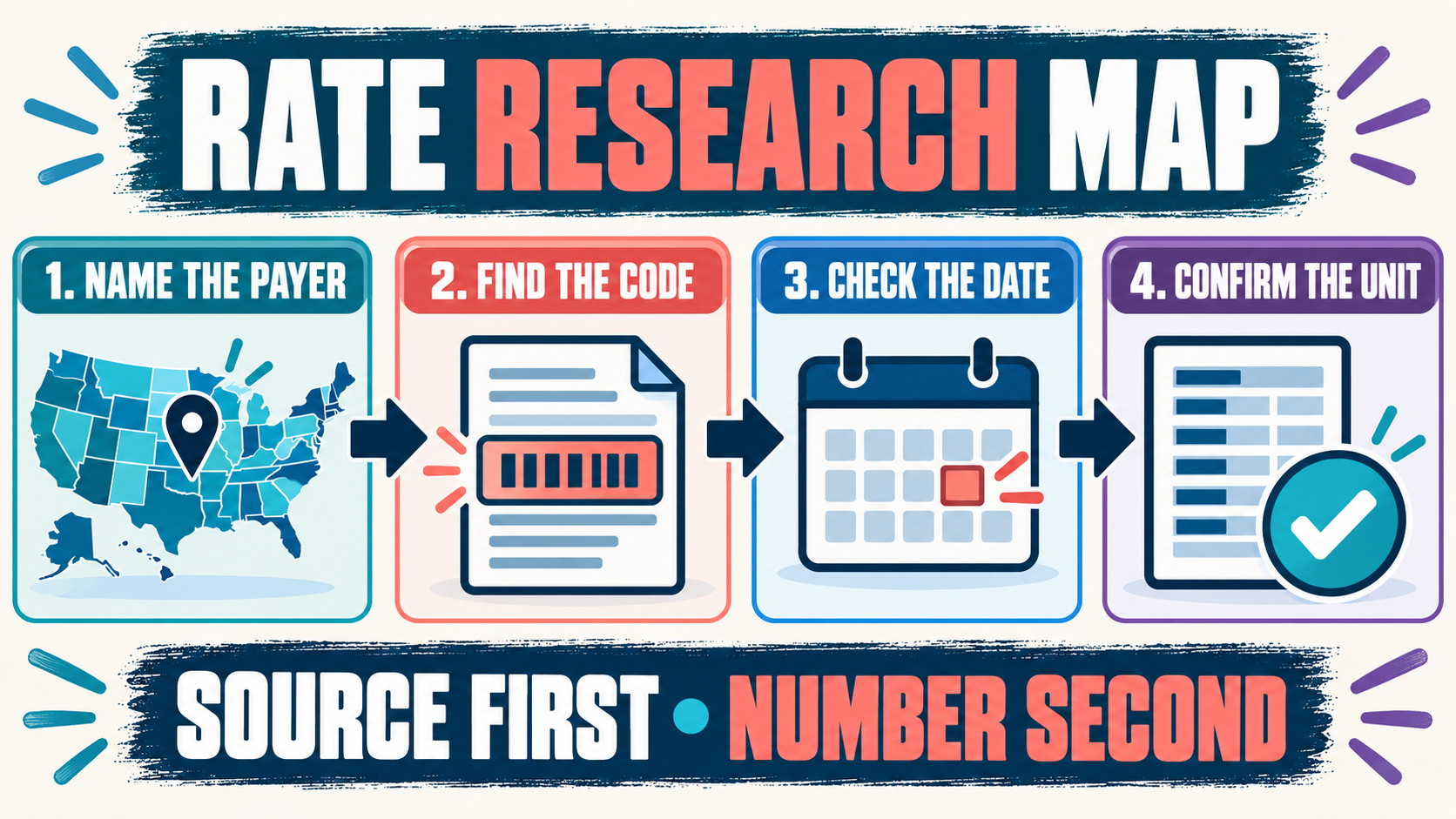
Use a source-first search process. The most reliable public number is attached to a document that names the payer, code, unit, provider type, and effective date. If a secondary page gives you a convenient state-by-state table, use it as a map to the underlying documents—not as permission to skip the official source.
- Name the jurisdiction: record the state, territory, or federal program and the date you are checking.
- Find the payer page: search the state agency or plan site for “fee schedule,” “behavior analysis,” “autism services,” or the applicable provider manual.
- Open the source document: identify whether it is a fee schedule, bulletin, policy, contract guide, or maximum allowed table.
- Search the code and descriptor: confirm that the line matches the service you mean rather than a neighboring code.
- Record the unit and date: save the source URL, document title, page or worksheet, effective date, and access date.
- Check the exception rules: look for provider tiers, place of service, prior authorization, modifiers, limits, and managed-care instructions.
Current public data pages can make this research easier to navigate. For example, The ABA Index publishes a state-by-state Medicaid and TRICARE data view with links to source documents. Use such a dataset to find the right state page, then confirm the number in the payer’s own material before using it in an estimate or claim workflow.
Which Codes and Units Must You Confirm?
A code is not a price by itself. It is a label that must be read with its descriptor, unit, provider category, and policy context. In ABA discussions, people often mention codes such as 97153 or 97155, but the applicable payer document may define the payment, provider type, unit conversion, or authorization rule differently. Never infer a complete rate from the code name alone.
Check whether the table states “per 15 minutes,” “per hour,” “per encounter,” “per day,” or another unit. If you convert a 15-minute amount into an hourly comparison, label the calculation and avoid presenting it as the payer’s own hourly rate. Also check whether the table is a maximum, a floor, a fee-for-service amount, or a negotiated rate. Those words determine what the number means.
How Can You Compare a State Rate Table Fairly?
Build a comparison row that keeps the context attached to the number. The example below is a research template, not a universal reimbursement table.
| Field | Record exactly | Why it matters |
|---|---|---|
| State and payer | State Medicaid FFS, plan name, TRICARE, or commercial carrier | Prevents unrelated programs from being blended. |
| Code and descriptor | Full code, service name, modifier or provider tier if listed | Shows what service the amount actually prices. |
| Amount and unit | Dollar amount plus per-unit definition | Stops a 15-minute amount from being mistaken for an hourly rate. |
| Effective period | Effective date, end date, or “current as of” language | Makes rate changes and stale documents visible. |
| Source trail | URL, file name, page, worksheet, and access date | Allows another person to reproduce the check. |
For an illustration of why context matters, a current 2026 secondary dataset reports that comparable published Medicaid fee-for-service 97153 values in its verified rows range from about $12.18 per 15-minute unit in Kentucky to $18.70 in Nebraska. Those figures are not a national rule or a provider’s guaranteed payment; they have different effective dates and must be checked against the linked state documents. A range can show why research is useful, but it cannot replace the source.
How Is TRICARE Different From State Medicaid?
TRICARE is a federal military health program, so its published ABA maximum allowed amounts are not a state Medicaid fee schedule. The Defense Health Agency publishes its own rate materials and effective dates. When you compare TRICARE with a state, keep the payer column visible, name the program, and preserve the unit and provider-level definitions.
Do not use a TRICARE table to estimate a Medicaid claim or treat a state’s Medicaid schedule as a TRICARE contract. The right comparison may be “what does each source publish for a comparable code and unit?” rather than “which payer pays more?” That distinction protects the reader from an attractive but invalid headline.
What Should You Verify Before Using a Rate?
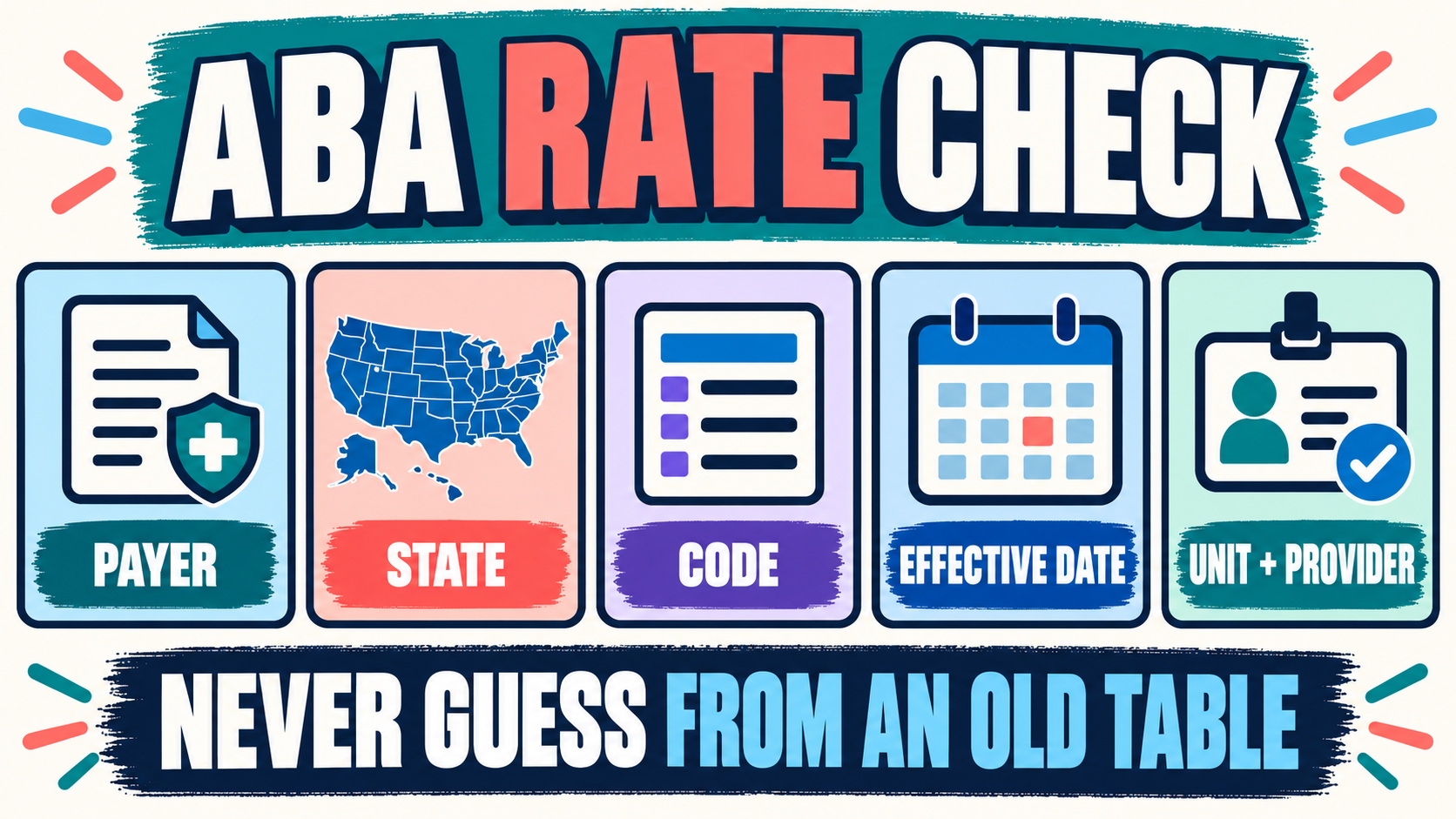
Run the five-point check shown above before a rate enters a budget, staffing model, claim review, or public article. A number is not ready to use until the surrounding context is also verified.
- Payer: is the source the same program that will process the service?
- State: does the document apply to the correct jurisdiction and program?
- Code: does the descriptor match the service and provider type being discussed?
- Effective date: is the schedule current for the dates of service?
- Unit and provider: is the amount tied to the right unit, credential, location, modifier, and authorization condition?
If any answer is unknown, label the number as unverified and keep researching. If the document is silent, contact the payer or the person responsible for billing policy. Do not fill a missing field with a rate copied from another state.
- Save the source trail: keep the official URL, file name, page or worksheet, and access date with the rate.
- Mark uncertainty: label missing, conflicting, or outdated information instead of silently choosing a number.
- Assign follow-up: name the person who will confirm the rule with the payer, state agency, or billing lead.
What Does a Safe Rate-Research Workflow Look Like?
For a clinic, analyst, or writer who needs repeatable research, use a small version-controlled rate log:
- Create one row per state, payer, code, unit, provider type, and effective period.
- Store the official document link and a local citation note, including page or worksheet.
- Mark each row as verified, changed, pending, or not publicly published.
- Review the log whenever a payer bulletin, new fee schedule, or contract update appears.
- Show the last verified date next to any public summary, and explain that rates can change.
Keep reimbursement research separate from clinical recommendations. A rate can inform operations, but it does not determine which goals to select, which procedure to use, or whether a service is appropriate for a particular learner. Those decisions require the responsible clinical and payer processes.
How Does Reimbursement Research Connect to BCBA Work?
BCBAs may encounter reimbursement questions while planning services, communicating with families, supervising staff, or reviewing whether a program is workable. The current BCBA Test Content Outline includes ethical and professional issues, legal and regulatory requirements, data-based decisions, intervention selection, collaboration, and personnel supervision. A strong exam answer separates a clinical decision from a payer or administrative question and identifies the information that must be verified.
The BACB ethics information is the correct official starting point for current ethics requirements. A reimbursement amount never justifies misrepresenting a credential, changing documentation, billing an unprovided service, or choosing a goal solely because it is easier to pay. If a payment question affects a client’s access or a provider’s plan, escalate it through the proper clinical, billing, and regulatory channels.
When you are studying these distinctions, ABA reimbursement rates by state practice questions can help you rehearse the reasoning pattern: identify the payer, spot the missing context, choose the source that controls, and avoid an unsupported conclusion. A mock score is feedback for review, not a billing credential or certification guarantee.
ABA Reimbursement Rates by State FAQ
Is there one national ABA reimbursement rate?: No. Payment depends on the payer, state or federal program, service code, provider category, unit, authorization, and contract or fee schedule. A national-looking number is usually a benchmark or a summary, not a universal claim rate.
Where can I find current Medicaid ABA rates?: Start with the state Medicaid agency’s current fee schedule and provider or behavioral-health policy pages. A reputable secondary dataset can help you locate the documents, but confirm the amount, unit, and effective date in the official source before relying on it.
Are commercial insurance rates public?: Often not in the same way as a state fee-for-service schedule. Commercial payment may be controlled by a provider agreement, plan policy, authorization, or negotiated contract. Treat public Medicaid or TRICARE numbers as context, not as proof of a commercial rate.
Can I compare a 15-minute rate with an hourly rate?: You can make a clearly labeled mathematical conversion for analysis, but keep the original unit next to it. A converted figure does not automatically account for authorization, cancellations, documentation, supervision, travel, modifiers, or the payer’s billing rules.
Bottom line: research ABA reimbursement rates by state as a source-and-context problem. Name the payer, locate the official document, confirm the code and unit, check the effective date, preserve the source trail, and never let a convenient table replace the rule that controls the claim.
Take the Free BCBA Mock Exam
If you want a low-pressure way to check your recall, use the free practice resource below. Take the Free BCBA Mock Exam



