
An ABA progress report sample is most useful when it shows the reasoning behind each section, not just a blank form. A strong report connects assessment data to measurable goals, describes progress without exaggeration, explains barriers, documents collaboration, and states what the team will do next.
Table of Contents
- What Is an ABA Progress Report?
- What Should an ABA Progress Report Include?
- How to Turn Goal Data into Report Language
- How to Document Barriers and Caregiver Participation
- How to Explain Continued Need Without Overclaiming
- ABA Progress Report Review Checklist
- BCBA Exam Connections
- ABA Progress Report Sample FAQ
- Take the Free BCBA Mock Exam
This is a fictional, educational sample for BCBA students and practitioners. It is not a payer-required form, a medical-necessity guarantee, or a substitute for your state, insurer, school, agency, or supervising clinician’s rules. Requirements vary, so use the current local template when one applies and protect all client information. Table of Contents
What Is an ABA Progress Report?
A progress report is a time-bounded summary of what happened during a reporting period and what the data support doing next. It is different from a session note, which documents a specific service encounter, and different from a treatment plan, which describes the broader program design. A progress report interprets a series of observations and connects them to goals, meaningful outcomes, barriers, collaboration, and revision decisions. The report should answer five practical questions:
- What were the learner’s starting levels and current levels?
- Which goals improved, remained stable, stalled, or require a new criterion?
- Did the skills generalize across people, materials, settings, or time?
- What variables affected progress or service delivery?
- What is the next measurable plan, and how will the team know whether it works?
Good writing is objective without being mechanical. “The client made excellent progress” is a conclusion without evidence. “Independent requests increased from a median of 2 of 10 opportunities during baseline to 8 of 10 opportunities during the final four weeks, across home and clinic observations” gives the reader something to evaluate.
What Should an ABA Progress Report Include?
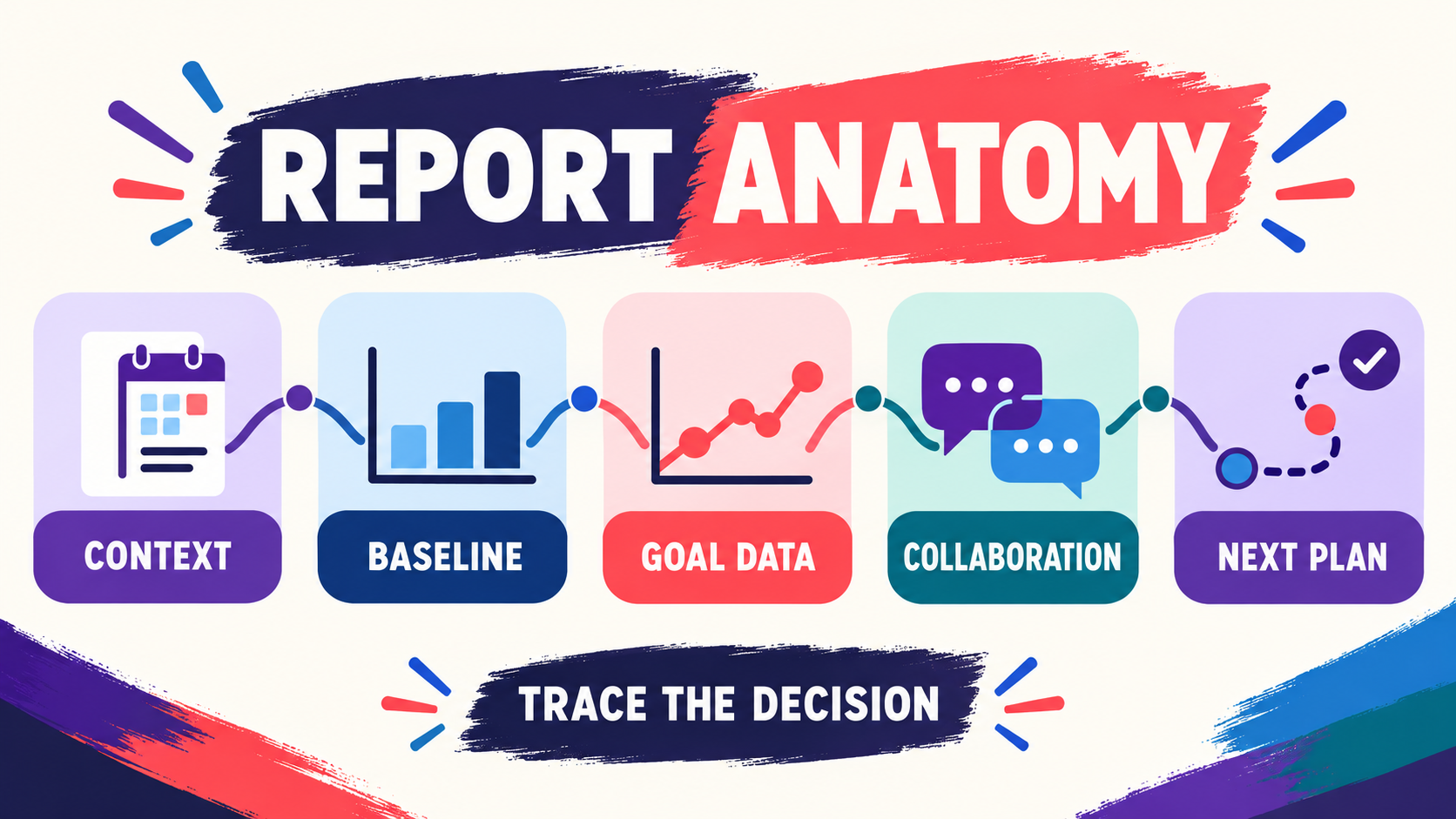
The exact order differs by agency and payer, but most useful reports contain the same reasoning blocks. The following is a teaching structure, not a mandated universal form.
| Report section | What to show | Fictional sample language |
|---|---|---|
| Reporting period and services | Dates, settings, service types, participation, and any meaningful change in delivery. | “This review covers January 1–March 31. Services occurred in the clinic, home, and community routines.” |
| Baseline and current data | The measurement dimension, baseline, recent trend, and level of independence. | “Independent requesting rose from 20% of opportunities at baseline to 80% in the final probe.” |
| Goal-by-goal interpretation | Status, data pattern, generalization, barriers, and the next criterion or action. | “Goal is improving; performance is independent in the clinic and emerging with a caregiver at home.” |
| Caregiver and team collaboration | Training opportunities, implementation information, stakeholder priorities, and coordination with other providers. | “The caregiver practiced the visual prompt during two routines and reported that the learner used the request at dinner.” |
| Next plan and transition logic | Revised goals, fading or generalization steps, risk monitoring, and criteria for continued review or discharge. | “Continue the target with novel materials, then thin prompts when independent responding remains above criterion.” |
Include only information that is relevant, accurate, and permitted to be shared. A report should not copy an entire chart or expose unnecessary protected health information. The BACB Ethics Code information page links to the current code, which addresses truthfulness, confidentiality, client and stakeholder involvement, data, and continual evaluation.
How to Turn Goal Data into Report Language
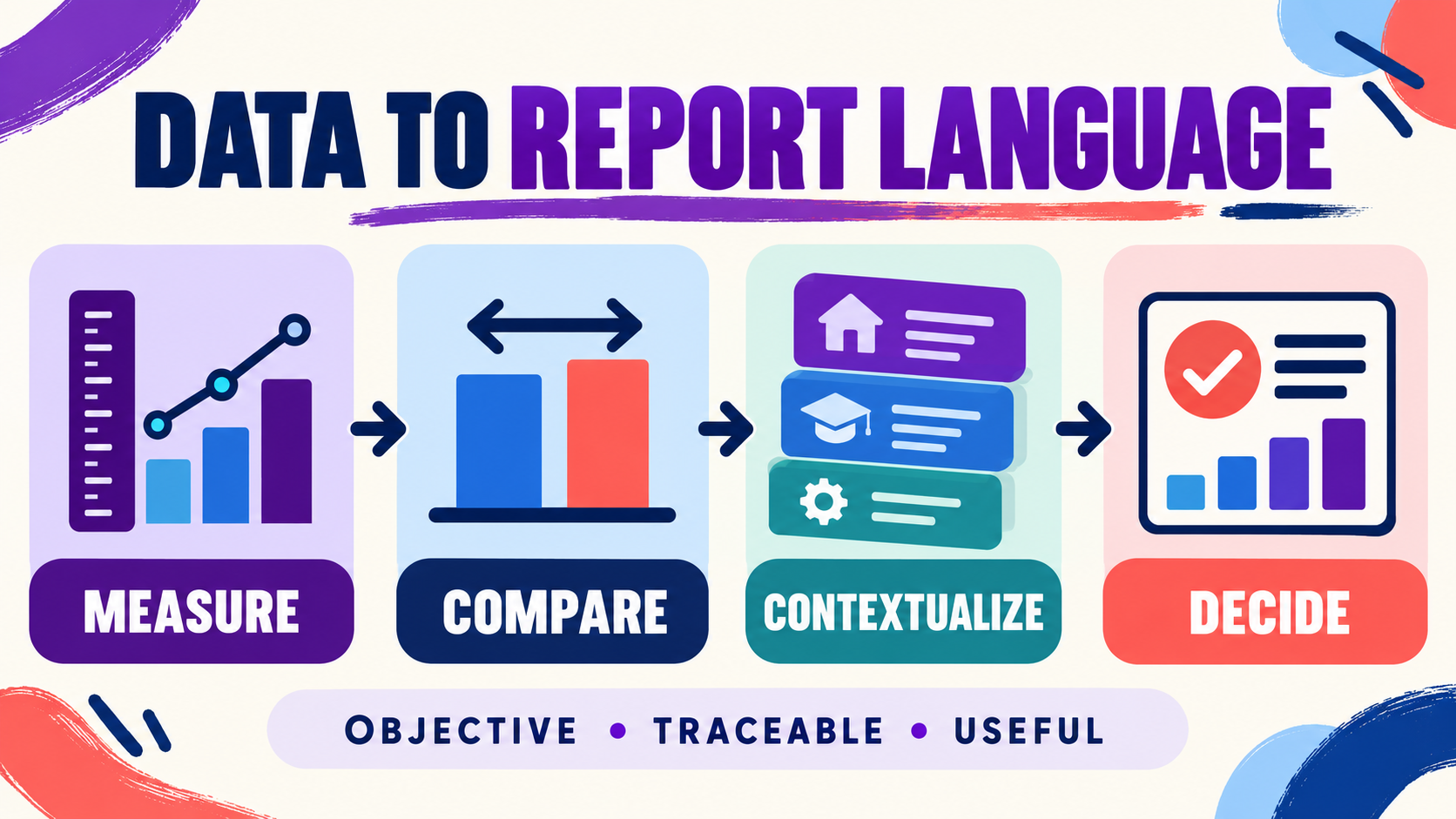
The central skill in an ABA progress report is moving from a graph to a defensible sentence. Use a repeatable four-part pattern:
- Measure: Name what was counted, timed, rated, or sampled.
- Compare: State the baseline and current level using the same measurement dimension.
- Contextualize: Identify people, settings, materials, prompts, and opportunities represented by the data.
- Decide: State whether the goal is mastered, improving, stalled, generalized, revised, or ready for a next step.
For example, imagine a fictional goal for following a two-step direction. A weak sentence would be: “The learner is doing much better.” A stronger sample is: “Correct independent responding increased from 3 of 10 opportunities during baseline to a median of 8 of 10 opportunities across the final five clinic sessions. Performance was 6 of 10 opportunities during two home probes, so the next step is to practice with a caregiver and unfamiliar materials before increasing task complexity.”
Notice what the sentence does not claim. It does not say the skill is mastered everywhere. It does not convert one clinic trend into a lifetime outcome. It distinguishes current evidence from the next hypothesis. This precision protects the learner, the team, and the reader.
Use the right measurement language: Frequency, rate, duration, latency, percentage of opportunities, interval data, and level of prompting answer different questions. Do not report “80% progress” without naming 80% of what. If the target is a reduction behavior, make clear whether lower frequency, shorter duration, longer latency, or fewer intervals reflects improvement. If the target is a skill, describe independence and the prompt level required.
Describe trends without hiding variability: A mean can conceal a meaningful pattern. When appropriate, report a median, range, trend, phase change, or representative probe. Explain missing data or unusual sessions when they affect interpretation. “Data were unavailable for two weeks because services paused” is more useful than silently connecting two unrelated phases.
How to Document Barriers and Caregiver Participation
A barrier is not an excuse and it is not a blame statement. It is a variable that affected learning, implementation, measurement, or access to services. Examples may include schedule changes, illness, transportation, limited caregiver availability, competing school demands, staffing changes, materials that were not available, or a procedure that did not fit the learner’s communication mode.
Describe the barrier, its observable effect, and the adjustment made. For instance: “Three home probes were cancelled because of a family schedule change. During available probes, the caregiver used the visual prompt with 70% procedural fidelity. The team shortened practice to five-minute routines and will collect two additional probes before changing the goal.” This is different from “The family was noncompliant,” which is vague, stigmatizing, and not actionable.
Caregiver participation should also be described as a skill and an opportunity. Document what was taught, what the caregiver implemented, what support was needed, and what outcome was observed. If participation is limited, identify barriers and offer a feasible next step. The report should not imply that a caregiver must perform a clinical role without training, time, consent, or support. Coordination matters when other providers, schools, or funders are involved. Note the consent status and the relevant information shared. Do not include another professional’s confidential details simply to make the report look complete.
How to Explain Continued Need Without Overclaiming
Some progress reports support a service review or authorization request, but the author should not promise approval. Payers and states use different definitions, forms, deadlines, and medical-necessity criteria. Use the current policy that applies to the case.
A responsible continued-need paragraph links four things: the functional impact of the target, the measurable response to treatment, the remaining skill or safety need, and the proposed next step. For example: “The learner’s independent functional requests increased across clinic routines, but communication remains inconsistent during community transitions and home generalization is emerging. Continued teaching is proposed to expand the response across people and settings, with a caregiver practice plan and a review of prompt dependence at the next data checkpoint.”
This language is stronger than “more ABA is needed because progress is good.” It shows why the next clinical decision follows from the data. It also leaves room for a plan to change if the learner’s needs, preference, safety, or response changes.
ABA Progress Report Review Checklist
Before submitting a report, check the following:
- Are all dates, service types, settings, and reporting periods correct?
- Does every major claim point to a measurement, observation, or clearly identified report from a stakeholder?
- Are baseline and current values measured in comparable ways?
- Does each goal have a status and a next decision?
- Does the report separate clinic performance from generalization?
- Are barriers described objectively, without blaming the learner or caregiver?
- Are confidentiality, consent, client voice, and professional scope protected?
- Do the proposed next steps include a review rule if progress stalls or risk changes?
- Does the report match the current payer, state, school, and agency requirements?
Run a final number check against the graph, source notes, authorization dates, and service totals. A polished narrative cannot repair a mismatch between the report and the underlying record.
BCBA Exam Connections
For BCBA candidates, an ABA progress report sample is a useful way to integrate measurement, documentation, ethics, and decision making. A scenario may ask you to identify the best statement, the appropriate graph interpretation, or the next action after a goal changes. Look for:
- Measurement alignment: The data dimension must match the target and the claim.
- Operational clarity: “Progress” should be tied to observable behavior and a stated criterion.
- Generalization: A skill in one setting is not automatically mastered across settings.
- Ethical documentation: Records must be truthful, accurate, confidential, and useful for client decisions.
- Data-based revision: When the data change, the plan may need to change too.
Practice asking, “What does the data justify—and what does it not justify?” That question reduces overclaiming and improves exam reasoning.
ABA Progress Report Sample FAQ
Is an ABA progress report the same as a session note?: No. A session note records a specific service encounter. A progress report summarizes a defined period, interprets goal-level data, documents barriers and collaboration, and explains the next plan.
Can I copy an ABA progress report sample?: Use a sample to learn structure and objective language, not to copy client details or make a generic form satisfy a payer. Replace every field with accurate, case-specific information and verify the current local requirements.
What should I write when a goal is not met?: Report the current data, the conditions under which the learner responded, barriers that affected implementation, and the decision being considered. A goal that is not met is not automatically a failure; it is information for changing the teaching arrangement, criterion, measurement, or support.
Do progress reports need graphs?: Many clinical and payer contexts benefit from graphs or other visual summaries, but the exact requirement varies. Include data in a form the intended reader can interpret, label the measurement and dates clearly, and make sure the narrative matches the graph. Where can I practice interpreting ABA data? Use the free BCBA mock exam to practice connecting a data pattern to an ethical next decision. It is independent study support, not official BACB material.
The best ABA progress report sample is not the longest form. It is a truthful bridge between data and the next clinical decision: specific enough to audit, readable enough to use, respectful enough to protect the learner, and flexible enough to follow the current rules of the setting.
Take the Free BCBA Mock Exam
If you want a low-pressure way to check your recall, use the free practice resource below. Take the Free BCBA Mock Exam



