
ABA non compliance is a common search phrase, but it is not a complete behavioral definition. In behavior analysis, a label such as “noncompliant” can hide several different responses: turning away, saying no, leaving an area, delaying, asking for help, refusing a task, or communicating that a condition is unacceptable. Those responses may have different functions and may require different supports.
Table of Contents
- What ABA Non Compliance Means
- Why the Label Is Not Enough
- How to Assess Function and Context
- Assent, Self-Advocacy, and Choice
- Teaching a Useful Alternative Response
- Measurement and Data-Based Decisions
- How BCBA Questions Test Non Compliance
- Common Mistakes
- FAQ
- Quick Review Checklist
- Take the Free BCBA Mock Exam
For BCBA exam questions, the strongest answer usually moves from the label to observable behavior, context, function, assent, and a useful alternative response. The goal is not to make a learner obey every instruction. The goal is to understand what is happening, protect communication and choice, and teach skills that improve safety, access, participation, or another person-approved outcome. This is educational study guidance, not a treatment recommendation. Table of Contents
What ABA Non Compliance Means
In everyday language, noncompliance means not doing what someone asked. In ABA, that phrase is usually a starting description rather than the behavior to measure. A behavior analyst should ask: What did the person do or say? Under what conditions? What happened immediately before and after? What outcome did the person obtain or avoid? What communication or choice was available?
The BACB Ethics Code for Behavior Analysts provides the professional framework for responsible behavior-analytic services. The Code does not turn obedience into a universal treatment goal. It requires behavior analysts to consider client welfare, effective treatment, cultural responsiveness, client involvement, and the professional’s competence and scope. Those principles matter when a team is tempted to treat every refusal as a problem to eliminate.
For example, a learner who pushes a worksheet away may be avoiding a difficult task, communicating pain, requesting a break, responding to an unclear instruction, or expressing a valid preference. The same topography can occur for different reasons. Conversely, two different responses—silence and leaving the room—could serve a similar escape function. The label alone cannot answer the intervention question.
Use respectful language in documentation. “When presented with a handwriting task, the learner pushed the paper to the left and said ‘break’ within 10 seconds” is more useful than “the learner was noncompliant.” A precise description makes it possible to assess the environment, protect communication, and select a replacement response that actually works.
Why the Label Is Not Enough
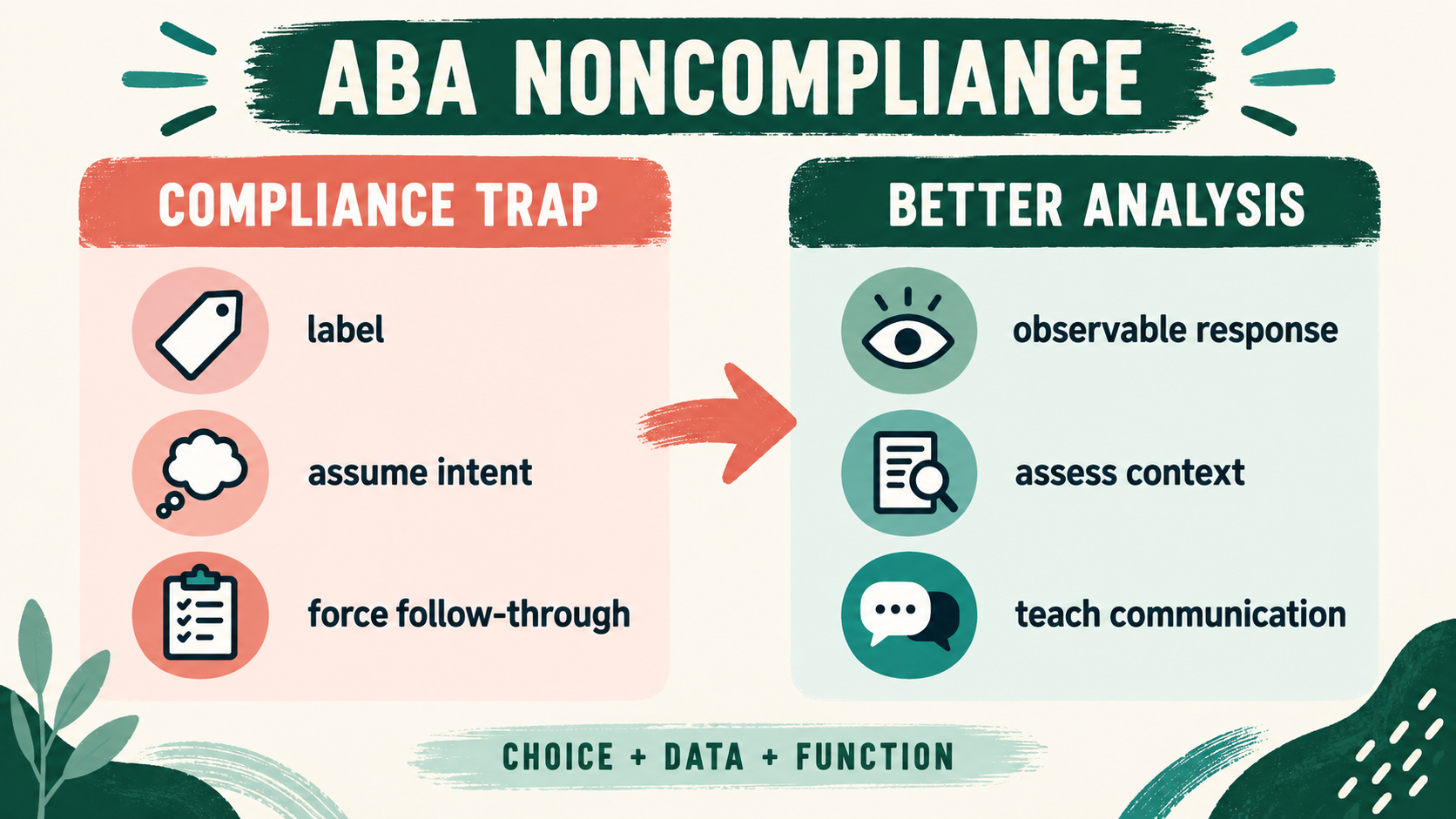
Labels often combine behavior, interpretation, and judgment. That combination can create a measurement problem and a treatment problem. If two staff members score “noncompliance” differently, the data cannot reliably show whether the plan is working. If the team assumes that the person is simply being defiant, it may miss a skill deficit, an aversive demand, an inaccessible communication system, or a health concern.
| Vague label | Observable description | Question to ask next |
|---|---|---|
| Refuses work | Places materials away, says “no,” and does not begin within 30 seconds after an instruction. | Is the task too hard, unclear, lengthy, painful, or less valuable than an available alternative? |
| Noncompliant in transition | Drops to the floor and remains in the current area for two minutes after a transition cue. | What is changing, what is ending, and what support or communication option is available? |
| Does not cooperate | Turns away, covers ears, or uses a selected signal to indicate “not now” during an interaction. | Is the person communicating a boundary or need that the team should honor? |
Not every failure to start a task needs an intervention. A person may have the right to decline, negotiate, or choose a different activity. The clinical question is whether the response creates a serious safety barrier or blocks an outcome the person wants, and whether the environment can be changed before teaching a new skill.
How to Assess Function and Context
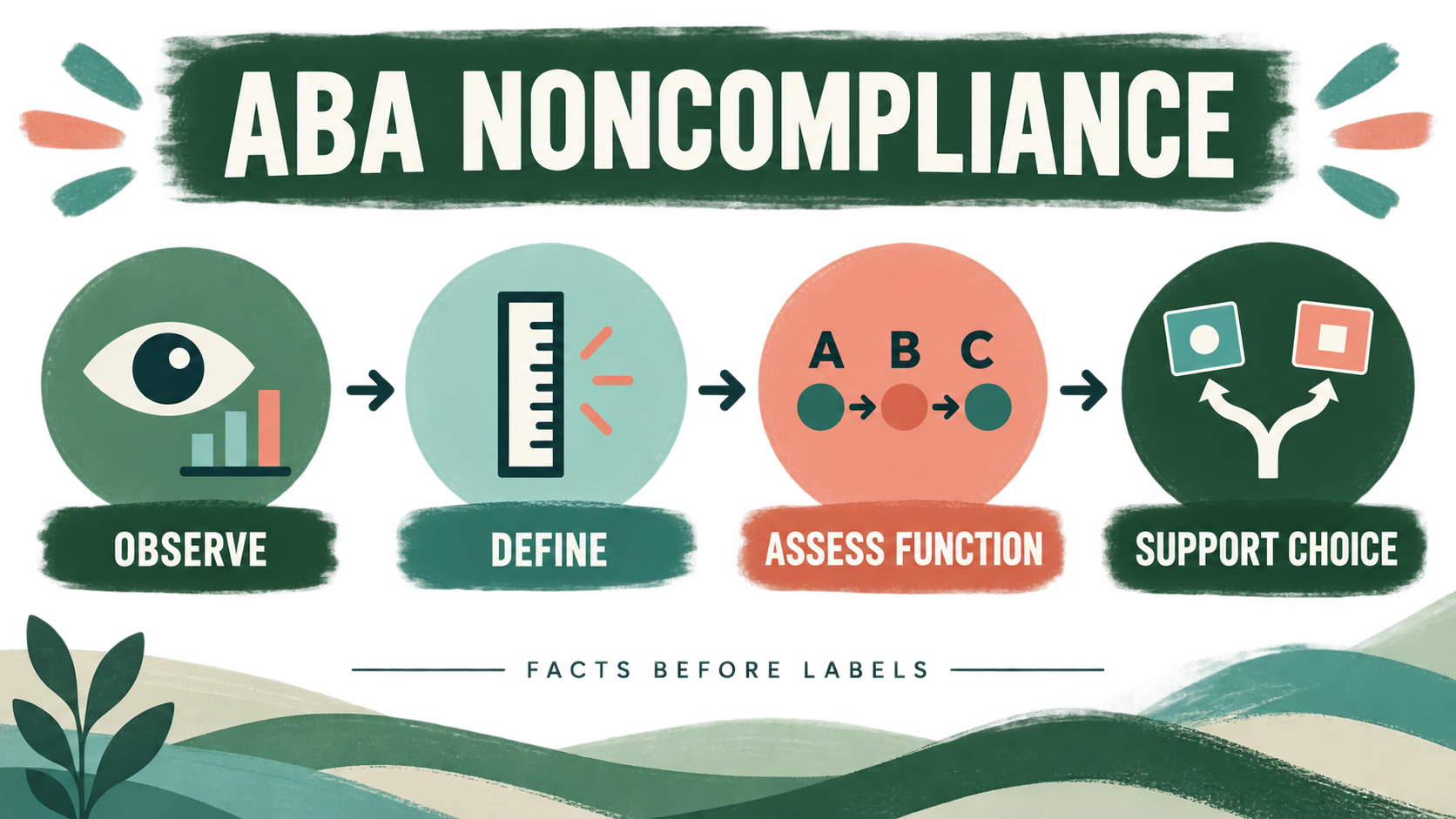
Assessment begins with information, not a punishment plan. Review the antecedent, the response, and the consequence, but also examine setting events such as sleep, pain, medication changes, sensory load, communication access, previous reinforcement history, and the relationship with the person delivering the instruction. Direct observation, interview, record review, and functional assessment methods may all contribute to the hypothesis.
Ask what the response accomplishes. It may produce a break, delay, escape from a difficult demand, access to attention or a preferred item, control over a routine, or sensory change. It may also communicate “I do not understand,” “I need help,” “I want a different option,” or “this is unsafe.” A hypothesis is not proven because it sounds plausible; collect data and test the plan carefully.
Context can change the meaning of the same response. A person leaving a noisy room may be using an adaptive self-management strategy. Leaving a designated safe area without a way to signal support may create a safety concern. A person declining a task after a clear explanation is not equivalent to a person who cannot access the instruction. BCBA-style questions often include these details to see whether the candidate notices the difference.
| Assessment area | Useful question | Why it matters |
|---|---|---|
| Demand | What exactly was requested, and was the instruction understood? | A skill or communication barrier may look like refusal. |
| Choice | Could the person choose the order, materials, timing, or support? | Choice can improve access without treating autonomy as a problem. |
| Consequence | What changed immediately after the response? | The outcome may suggest a function and a more effective replacement. |
| Health and safety | Could pain, fatigue, medication, trauma, or danger change the response? | Some concerns require medical, mental-health, or emergency consultation. |
Assent, Self-Advocacy, and Choice
Modern ABA discussions increasingly distinguish cooperation from forced compliance. Autism Spectrum News’ discussion of non-compliance and self-advocacy highlights why a person may need to learn when and how to communicate “no,” request a change, or recruit support. That perspective aligns with a behavior-analytic focus on socially meaningful behavior: communication and self-advocacy can be treatment outcomes, not obstacles to treatment.
Assent is not the same as a one-time signature or the absence of loud protest. Look for ongoing, developmentally and communicatively appropriate indications that the person understands and is willing to participate, while respecting a withdrawal of assent according to the setting’s procedures. A person may agree to one activity and decline another. The team should make that distinction visible in the plan.
This does not mean that every refusal can end a safety-critical routine without further planning. It means the team should teach a safe communication response, modify the task where possible, explain what will happen, and involve the appropriate decision makers. If a medical procedure, crisis, abuse concern, or immediate danger is present, follow the relevant professional and emergency protocol instead of improvising an ABA compliance procedure.
Teaching a Useful Alternative Response
An alternative response should contact an outcome that is meaningful and available. If pushing materials away is the only way a learner obtains a break, teaching “break” or a device-based request will not work if staff ignore it. Reinforce the communication response, make the arrangement predictable, and gradually teach the person how to navigate the routine with the least intrusive support that still preserves safety and choice.
- Request help: teach a selected word, sign, button, gesture, or written signal that produces timely assistance.
- Request a break: define how long the break lasts, how the person returns or changes the plan, and what happens if the task is still too difficult.
- Request a change: offer a way to choose materials, order, location, partner, or timing when the options are genuinely available.
- Negotiate or decline: teach a respectful, accessible response for “not now,” “different,” or “stop,” with a plan for safety-critical situations.
Do not call a replacement response successful merely because it produces compliance with the adult’s original demand. The outcome should be evaluated by function, social validity, generalization, and the person’s experience. A visual schedule or prompt may remain a useful accommodation; independence does not require removing every support.
Measurement and Data-Based Decisions
Choose a measure that matches the response. Frequency or rate may fit requests or episodes; latency may fit starting a task; duration may fit leaving an area; percentage of opportunities may fit a communication response; and task-analysis data may show which step requires support. Record the prompt level and the consequence when those variables change the meaning of performance.
Track more than whether the person eventually followed through. Review the rate of the original response, the rate of the alternative response, time to access a break or help, the context in which each response occurs, and whether the skill transfers across people and settings. A lower rate of refusal paired with higher distress is not automatically improvement. A higher rate of requesting may show that communication has become effective.
Use graphs and direct observation to evaluate level, trend, variability, and the effects of the intervention. If the response changes only with one staff member, assess generalization. If the person stops requesting after requests are denied, the data may show a problem with the consequence arrangement rather than a successful reduction in noncompliance. Modify the plan based on evidence and consultation.
How BCBA Questions Test Non Compliance
The BCBA Test Content Outline emphasizes assessment, intervention selection, measurable behavior, client variables, data-based decisions, and generalization. A question about ABA non compliance may test whether you recognize an operational-definition problem, identify a likely function, honor client preferences, or select a functionally equivalent communication response.
- If the stem uses “defiant,” “lazy,” or “noncompliant” without observable detail, define the response before choosing an intervention.
- If the learner says “no” or requests a break, do not automatically treat that communication as problem behavior.
- If the answer jumps to punishment or forced follow-through without assessment, look for a less assumptive, function-based option.
- If a replacement response is taught but not reinforced, the answer is missing the consequence that makes the response useful.
- If risk, pain, medication, abuse, or a medical procedure appears, select the appropriate consultation or safety protocol.
A concise exam rationale is: define the behavior, assess the context and function, protect assent and communication, teach a useful alternative, and use data to evaluate whether the plan improves the person’s actual outcome.
Common Mistakes
- Measuring a label. “Noncompliance” is not precise enough to guarantee reliable scoring.
- Assuming intent. Refusal does not prove defiance, manipulation, or escape without assessment.
- Equating obedience with progress. Participation should be meaningful, safe, and person-approved where possible.
- Teaching a request without honoring it. A communication response loses value when the team routinely ignores its function.
- Ignoring setting events. Health, sensory, cultural, trauma, and communication variables can change the analysis.
FAQ
What does ABA non compliance mean?: It is a broad phrase for not following an instruction, but it is not a complete behavioral definition. A BCBA should describe the observable response, the conditions in which it occurs, its consequences, and the person’s communication or choice options before selecting an intervention.
Is noncompliance a behavior in ABA?: The label itself is usually too vague because it describes the absence of an expected response rather than a specific action. The person may push materials away, leave, say “no,” request a break, or do something else observable. Define that response so it can be measured consistently.
How should a BCBA respond to refusal?: Assess the context and function, check for health or safety concerns, respect communication and assent, and teach a useful alternative such as requesting help, a break, a change, or a later time. Follow the current Ethics Code, supervision, organizational policy, and applicable law.
How can I study ABA non compliance for the BCBA exam?: Practice turning labels into operational definitions, identifying antecedents and consequences, distinguishing refusal from communication, and choosing function-based alternatives. For additional scenario practice, try the free BCBA mock exam.
ABA non compliance questions are rarely solved by demanding more obedience. The better reasoning is to observe carefully, assess function and context, protect communication and choice, teach a response that works, and evaluate the result with data. That approach produces clearer documentation and stronger BCBA exam answers.
Quick Review Checklist
Use this final checklist to turn aba non compliance into exam-ready reasoning. The goal is not to memorize a label in isolation; it is to identify the relevant evidence and explain why the best answer fits the scenario. Key ideas to review:
- State the central definition or decision point for aba non compliance in your own words.
- Identify the detail that makes aba non compliance different from its closest related ABA term.
- Separate the observable facts in a scenario from assumptions that are not supported by the facts.
- Write one example and one nonexample so you can recognize the concept in a new setting.
Exam application checks:
- Ask what the question is actually requesting before comparing the answer choices.
- Mark the antecedent, response, consequence, or other evidence that supports the selected answer.
- Look for a distractor that describes a related process but does not answer the specific question.
Final self-check:
- Explain how you would verify the interpretation with clear observations or data.
- Change one detail in the scenario and decide whether your answer should change.
- Give a one-sentence rationale that a supervisor or study partner could evaluate.
Take the Free BCBA Mock Exam
If you want a low-pressure way to check your recall, use the free practice resource below. Take the Free BCBA Mock Exam



