

Scientific rigor in ABA means using a transparent chain from question to decision: define behavior, measure it well, test whether the intervention produced the change, check implementation, and examine whether the outcome matters for the client. If you searched for scientific rigor ABA, the short answer is that rigor is visible in the quality of the definitions, data, design, implementation, and interpretation—not just in the presence of a graph. It is not just “having data,” using complicated statistics, or citing a research paper.
Table of Contents
- What Does Scientific Rigor ABA Mean in Practice?
- How Does Rigor Move From Question to Decision?
- Which Evidence-Quality Checks Should a BCBA Track?
- How Are Reliability, Treatment Fidelity, and Validity Different?
- How Do Measurement and Replication Strengthen a Clinical Decision?
- How Should a BCBA Read an Evidence-Based Claim?
- What Mistakes Weaken Scientific Rigor?
- How Can You Study Scientific Rigor for the BCBA Exam?
- Frequently Asked Questions
- Sources for Further Study
- Take the Free BCBA Mock Exam
For BCBA students, scientific rigor is a practical study lens. When a scenario claims that an intervention worked, ask how behavior was defined, how data were collected, whether the plan was implemented as designed, whether the design supports a causal conclusion, and whether the outcome is meaningful and safe. This article focuses on applied scientific rigor—not the philosophical assumptions of ABA covered elsewhere on the site.
What Does Scientific Rigor ABA Mean in Practice?
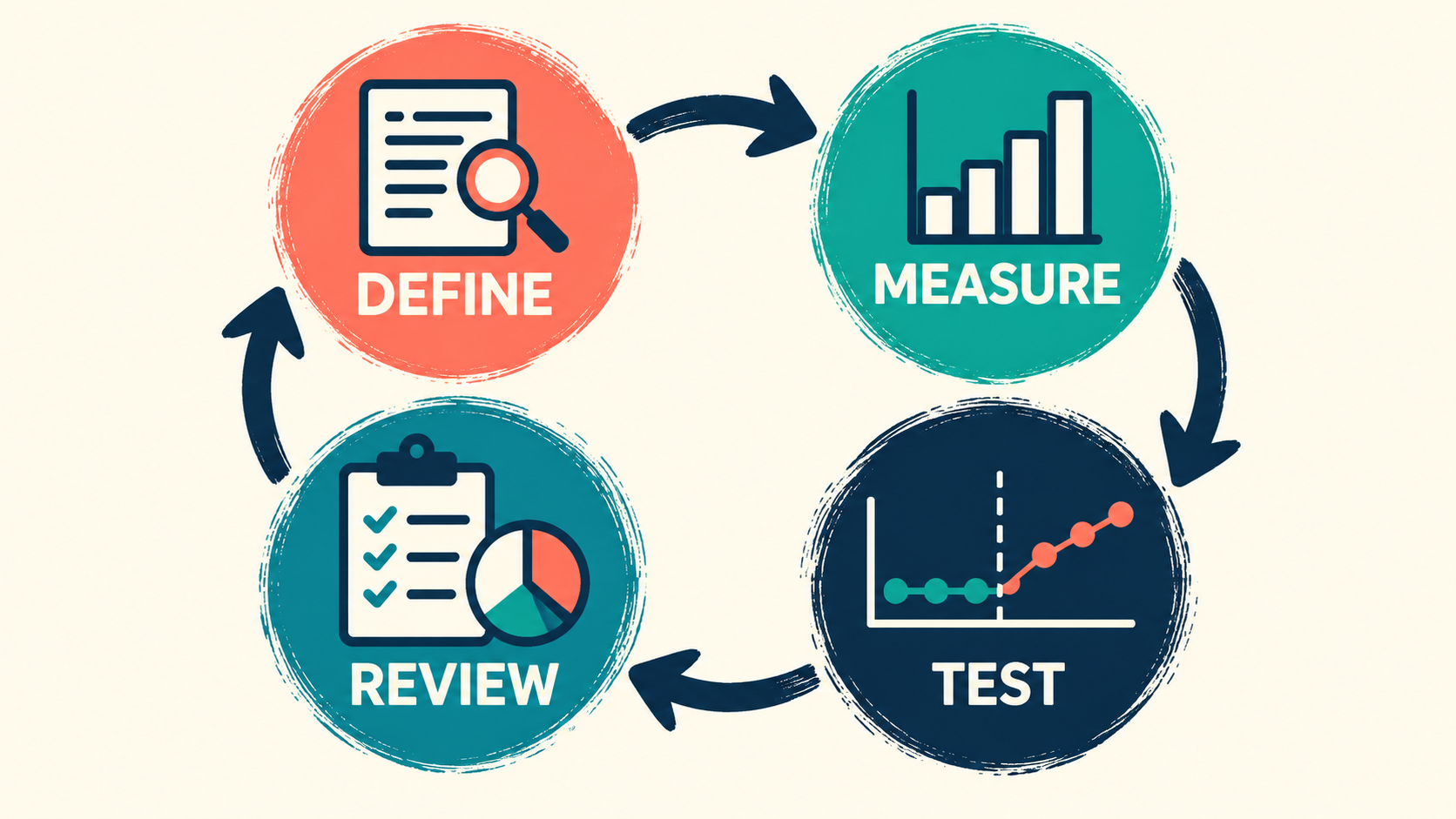
Scientific rigor is the discipline of making each important step visible and testable. In applied behavior analysis, that usually starts with a socially important question and ends with a decision that can be explained from the data. A rigorous description tells another trained person what was measured, under what conditions, how the intervention was delivered, and why the conclusion is justified.
That definition is different from saying that a study must be complicated. A single-case design, a carefully selected measurement system, and repeated observations can be rigorous when they fit the question and are implemented well. Conversely, a large data set can still be weak if the target behavior is vague, observers disagree, the treatment was not delivered as planned, or the conclusion goes beyond what the design supports.
Scientific rigor also does not mean ignoring the person who receives services. Applied work should connect measurement and experimental logic to meaningful outcomes, acceptable procedures, dignity, safety, and generalization. Evidence helps a BCBA make a defensible decision; it does not replace professional judgment, consent, collaboration, or current ethical requirements.
How Does Rigor Move From Question to Decision?
A useful way to study scientific rigor is to follow the path of a clinical question instead of memorizing isolated vocabulary:
- Define the target: State the observable behavior and the conditions that matter. Include examples, nonexamples, and a measurement dimension such as frequency, duration, latency, or percentage of opportunities.
- Measure consistently: Choose a system that captures meaningful change and train observers to use it. The method should be practical enough to use in the setting where decisions will be made.
- Describe the intervention: Specify what the practitioner will do, when it will happen, what materials are required, and what counts as a correct implementation.
- Test the relation: Use a design and data pattern that fit the question. Repeated measurement, prediction, verification, replication, or another appropriate logic helps separate an intervention effect from coincidence or unrelated change.
- Review the outcome: Check reliability, treatment fidelity, maintenance, generalization, social validity, safety, and the learner’s experience before deciding whether to continue, modify, or fade the plan.
The steps do not always happen in a perfectly straight line. Weak measurement may require a revised definition. Low fidelity may require staff coaching before the intervention is judged. A new setting may require a generalization probe. The rigorous response is to identify the limitation and improve the chain, not to hide it.
Which Evidence-Quality Checks Should a BCBA Track?
The following checks are common ways to ask whether a conclusion is supported. They are related, but they answer different questions. A strong data-based decision usually needs more than one.
| Check | Core question | What it protects against |
|---|---|---|
| Operational definition | Can a trained observer identify exactly what counts as the target? | Vague targets and inconsistent interpretation |
| Measurement quality | Does the system capture the behavior in a consistent and useful way? | Conclusions based on inaccurate or incomplete data |
| Experimental control | Does the design show a credible relation between the intervention and behavior change? | Attributing natural change or outside events to treatment |
| Treatment fidelity | Was the intervention delivered as it was designed? | Judging a treatment that was never actually implemented |
| Replication | Does the pattern occur again across time, conditions, people, or settings when appropriate? | Treating a one-time fluctuation as a stable effect |
| Social validity | Are the goals, procedures, and outcomes important and acceptable to the people affected? | Optimizing a graph while missing meaningful quality of life |
These checks should be interpreted together. High observer agreement does not prove that an intervention caused improvement. A well-controlled design does not make an inaccurate target definition useful. A treatment can be technically effective and still require revision if it is unsafe, impractical, or not meaningful to the learner and family.
How Are Reliability, Treatment Fidelity, and Validity Different?
Several terms sound similar because they all concern confidence in a conclusion. On a BCBA question, identify what is being compared before selecting the term.
| Term | What is being checked? | Example question |
|---|---|---|
| Reliability | Consistency of measurement or agreement between observers, depending on the method. | Would trained observers record similar events under the same conditions? |
| Treatment fidelity | Whether the independent variable or intervention was implemented as planned. | Did staff deliver each required step and consequence? |
| Validity | Whether the measurement and conclusion answer the intended question and matter in context. | Does the measure represent the target, and does the outcome support the claim being made? |
For example, observers can agree perfectly on a poorly defined target. That produces consistent data, but consistency alone does not make the target meaningful. Similarly, a plan can show strong treatment fidelity and no behavior change. That result is useful information: it may suggest the hypothesis or intervention needs revision rather than proving that data collection failed.
How Do Measurement and Replication Strengthen a Clinical Decision?
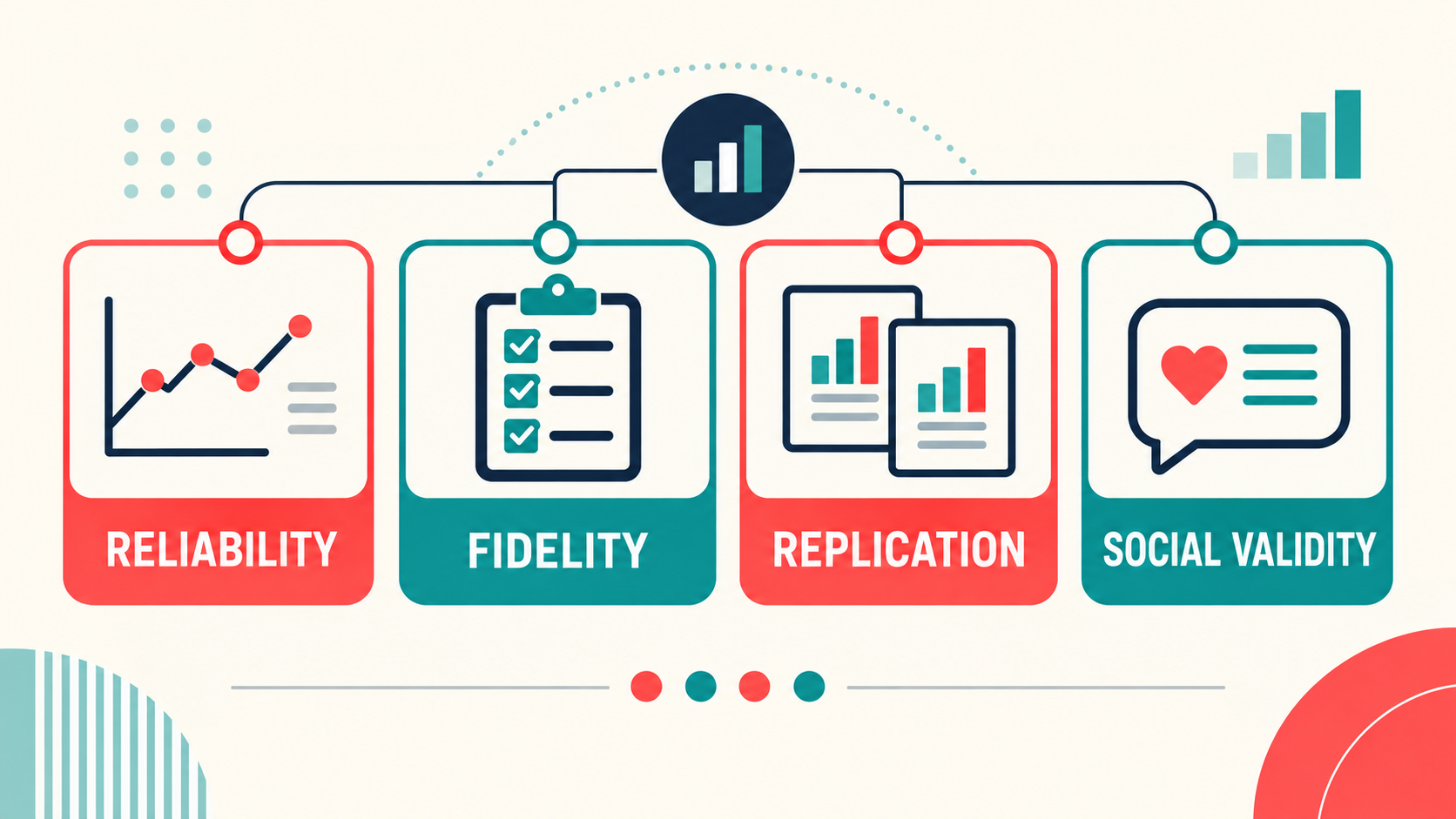
Measurement gives the decision a record; experimental logic gives the record interpretive force. A baseline shows what happened before the intervention, but baseline alone does not prove what will happen next. A design with repeated opportunities to compare conditions can make the intervention–behavior relation more convincing when the pattern is clear and alternative explanations are addressed.
Replication is one way to ask whether a result is dependable. In a single-case design, replication may involve a repeated change in level or trend after a planned condition change, or a similar effect across tiers, participants, settings, or behaviors when that arrangement is appropriate. The exact design should fit the ethical and clinical question. Do not delay needed support simply to create a visually perfect graph.
Generalization and maintenance extend the question beyond the original demonstration. A learner may improve with one therapist but not at home, or improve immediately but not after the plan is faded. Those are not minor details. A rigorous review asks whether the outcome lasts, transfers to important people and places, and remains safe and functional.
The final check is social significance. A statistically or visually impressive change can still be a poor clinical outcome if it does not improve participation, communication, independence, comfort, or another agreed-upon goal. Ask the learner, caregivers, and relevant team members what improvement looks like, and document limitations rather than overselling a result.
How Should a BCBA Read an Evidence-Based Claim?
“Evidence-based” is a starting point, not a complete answer. When reading a study, training resource, or marketing claim, use a short screening sequence:
- What is the actual claim? Separate “this procedure was studied under these conditions” from “this will work for everyone.”
- Who and what were studied? Check the learner characteristics, target behavior, setting, implementer, and outcome measure.
- How was change demonstrated? Look for a design and data pattern that support the conclusion, not only a before-and-after statement.
- Was implementation checked? A study cannot tell you much about an intervention that was delivered inconsistently or incompletely.
- Does it fit this client? Consider preferences, communication, culture, risk, feasibility, and the goals identified with the people receiving services.
Professional resources can help with terminology and research literacy, while the current BACB Test Content Outline and current BACB guidance remain the source of truth for certification-related requirements. A study article or mock question should not be treated as an official BACB policy document.
What Mistakes Weaken Scientific Rigor?
These errors appear in study questions and in real-world reasoning:
- Confusing data with evidence: A graph is an important record, but its meaning depends on the definition, measurement system, design, and context.
- Using a vague target: “Noncompliance” or “attention seeking” may be shorthand, not an operational definition. Describe observable behavior and the relevant conditions.
- Ignoring treatment fidelity: If staff skipped key steps, the result does not cleanly test the planned intervention.
- Overclaiming causation: Improvement after treatment is not automatically proof that treatment caused the change.
- Confusing reliability with validity: Observers may agree on a measure that does not represent the intended target.
- Stopping at the first improvement: Check maintenance, generalization, social validity, and any unwanted effects before declaring success.
How Can You Study Scientific Rigor for the BCBA Exam?
For an exam scenario, start with the question the stem is asking rather than the most familiar vocabulary word. Use this sequence:
- Underline the target behavior and decide whether it is observable and measurable.
- Identify the measurement system and ask whether it can capture the claimed change.
- Look for the design feature or data pattern that supports experimental control.
- Check whether the intervention was implemented with fidelity.
- Separate reliability, validity, replication, maintenance, generalization, and social validity questions.
- Choose the answer that matches the evidence actually described, not a stronger conclusion you wish the data supported.
Remember the distinction between “the data are consistent” and “the intervention caused the change.” Also remember that a technically correct answer should still respect the client’s goals, safety, dignity, and context. For additional practice, the free BCBA mock exam can be used as study practice; it is not official BACB content and cannot guarantee a passing result.
Frequently Asked Questions
What does scientific rigor mean in ABA?: It means making the path from question to decision transparent: define the behavior, measure it consistently, test the intervention relation, verify implementation, examine replication and generalization, and evaluate whether the outcome is meaningful and safe.
Is scientific rigor the same as evidence-based practice?: They are related but not identical. Scientific rigor concerns the quality and transparency of the measurement, design, implementation, and interpretation. Evidence-based practice also requires integrating the best available evidence with professional expertise and the client’s values, context, and goals.
Why is treatment fidelity important?: Treatment fidelity shows whether the intervention was delivered as planned. Without it, a lack of improvement may reflect incomplete implementation, and an apparent improvement may be difficult to attribute to the planned intervention.
Does replication mean repeating the exact same study?: Not always. In applied single-case work, replication can be demonstrated through a planned repeated effect within a design or across relevant people, settings, behaviors, or conditions. The form of replication should fit the question and ethical context.
Can a reliable measure still be invalid?: Yes. A measure can be consistent without representing the intended behavior or outcome. Reliability supports confidence in the recording process, while validity asks whether the measure and conclusion answer the question that matters.
Sources for Further Study
- BACB Test Content Outlines — current examination-content resources.
- BACB: About Behavior Analysis — official behavior-analysis overview.
- What Is Evidence-Based Behavior Analysis? — peer-reviewed discussion of evidence-based behavior analysis.
- ASAT Autism Glossary: Applied Behavior Analysis — terminology reference.
- Some Current Dimensions of Applied Behavior Analysis — foundational applied behavior-analysis article.
For targeted review, use our scientific rigor aba practice questions to apply the concept in exam-style scenarios.
Take the Free BCBA Mock Exam
If you want a low-pressure way to check your recall, use the free practice resource below. Take the Free BCBA Mock Exam



