

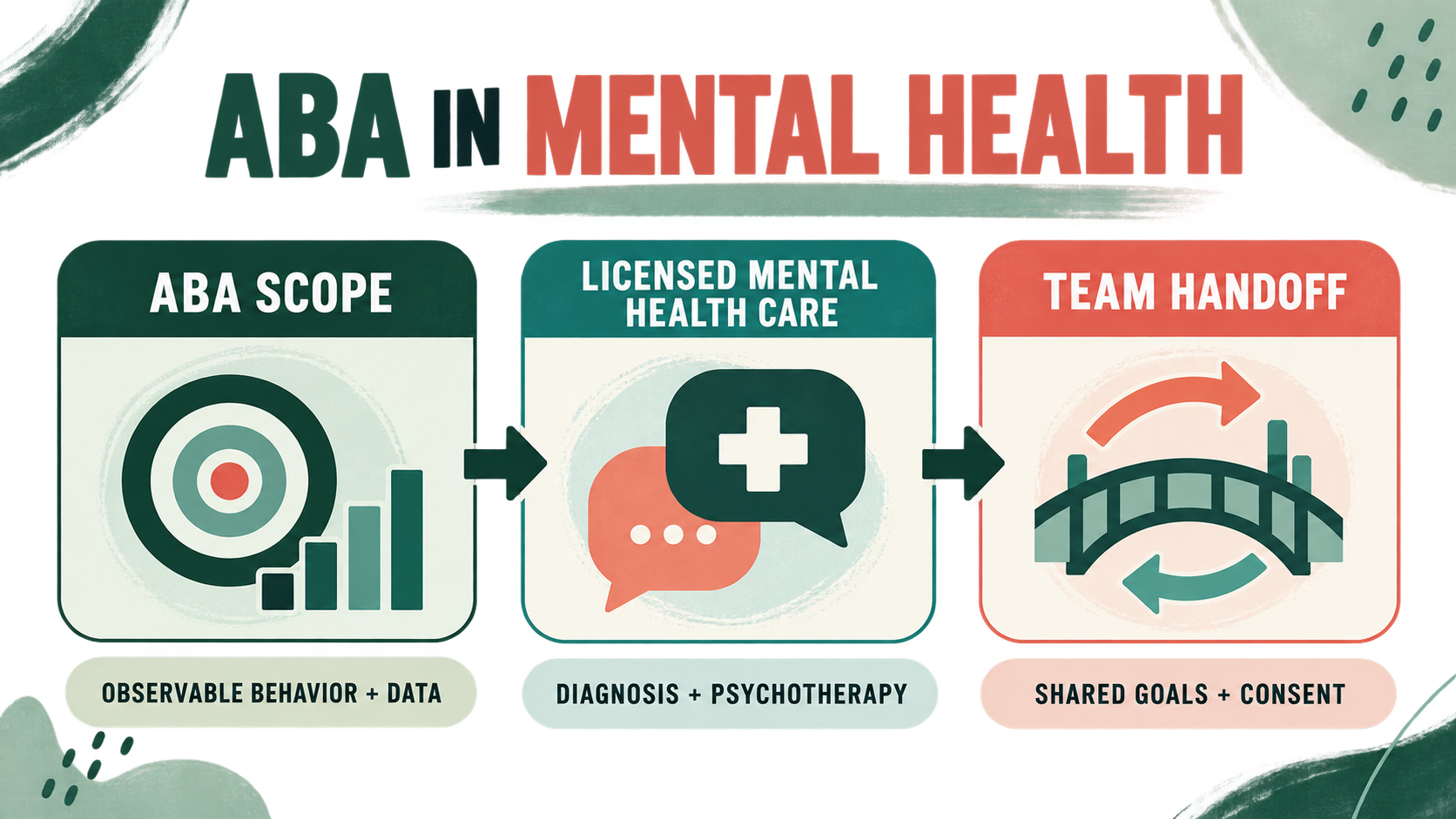
ABA in mental health is best understood as the application of behavior-analytic assessment and behavior-change principles to meaningful actions, routines, skills, and environments that affect a person’s quality of life. It is not a shortcut for diagnosing a mental health condition, and an ABA professional should not present behavior support as a replacement for licensed psychotherapy, psychiatric care, or crisis services.
Table of Contents
- What ABA in Mental Health Means
- What a Behavior Analyst May Contribute
- Where the Scope Boundary Matters
- Examples of Settings and Behavioral Targets
- Assessment, Measurement, and Risk
- Collaboration and Person-Centered Practice
- How BCBA Questions Test the Topic
- Common Mistakes
- FAQ
- Quick Review Checklist
- Take the Free BCBA Mock Exam
That distinction matters for practice and for the BCBA exam. A strong answer identifies an observable target, uses data to understand the behavior and its context, respects the client’s preferences and consent, and collaborates with the qualified professionals whose scope includes diagnosis or psychotherapy. This guide explains what behavior analysts may contribute, where the boundary sits, and how to recognize the best decision in a scenario question. It is educational information, not a clinical treatment recommendation. Table of Contents
What ABA in Mental Health Means
Behavior analysis focuses on the relationship among behavior, the environment, and meaningful outcomes. In a mental health setting, that lens may be used to examine observable routines such as attending an appointment, using a coping response, communicating a need, following a sleep routine, taking part in a preferred activity, or asking for help. The target is the behavior and its context, not an assumption about what a person’s diagnosis means.
The BACB overview of clinical behavior analysis describes clinical BA as an area that can address socially significant behavior in health-related contexts. The page does not turn every mental health concern into an ABA case. Instead, it reinforces the need to work within competence, identify behavior-analytic targets, and coordinate with other providers when the client’s needs extend beyond that scope.
For example, “depression” is not an operational definition. A team might instead assess missed meals, reduced participation in chosen routines, difficulty initiating a task, or a pattern of leaving an appointment before receiving information. Those behaviors still require careful context: a person may be communicating pain, experiencing a medication side effect, responding to trauma, or making a valid choice to decline an activity. The behavior-analytic question is not “How do we make the person comply?” It is “What is happening, what outcome matters to the person, and what support is appropriate?”
What a Behavior Analyst May Contribute
A behavior analyst’s contribution should be concrete enough to assess and modest enough to remain within competence. The following examples describe behavior-analytic tasks, not a universal service package. Before selecting one, the professional should review the referral question, obtain the relevant consent, and confirm that the target is appropriate for behavior analysis.
| Behavior-analytic task | What it can look like | Boundary to check |
|---|---|---|
| Behavioral assessment | Define the response, review antecedents and consequences, and identify patterns across people, places, and routines. | Do not present a functional assessment as a psychiatric diagnosis or assume one cause from a label. |
| Skill building | Teach requesting, self-monitoring, routine initiation, coping choices, problem solving, or help-seeking when those targets are selected by the client and team. | Use an accessible response form; do not make speech, eye contact, or compliance the goal without a justified reason. |
| Environmental support | Adjust prompts, schedules, task demands, reinforcement, or access to preferred activities so the desired response is easier and more useful. | A change should be based on assessment and reviewed for effectiveness, acceptability, and unintended effects. |
| Data review | Graph level, trend, variability, prompt dependence, and generalization to decide whether a plan should continue or change. | Data do not replace clinical judgment from a qualified mental health professional or the client’s own report. |
| Team coordination | Share operational definitions, progress data, and agreed support procedures with consent and appropriate privacy protections. | Clarify who is responsible for diagnosis, psychotherapy, medication, crisis response, and other regulated services. |
Where the Scope Boundary Matters
Scope varies by jurisdiction, organization, credential, referral, and competence. The Association for Behavior Analysis International best-practice resources can support professional reasoning, but they do not replace current local rules or supervision.
| Question | Behavior-analytic focus | When to involve another provider |
|---|---|---|
| What is being changed? | An observable response, routine, environmental arrangement, or skill deficit that has been defined and measured. | When the referral asks for diagnosis, psychotherapy, medication management, or another service outside the BCBA’s role. |
| What evidence is needed? | Direct or reliable measurement, contextual information, the client’s report, and data about intervention effects. | When symptoms, medication effects, trauma, medical issues, or safety concerns require specialized assessment. |
| What is the outcome? | More access, communication, participation, self-management, safety, or another person-approved improvement. | When the desired outcome is a clinical mental health treatment that the BCBA is not credentialed or trained to provide. |
“Refer out” does not mean abandoning the client. It may mean coordinating a shared plan, asking for a medical review, consulting a supervisor, or following an emergency or crisis protocol when danger is immediate.
Examples of Settings and Behavioral Targets
ABA in mental health may arise in outpatient programs, residential services, community supports, hospitals, or integrated care teams. The setting does not determine the intervention; the target still must be meaningful, observable, feasible, and assessment-based.
- Community support: use a chosen coping routine, request a change in support, attend a planned appointment, or communicate a safety concern.
- Residential services: start a preferred daily routine, use a visual or digital schedule, complete a self-monitoring check, or ask for help before a task becomes unsafe.
- Work or education: prepare materials, request clarification, take an agreed break, return to a task, or communicate an accommodation need.
- Health routines: record a symptom or question, follow an agreed appointment preparation sequence, or use a communication response when a procedure is uncomfortable.
Assessment, Measurement, and Risk
Start by translating the referral into an observable question. Define the response in terms an independent observer could recognize. Record relevant antecedents, consequences, setting events, prompts, and the person’s report. Depending on the target, measurement may include frequency, rate, duration, latency, percentage of opportunities, task-analysis steps, or a rating scale paired with a clearly described response.
For example, “uses a coping skill” is too broad unless the team specifies what counts as the skill. A measurable definition might be “selects one of the person-approved regulation options and uses it for at least two minutes after a recorded early warning signal,” but even that definition must be individualized. The person may prefer movement, quiet, text communication, sensory equipment, contact with a support person, or a different option entirely.
Review data at the level of the individual and the context. A lower rate of an observable response is not automatically a better outcome. If the response is help-seeking, fewer requests might mean the person has better access to support—or that the person has stopped asking because requests are ignored. If participation rises only when a particular staff member is present, examine generalization and whether the support arrangement is sustainable.
Risk assessment deserves separate attention. Do not use a restrictive procedure simply because a graph is inconvenient. Safety procedures must follow applicable law, policy, training, supervision, and ethical requirements. Consult qualified medical or mental health professionals when risk may reflect a medical condition, trauma response, medication issue, suicidal thinking, psychosis, abuse, or another concern beyond the referral.
Collaboration and Person-Centered Practice
Effective collaboration begins with role clarity and consent. The behavior analyst can explain the operational definition, the data pattern, and the proposed behavior-change procedure. A therapist, psychologist, psychiatrist, nurse, physician, or other qualified professional may contribute information about diagnosis, psychotherapy, medication, medical status, or crisis planning. The client should know what information is being shared and why, subject to applicable privacy rules.
Person-centered care is more than asking for agreement after a plan is written. Invite the person to select priorities, choose communication methods, identify acceptable prompts, describe what feels aversive, and define what success would look like. If a caregiver or payer requests a target that conflicts with the person’s preferences, the BCBA-style answer is not automatic compliance. Clarify the referral, assess social validity, discuss alternatives, and document the decision-making process.
Trauma-informed practice changes interpretation: consider predictability, power, consent, sensory load, past experiences, and the person’s ability to pause or opt out. A plan can teach a replacement response while also changing the environment that makes the original response necessary.
How BCBA Questions Test the Topic
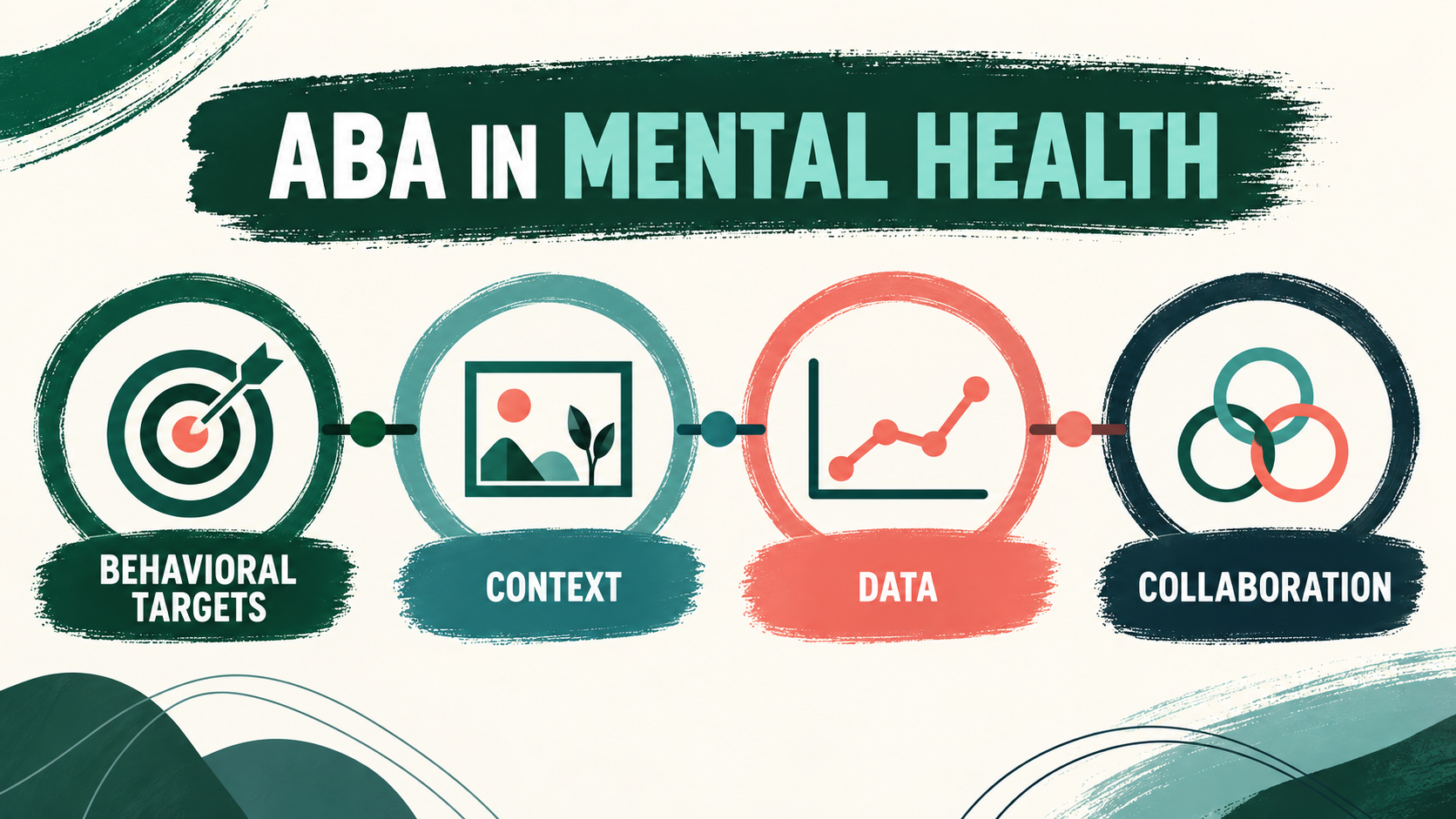
The BCBA Test Content Outline emphasizes assessment, measurable goals, client preferences, data-based decisions, generalization, maintenance, and collaboration. A mental-health scenario may include several plausible answers, but the best answer usually follows the same sequence: define the behavior, check the function and context, respect the client’s preferences, select a fitting measurement, and stay inside the professional boundary.
- If an option promises to treat or cure a diagnosis without describing a behavior-analytic target, treat it as a scope warning.
- If an option ignores the person’s communication system or choice, ask whether it is measuring compliance instead of the intended skill.
- If performance changes only in one clinic, look for a generalization or maintenance assessment before calling the intervention effective.
- If a crisis or medical concern appears, choose the appropriate referral or emergency protocol rather than improvising a standard ABA procedure.
- If several providers are involved, select the answer that clarifies roles, protects privacy, and coordinates around shared goals.
Exam questions often reward the least assumptive answer. Do not infer a function from a diagnostic label, and do not choose a more intensive intervention merely because it sounds decisive. A precise definition, an assessment-based plan, and a respectful referral may be the strongest answer.
Common Mistakes
- Equating ABA with mental health treatment as a whole. ABA can contribute a behavior-analytic lens; it does not automatically include every regulated mental health service.
- Using a diagnosis as the goal. A diagnosis may be relevant context, but the goal still needs an observable, measurable, person-approved response.
- Calling compliance a coping skill. A person should have a meaningful way to communicate distress, decline, ask for help, or request a change.
- Ignoring medical and trauma variables. Sudden behavior change, severe distress, or safety risk may require urgent consultation outside the behavior analyst’s role.
- Sharing data without role clarity. Coordinate deliberately, obtain appropriate consent, and communicate only what the team needs for the agreed purpose.
FAQ
Can ABA be used for mental health concerns?: Behavior analysis may support observable skills, routines, communication, self-management, participation, and environmental changes that relate to a person’s mental health goals. The service must fit the referral, the professional’s competence, applicable rules, and the client’s preferences. It should not be presented as a replacement for diagnosis, psychotherapy, medication management, or emergency care.
What is an example of ABA in a mental health setting?: An example is defining and measuring how a person requests a break during a difficult routine, then teaching a preferred communication response and reviewing whether the break is provided effectively. The team would also consider medical, trauma, environmental, and therapeutic information rather than assuming that the behavior has one cause.
What should a BCBA do when a client needs psychotherapy?: The BCBA should clarify the need, remain within competence, follow the referral and consent process, and coordinate with an appropriately qualified mental health professional. If there is immediate danger, follow emergency or crisis procedures. Collaboration is part of responsible care; it is not a failure of ABA.
How can I study ABA in mental health for the BCBA exam?: Practice separating diagnosis from observable behavior, identifying the function and context, choosing a measurement system, recognizing client preferences, and spotting scope or safety concerns. For additional scenario practice, try the free BCBA mock exam.
ABA in mental health works best when its contribution is specific: behaviorally defined targets, assessment-based support, useful data, and respectful collaboration. Keep the person’s goals and communication at the center, make scope boundaries explicit, and refer when the question requires expertise outside behavior analysis. That reasoning is useful in practice and is exactly the kind of decision logic BCBA questions are designed to test.
Quick Review Checklist
Use this final checklist to turn aba in mental health into exam-ready reasoning. The goal is not to memorize a label in isolation; it is to identify the relevant evidence and explain why the best answer fits the scenario. Key ideas to review:
- State the central definition or decision point for aba in mental health in your own words.
- Identify the detail that makes aba in mental health different from its closest related ABA term.
- Separate the observable facts in a scenario from assumptions that are not supported by the facts.
- Write one example and one nonexample so you can recognize the concept in a new setting.
Exam application checks:
- Ask what the question is actually requesting before comparing the answer choices.
- Mark the antecedent, response, consequence, or other evidence that supports the selected answer.
- Look for a distractor that describes a related process but does not answer the specific question.
Final self-check:
- Explain how you would verify the interpretation with clear observations or data.
- Change one detail in the scenario and decide whether your answer should change.
- Give a one-sentence rationale that a supervisor or study partner could evaluate.
Take the Free BCBA Mock Exam
If you want a low-pressure way to check your recall, use the free practice resource below. Take the Free BCBA Mock Exam



