
Behavior reduction goals in ABA should identify a meaningful target, explain why it matters, and pair reduction with a functional skill the learner can use instead. This guide shows how a BCBA can move from assessment and baseline to a measurable, ethical goal and a data-based review rule.
Table of Contents
- What Should Behavior Reduction Goals ABA Include?
- How Is a Reduction Goal Different From a General ABA Goal?
- How Do You Select a Meaningful Behavior to Reduce?
- What Assessment Information Should Support the Goal?
- What Does Baseline Add to a Behavior-Reduction Goal?
- How Should the Goal Connect to Function?
- Which Replacement Skill Belongs With the Reduction Goal?
- How Do You Turn the Assessment Into a Clear Goal?
- How Should You Measure Progress and Side Effects?
- What Ethical Checks Should Happen Before Approval?
- What Common Mistakes Weaken Behavior Reduction Goals?
- When Should a Behavior-Reduction Goal Be Revised?
- How Is This Tested on the BCBA Exam?
- What Is the Bottom Line?
- Quick Review Checklist
- Take the Free BCBA Mock Exam
When teams choose behavior reduction goals ABA programs should not treat the label “reduction” as the whole plan. A lower rate of a response can look successful on a graph while the learner has fewer ways to communicate, less access to support, or more dependence on prompts. The better question is: what change would improve the learner’s life, and what skill or environmental adjustment will make that change possible?
This topic is narrower than a general article about how to write ABA goals. Broad goal writing explains the anatomy of an observable, measurable objective. A behavior-reduction page must first address target selection: which behavior should change, what assessment information supports that decision, what replacement response will be taught, and how the team will protect dignity, safety, and meaningful choice.
The current BACB ethics resources and official BCBA task list provide professional context, but neither replaces an individualized assessment. The examples below are study guidance, not a universal treatment protocol or a recommendation for a particular learner.
What Should Behavior Reduction Goals ABA Include?
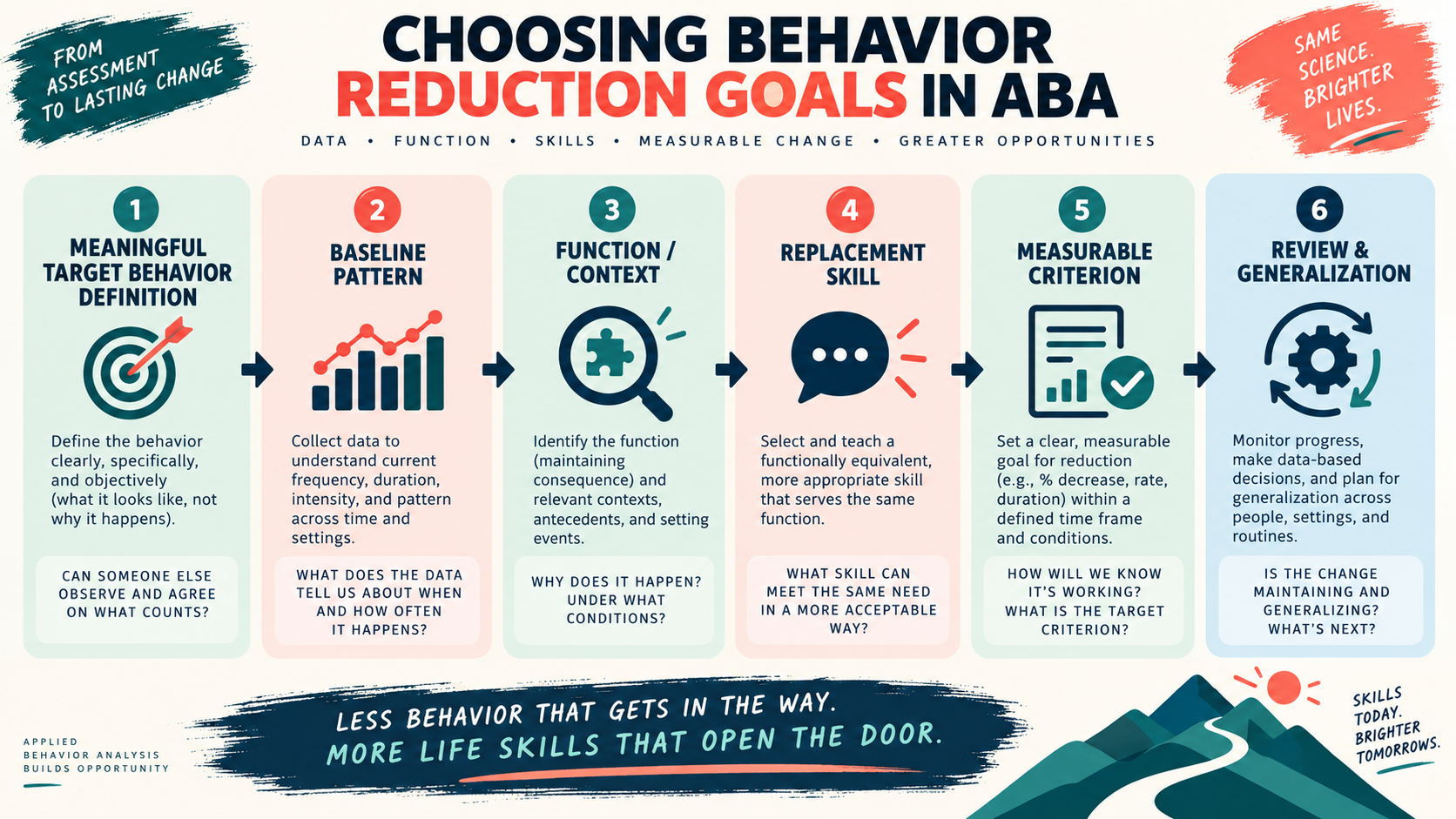
A strong behavior-reduction goal connects six pieces: a clearly defined response, a meaningful reason for change, assessment and baseline information, a functionally relevant replacement skill, a measurable criterion, and a rule for review. If one of those pieces is missing, the goal may be difficult to interpret or may produce an unwanted side effect.
For example, “reduce noncompliance” is not enough. It does not say what the response looks like, when it occurs, what it accomplishes, or what the learner should do instead. A stronger plan might define leaving the instructional area, identify the demands and contexts associated with it, teach a way to request help or a pause, and measure both leaving and functional communication. The exact wording still depends on the assessment.
How Is a Reduction Goal Different From a General ABA Goal?
A general ABA goal may target skill acquisition, maintenance, generalization, communication, independence, or a behavior change that improves participation. A reduction goal specifically identifies a response the team wants to see less often, for less time, with lower intensity, or under fewer conditions. The reduction dimension is only one part of the plan.
How Do You Select a Meaningful Behavior to Reduce?
Start with significance, not convenience. Ask how the behavior affects safety, communication, learning, relationships, access, health, or independence. Include the learner’s preferences and the perspectives of people who know the learner well. A behavior that adults find annoying is not automatically an appropriate reduction target, especially when it is a harmless form of communication, movement, or self-regulation.
Meaningfulness does not mean ignoring risk. If a response creates an immediate danger, safety planning may take priority while the team continues assessment. The target should still be defined objectively and handled with competent, proportionate procedures. Avoid goals that describe appearance, personality, eye contact, “attitude,” or quietness without a clear functional reason.
What Assessment Information Should Support the Goal?
Define the target in observable terms. State what an observer can see or hear, what counts as an occurrence, when the response starts and stops, and what similar behavior is excluded. “Aggression” could mean many things; “hitting another person with an open or closed hand” is more measurable. The final definition should fit the referral question and the context.
Then review antecedents, consequences, setting events, skill requirements, communication access, and patterns across people and settings. Direct observation, interviews, record review, and formal functional assessment may contribute different kinds of evidence. The purpose is not to force a function label onto the behavior. The purpose is to understand what variables may be relevant before choosing a goal or intervention.
What Does Baseline Add to a Behavior-Reduction Goal?
Baseline shows the current pattern before the new plan is evaluated. Depending on the behavior, useful measures may include frequency, rate, duration, latency, intensity, percentage of opportunities, or a defined rating scale. Record the observation period and opportunities so a change can be interpreted fairly. “Three episodes” means something different in a ten-minute observation than in an eight-hour day.
How Should the Goal Connect to Function?
Function does not mean the target must be tolerated because it serves a purpose. It means the plan should account for the outcome the response produces. If leaving a task reliably postpones difficult work, a useful plan may include teaching an efficient break or help request, adjusting the task, and arranging reinforcement for the replacement response and appropriate participation. If the behavior is related to attention, access, sensory conditions, or pain, the goal and intervention questions will be different.
Which Replacement Skill Belongs With the Reduction Goal?
Pair the reduction target with a response that is easier, safer, socially valid, and functionally equivalent when possible. The replacement skill should help the learner obtain the relevant outcome or meet the same need in an appropriate way. Examples may include requesting help, asking for a pause, using an AAC response, tolerating a short wait, completing a manageable step, or moving to a designated safe area.
The replacement response must be accessible. If the learner can use the problem behavior in two seconds but needs a complicated speech response, a multi-step card, and an adult who is not available, the replacement may not compete. Teach it across relevant situations, reinforce it consistently enough to establish value, and plan how prompts will be faded. A reduction goal without a functional alternative can accidentally remove communication without building independence.
How Do You Turn the Assessment Into a Clear Goal?
Use the goal to specify the behavior, condition, measurement, criterion, and timeframe. The wording should allow two trained observers to identify the response and calculate the outcome similarly. It should also identify what the learner will gain, not just what adults want to stop seeing.
| Goal component | Question to answer | Illustrative direction |
|---|---|---|
| Target definition | What exactly counts, and what does not? | Define leaving the assigned area by observable location and duration rather than “noncompliance.” |
| Meaning and function | Why does changing it matter, and what outcome may maintain it? | Review task difficulty, escape patterns, communication access, safety, and learner priorities. |
| Replacement skill | What should the learner do instead to meet the relevant need? | Teach an efficient request for help or a pause, then practice it in the natural context. |
| Measurement and criterion | How much change counts, under which conditions, and by when? | Specify rate, duration, or percentage across defined opportunities, with a review date and generalization check. |
How Should You Measure Progress and Side Effects?
Measure the reduction target and the replacement or participation skill together. If the target is a behavior that can happen repeatedly, rate or frequency may be useful. If episodes vary in length, duration may answer the question better. If the goal concerns starting a task, latency may be relevant. If the opportunities differ, percentage of opportunities can be more interpretable than a daily count.
- Define the observation unit: record the session length, opportunity count, activity, and setting.
- Track the replacement response: record independent use, prompt level, and whether the response produced the intended outcome.
- Review quality as well as quantity: check distress, prompt dependence, communication loss, and access to meaningful activities.
- Check agreement and fidelity: inconsistent definitions or implementation can make a trend difficult to trust.
What Ethical Checks Should Happen Before Approval?
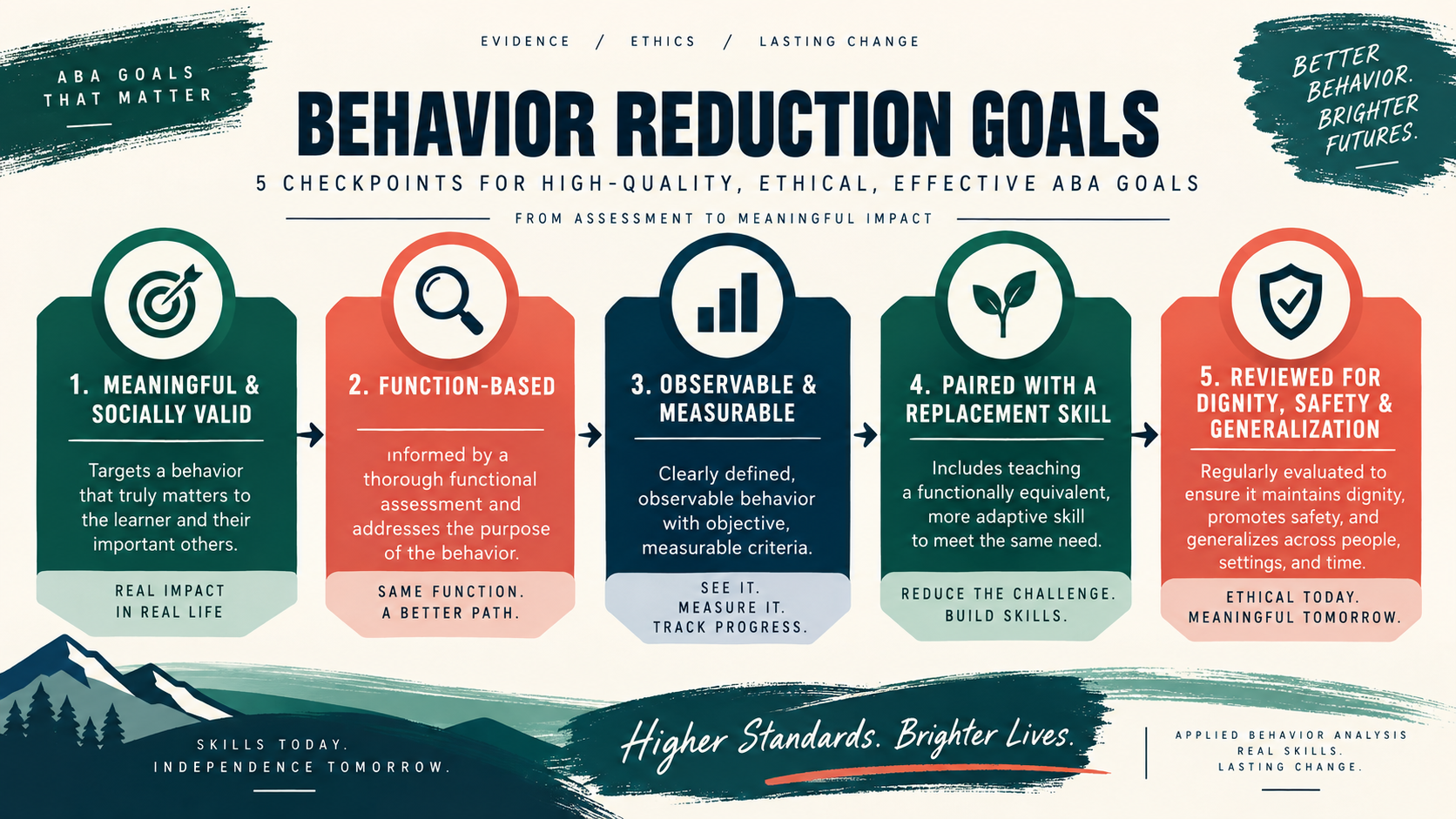
Before approving a reduction goal, ask whether the target is socially meaningful, functionally informed, observable, measurable, and paired with a useful alternative. Consider dignity, assent or consent processes as applicable, safety, privacy, cultural context, and the least intrusive effective approach. The goal should improve the learner’s options rather than make the learner easier for others to control.
Review whether the plan could suppress communication, punish an appropriate refusal, or require a performance that is not necessary for access and participation. A goal should not be justified only by adult convenience. When a safety concern exists, document the concern and seek qualified professional oversight; do not turn a general article into a step-by-step crisis protocol.
What Common Mistakes Weaken Behavior Reduction Goals?
- Using a vague label: “reduce defiance” or “improve attitude” cannot guide reliable measurement.
- Choosing the most visible behavior: the loudest response is not always the most meaningful target.
- Writing only a reduction number: without a replacement skill, the goal may remove behavior without teaching an alternative.
- Skipping function and baseline: the same topography can require different questions in different contexts.
- Equating compliance with improvement: participation should be meaningful, safe, and connected to the learner’s priorities.
- Keeping a goal after the data change: a criterion should be reviewed when the learner, environment, or function changes.
When Should a Behavior-Reduction Goal Be Revised?
Set a review rule before collecting the first progress sample. Revisit the goal when the data show stable improvement, no meaningful change, unexpected deterioration, a new side effect, or a change in setting, skill, communication, health, or preference. Also review whether the original target remains important. A goal should not continue merely because it was written into an earlier plan.
Generalization requires more than a low rate in one treatment session. Check whether the replacement skill occurs with different people, materials, settings, and routines, and whether the learner can use it with less prompting. Maintenance may require periodic opportunities and natural reinforcement. The next target should be selected from current needs rather than from a fixed sequence.
How Is This Tested on the BCBA Exam?
Exam questions may present a target behavior, a baseline graph, and several proposed goals. Look for the answer that begins with an operational definition and assessment information, identifies a socially meaningful outcome, and measures both reduction and replacement skill. Be cautious when an option jumps directly to punishment, extinction, or “compliance” without identifying function, communication, safety, or the learner’s current skills.
Another common distinction is between a behavior-reduction goal and an intervention procedure. A goal states the measurable outcome; an intervention describes what the team will do to support it. Do not confuse a consequence with a replacement skill, or a lower frequency with successful generalization. The strongest answer usually connects assessment, function, teaching, measurement, and ethical review.
What Is the Bottom Line?
Behavior reduction goals in ABA should be specific about the response, meaningful about the reason for change, informed by assessment and baseline, paired with a functional replacement skill, and judged with data that include quality of life and side effects. The goal is not simply less visible behavior. The goal is more effective communication, safer participation, greater independence, or another outcome that matters to the learner.
For a structured study session on assessment, measurement, and intervention selection, try the free BCBA mock exam. Use practice questions to check your reasoning; they are not a substitute for supervision, assessment, or an individualized professional plan.
For targeted review, use our behavior reduction goals ABA practice questions to apply the concept in exam-style scenarios.
Quick Review Checklist
Use this final checklist to turn behavior reduction goals ABA into exam-ready reasoning. The goal is not to memorize a label in isolation; it is to identify the relevant evidence and explain why the best answer fits the scenario. Key ideas to review:
- State the central definition or decision point for behavior reduction goals ABA in your own words.
- Identify the detail that makes behavior reduction goals ABA different from its closest related ABA term.
- Separate the observable facts in a scenario from assumptions that are not supported by the facts.
- Write one example and one nonexample so you can recognize the concept in a new setting.
Exam application checks:
- Ask what the question is actually requesting before comparing the answer choices.
- Mark the antecedent, response, consequence, or other evidence that supports the selected answer.
- Look for a distractor that describes a related process but does not answer the specific question.
Final self-check:
- Explain how you would verify the interpretation with clear observations or data.
- Change one detail in the scenario and decide whether your answer should change.
- Give a one-sentence rationale that a supervisor or study partner could evaluate.
Take the Free BCBA Mock Exam
When you are ready to apply the idea, use the free practice resource below for additional feedback. Take the Free BCBA Mock Exam



