
Quick answer: For a BACB report violation, start with the BACB Ethics Department’s current reporting page and identify the correct path before submitting anything. A report may concern an alleged violation by another BCBA, BCaBA, BCBA-D, applicant, or other person within BACB jurisdiction; it may concern your own conduct, which is a self-report; or it may concern publicly available documentation. Do not submit a Notice of Alleged Violation for yourself, do not report a company as if it were a certificant, and do not send unredacted client information.
Table of Contents
- What Does a BACB Report Violation Mean?
- Which BACB Reporting Path Fits the Situation? Compare the Three Options
- What Should You Check Before Submitting?
- What Evidence Should You Prepare?
- What Happens After a Report Is Filed?
- What Mistakes Can Create Problems?
- What Is the Final Submission Checklist?
- Frequently Asked Questions
What Does a BACB Report Violation Mean?
The phrase “BACB violation” usually refers to a possible violation of an applicable BACB ethics code or related ethics requirement. The BACB Ethics Department receives reports through different routes, including reports about another person, self-reports, and reports based on publicly available documentation. These routes are not interchangeable, even when the underlying concern sounds similar.
For BCBA candidates and certificants, the relevant standard is generally the Ethics Code for Behavior Analysts. RBT matters use the RBT Ethics Code (2.0), and the reporting instructions can differ. The BACB also does not provide legal or ethics advice. A page explaining how to submit a report cannot decide whether the facts prove a violation, whether a state law was broken, or whether a specific person should be reported.
Start by identifying the person, credential, conduct, date range, and authority involved. If the concern is about a state license, Medicaid, a court order, a third-party payer, or an immediate safety issue, another agency may also have jurisdiction. The BACB’s reporting page should be read together with the relevant state and organizational procedures.
If you are studying how ethics, legal duties, and certification boundaries interact, review the site’s BCBA legal-requirements guide and the related mandated-reporting overview as exam-preparation context. Neither page replaces the current BACB form or a state reporting rule.
Which BACB Reporting Path Fits the Situation? Compare the Three Options
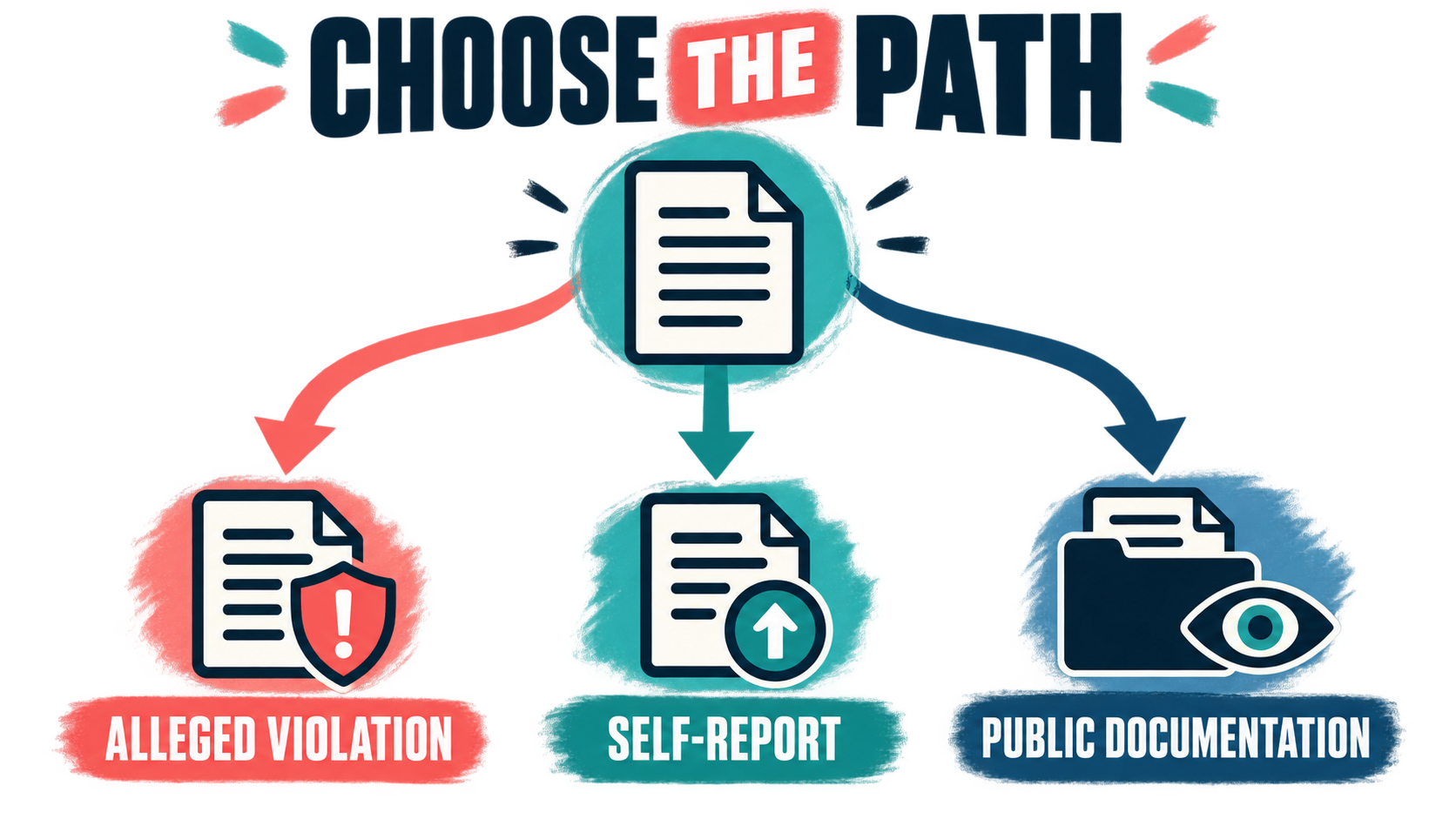
Choosing the correct path is the most important decision before you upload evidence. A Notice of Alleged Violation is generally for an allegation involving someone else. A self-report uses a separate form and statement. A report based on public documentation is designed for information that the public can access without an account, payment, or private invitation.
| Situation | Likely BACB path | Important boundary |
|---|---|---|
| You believe another BACB applicant or certificant violated an ethics requirement. | Report an alleged violation through the BACB Ethics Department. | Use facts and supporting documentation; do not present a conclusion as an established finding. |
| You are concerned that you did not follow an applicable BACB ethics requirement. | Use the self-reporting process and its required statement/form. | Do not complete a Notice of Alleged Violation for yourself. |
| A named person’s possible violation is documented in a public ruling, agency action, website, video, or similar source. | Use the public-documentation reporting route. | The source must be publicly accessible; anonymous reporting means you may not receive updates. |
| The concern is about a company, state license, payer, court, or immediate danger. | Consider the company, licensing, payer, court, emergency, or law-enforcement channel that has authority. | The BACB certifies people, not companies, and may not be the only reporting authority. |
When a situation has several parts, separate them. For example, a practitioner may be a BACB certificant, an employee of a company, and licensed by a state. A BACB report may address the person’s ethics conduct, while a state board handles licensure and an employer handles workplace policy. One submission does not automatically replace the others.
What Should You Check Before Submitting?
Before opening the form, write a short neutral summary. Include what was observed, when it occurred, who was involved, and why it may relate to a BACB requirement. Avoid adjectives that do not add evidence. A reviewer needs a traceable account, not a long argument.
- Identify whether the subject is an applicant, BCBA, BCaBA, BCBA-D, RBT, ACE provider, or someone outside BACB jurisdiction.
- Confirm the conduct is connected to a current BACB ethics requirement or another reportable BACB category.
- Separate direct observations from statements made by another person.
- Write the relevant dates, locations, and sequence of events.
- Check whether you could first resolve the issue through a safe conversation or supervisor channel.
- Consider whether a state licensing or regulatory agency must also be contacted.
- Remove client names, addresses, dates of birth, medical details, and other unnecessary identifying information.
The BACB’s guidance encourages people to consider whether the issue can be addressed directly or through an organization before reporting, when doing so is safe and appropriate. That is not a requirement to confront someone in a situation involving retaliation, danger, power imbalance, or a conflict that makes direct resolution unsuitable. Treat this as a decision point, not a universal instruction.
What Evidence Should You Prepare?
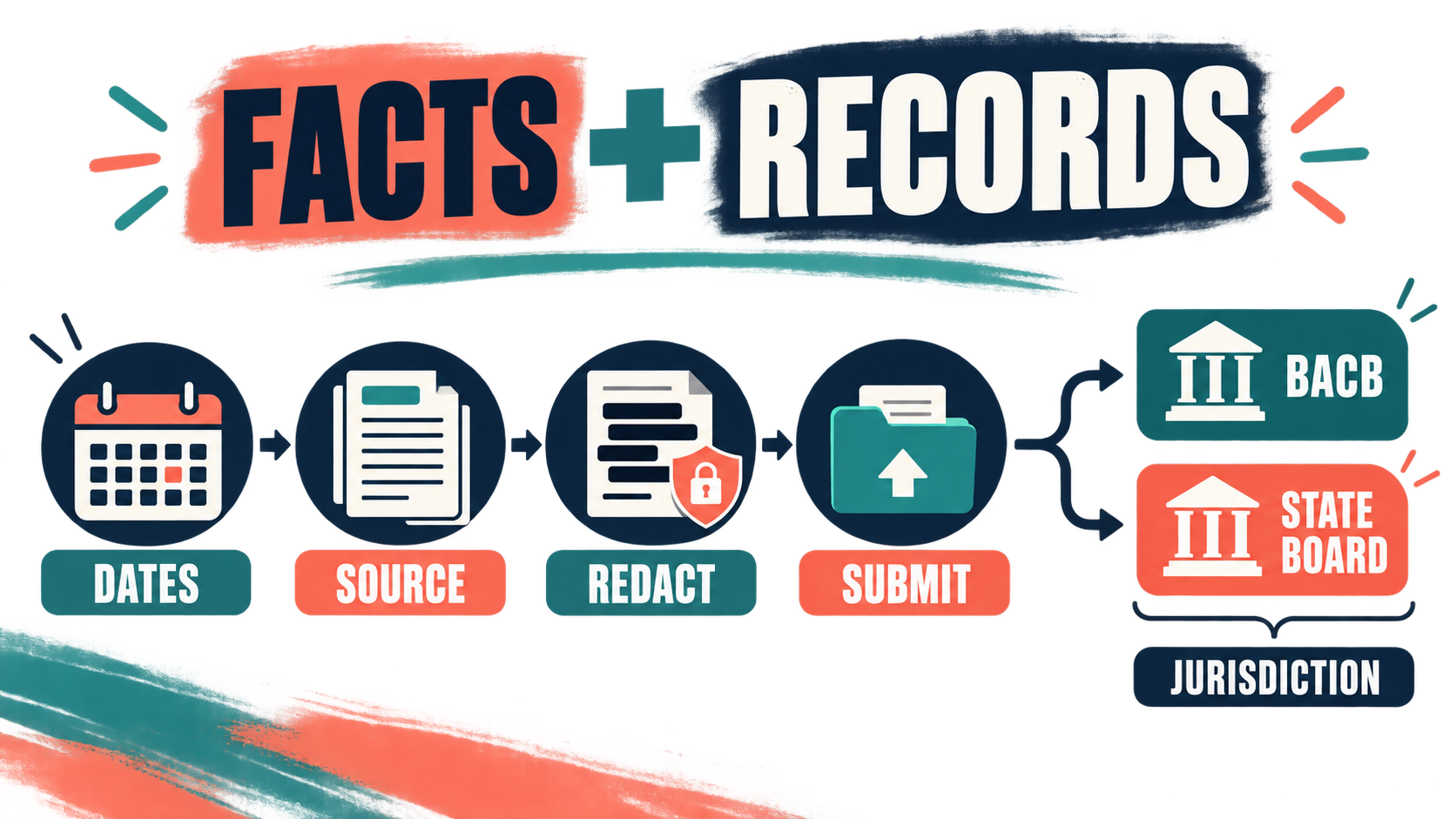
The BACB is not an investigatory body that independently gathers every fact. Its reporting guidance says that the documentation you submit is important to the review. Depending on the concern, useful records may include training or performance feedback, termination letters, court documents, texts or emails, third-party findings, photos or videos, behavioral assessments, intervention documents, or a witness account.
Organize evidence by event rather than uploading a disordered folder. Give each file a short name, date, and description. If a personal statement or witness account is central, the BACB describes an affidavit as one option to formalize that statement. Read the current reporting page for file-type, size, and form-specific instructions before submission.
| Evidence layer | Useful question | Privacy check |
|---|---|---|
| Timeline | What happened first, next, and afterward? | Use dates and roles; remove unrelated identities. |
| Primary record | What document, message, assessment, or recording supports the description? | Redact personally identifiable information that is not necessary. |
| Standard connection | Which current ethics requirement may relate to the facts? | Do not invent a code citation or treat a suspicion as a finding. |
| External authority | Is there a licensing, payer, court, or safety process running in parallel? | Use the receiving agency’s secure submission rules. |
Redaction protects consumers, clients, certificants, and applicants, but it should not make the evidence impossible to understand. Keep a secure original for the authority that is entitled to receive it, and submit only what the BACB form requests. Never post confidential client material publicly to “prove” a report.
What Happens After a Report Is Filed?
The current BACB reporting page explains that the notifier describes the alleged code violation and provides supporting documentation. If the notice is accepted, the notice and supporting materials are shared with the subject, who receives an opportunity to respond and provide documentation. This means a BACB report violation should be written with the expectation that the subject may see the allegation and the evidence submitted.
Public-documentation reports are different: the BACB says that route is anonymous, so the notifier cannot request an update. The BACB may follow up with the subject if the evidence substantiates a violation, and the public can check the Certificant Registry for published sanctions. An anonymous report is not a promise that the BACB will disclose an outcome to the person who submitted it.
The timeline depends on the matter and the Code-Enforcement Procedures. The BACB says it strives to review notices within a reasonable time and keep notifiers and subjects apprised of relevant actions, but a reporting page should not be used to promise a fixed resolution date. Keep your confirmation, case identifier, and any follow-up request in a secure folder.
What Mistakes Can Create Problems?
- Using a Notice for self-reporting: The BACB directs people to use the self-report process for their own conduct.
- Reporting a company instead of a person: The BACB certifies individuals and may not have jurisdiction over an organization as such.
- Ignoring state licensure: In a licensed state, a state board may need to receive the complaint or make the first determination.
- Uploading unredacted records: Unnecessary client or consumer information can create a second privacy problem.
- Writing a conclusion instead of a timeline: “They are unethical” is less useful than dated facts and supporting documents.
- Using an old code: Confirm the current ethics code and reporting instructions instead of copying a historical document.
- Expecting the BACB to provide legal advice: Legal questions should go to a licensed attorney or the appropriate regulator.
What Is the Final Submission Checklist?
Use this checklist before submitting any BACB report. If there is immediate danger or a mandatory-reporting obligation, follow the emergency or legal process first.
- Have you chosen alleged violation, self-report, or public-documentation reporting?
- Have you identified the subject’s credential and BACB jurisdiction?
- Have you separated facts, dates, direct observations, and secondhand statements?
- Have you checked the current ethics code or requirement connected to the concern?
- Have you considered a safe organizational or supervisor response?
- Have you checked state licensing, payer, court, or safety reporting duties?
- Have you organized evidence in a readable sequence?
- Have you redacted unnecessary personally identifiable information?
- Have you verified the current BACB form and upload instructions?
- Have you saved the confirmation and any case information securely?
Frequently Asked Questions
Can I report a BACB violation anonymously?: The BACB’s public-documentation reporting route is anonymous, but an anonymous notifier should not expect case updates. Other reporting routes may request contact information and may share the notice and supporting documents with the subject.
Can I report a company to the BACB?: The BACB states that it certifies people, not companies. If the concern is about a certificant who owns or works at a company, the individual’s conduct may be reportable, while company, employment, payer, and licensing issues may belong to other authorities.
What if I believe I violated the Ethics Code?: Use the BACB self-reporting process. The BACB specifically says not to complete a Notice of Alleged Violation for yourself. Read the current self-reporting instructions and prepare the required statement and form.
Does submitting a report prove that a violation occurred?: No. A report communicates a concern for review. The BACB evaluates the information under its procedures, and the subject has an opportunity to respond when the relevant process provides one. Write accurately and avoid presenting an allegation as a final finding.
Take the Free BCBA Mock Exam: For BCBA exam preparation, a free BCBA mock exam can help you practice separating ethics-code concepts, reporting routes, and legal-jurisdiction questions. It is a study resource, not an ethics hotline or legal service. Official Sources Used
- BACB Reporting to the Ethics Department
- BACB Self-Reporting
- Publicly Available Documentation Reporting
- BACB Ethics Codes and Enforcement Procedures



