
ABA tracking sheets turn observations into data that a behavior analyst can interpret, graph, and use for a decision. A useful sheet is not simply a page of boxes. It connects a clearly defined target behavior to the measurement that answers the clinical or educational question. For BCBA candidates, that connection is the part that exam questions test most often.
Table of Contents
- In This Guide
- What Are ABA Tracking Sheets?
- How to Match an ABA Tracking Sheet to the Measurement Question
- Fields That Make an ABA Tracking Sheet Useful
- Operational Definitions and Context: The Quality Check
- How Tracking Data Becomes a Data-Based Decision
- How ABA Tracking Sheets Appear on BCBA Exam Questions
- Common Mistakes With ABA Tracking Sheets
- ABA Tracking Sheets FAQ
- Take the Free BCBA Mock Exam
This guide explains how to choose an ABA tracking sheet, which fields make a record defensible, and how raw entries become a data-based change. It is written for exam preparation and general education. A real client’s form should follow the supervising BCBA’s plan, privacy requirements, payer rules, and setting-specific procedures.
In This Guide
What Are ABA Tracking Sheets?
An ABA tracking sheet is a structured record for collecting behavior or skill data across observations, trials, activities, or sessions. Depending on the target, it may record frequency, duration, latency, rate, percentage, interval outcomes, task-analysis steps, prompt levels, or another defined measure. The sheet can be printed, electronic, or built into a clinical platform; the format matters less than the quality of the measurement system.
The first question is not “Which form looks most professional?” It is “What decision will this information support?” If the team needs to know how often a response occurs, a frequency or rate sheet may fit. If the concern is how long an episode lasts, duration is more appropriate. If the goal is to know how quickly a learner begins after an instruction, latency is the better match. A tracking sheet becomes useful when its fields answer that question consistently.
Good data collection also respects the person being observed. A target should be meaningful, observable, and defined well enough that trained observers can recognize it. The form should avoid turning a judgment such as “was difficult” or “was noncompliant” into a pretend measurement. Record what happened, the context in which it happened, and the agreed measure.
How to Match an ABA Tracking Sheet to the Measurement Question
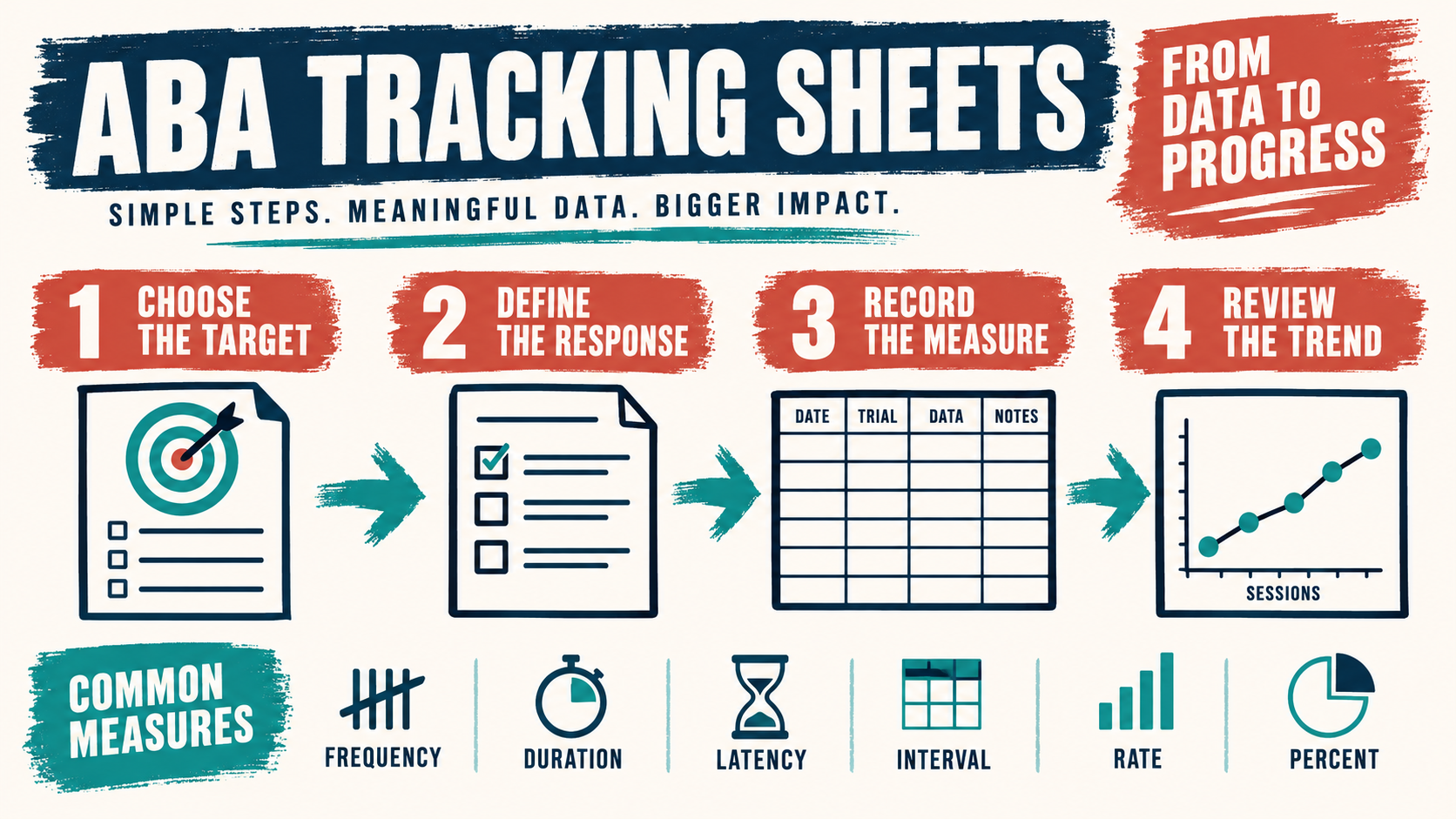
Different measures answer different questions. A common BCBA exam trap is choosing a measure because it is familiar rather than because it matches the behavior and the decision. The table below is a study guide, not a substitute for the measurement plan approved for an actual client.
| Question the team needs answered | Possible measure | What the sheet must capture | Exam reasoning cue |
|---|---|---|---|
| How often did the response occur? | Frequency or event count | A defined observation period and one count per qualifying event | Do not compare counts from unequal observation times without a plan. |
| How long did an episode last? | Duration | Start and stop rules, plus the time unit | A longer episode is not the same variable as more episodes. |
| How quickly did the learner respond? | Latency | The instruction or cue and the operational response onset | Define when timing begins and what counts as a response. |
| What proportion of opportunities were successful? | Percentage or percent correct | The number of opportunities and the scoring rule for each one | A percentage needs a known denominator; do not hide missing trials. |
| When does the behavior occur during the day? | Scatterplot or time-based record | Consistent time blocks, locations, and contextual variables | A pattern suggests a question to test, not a confirmed function. |
For exam preparation, connect this reasoning to the measurement and data-based decision language in the BACB BCBA Test Content Outline. The outline is the authority for the exam’s current content scope; a tracking sheet itself is not automatically an official BACB form.
- Start with the behavior or skill, not with a favorite template.
- Name the unit before recording the first value.
- Keep observation periods and opportunity rules comparable.
- Include only context fields that will affect interpretation or action.
- Decide when the record will be reviewed before collecting a large backlog.
Fields That Make an ABA Tracking Sheet Useful
A strong sheet makes the observer’s task clear before the first observation starts. The exact design will vary, but most useful ABA tracking sheets include the following field groups:
- Identification and date: Include the learner or case identifier used by the organization, the date, observer, setting, and session or observation period. Use the minimum information needed and follow privacy procedures.
- Target definition: State the observable response, the start rule, the stop rule when relevant, and examples or nonexamples if the team needs them. Avoid diagnostic labels as if they were behavior measures.
- Measurement rule: Name the measure, unit, denominator, interval length, or opportunity rule. The observer should not have to guess whether a mark means an occurrence, a trial, a prompt, or a comment.
- Context fields: Record information that the plan says may affect interpretation, such as activity, instruction, location, materials, communication partner, or relevant antecedent and consequence events.
- Response fields: Provide enough room to record the actual observation without forcing the observer to replace data with a vague summary. For skill programs, include prompt level, independence, error type, or correction information when those variables are part of the plan.
- Review field: A brief space for a supervisor or analyst to note the date reviewed, calculation checked, pattern observed, or next step can prevent data from disappearing into a folder.
Not every form needs every field. Excessive fields can reduce completion quality and create information that nobody uses. The best sheet is complete enough for the decision, quick enough for the setting, and stable enough that different observers can use it in the same way.
Operational Definitions and Context: The Quality Check
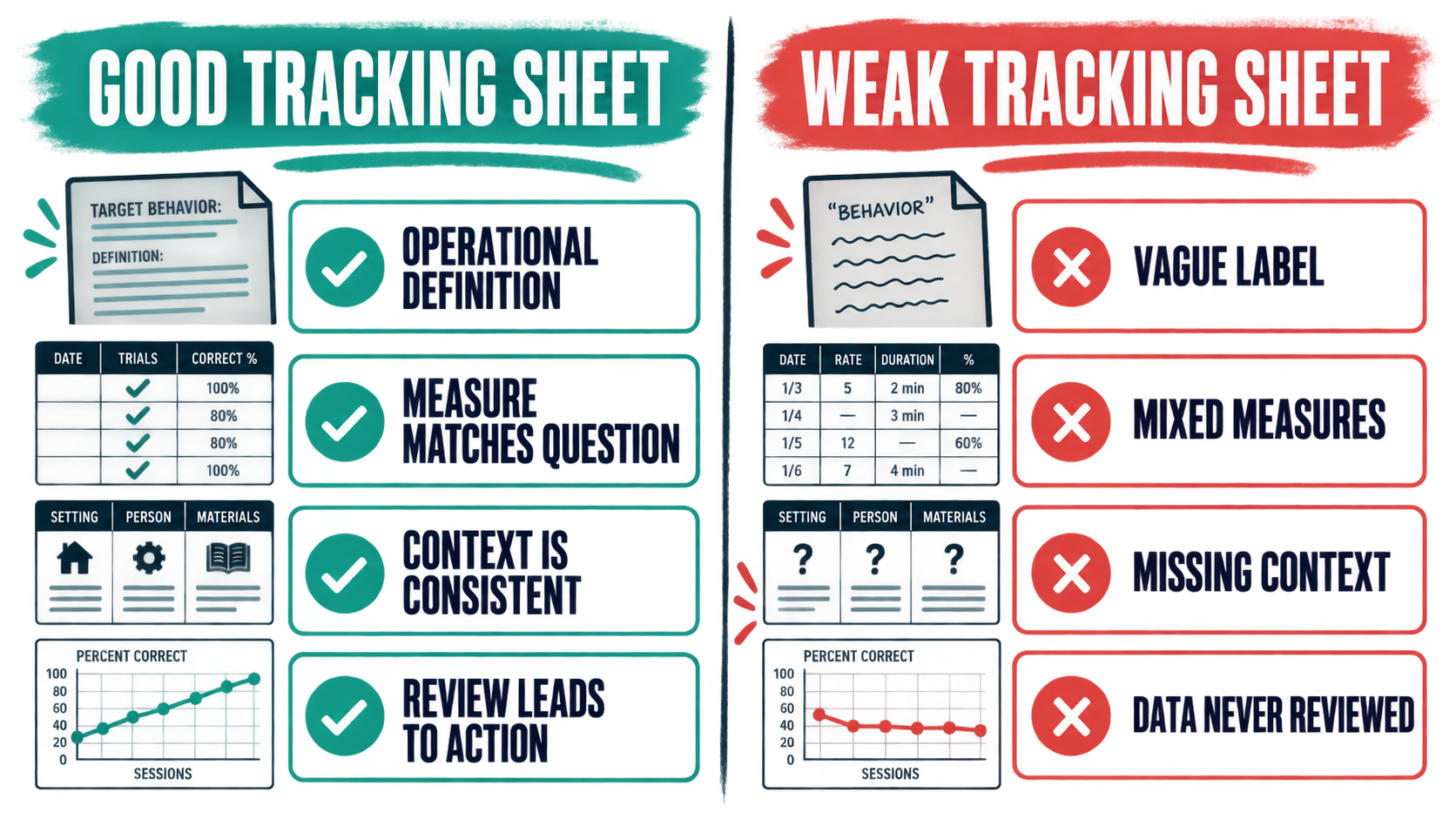
Before using a tracking sheet, test the definition with a few realistic examples. Could two trained observers decide whether the response occurred? Would they agree about the start and stop of an episode? If the answer changes depending on who is holding the clipboard, the sheet is not ready for reliable collection.
| Weak entry | Why it is weak | Stronger tracking approach |
|---|---|---|
| “Bad behavior: 4” | The label and count are not observable enough to reproduce. | Define the response topographically and count qualifying events during a stated period. |
| “Did well: 80%” | The target skill, opportunities, prompts, and scoring rule are missing. | List the target, number of opportunities, response criterion, and prompt or independence code. |
| “More behavior after lunch” | It suggests a pattern but does not show how often, where, or under what conditions. | Use consistent time blocks and record the planned contextual variables before interpreting the pattern. |
Context belongs on the sheet only when it helps answer the question. Adding a long narrative box to every record can create inconsistent data. For an ABC observation, the team may need brief antecedent, behavior, and consequence descriptions. For a skill-acquisition program, the priority may be trials, prompt level, and independent responses. The plan determines the fields.
How Tracking Data Becomes a Data-Based Decision
Data collection is not the endpoint. After the records are checked, the behavior analyst should summarize them in a way that makes a comparison possible. That may mean calculating a rate, percentage, mean duration, or another planned summary, then displaying the values across time. A graph or summary should preserve the important conditions so that a visual change is not mistaken for a treatment effect without context.
Next, compare the current pattern with the decision rule in the plan. If a learner meets the mastery criterion across the required sessions, the team may consider the next planned step. If the target is not improving, the analyst may check implementation fidelity, measurement quality, skill difficulty, reinforcement conditions, generalization, or other variables before changing an intervention. The answer is not automatically “collect more data” or “change the treatment.” It depends on the question and the evidence.
For behavior reduction, a lower number is not always the only meaningful outcome. The team may also track replacement communication, participation, independence, or quality-of-life indicators. A sheet should support socially significant goals and avoid rewarding a lower score if the person loses an important way to communicate or access support.
How ABA Tracking Sheets Appear on BCBA Exam Questions
Exam questions often describe an observer, a target behavior, and a proposed data sheet. Work through the scenario in this order:
- Identify the target: Is it a behavior, skill, episode, opportunity, or environmental event? Do not accept a vague label just because it sounds clinical.
- Find the measurement question: Is the question about count, time, speed, proportion, pattern, or performance across trials?
- Check the unit and denominator: Frequency needs an observation frame. Percentage needs opportunities. Rate needs time. Duration needs start and stop rules.
- Check feasibility: A measure can be technically appropriate but impractical if the observer cannot record it accurately while teaching or supervising.
- Check decision relevance: The measure should help the analyst evaluate the goal, make a data-based decision, or test a clearly stated question.
A common distractor is a form that collects many numbers but does not match the target. Another is a sheet that gives a precise-looking percentage while hiding missing opportunities or changing the observation period. When two answers appear plausible, choose the one that links the operational definition, measurement system, and decision rule most clearly.
Common Mistakes With ABA Tracking Sheets
- Using “behavior” as the definition: A category or diagnosis is not an operational definition.
- Changing the measure midway: A raw count from a 20-minute observation cannot be casually compared with a count from a 60-minute observation.
- Recording interpretation instead of observation: “Wanted attention” is a hypothesis; record the observable events and analyze function cautiously.
- Leaving prompts out of skill data: An independent response and a prompted response should not be treated as identical when independence is the goal.
- Collecting data nobody reviews: A form is part of a decision system. Set a review routine and document what the data changed or confirmed.
- Copying a public template without checking it: A downloadable form may be useful, but it still needs to match the approved definition, plan, privacy requirements, and setting.
ABA Tracking Sheets FAQ
What is the best ABA tracking sheet?: There is no single best sheet for every target. Choose the simplest form that measures the behavior or skill in a way that answers the team’s question and supports the planned decision.
Can an ABA tracking sheet be used for BCBA fieldwork?: It may support observation, data collection, or documentation when it is part of an approved activity and follows the supervisor’s direction. A generic form does not automatically make an activity unrestricted fieldwork or replace required BACB documentation.
Should ABA tracking sheets include ABC data?: They should include ABC fields when the purpose is to document antecedent, observable behavior, and consequence events for a functional assessment or related question. They do not need ABC narrative boxes when the goal is a different measure, such as trial-by-trial skill acquisition.
How do I know whether tracking data are reliable?: Start with a clear operational definition and consistent procedures. When the plan calls for it, train observers, conduct interobserver agreement checks, review missing or unusual entries, and compare the record with the decision rule. Reliability is a property of the measurement process, not the appearance of the form.
Once you can connect the target, definition, measurement, context, and decision rule, ABA tracking sheets become much easier to analyze—and BCBA exam questions become easier to reason through. For more practice applying measurement choices to realistic scenarios, try the free BCBA mock exam.
Take the Free BCBA Mock Exam
If you want a low-pressure way to check your recall, use the free practice resource below. Take the Free BCBA Mock Exam



