

Short answer: An education intervention is a planned, targeted set of teaching or environmental actions designed to improve a defined learning outcome, with progress measured and the plan adjusted from data. In an ABA or BCBA context, it may teach an academic, communication, adaptive, social, or classroom-participation skill. It is more specific than “help the student learn”: it states the target, teaching conditions, support level, measurement system, and decision rule.
Table of Contents
- What is an education intervention?
- How is an intervention different from curriculum or accommodation?
- How do you build an education intervention?
- What is an ABA education intervention example?
- How do evidence and fidelity matter?
- How does the BCBA exam test this concept?
- What are common education-intervention mistakes?
- Education intervention FAQ
- Take the Free BCBA Mock Exam
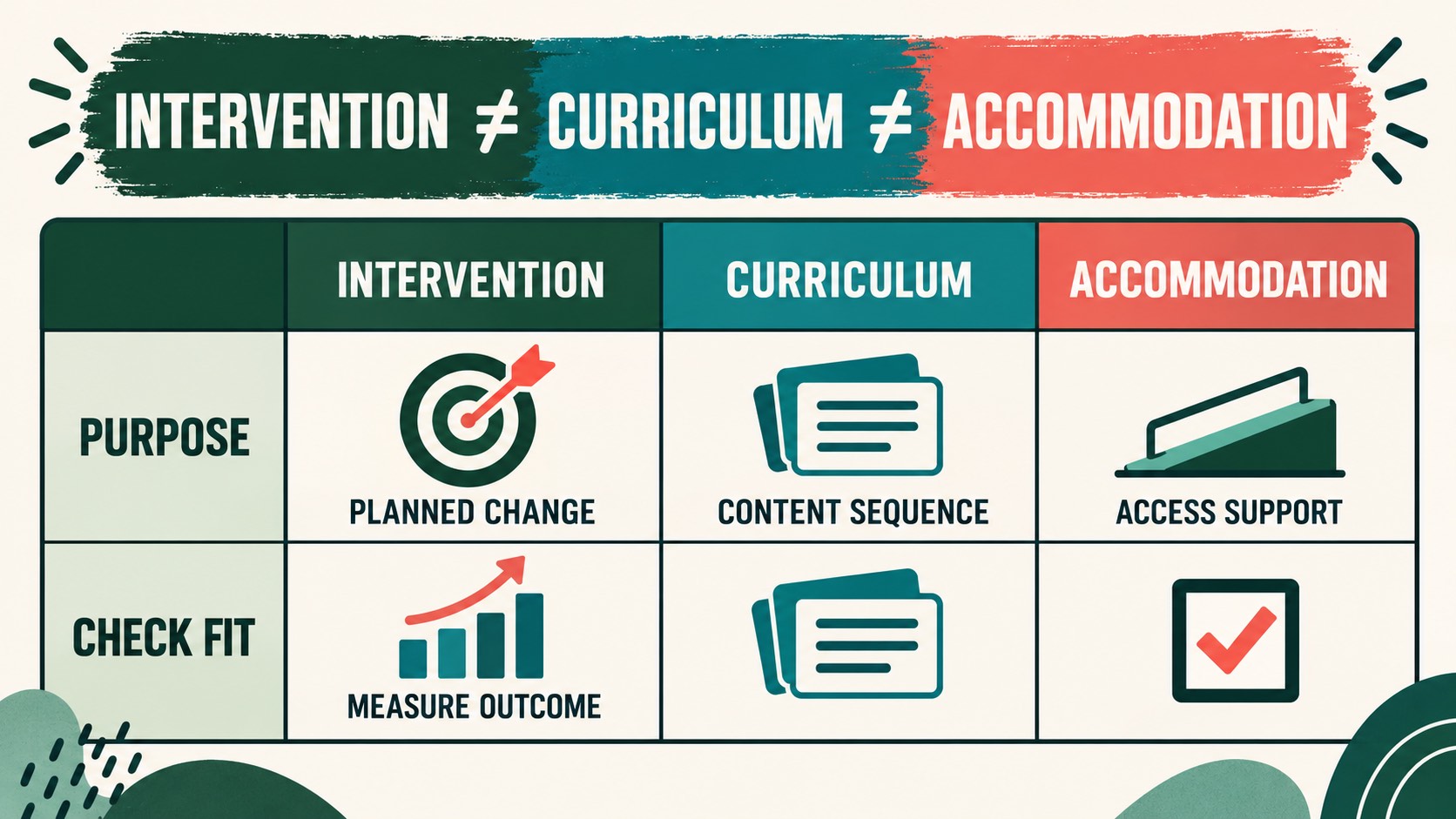
When someone asks, “what is education intervention?” they may be using a broad school or special-education term rather than a single named ABA procedure. A curriculum describes content and sequence; an accommodation changes access; an intervention is a deliberate change intended to improve a measurable outcome. These categories can work together, but they should not be treated as synonyms.
This article uses education intervention as a concept for BCBA study and educational decision-making. The current BACB overview of behavior analysis in education describes behavior analysis as a scientific approach to analyzing teaching and learning interactions. Follow the current BACB Test Content Outline, school requirements, consent or assent processes, and qualified supervision. This is educational study support, not an individualized IEP, treatment, or placement recommendation. Table of Contents
What is an education intervention?
An education intervention is an intentional, organized approach used to change a learning-related outcome. It may be delivered to one learner, a small group, a classroom, or a larger school system. The defining feature is not the setting or the label. The defining feature is a planned relationship between what educators do, what the learner does, and what outcome is measured. A useful definition has five parts:
- Target: an observable skill or outcome, such as reading a word, requesting help, completing a transition, or participating in a group.
- Instructional arrangement: the materials, prompts, models, practice opportunities, feedback, and consequences that make the response more likely.
- Context: the people, setting, schedule, cultural and communication variables, resources, and constraints that affect implementation.
- Measurement: a defined way to record accuracy, independence, fluency, duration, latency, participation, or another relevant dimension.
- Decision rule: a plan for continuing, fading, adapting, intensifying, or reassessing the intervention when the data show a particular pattern.
For example, “use extra practice” is too vague to be a complete education intervention. “Present five functional sight words, provide a model only after a five-second opportunity, record independent correct responses, and review the percentage across three sessions” is much closer to an intervention description. It still needs to fit the learner, the educational goal, the communication system, and the team’s professional responsibilities.
In ABA, intervention does not mean that every learner receives the same program. A BCBA may use prompting, shaping, task analysis, differential reinforcement, naturalistic teaching, stimulus fading, or another procedure when assessment and the learning goal support it. The procedure is one component. The intervention is the functionally and educationally coherent package, including measurement and revision.
How is an intervention different from curriculum or accommodation?
These terms overlap in school conversations, but they answer different questions. A curriculum answers “what content or sequence is being taught?” An accommodation answers “what access change allows the learner to participate or demonstrate knowledge?” An intervention answers “what planned change is being implemented and evaluated to improve a defined outcome?”
| Term | Primary purpose | BCBA exam distinction |
|---|---|---|
| Education intervention | Produce a planned, measurable change in a learning or participation outcome. | Look for a defined target, teaching arrangement, data, fidelity, contextual fit, and decision rule. |
| Curriculum | Organize content, skills, sequence, and learning experiences. | A curriculum can contain interventions, but the curriculum label alone does not identify the measured behavior-change procedure. |
| Accommodation | Change access, response format, timing, or presentation without necessarily changing the learning standard. | An accommodation may support participation, but it is not automatically a teaching intervention. |
| Universal instruction | Provide the ordinary teaching arrangement available to a broad group of learners. | A targeted intervention is usually an additional or adapted support selected for a defined need, not merely regular instruction. |
The categories can combine. A learner may receive the grade-level curriculum, an extended-time accommodation, and a function-based education intervention for independent help-seeking. The team should document which component is expected to change which outcome rather than calling the whole package “intervention” without a measurement plan.
How do you build an education intervention?
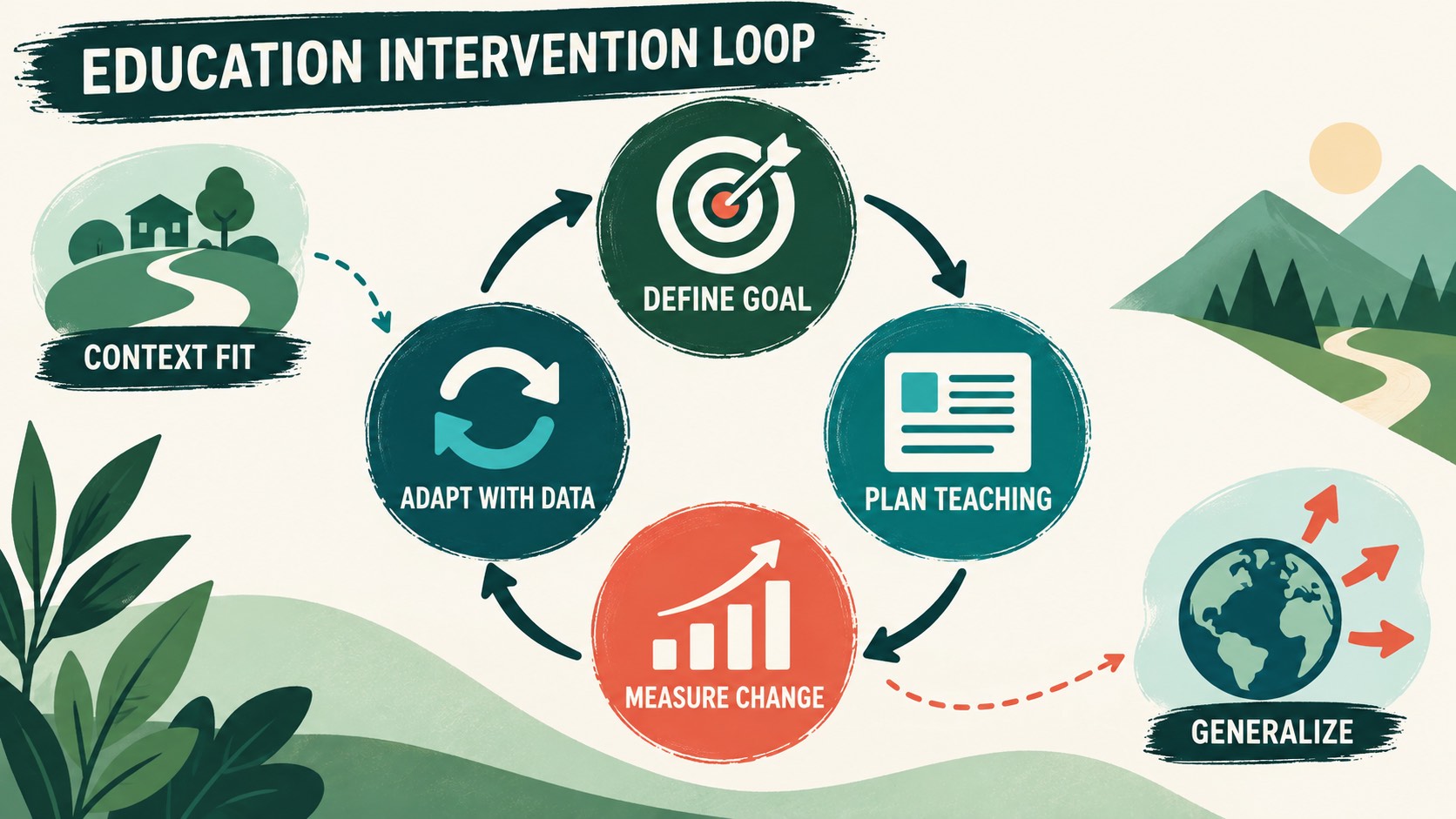
Build the plan as a loop: define the goal, arrange instruction, measure the response, review fit, and adapt. A strong plan is specific enough that trained implementers can follow it and flexible enough to respond to data and learner preferences.
Start with the educational question. Is the learner not acquiring a skill, not performing it fluently, not generalizing it, or not accessing the lesson because of a communication or environmental barrier? Different questions call for different interventions. A fluency problem may require practice and reinforcement; a generalization problem may require varied exemplars and settings; an access problem may require an accommodation or communication support before more teaching is added.
Then define the response and the opportunity. “Improve math” is not an operational target. “Solve single-digit addition problems with 80% independent accuracy across two worksheets” is more measurable, although the team should still confirm that the goal is meaningful and appropriate. For a behavior-analytic plan, describe what counts as an opportunity, what prompt level is allowed, how errors are handled, and which consequence follows the response.
| Planning step | Decision question | Evidence to retain |
|---|---|---|
| Define the outcome | What observable response or participation change matters? | Operational definition, baseline, context, and social-validity information. |
| Select the teaching arrangement | What antecedent, prompt, model, practice opportunity, or consequence is relevant? | Written steps, materials, roles, prompt hierarchy, and reinforcement plan. |
| Monitor implementation | Was the intervention delivered as designed and accessibly? | Treatment-integrity checks, implementer feedback, learner assent or refusal signals, and context notes. |
| Review and adapt | What does the data say about acquisition, maintenance, fluency, and generalization? | Graph or summary, decision rule, change log, and plan for fading or transfer. |
Contextual fit matters throughout the loop. Consider language, culture, sensory and communication access, preferences, family and teacher resources, schedule, safety, and the response effort required. A technically clear plan can still be a poor education intervention if it is too difficult to implement, restricts communication, or measures a behavior that does not matter to the learner.
What is an ABA education intervention example?
Imagine a student who rarely begins a multi-step independent-work task. The educational goal is not simply “increase compliance.” The team defines task initiation as starting the first step within a specified interval after the instruction and materials are available. Baseline data show that initiation is more likely when the task is short, the first step is clear, and the student can request help.
A possible educational intervention package might include a visual first-then cue, a brief task analysis, a choice between two equivalent starting tasks, a taught help request, prompting with a planned fade, and reinforcement for independent initiation and communication. The team records opportunities, independent starts, prompted starts, help requests, completion, and any relevant contextual variable. If the student starts more often only when the adult points to the first step, the data suggest that prompt fading and stimulus-control transfer still need attention. Notice the boundaries:
- The visual cue is a component, not the whole definition of the intervention.
- The task analysis describes the skill sequence, while the intervention specifies how instruction and reinforcement are arranged.
- The help request is a replacement communication response, not a reason to remove all learning demands.
- The graph does not prove effectiveness unless implementation and measurement are credible.
- The team should plan transfer to other subjects, adults, settings, and naturally occurring work.
This example is a study illustration, not a prescription for a real learner. In practice, a qualified team would assess the situation, coordinate with educators and caregivers, protect access and dignity, and revise the plan when the data or learner’s preferences change.
How do evidence and fidelity matter?
Calling a program “educational” or “evidence-based” does not establish that it will work for every learner or context. The U.S. Department of Education describes evidence-based intervention decisions in terms of research quality and ongoing examination of effects. The What Works Clearinghouse also distinguishes reviewing evidence from endorsing a program and notes that population, cost, feasibility, and context matter. For BCBA reasoning, separate three questions:
- Evidence: What research or professional source supports the procedure, target, and population?
- Fit: Does the plan align with the learner’s communication, preferences, culture, environment, and available implementer skill?
- Effect: Did the defined outcome change under credible measurement and adequate implementation fidelity?
A weak outcome does not always prove that the teaching idea is ineffective. The team may have delivered the wrong prompt, missed practice opportunities, used an unreliable measure, or selected a target that was not meaningful. Conversely, a short-term graph improvement does not automatically prove maintenance, generalization, or social validity. Review the whole decision system before claiming success or failure.
How does the BCBA exam test this concept?
Question writers may avoid the phrase “education intervention” and instead describe a teaching problem, an intervention component, or a data pattern. Read for the level of the question. Is it asking for a goal, a procedure, an accommodation, an assessment, a measurement method, or a complete intervention plan?
| Question wording | Likely task | Best reasoning move |
|---|---|---|
| “Which support changes access to the assignment?” | Accommodation | Separate access from teaching a new skill or changing the standard. |
| “Which plan teaches the learner to request help and measures independent requests?” | Targeted education or behavior-analytic intervention | Identify the replacement response, teaching arrangement, and independent measurement. |
| “The learner improved only with the original instructor and worksheet.” | Generalization or stimulus-control problem | Vary exemplars, people, materials, and contexts; measure transfer instead of adding a generic reward. |
| “Data are flat after several sessions.” | Data-based decision and integrity review | Check the target, measure, fidelity, context, and learner response before changing procedures. |
Use a simple exam loop: define the educational outcome, identify the variable or skill to teach, select the least intrusive and contextually fit arrangement supported by the stem, measure the relevant response, and revise from data. Avoid answers that jump to a favorite procedure without an operational target or that claim success from a vague impression.
What are common education-intervention mistakes?
- Defining the intervention as a product: a workbook, app, curriculum, or card set may be a material; it does not explain the teaching contingency or outcome.
- Using “education” as a sufficient target: specify the skill, opportunity, response form, and criterion.
- Confusing accommodation with acquisition: access support may be essential, but it is not automatically a skill-teaching procedure.
- Ignoring implementation fidelity: do not abandon or praise a plan before checking whether its critical steps occurred.
- Measuring the wrong dimension: accuracy may be high while latency, independence, generalization, or functional participation remains weak.
- Overpromising evidence: a positive study result is not a guarantee for every learner, setting, or implementer.
- Forgetting social validity: an academic improvement is not the only relevant outcome; goals and procedures should be meaningful and acceptable.
- Skipping transfer: performance at the teaching table does not automatically transfer to class, home, community, or future teachers.
Quick review: An education intervention is a planned and measurable change process. Separate the target from the material, the intervention from the curriculum, and the teaching procedure from the accommodation. Then check fit, fidelity, data, maintenance, and generalization.
For additional independent practice, use the free BCBA mock exam to rehearse intervention-selection and data-based decision scenarios. It is a practice and feedback resource, not an official BACB product, does not reproduce official exam questions, and does not guarantee certification or exam performance.
Education intervention FAQ
Is an education intervention the same as an instructional strategy?: They can overlap. An instructional strategy is often one component, such as modeling, prompting, guided practice, or feedback. An education intervention usually includes the target, context, measurement, implementation plan, and rule for adapting the strategy.
Is a curriculum an intervention?: A curriculum may contain or organize interventions, but the terms are not interchangeable. Curriculum describes what is taught and in what sequence; intervention describes a planned change intended to improve a defined outcome and evaluated with data.
What makes an intervention evidence-based?: Evidence-based status depends on the quality and relevance of available research, how the procedure is implemented, the population and outcome studied, and whether local data support the decision. It does not guarantee a result or replace professional judgment and contextual fit. What should a BCBA measure?: Measure the response dimension that answers the question: accuracy, rate, duration, latency, independence, participation, maintenance, generalization, or another justified outcome. Record prompts and implementation fidelity when they affect interpretation.
Bottom line: Education intervention means intentional teaching or environmental change tied to a defined learning outcome, measurement plan, and data-based revision process. The strongest BCBA answer identifies what is being taught, how the learner will access it, how the team will measure it, and whether the plan fits the person and context.
Take the Free BCBA Mock Exam
When you are ready to apply the idea, use the free practice resource below for additional feedback. Take the Free BCBA Mock Exam



