

ABA in sports applies applied behavior analysis to observable performance, practice habits, feedback, and team routines. The goal is not to turn every athletic problem into a behavior plan. It is to define a meaningful target, measure it, choose an ethical intervention, and test whether the change generalizes to real sport conditions.
Table of Contents
- What Does ABA in Sports Mean?
- How Behavior Analysis Applies to Sports
- What Can Be Measured?
- Common ABA-Informed Sports Strategies
- Why Generalization Matters Beyond Practice
- Scope, Competence, and Collaboration
- ABA in Sports vs. Sports Psychology vs. Coaching
- The BCBA Exam Angle
- Common Mistakes
- ABA in Sports FAQ
- Quick Review Checklist
- Take the Free BCBA Mock Exam
In this article, ABA means applied behavior analysis. It does not mean the American Basketball Association. The examples below are educational and do not replace sport-specific training, medical care, licensed mental-health care, or a current BACB review of competence and scope. Table of Contents
What Does ABA in Sports Mean?
ABA in sports means using behavior-analytic principles to understand and improve observable actions that matter in an athletic setting. A practitioner might study a pre-performance routine, practice attendance, communication during drills, adherence to a rehabilitation plan, use of self-monitoring, or a specific skill component. The starting point is behavior that can be described and measured—not a label such as “lacks confidence” or “is not motivated.”
The phrase can also create an acronym problem. In this guide, ABA is applied behavior analysis. The American Basketball Association is a sports league, not the field being discussed. If you are searching for a behavior-analysis service or studying for the BCBA exam, add terms such as applied behavior analysis, behavioral sport psychology, or sports performance behavior to keep the search focused.
The Behavior Analyst Certification Board identifies health, fitness, and sports as an area in which behavior analysis may be applied. That recognition describes a possible area of application; it is not a blanket endorsement of a specific program, treatment, coach, or performance claim. The work still needs a meaningful target, valid measurement, informed consent, and a practitioner who is competent for the services being offered.
How Behavior Analysis Applies to Sports
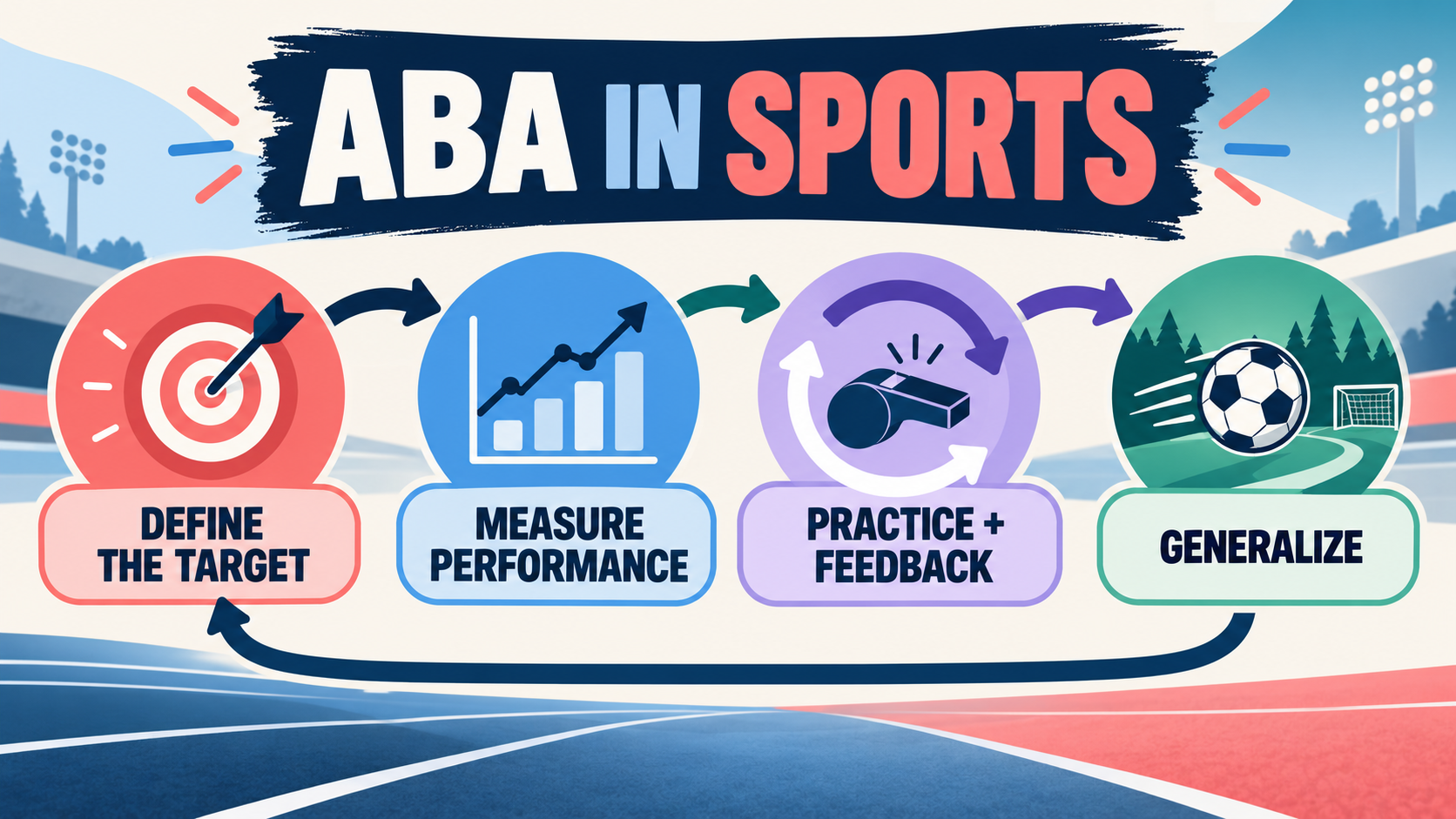
A behavior-analytic sports project usually becomes clearer when the question is narrowed. “Why does the athlete play badly under pressure?” is too broad to guide a responsible intervention. “How often does the athlete begin the agreed pre-shot routine within 10 seconds of the referee signal during the final five minutes of a game?” is closer to a measurable target. The second question makes it possible to define the response, select a recording system, and compare performance across conditions.
The same logic can apply to a team routine. A coach may want players to complete a warm-up sequence, use a communication call, reset after an error, or record recovery behaviors. The analyst can examine what happens before the behavior, what the athlete does, and what consequence follows. That does not mean every sports problem has a simple single cause. Fatigue, pain, equipment, sleep, coaching history, competition rules, social context, and access to care may all matter.
Behavior analysis is most useful when it makes the target more precise and the decision more testable. The team should know what success looks like, how data will be collected, who will collect it, and what would justify changing the plan.
What Can Be Measured?
Measurement should fit the behavior and the decision. A percentage can be useful for successful serves, but it may hide whether the athlete completed the routine that supports the serve. Duration may matter for a recovery exercise, while latency may matter for starting a drill. The table below is a planning example, not a universal sports protocol.
| Observable target | Possible measure | Useful decision |
|---|---|---|
| Completes a pre-performance routine in the stated order | Task-analysis percentage and latency to begin | Identify which step needs teaching or a prompt |
| Uses a communication call during a defensive drill | Frequency per opportunity, with context recorded | Compare practice conditions and team feedback |
| Executes a defined skill component | Accuracy, topography, or percentage of correct trials | Evaluate teaching, feedback, and practice dosage |
| Returns to the next play after an error | Latency and a clear definition of the reset response | Test whether the reset routine transfers to competition |
| Completes an approved recovery or training routine | Opportunity-based adherence, duration, and reported barriers | Coordinate with medical or training professionals |
Do not collect data just because data collection feels scientific. Choose a measure that the athlete and team can use consistently, protect privacy, and explain how the information will affect decisions. If a measure does not help anyone decide what to teach, change, continue, or refer, reconsider it.
Common ABA-Informed Sports Strategies
Several familiar sports practices can be designed more precisely with behavior analysis. Their usefulness depends on the target, the learner, the setting, and the quality of implementation.
- Goal-setting: translate a broad goal such as “be more consistent” into a small number of observable process behaviors and a realistic review schedule. Outcome goals can be important, but process data often tell the team what to change next.
- Self-monitoring: teach the athlete to record a defined behavior, routine step, or decision. The recording system should be brief enough to use and should not create extra pressure or interfere with play.
- Feedback: give specific, timely information about the behavior and its result. Video or auditory feedback may be useful when the athlete can interpret it and the team has a clear reason to use it.
- Behavior skills training: instruction, modeling, rehearsal, and feedback can teach a routine or communication skill. The learner should practice under conditions that resemble the situations in which the skill will be needed.
- Contingency management: reinforcement can support practice and follow-through when the contingency is clearly explained, socially acceptable, and consistent with the athlete’s preferences and autonomy. A reward is not a substitute for an effective skill or a response to pain.
These strategies are not magic words. “Use positive reinforcement” is incomplete unless the team can identify the behavior, the opportunity, the consequence, and the data used to judge whether the arrangement is working. Ethical practice also requires considering choice, dignity, cultural context, and whether the intervention changes a meaningful outcome rather than merely making the athlete easier for adults to manage.
Why Generalization Matters Beyond Practice
An athlete may perform a routine in a quiet practice environment and not use it during competition. That difference is not automatically a motivation failure. The cues, timing, audience, noise, equipment, rules, and consequences may have changed. A plan that works only with one coach giving one prompt at one location has not yet demonstrated robust generalization.
Plan for transfer deliberately. Vary the practice partner, location, time pressure, score, and level of feedback when it is safe and appropriate. Fade prompts so the athlete does not wait for an adult cue. Measure the behavior in the actual setting, not only in a clinic or controlled drill. Then check maintenance after the formal teaching period ends.
The competition environment is also a real context with real risks. Do not create a practice challenge that increases injury risk or asks an athlete to ignore pain, medical advice, or a safety rule. Coordinate with the coach, athletic trainer, physician, or other qualified professional whenever the target touches health, rehabilitation, concussion management, medication, or physical load.
Scope, Competence, and Collaboration
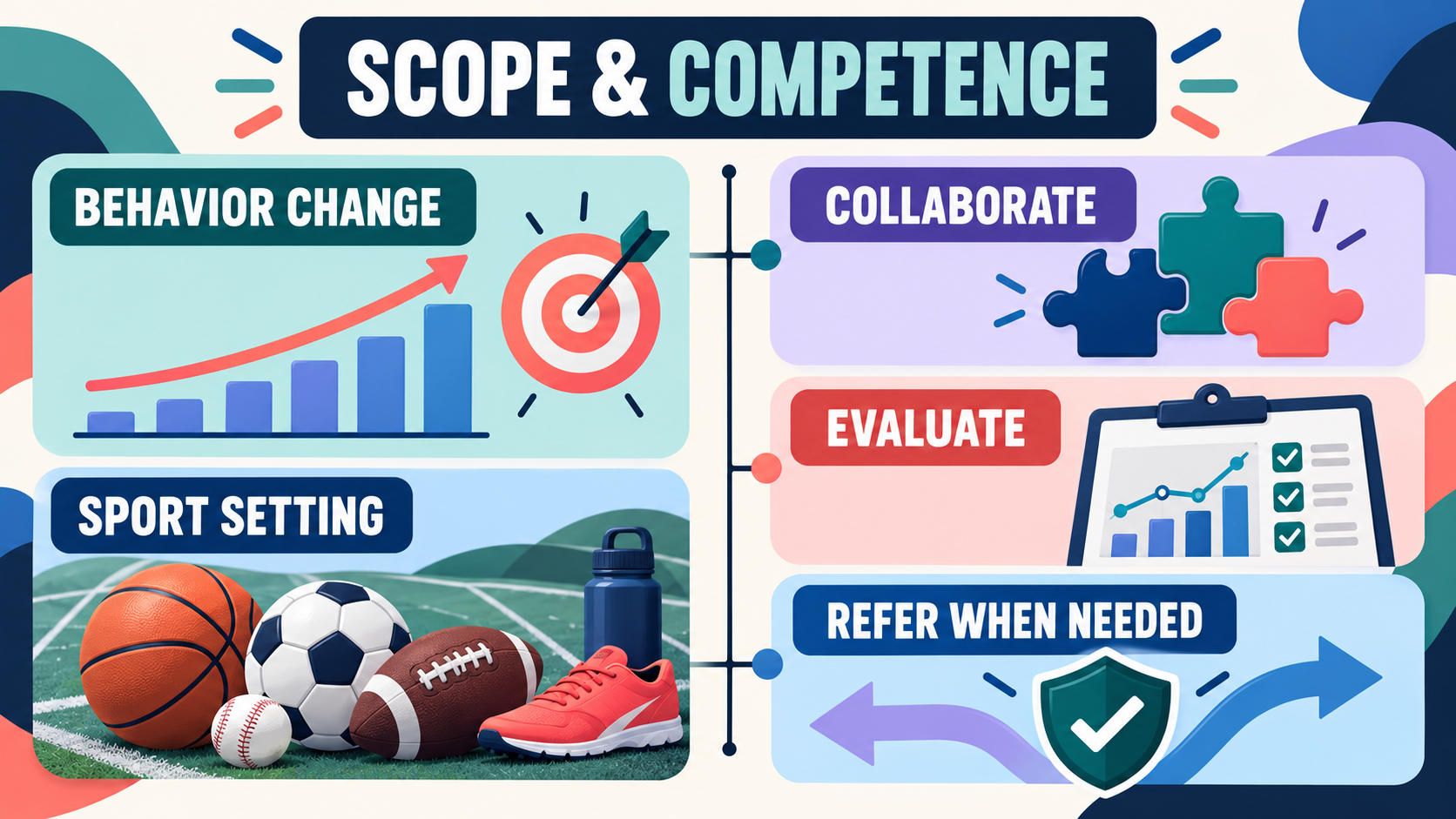
Sports applications sit near several professions. A BCBA may bring expertise in observable behavior, measurement, teaching procedures, environmental variables, and behavior-change evaluation. A sports psychologist may address mental skills or psychological processes within the person’s license and training. A coach may teach sport technique and organize practice. An athletic trainer, physician, physical therapist, or other clinician may manage health and rehabilitation. These roles can overlap, but they are not interchangeable.
The BACB’s behavioral sport psychology resource and health, fitness, and sports resource are useful starting points. They do not give a practitioner competence by themselves. Before accepting a case, review your training, supervision, applicable law, employer policy, informed-consent process, and the complexity of the sport setting.
Collaboration should be concrete. Decide who owns the medical decision, who records the target, who communicates with the athlete, and what information can be shared. If an issue involves diagnosis, medication, injury, eating concerns, trauma, or mental-health treatment outside your competence, refer or collaborate rather than stretching a behavior-analytic label to cover a different service.
ABA in Sports vs. Sports Psychology vs. Coaching
The following comparison is intentionally broad. Actual services depend on credentials, local law, training, consent, and the agreement of the athlete and team.
| Area | Typical question | Boundary to remember |
|---|---|---|
| Behavior analysis | What observable behavior should change, under what conditions, and how will we know? | Do not imply medical, psychological, or sport-specific authority that you do not hold. |
| Sports psychology | How do psychological skills or mental processes affect performance and well-being? | The title, license, and permitted services vary; verify the professional’s qualifications. |
| Coaching | How should the athlete execute the sport skill or team system? | Coaching feedback does not automatically constitute a behavior-analytic assessment or treatment. |
A good plan can use more than one perspective. The key is that the athlete understands the service, the team knows the roles, and each professional stays within competence.
The BCBA Exam Angle
ABA in sports is not usually tested as a special sports chapter. The BCBA exam logic is visible in the way you analyze the example. Can you write an operational definition? Select a valid measurement system? Identify relevant antecedents and consequences? Consider function, social validity, generalization, maintenance, ethics, and scope? Those are the transferable questions. When studying a sports scenario, practice moving from the story to the behavior-analytic decision:
- Describe the behavior in observable terms and separate it from a mentalistic label.
- Choose a measure that matches the target and the decision.
- Look for patterns in the environment instead of assuming the athlete’s character is the cause.
- Select a teaching or behavior-change procedure that is ethical, feasible, and within competence.
- Plan for generalization and maintenance, then evaluate the data.
After working through a sports example, use the free BCBA mock exam to check whether your reasoning transfers to assessment, measurement, intervention, and ethics questions outside the sports context.
Common Mistakes
- Using “motivation” as the entire assessment: define what the athlete does, when it occurs, and what changes the response.
- Measuring only the final score: track process behaviors that can actually be taught and changed.
- Assuming practice equals competition: plan and measure generalization rather than declaring success from a controlled drill.
- Applying one favorite strategy to everyone: use data, preference information, athlete choice, and ongoing evaluation.
- Ignoring health and consent: behavior analysis does not replace medical evaluation, rehabilitation, or the athlete’s right to understand and participate in the plan.
- Overstating credentials: an ABA background alone does not make a person a sports psychologist, medical provider, or elite-sport specialist.
ABA in Sports FAQ
Is ABA in sports only for professional athletes?: No. The same measurement and teaching logic may be relevant in youth, school, recreational, adaptive, collegiate, or professional settings. The goals, consent process, safeguarding requirements, and collaboration team will differ by context.
Can a BCBA work with athletes?: A BCBA may work in a sports-related setting when the service is within the practitioner’s competence, permitted by applicable rules, and clearly defined. A BCBA credential alone does not establish competence in every sport, psychological service, or medical issue.
Does ABA in sports mean treating anxiety?: Not automatically. A behavior analyst may measure and teach observable coping or performance behaviors within competence, but anxiety, trauma, eating concerns, medication, and other health or mental-health matters may require a qualified clinician or coordinated care. Do not use an ABA label to bypass that boundary.
What is the best first step for an ABA sports project?: Choose one meaningful, observable target and define how it will be measured. Then confirm consent, scope, collaborators, baseline conditions, and a safe way to evaluate change. A narrow question with usable data is more valuable than a broad promise to make an athlete “more confident.”
Bottom line: ABA in sports is a focused application of behavior analysis, not a shortcut around sport-specific or health-related expertise. Define the behavior, measure what matters, teach ethically, plan for generalization, and collaborate when the question crosses professional boundaries. Those habits improve both real-world practice and BCBA exam reasoning.
Quick Review Checklist
Use this final checklist to turn aba in sports into exam-ready reasoning. The goal is not to memorize a label in isolation; it is to identify the relevant evidence and explain why the best answer fits the scenario. Key ideas to review:
- State the central definition or decision point for aba in sports in your own words.
- Identify the detail that makes aba in sports different from its closest related ABA term.
- Separate the observable facts in a scenario from assumptions that are not supported by the facts.
- Write one example and one nonexample so you can recognize the concept in a new setting.
Exam application checks:
- Ask what the question is actually requesting before comparing the answer choices.
- Mark the antecedent, response, consequence, or other evidence that supports the selected answer.
- Look for a distractor that describes a related process but does not answer the specific question.
Final self-check:
- Explain how you would verify the interpretation with clear observations or data.
- Change one detail in the scenario and decide whether your answer should change.
- Give a one-sentence rationale that a supervisor or study partner could evaluate.
Take the Free BCBA Mock Exam
If you want a low-pressure way to check your recall, use the free practice resource below. Take the Free BCBA Mock Exam



