
If you searched for ABA ethics rules, start with one distinction: the current BACB Ethics Code is not a list of slogans to memorize. It is a professional standard that you apply to the facts, the people affected, your role, and the next defensible action. For BCBA candidates, that means learning how to locate the duty inside a scenario before choosing an answer.
Table of Contents
- What ABA Ethics Rules Means for BCBA Candidates
- Read the Current Code Before Memorizing Old Rule Numbers
- Use a Four-Step Ethics Rule Lookup
- Start With Client Welfare, Not the Loudest Stakeholder
- Use the First-Action Matrix for Common Scenario Types
- Separate Facts, Preferences, and Legal Questions
- Translate the Code Into BCBA Exam Decisions
- Document, Consult, and Check Self-Reporting Boundaries
- Turn Ethics Review Into Targeted Practice
- FAQ
- Take the Free BCBA Mock Exam
Short answer: use the current BACB Ethics Code for Behavior Analysts as your primary source, identify the client and other stakeholders, name the ethical duty at risk, locate the relevant code area, and choose the action that protects the client while staying within your competence and role. Then document the reasoning, consult when needed, and check the official self-reporting or enforcement guidance instead of guessing.
What ABA Ethics Rules Means for BCBA Candidates
The phrase ABA ethics rules can be ambiguous. In a BCBA context, it usually points to the BACB Ethics Code for Behavior Analysts, not a generic list of ABA values and not the American Bar Association’s rules. The BACB says the current code sets ethics standards for BCBA and BCaBA certificants and applicants and went into effect January 1, 2022. The BACB also tells readers to check for current versions and explains that it cannot provide legal or ethics advice. The code matters in three different situations:
- Professional practice: deciding how to protect clients, communicate honestly, work within competence, and provide responsible services.
- Supervision and training: managing responsibilities to trainees, supervisees, and other professionals without blurring roles.
- Certification and examination: preparing ethically, protecting confidential examination content, and meeting applicant or certificant obligations.
| Question | Use the Ethics Code for | Do not use it as |
|---|---|---|
| What should a behavior analyst do? | A professional conduct and decision-making standard | A substitute for applicable law, a contract, or clinical consultation |
| Which answer is strongest on an exam? | A lens for matching the facts, duty, client welfare, and role boundaries | A cue to select the most dramatic or punitive option |
| What happens in a real complaint? | A reason to read current BACB enforcement and reporting procedures | A promise that an article can interpret your case or predict a sanction |
Read the Current Code Before Memorizing Old Rule Numbers
Older study materials may use a previous ethics code, old numbering, or informal labels. Start at the BACB’s current Ethics Codes page and confirm the version before building flashcards. The BACB handbook describes six sections that cover responsibilities involving professional conduct, clients and service provisions, supervision, and colleagues. For exam preparation, the current BCBA Handbook also recommends reviewing the Ethics Code alongside the BCBA Test Content Outline and your training materials. A useful first pass is to turn each scenario into a responsibility category:
| Scenario signal | Responsibility to test | Evidence to look for |
|---|---|---|
| A client may be exposed to avoidable risk | Client welfare, informed participation, and least-risk planning | Urgency, consent or assent, data, medical context, and safeguards |
| The practitioner lacks relevant experience | Scope of competence, consultation, referral, or additional training | Population, procedure, setting, supervision, and available expertise |
| A trainee or supervisee is involved | Supervision quality, feedback, role clarity, and client protection | Who is responsible, what was taught, and how performance is monitored |
| A post, claim, or testimonial is public | Truthful representation, privacy, and professional communication | Accuracy, permission, audience, credentials, and outcome claims |
This mapping is a study aid, not a replacement for the code. If the wording of a current BACB standard controls the question, open the official source and read the surrounding context rather than relying on a memorized fragment.
Use a Four-Step Ethics Rule Lookup
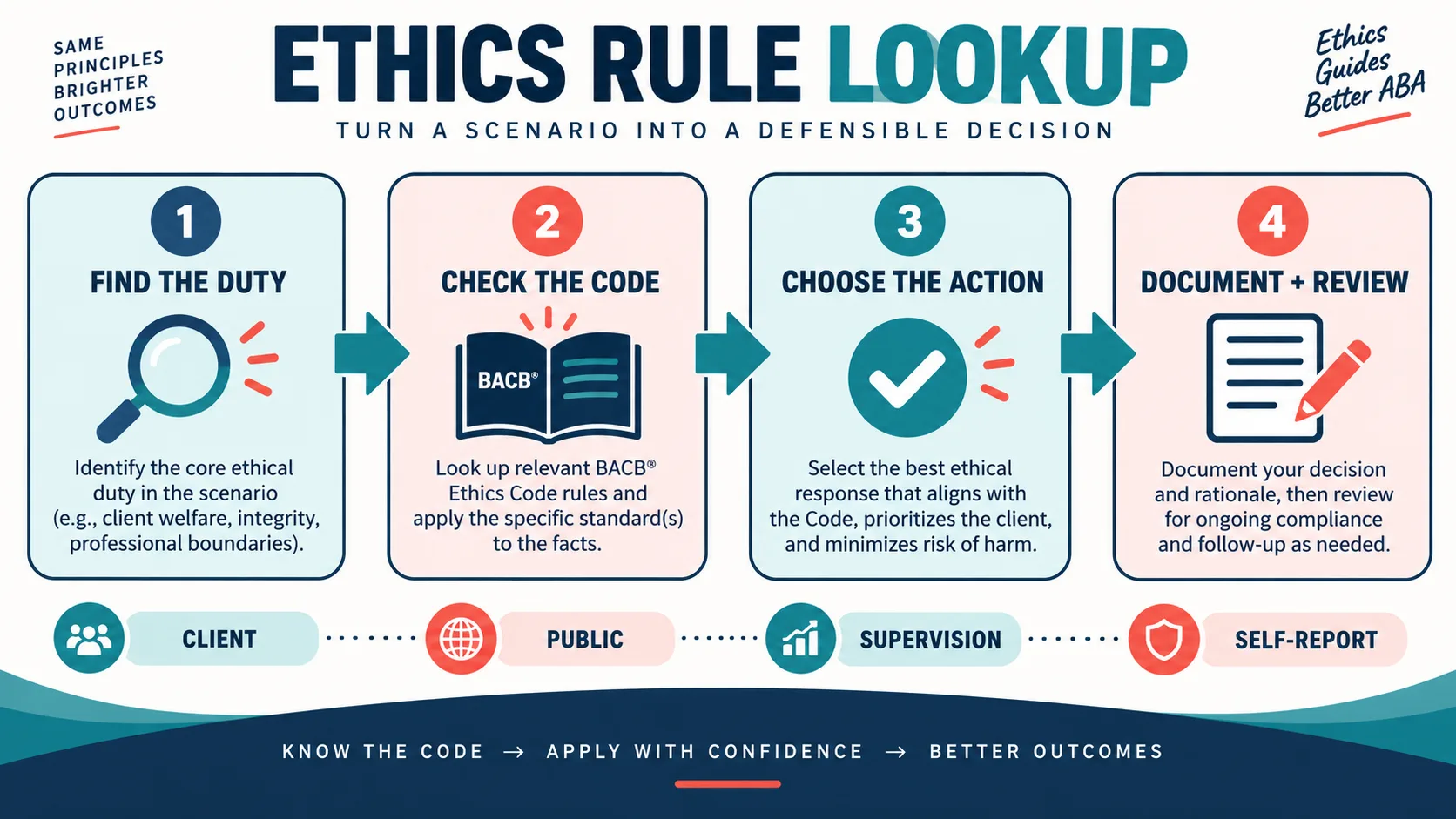
Ethics questions often feel difficult because several answers sound kind, collaborative, or efficient. Use a repeatable lookup instead of choosing the answer with the nicest tone. The purpose is to move from the scenario’s facts to a defensible first action.
- Find the duty: write one phrase describing what may be at risk, such as client welfare, honesty, competence, privacy, supervision, or continuity of care.
- Check the Code: identify the current section or standard that fits the duty. Do not force a rule into the question simply because one keyword appears in the stem.
- Choose the action: select the response that protects the client, stays within role boundaries, and addresses the problem at the right level of urgency.
- Document and review: record the rationale, consultation, follow-up, and any change needed to reduce recurrence.
On a practice item, you can write a four-word scratch outline: duty → code → action → follow-up. If an answer skips the duty, jumps to punishment, or avoids documentation, treat it as a warning sign. The best answer is often the one that takes a protective first step and creates a path for informed follow-up.
Start With Client Welfare, Not the Loudest Stakeholder
Parents, employers, funders, teachers, supervisors, and clients can all appear in one stem. The person with the strongest demand is not automatically the person whose preference controls the ethical decision. Identify the client, the client’s rights and welfare, and the immediate risk before you optimize for convenience or satisfaction.
- Ask whether the proposed action could create immediate physical, psychological, privacy, or service-continuity risk.
- Check whether the client can participate through informed consent, assent, communication support, or an authorized decision-maker as appropriate.
- Separate a stakeholder’s preference from evidence about the client’s goals and welfare.
- Look for a less risky way to achieve the legitimate clinical or educational objective.
- Consider whether medical, legal, cultural, or contextual expertise must be added before action.
This does not mean every answer is “do what the client wants” without assessment. It means client welfare is a central anchor, and the professional must use data, consent processes, competence, and collaboration to make the decision defensible.
Use the First-Action Matrix for Common Scenario Types
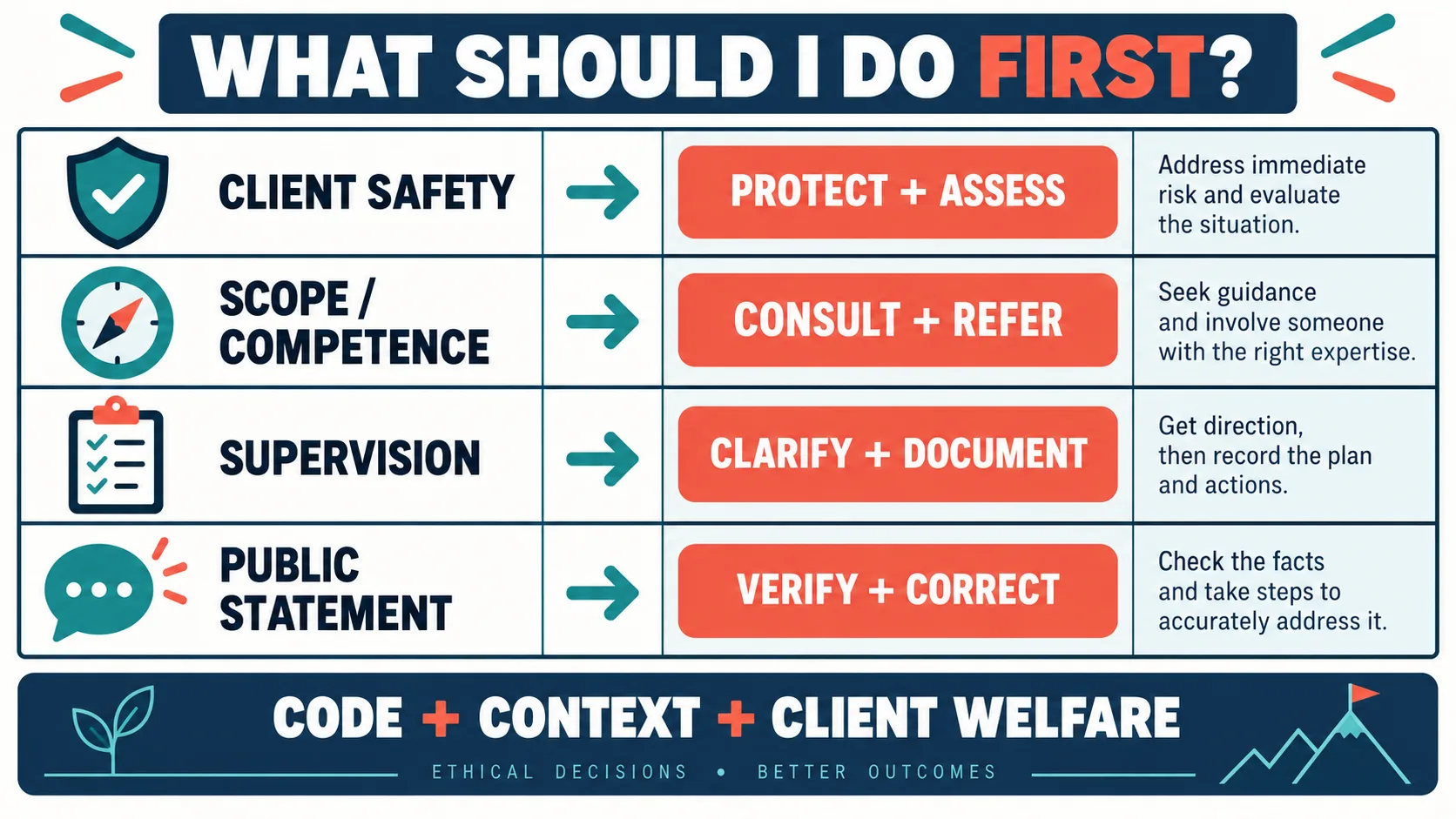
The first action is not always the final resolution. A scenario may require assessment, consultation, correction, documentation, or reporting in sequence. The matrix below helps you discriminate the first move without turning it into an automatic rule. Read the stem for urgency and for instructions such as FIRST, MOST appropriate, or NEXT.
| Primary signal | First-action direction | What to avoid |
|---|---|---|
| Immediate client safety risk | Protect, assess the facts, and obtain the urgent expertise or support required | Waiting for a perfect committee discussion while risk continues |
| Possible scope or competence gap | Pause unsupported action, consult, and refer or obtain training as appropriate | Accepting a case simply because an employer or caregiver asks |
| Supervision ambiguity | Clarify roles, expectations, feedback, and responsibility, then document | Leaving a trainee to infer the standard from a vague correction |
| Public statement or credential claim | Verify the fact, correct the claim, and protect private information | Amplifying an inaccurate post or deleting evidence without correction |
For a real case, the matrix is a starting point, not individualized advice. For an exam question, it helps you compare the options by urgency, client impact, role, and reversibility. An answer that simply “reports everyone” may be premature when direct clarification is safe and the stem asks for the first step. An answer that does nothing may be too passive when there is immediate risk.
Separate Facts, Preferences, and Legal Questions
Many ethics errors happen because the reader treats an opinion as a fact or assumes the BACB Code answers a legal question. Make three columns while reviewing a difficult item:
- Known facts: what the stem actually states, including who is affected and what has already happened.
- Preferences or claims: what a stakeholder wants, believes, or says without supporting evidence.
- External requirements: state law, payer rules, employer policy, court orders, or licensing requirements that may need separate verification.
| If the stem says | Ask | Study move |
|---|---|---|
| “The caregiver demands…” | Does the demand align with consent, client goals, evidence, and safety? | Do not confuse insistence with authorization |
| “The BCBA is experienced…” | Experienced with this population, procedure, and setting? | Test the actual competence boundary |
| “The employer says it is policy…” | Does policy remove the practitioner’s ethical responsibility? | Treat policy as context, not automatic permission |
In a real practice concern, the right next step may include a supervisor, qualified colleague, state regulator, attorney, or another specialist. The BACB expressly states that it cannot provide legal or ethics advice, so an article should teach a safe process without pretending to decide a person’s case.
Translate the Code Into BCBA Exam Decisions
The current BCBA Handbook says the examination is based on the BCBA Test Content Outline (6th ed.), recommends reviewing the Ethics Code, and includes an Ethical and Professional Issues content area. It also states that exam content is confidential. That creates two boundaries for preparation: use original practice material, and practice applying principles without seeking or sharing live examination content.
- Underline the action word in the stem: first, best, most appropriate, or next.
- Circle the client, trainee, colleague, employer, payer, or public audience involved.
- Label the threatened duty before reading the answer choices again.
- Eliminate choices that exceed competence, hide the problem, or ignore client risk.
- Compare the remaining choices by urgency, transparency, consultation, and follow-up.
- After answering, write why the tempting option fails; that explanation is more useful than a score alone.
Do not turn one practice percentage into an official pass prediction. The BACB explains that preparation materials are not endorsed and do not guarantee a passing result. Your review goal is to make the reasoning more consistent: identify the duty faster, locate the relevant Code area, and choose a response that is both protective and within role.
Document, Consult, and Check Self-Reporting Boundaries
Ethical decision-making does not stop when you select an option. In professional practice, document the facts, the consultation, the action, the person responsible, and the follow-up date. The current handbook also describes self-reporting obligations for certain conduct, conditions, and investigations, including a 30-day timing rule for some events. Because the facts matter, use the official handbook and self-reporting guidance rather than applying a shortcut from a study card.
- Record the date, people involved, and observable facts.
- State the client or service risk in neutral language.
- Identify the code area and any external rule that may also apply.
- Record who was consulted and what action was agreed.
- Set a follow-up date to review safety, consent, data, and continuity.
- Check the current BACB reporting or enforcement page if a potential violation or investigation is involved.
Documentation is not a defensive substitute for good care. It makes the decision reviewable and helps the team notice whether the chosen action solved the problem or merely moved it to another person.
Turn Ethics Review Into Targeted Practice
A broad ethics article may leave you with more notes but no measurable next step. After each study block, classify your misses:
- Rule-location miss: you could not identify which duty or code area fit the facts.
- Context miss: you chose an answer without checking the client, role, urgency, or external requirement.
- First-action miss: you understood the concern but selected a later step before the required initial move.
- Language miss: you missed a qualifier such as best, first, least, or most appropriate.
- Boundary miss: you treated practice material as official BACB content or treated an article as legal advice.
When you want a low-pressure checkpoint, use the site’s free BCBA mock exam and review ethics items with this lookup method. It is a preparation tool, not an official BACB exam, a code-enforcement decision, or a pass guarantee.
FAQ
What are the current ABA ethics rules for BCBA candidates? In a BCBA context, begin with the current BACB Ethics Code for Behavior Analysts. It applies to BCBA and BCaBA certificants and applicants, and the BACB says the current code went into effect January 1, 2022. Always check the live BACB page for the current version. Should I memorize every ethics rule number? Memorization can help recognition, but rule-location and application matter more. Practice moving from duty to code to action to follow-up, and read the official surrounding context. Is every uncomfortable situation an ethics violation? Not necessarily. Separate a preference, a clinical disagreement, a policy conflict, an ethics concern, and a legal question. Gather facts and consult the appropriate authority.
What is the best first step in an ethics scenario? There is no universal answer. Identify the client and urgency, then choose the option that protects welfare, fits your role and competence, and addresses the stated problem at the requested time point.
Bottom line: the strongest way to study ABA ethics rules is to use the current BACB Code as a decision tool. Find the duty, locate the rule, apply it to the facts, choose the first protective action, and document the follow-up. That process supports both more reliable exam reasoning and more responsible professional practice.
Take the Free BCBA Mock Exam
A useful next step is to apply this idea in a fresh set of BCBA-style practice questions and review the feedback. Take the Free BCBA Mock Exam



