
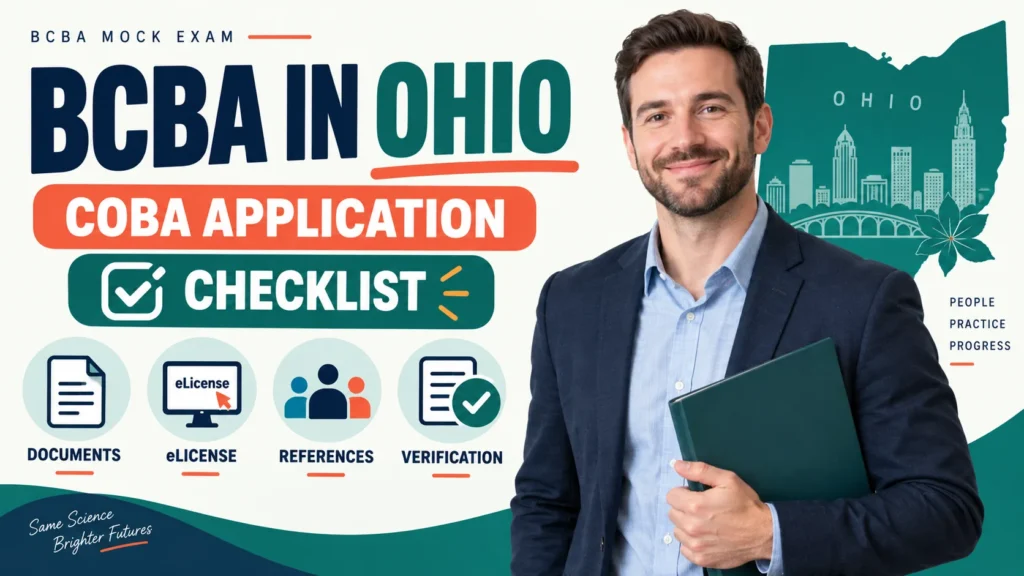
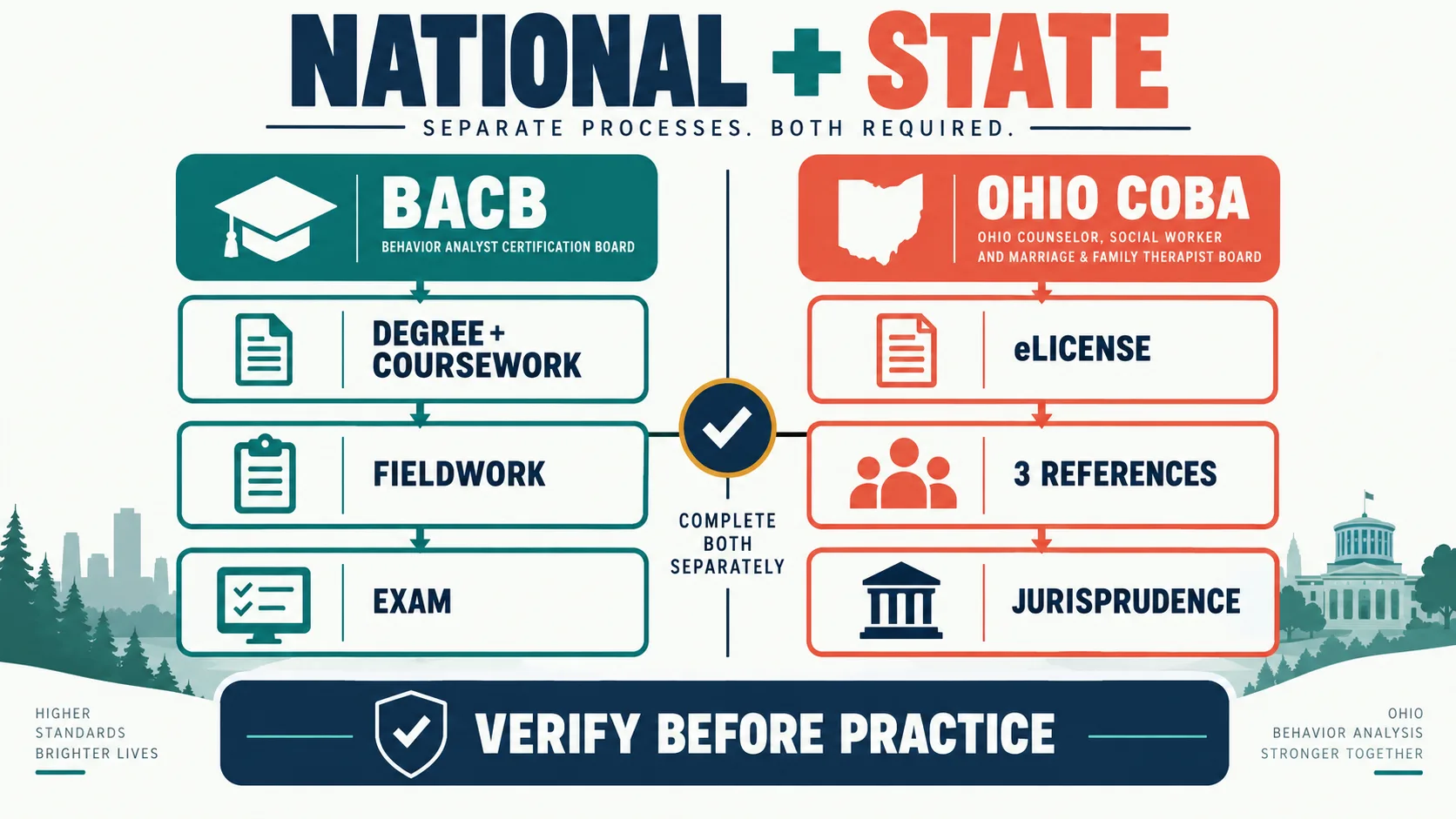
If you are searching for how to become a BCBA in Ohio, separate two questions before you collect documents: how you earn and maintain the national BCBA credential, and what Ohio requires before you practice under its state behavior-analyst credential. The fastest way to create a delay is to treat those as one application.
Table of Contents
- How to Become a BCBA in Ohio: Start With Two Separate Credentials
- Build the Ohio Application Packet Before You Open eLicense
- Verify the National BACB File First
- Prepare the Three Professional References
- Complete Background, Law, and Jurisprudence Checks
- Use eLicense as a Document-Control System
- Decide Whether Reciprocity Is Your Route
- Recheck the 2027 BCBA Transition Before Filing
- Keep Application Work Separate From Exam Preparation
- FAQ and the Next Step
- Take the Free BCBA Mock Exam
Short answer: complete the current BACB pathway first or confirm the route that applies to you, then prepare the Ohio packet through the Ohio Board of Psychology and eLicense. Verify current BCBA status, gather the required documents, arrange three professional reference letters sent directly as required by the state rule, complete background and law-related checks, finish the required jurisprudence step, and keep a dated copy of every submission. If you already hold an out-of-state credential, check reciprocity before starting the standard packet.
How to Become a BCBA in Ohio: Start With Two Separate Credentials
Ohio applicants often see national certification and state authorization discussed on the same page, but they are controlled by different authorities. The BACB BCBA Handbook controls the national certification application, examination, and certification rules. Ohio statutes and rules, administered through the Ohio Board of Psychology, control the state credential and its application requirements.
| Track | Main authority | Evidence to control | Common mistake |
|---|---|---|---|
| National BCBA certification | BACB | Degree or qualifying pathway, coursework, supervised fieldwork, application, and examination evidence | Assuming an Ohio application replaces an incomplete BACB file |
| Ohio state credential | Ohio Board of Psychology and Ohio rules | Current BCBA verification or qualifying route, references, state forms, checks, jurisprudence, and fee | Treating a national certificate as the entire Ohio filing |
| Practice readiness | Your employer, supervisor, and applicable rules | Active credentials, role boundaries, supervision records, and current policies | Starting work while a required state step is still unverified |
Use the site’s existing Ohio certification roadmap for the broad sequence. This checklist narrows the question to the packet you assemble after you know which national and state route applies to you.
Build the Ohio Application Packet Before You Open eLicense
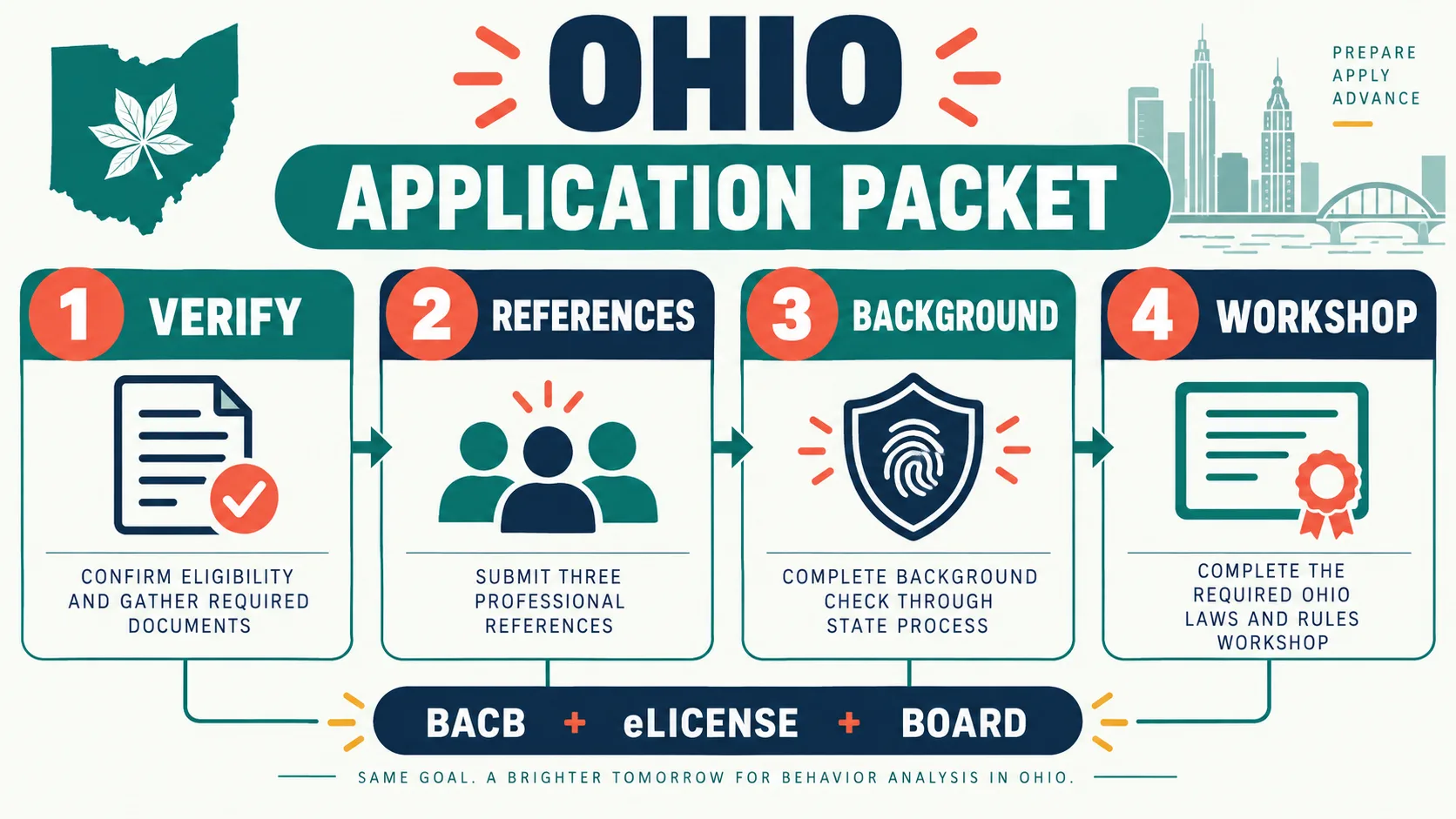
Do not begin by clicking through a form and hoping the missing documents become obvious later. Start a folder with one subfolder for national evidence, one for Ohio evidence, and one for submission receipts. Use the current Ohio Board laws and rules page as the regulatory starting point, because forms, fees, and instructions can change.
| Packet area | What to prepare | Verification before submission |
|---|---|---|
| Identity and application | Current legal name, contact details, application form, fee, and any requested identity information | Name matches the national record and every uploaded document |
| National credential | Current BCBA verification or the evidence required for the route identified by the Board | Verification source and expiration status are current on filing day |
| References | At least three professional reference letters in the format and delivery method required by the rule | Each writer knows where to send the letter; you keep a request date and follow-up date |
| State checks | Background, law, jurisprudence, and any additional state documentation applicable to your route | You record completion dates and save confirmation rather than relying on memory |
- Download or open the current state instructions from the Board’s official resource page.
- Write the exact name you will use across BACB, Ohio, and eLicense records.
- Create a checklist with a status, owner, request date, receipt date, and expiration date for every item.
- Do not upload a screenshot of a draft request when the rule requires direct verification or direct delivery.
- Save the final file names in a simple index so you can answer a deficiency request quickly.
Verify the National BACB File First
Ohio’s state application may ask for proof connected to your national credential, so resolve the BACB side before you treat the packet as ready. The BACB’s current handbook and 2027 requirements hub are the controlling sources for degree, coursework, supervised fieldwork, application, and examination details. A commercial article or school page can help you plan, but it cannot override the current handbook. Check these national items in order:
- Confirm that your education and coursework route matches the requirement set that applies to your timeline.
- Confirm that fieldwork documentation is complete, signed, and retained according to BACB instructions.
- Confirm that your BACB account name and contact information are current.
- Confirm whether you hold an active BCBA certification or whether you are still at an earlier application stage.
- Save the current handbook link and the date you checked it in your packet index.
This order matters because a state file can be complete as a collection of PDFs and still fail its purpose if the national verification is missing, expired, or inconsistent. If you are not yet eligible for the BACB examination, use the national pathway page first and treat the Ohio checklist as a later state-application phase.
Prepare the Three Professional References
Ohio’s application rule is unusually easy to mishandle because a reference letter is not just a document you upload after a writer sends it to you. The rule calls for at least three reference letters, and the references must come from permitted professional categories. The letters are sent directly to the Board according to its instructions. Confirm the current delivery method and acceptable writer categories before you ask anyone to write.
| Reference control | What to confirm | Why it prevents delay |
|---|---|---|
| Writer eligibility | The writer fits a category accepted by the current Ohio rule | A strong letter from an ineligible writer may not satisfy the application |
| Direct delivery | The writer sends the letter to the Board using the required channel | Forwarding your own copy can break the required chain of custody |
| Timing | The letter is requested early and arrives before the application is reviewed | You can follow up before a missing reference becomes a deficiency |
- Choose more than three possible writers if one person may be unavailable.
- Send each writer the official delivery instructions and a realistic due date.
- Ask the writer to use your exact legal name and any identifier requested by the Board.
- Record when the request was sent, when the writer confirmed, and when delivery was reported.
- Do not edit, combine, or re-send a reference letter unless the Board instructs you to correct it.
Complete Background, Law, and Jurisprudence Checks
The Ohio rules describe state-specific conditions beyond the national credential. Depending on the route and the current instructions, your checklist may include background or criminal-record steps, an acknowledgement that you understand Ohio law, a jurisprudence workshop, and a post-workshop examination. Read the current rule and Board instructions together; do not infer that passing the BACB exam automatically completes these Ohio steps.
- Background check: follow the state’s current provider, fingerprint, and submission instructions rather than uploading an informal report.
- Law acknowledgement: keep a copy of any signed statement and the version of the law or rule you reviewed.
- Jurisprudence: record workshop registration, completion, and any required post-workshop exam result.
- Disclosure: answer background or discipline questions consistently across national and state applications; obtain professional advice when a disclosure is complex.
One important caution: Ohio administrative rules can contain language for more than one eligibility route and may preserve older education or experience descriptions. Do not use an older state-rule pathway as a substitute for the current BACB certification pathway. The practical question is always: which route does the Board say applies to your application today, and what primary-source evidence does that route require?
Use eLicense as a Document-Control System
The Ohio eLicense portal is the practical starting point for the state account and application workflow, but an online form is not a substitute for a complete packet. Before you submit, make a small audit table outside the portal so you can reconstruct what was sent.
| Audit field | Record | Pass condition |
|---|---|---|
| Portal identity | Account email, legal name, application type, and submission date | Every field matches the identity used in the national file |
| Uploads | File name, version, date uploaded, and confirmation number | Each required item has a receipt or a documented direct-delivery path |
| External items | BACB verification, references, and checks supplied by another party | You recorded who sends it and how you will confirm receipt |
| Follow-up | Board contact, deficiency notice, response date, and resolution | No open deficiency is left without an owner and next date |
Keep the confirmation page and payment receipt in the same folder as the final packet. If the portal displays a status that you do not understand, use the official Board contact information instead of submitting a second application. Duplicate filings can make your own record harder to interpret.
Decide Whether Reciprocity Is Your Route
If you are already licensed or certified in another state or jurisdiction, stop before following the standard Ohio checklist. Ohio has a reciprocity rule, but reciprocity is not an automatic transfer and it is not the same as having a national BCBA certification. The Board still needs to verify the out-of-state credential and may require references, jurisprudence, background information, a fee, and evidence about active practice.
| Question | If yes | If no or unclear |
|---|---|---|
| Do you hold an active qualifying credential in another jurisdiction? | Read the Ohio reciprocity rule and request primary-source verification | Continue evaluating the standard Ohio route |
| Can the issuing authority send verification directly? | Record the request and expected delivery date | Ask the Board what alternate evidence is accepted |
| Does your recent practice history meet the current rule? | Keep dates and employer or supervisor evidence ready | Do not assume a dormant or expired credential qualifies |
Use the current Ohio reciprocity rule as the decision source. When your facts do not fit a simple yes or no, ask the Board before paying for the wrong application type.
Recheck the 2027 BCBA Transition Before Filing
The 2027 change is a timing issue, not a reason to guess. The BACB says significant BCBA and BCaBA requirement changes take effect January 1, 2027. Its transition notice also explains that a complete application, including payment and required documents, must be received by December 31, 2026 to be reviewed under the current 2022 requirements. A practice test, a partially completed portal form, or an email draft does not create that application date.
- Open the live BACB 2027 requirements page and note the date you checked it.
- Identify whether your national application is complete, submitted, or still missing documents.
- Check whether the Ohio Board has updated its forms or instructions for the state credential.
- Keep national transition evidence and Ohio state evidence in separate folders.
- Ask the relevant authority when a rule or date changes your personal route; do not rely on a screenshot from an older article.
The safest plan is to make a dated decision record: “I checked the BACB transition notice on [date], my national status is [status], my Ohio route is [route], and the next missing item is [item].” That record will not replace an official application, but it prevents a vague deadline memory from driving the plan.
Keep Application Work Separate From Exam Preparation
State paperwork and BCBA exam readiness support the same career goal, but they need different checklists. While your packet is moving through Ohio review, keep exam preparation focused on the current BACB Test Content Outline, ethical decision-making, applied scenarios, and deliberate pacing. Do not use an Ohio approval status as proof that you are ready for the national examination, and do not use a mock-exam percentage as proof that the state will approve your application.
- Use the official BACB handbook for exam format, application boundaries, and test security.
- Use a short practice set to locate concept or discrimination gaps.
- Record wrong, guessed, and slow items in an error log.
- Study the narrowest weak area before repeating a full simulation.
- Keep any practice CTA separate from the legal and licensing instructions above.
When you are ready for a low-pressure preparation checkpoint, you can use the site’s free BCBA mock exam. Treat the result as study feedback only. It is not BACB approval, an Ohio license, or a prediction of a passing result.
FAQ and the Next Step
Do I need to become a BCBA before applying in Ohio? The Ohio rules describe a current BCBA verification or an applicable equivalent route for the state credential. Confirm the route with the current Ohio Board instructions and do not assume that a pending BACB application is enough.
Are three references really part of the Ohio packet? The Ohio application rule describes at least three professional reference letters and a direct-delivery process. Confirm the permitted writer categories and current submission instructions before requesting them.
Can I use the standard packet if I already hold a credential in another state? Maybe, but first read the reciprocity rule. The evidence, verification, practice history, and other state conditions may differ from the standard route.
What should I do if an Ohio rule seems to conflict with a BACB page? Identify which question is national and which is state-specific, then ask the responsible authority. Do not merge the rules into a single informal requirement list.
Bottom line: the practical answer to how to become a BCBA in Ohio is a two-track project. Finish or verify the national BACB pathway, then build the Ohio packet with current state instructions, direct references, background and jurisprudence evidence, eLicense receipts, and a dated 2027 transition check. That separation makes the application easier to audit and reduces the chance that a missing state document will be confused with an unfinished national requirement.
Take the Free BCBA Mock Exam
A useful next step is to apply this idea in a fresh set of BCBA-style practice questions and review the feedback. Take the Free BCBA Mock Exam



