

Direct answer first: when “practical value” means that an intervention produces a meaningful real-world change, the best seven-dimensions answer is effective. The applied dimension asks whether the goals matter socially. Those ideas work together, but they are not interchangeable on a BCBA exam.
Table of Contents
- Which Principle Ensures ABA Has Practical Value? The Effective Dimension
- Applied vs Effective: Two Different Exam Questions
- Worked BCBA Scenario: Is the Change Practically Meaningful?
- What Evidence Supports Practical Value?
- Practical Value Is More Than a Percentage
- Where Generality Fits
- A Two-Question BCBA Decision Routine
- Common Applied-vs-Effective Traps
- Mini Practice Set
- Frequently Asked Questions
- Sources and Scope
- Quick Review Checklist
- Take the Free BCBA Mock Exam
If you search for which principle ensures ABA has practical value, you are probably trying to identify one word in a multiple-choice stem. The safest way to solve it is to ask what the stem is evaluating: the importance of the goal, the size and usefulness of the outcome, or whether the change carries across people and settings. “Practical value” usually points to the Effective dimension because the intervention must make enough difference to matter in everyday life. If the question instead says that ABA selects socially significant behavior, the answer is Applied.
This is an exam-preparation explanation, not a treatment plan. The BACB Test Content Outline (6th ed.) is the current official exam reference. Social validity is a related way to ask whether goals, procedures, and outcomes matter to the people affected.
Which Principle Ensures ABA Has Practical Value? The Effective Dimension
The Effective dimension is the best answer when a question asks whether ABA produced a change that is large enough, useful enough, or meaningful enough to have practical value. A result can be statistically interesting or visually noticeable without improving the person’s daily life. Effectiveness requires the analyst to judge the outcome against the behavior’s purpose, the client’s priorities, and the context in which the behavior matters.
For example, an intervention might raise independent responding from 20% to 30%. That is a numerical increase, but it may not be enough to help a learner participate in a classroom routine, communicate a need, or complete a safety step. Another intervention might raise the response from 60% to 85% and reduce the need for prompts during a valued routine. The percentage alone does not decide the answer. The question is whether the change makes a functional difference. On an exam, phrases such as meaningful improvement, practical difference, or clinically useful result point toward Effective. Do not choose Applied merely because the scenario occurs in a real-world setting.
Applied vs Effective: Two Different Exam Questions
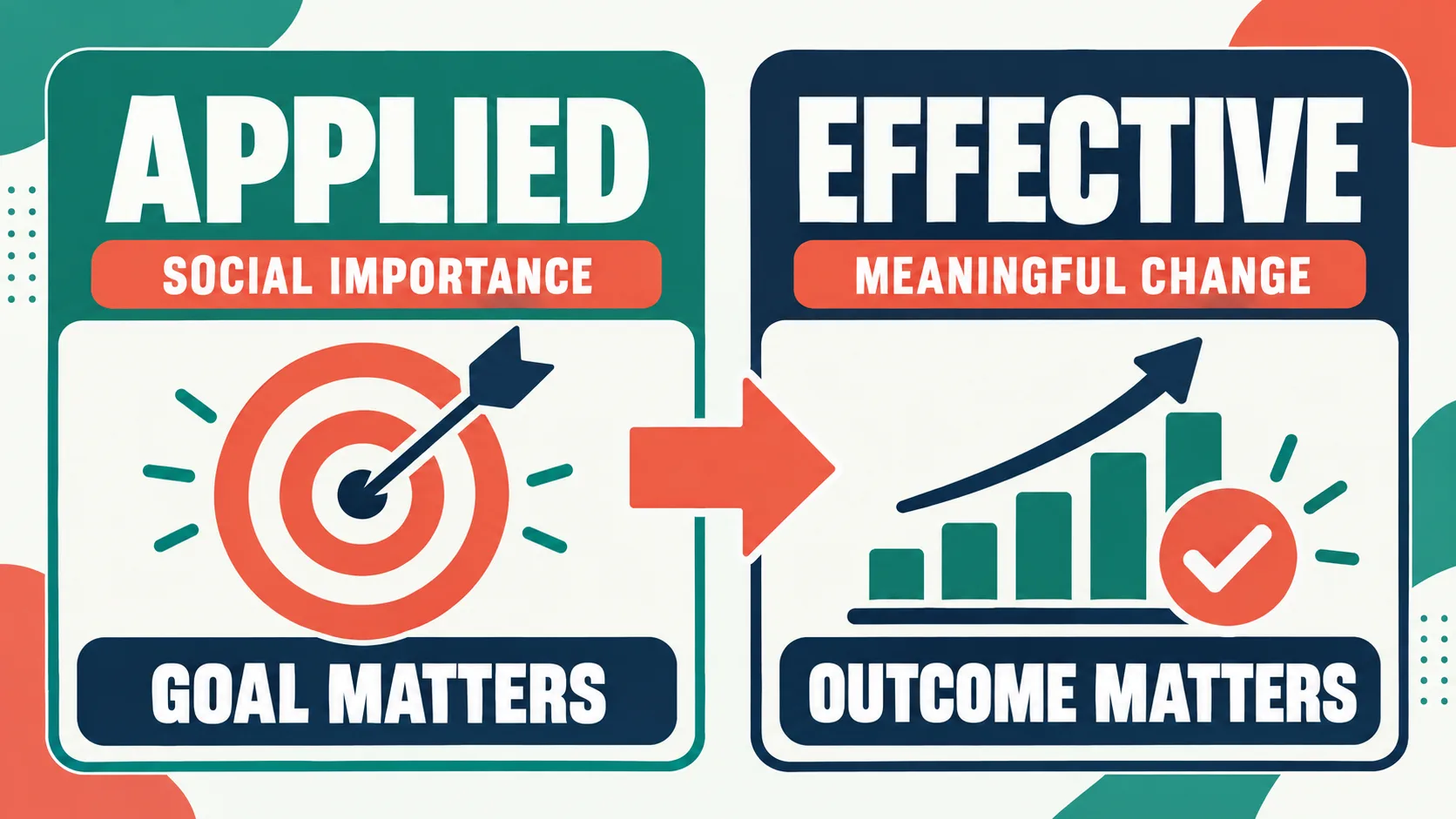
The easiest way to separate the two dimensions is to locate the decision point. Applied is about what behavior or goal was selected. Effective is about what happened after the intervention. A socially important target is not automatically improved, and a large behavior change is not automatically applied if the goal itself is trivial or disconnected from the person’s life.
| Concept | What the stem is asking | Evidence to look for | Common wrong answer |
|---|---|---|---|
| Applied | Does the goal address behavior that is socially important to the client, family, community, or daily routine? | A meaningful target such as communication, safety, independence, participation, or quality of life. | Effective, when the stem has not yet shown an outcome. |
| Effective | Did the intervention produce enough change to make a practical difference? | Outcome data, functional improvement, reduced support, or a result that matters in the routine. | Applied, when the question is about the size or usefulness of the result. |
| Generality | Does the improvement persist or transfer across people, settings, materials, time, or related responses? | Maintenance and generalization probes rather than one successful training session. | Effective, if the only evidence is a short-term change in one setting. |
| Social validity | Do stakeholders value the goals, accept the procedures, and find the outcomes meaningful? | Client and stakeholder judgments about importance, acceptability, and real-life outcomes. | Applied or Effective as a replacement for the stakeholder perspective. |
These labels can overlap in a strong intervention. A goal may be Applied, the outcome Effective, and the improvement Generalized. A multiple-choice item usually asks for the dimension that best matches one part of the story, so match evidence to wording instead of choosing the broadest ABA term.
Worked BCBA Scenario: Is the Change Practically Meaningful?
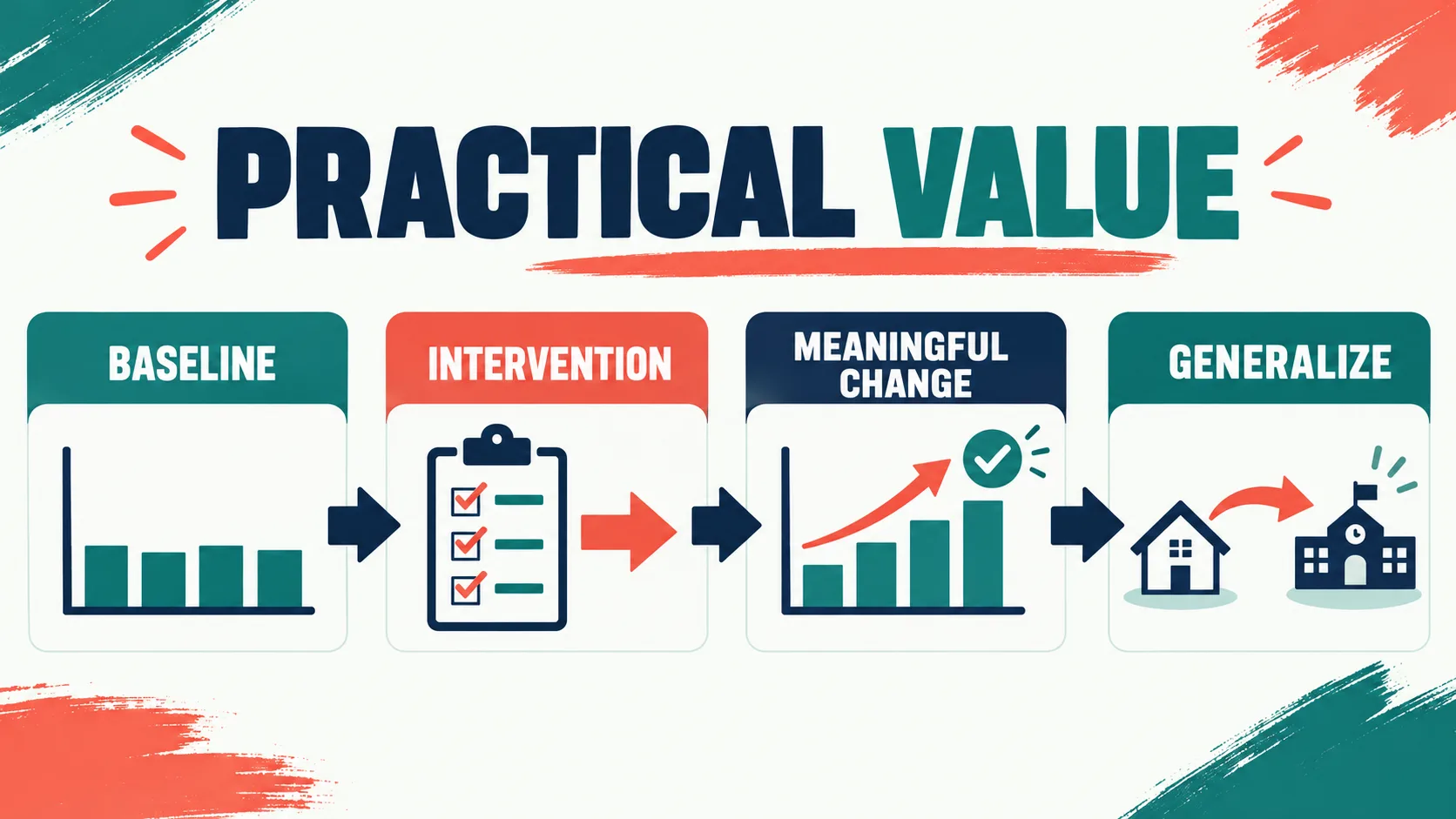
Scenario: A learner rarely uses a taught break card during a difficult independent-work routine. During baseline, the learner independently hands over the card on 2 of 10 opportunities and often leaves the area without communicating. The team teaches the card response, arranges a brief break after an independent request, and measures both card use and leaving the area. After training, the learner uses the card on 8 of 10 opportunities during the original routine.
There are several possible exam questions hidden in this short example. If the stem asks why the break-card goal was selected, look for the Applied dimension: functional communication and safer participation are socially important. If it asks which dimension is demonstrated by the increase from 2 of 10 to 8 of 10, the likely answer is Effective, provided the change is meaningful under the actual routine. If it asks whether the skill appears during another task or with another instructor, the focus shifts to Generality.
The analyst should not declare practical value from one percentage alone. Check prompt level, delivery of the break, the leaving measure, and use of the communication response in other relevant routines. The outcome may be promising without being complete evidence of effectiveness.
What Evidence Supports Practical Value?
Practical value is a reasoned conclusion supported by behavior data and the function of the goal. The exact measure depends on the response. For a communication response, record independent opportunities, prompt level, latency, and whether the request produces the intended outcome. For a safety response, record correct performance under realistic conditions and the level of assistance required. For a reduction target, measure the behavior that should decrease and the replacement behavior that should increase.
- Define the target: State exactly what counts as the response and what does not. Vague labels such as “better communication” cannot show effectiveness clearly.
- Measure the important dimension: Use frequency, rate, percentage, latency, duration, accuracy, independence, or another measure that represents the routine’s real demand.
- Compare the outcome with the starting point: A baseline or meaningful comparison helps show whether the change is larger than ordinary variation.
- Ask what the change buys the learner: Does it create access, independence, safety, participation, choice, or reduced disruption in a way the learner and stakeholders value?
- Check procedural integrity: If the intervention was not implemented as designed, the data may not answer whether the intervention was effective.
“The graph moved” is an observation. “The learner can now do something important with less support” is an effectiveness judgment that requires context and evidence.
Practical Value Is More Than a Percentage
A common trap is treating a numerical increase as proof that the outcome has practical value. Imagine a learner’s correct response rate increases from 1% to 5% on a task that still cannot be completed independently. That is a change, but it may not yet be effective for the stated goal. Conversely, a modest numerical change might be highly meaningful if it allows the learner to communicate a medical need, tolerate a necessary transition, or participate in a preferred activity.
Social validity adds another perspective. Wolf’s framework asks about the social importance of goals, acceptability of procedures, and importance of outcomes. Stakeholder feedback does not replace direct measurement, and measurement does not replace listening to the people affected.
The BACB Ethics Code also frames practice around benefiting others, protecting client welfare, treating people with dignity and respect, and working within competence. Those principles are not simply synonyms for the Effective dimension. They are professional boundaries that help prevent an analyst from calling an inconvenient or unwanted outcome “successful” just because a graph improved.
Where Generality Fits
Generality asks whether the change lasts, spreads, or produces related useful effects beyond the training arrangement. A break card used only with one therapist at a table has not yet demonstrated generality. Test another person, routine, material, or setting when the plan and safety conditions support it.
Generality also tests practical value over time. A quick improvement that depends on a narrow prompt may have limited usefulness, so do not select Generality just because a scenario sounds practical; look for maintenance or transfer evidence.
A Two-Question BCBA Decision Routine
When the wording is short, use this routine before looking at the answer choices:
- Question one: What is being judged? If the stem is judging the importance of the selected target, choose Applied. If it is judging the size, usefulness, or real-life effect of the outcome, continue to the second question.
- Question two: What happened after intervention? If the data show a meaningful change that matters in the routine, choose Effective. If the data show transfer or maintenance, choose Generality. If the evidence is mainly stakeholder ratings of goals, procedures, or outcomes, think Social Validity.
A fast memory cue is: Applied chooses the “why this goal?”; Effective answers “did it make enough difference?”; Generality asks “does it travel?” This cue is not a replacement for the stem. It is a way to locate the evidence quickly.
Common Applied-vs-Effective Traps
- Trap 1: “Real-world” means Applied. A real-world setting does not prove the goal is socially important or that the intervention worked. Identify what the question is evaluating.
- Trap 2: Any improvement means Effective. Effectiveness requires enough change to matter for the stated purpose, not merely a nonzero difference.
- Trap 3: Stakeholder approval equals effectiveness. Acceptability is important social-validity information, but it does not replace outcome data.
- Trap 4: Generalization is assumed. A skill may be effective in training and still need probes across people, places, materials, and time.
Mini Practice Set
Item A: An analyst selects independent toothbrushing because the learner and caregiver identify it as an important daily-living goal. Which dimension is most directly illustrated? Applied. The evidence concerns the social importance of the target, not yet the size of the outcome. Item B: A learner completes the routine independently with fewer prompts and maintains it at home. The meaningful improvement supports Effective; maintenance and transfer support Generality.
For more questions, use the Free BCBA Mock Exam and label each missed item before reviewing the answer: goal-selection error, outcome/effectiveness error, generalization error, measurement error, or social-validity error. That makes the practice session more useful than memorizing the seven words as an undifferentiated list.
Frequently Asked Questions
Which principle ensures ABA has practical value?: The most precise answer is Effective when “practical value” refers to a meaningful, useful outcome. Choose Applied when the stem asks whether the target behavior or goal is socially important. Is Applied the same as Effective?: No. Applied concerns the importance of the goal; Effective concerns whether the intervention produced enough change to matter. A strong program should address both. Does a statistically significant result prove practical value?: No. Practical value requires context: the size of change, the behavior’s purpose, independence, priorities, and effect on the actual routine.
How is social validity different?: Social validity asks whether goals, procedures, and outcomes are meaningful and acceptable to the people affected. It complements direct behavioral measurement but is not a substitute for the Effective dimension.
What should I write on a BCBA exam?: First name what the stem is judging. Then match the evidence: socially important target equals Applied; meaningful outcome equals Effective; transfer or maintenance equals Generality; stakeholder judgments equal Social Validity.
Sources and Scope
This study guide uses the BACB Test Content Outline (6th ed.), Baer, Wolf, and Risley’s 1968 dimensions article, and Wolf’s 1978 social-validity article. Use it for exam reasoning; individualized decisions require assessment, consent, competence, and supervision. For targeted review, use our which principle ensures aba has practical value practice questions to apply the concept in exam-style scenarios.
Quick Review Checklist
Use this final checklist to turn which principle ensures aba has practical value into exam-ready reasoning. The goal is not to memorize a label in isolation; it is to identify the relevant evidence and explain why the best answer fits the scenario. Key ideas to review:
- State the central definition or decision point for which principle ensures aba has practical value in your own words.
- Identify the detail that makes which principle ensures aba has practical value different from its closest related ABA term.
- Separate the observable facts in a scenario from assumptions that are not supported by the facts.
- Write one example and one nonexample so you can recognize the concept in a new setting.
Exam application checks:
- Ask what the question is actually requesting before comparing the answer choices.
- Mark the antecedent, response, consequence, or other evidence that supports the selected answer.
- Look for a distractor that describes a related process but does not answer the specific question.
Final self-check:
- Explain how you would verify the interpretation with clear observations or data.
- Change one detail in the scenario and decide whether your answer should change.
- Give a one-sentence rationale that a supervisor or study partner could evaluate.
Take the Free BCBA Mock Exam
When you are ready to apply the idea, use the free practice resource below for additional feedback. Take the Free BCBA Mock Exam



