
Short answer: An intervention strategy is the behavior-change approach selected to influence a target behavior, teach a replacement skill, or improve a meaningful outcome. In ABA, the strategy should be connected to assessment evidence, the behavior’s function or maintaining variables, the learner’s context, and a measurement plan. A strategy is not the same as a complete BIP, and a familiar procedure is not automatically the best choice.
Table of Contents
- What is an intervention strategy in ABA?
- What types of intervention strategies are common?
- How do you select an intervention strategy?
- Why should an intervention strategy match function?
- What does an intervention strategy look like in a scenario?
- How do you evaluate an intervention strategy?
- What intervention-strategy mistakes appear on the BCBA exam?
- Intervention strategy FAQ
- Take the Free BCBA Mock Exam
For BCBA exam questions, read “intervention strategy” as a decision problem. First define the behavior and identify what the assessment suggests. Then choose an antecedent, teaching, reinforcement, consequence, or generalization approach that fits the function and the goal. Finally, ask how the team will measure progress, check procedural integrity, and decide whether to continue or modify the approach.
This page uses intervention strategy as a broad ABA study term. A school, clinic, payer, or research article may use “strategy,” “procedure,” “intervention,” and “plan” with slightly different boundaries. In practice, follow the current BACB Test Content Outline, the applicable ethics requirements, and the qualified professional’s supervision and documentation process. This article is educational study support, not individualized treatment advice. Table of Contents
What is an intervention strategy in ABA?
An intervention strategy is a planned way to change the variables that influence behavior or to teach a more useful response. It may change what happens before behavior, arrange reinforcement after a response, teach a new skill, alter response effort, support generalization, or combine several procedures into a function-based package.
The word strategy describes the level of decision-making. For example, “teach functional communication and reinforce the request” is a strategy direction. The exact prompt sequence, reinforcer schedule, materials, data sheet, and mastery criterion are procedures and implementation details. A BIP or treatment plan documents how the selected strategy will be used for a specific person and setting. A defensible strategy usually answers five questions:
- What behavior or skill is the team trying to change?
- What assessment information supports the proposed approach?
- What variable will the strategy change: antecedent, skill, consequence, reinforcement, or context?
- What replacement response or meaningful outcome should increase?
- What data will show whether the strategy is effective and acceptable?
This definition protects against a common exam error: choosing a procedure because it sounds active or familiar. “Use prompting,” “use a token economy,” or “use extinction” is not enough information by itself. The best answer explains why that strategy fits the assessment and how it will be monitored.
What types of intervention strategies are common?
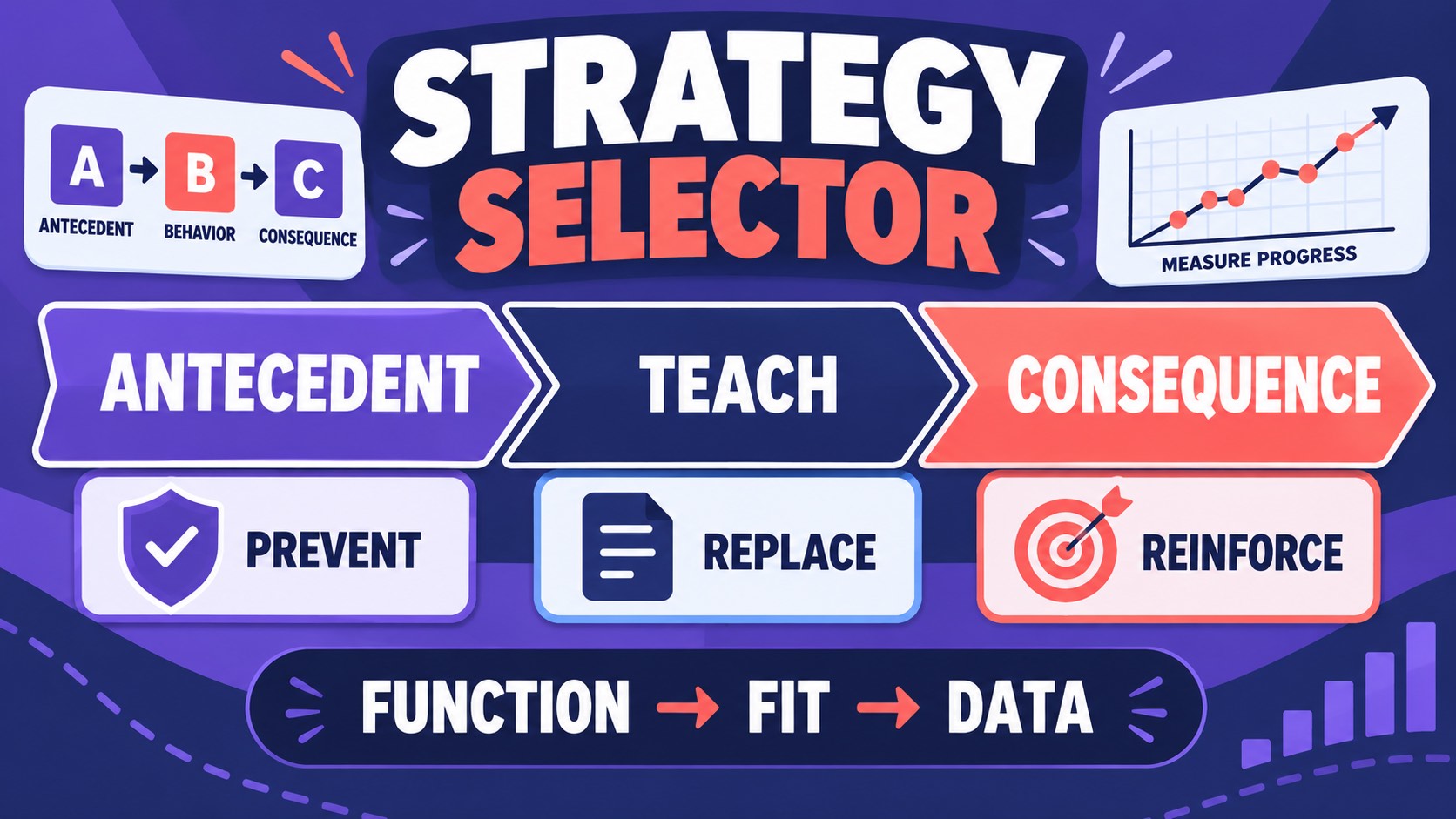
ABA strategies can be grouped in several ways. The categories below are not mutually exclusive; a well-designed intervention often combines an antecedent arrangement, direct teaching, reinforcement, and a plan for generalization.
| Strategy family | Primary question | Study examples |
|---|---|---|
| Antecedent strategies | What can change before the response so the desired behavior is easier or the problem behavior is less likely? | Choice, task modification, visual cues, high-probability sequences, motivating-operation arrangements, and clear instructions. |
| Teaching strategies | What new response should the learner acquire, and how will instruction transfer control? | Modeling, prompting and fading, shaping, chaining, discrimination training, and functional communication training. |
| Consequence and reinforcement strategies | What consequence will strengthen the replacement or desired behavior, and what response pattern is being changed? | Differential reinforcement, planned reinforcement schedules, natural reinforcement, and carefully assessed response strategies. |
| Generalization and maintenance strategies | How will the skill contact reinforcement across people, places, materials, and time? | Programming common stimuli, varying examples, thinning reinforcement, training multiple exemplars, and arranging natural consequences. |
These families overlap with the intervention-development and behavior-change content in the current BCBA outline. The outline is the exam reference; a study article or commercial checklist should not be treated as a BACB endorsement or a substitute for the source document.
How do you select an intervention strategy?
Selection starts with assessment, not with a list of favorite techniques. The strategy should be function-based when the available evidence supports a function hypothesis, should fit the learner and environment, and should be feasible enough to implement with integrity.
- Define the target. Describe the response in observable, measurable terms. A label such as “defiance” or “attention seeking” is not a sufficient target definition.
- Review the assessment. Examine direct observation, ABC patterns, interviews, preference information, skill assessment, and other relevant evidence. Use the assessment method appropriate to the question.
- State the goal. Choose a socially meaningful outcome and identify the replacement skill or behavior to increase. Reducing a response without planning a useful alternative can create a serious implementation problem.
- Match the approach. Select strategies that change the relevant antecedent or consequence, teach an efficient alternative, and make reinforcement available for the desired response.
- Check contextual fit. Consider preferences, culture, communication, resources, response effort, safety, assent or consent requirements, and who will implement the procedure.
- Plan measurement. Choose a measure that answers the decision question and state what pattern will lead to continuation, troubleshooting, modification, generalization, or fading.
On a multiple-choice question, the strongest option often contains this entire chain in compressed form: assessment evidence, observable goal, function-consistent strategy, feasible implementation, and data-based review. A distractor may name a real ABA procedure but apply it before the behavior has been defined or assessed.
Why should an intervention strategy match function?
Function matching means the strategy addresses the consequence or variable that is maintaining the behavior, rather than relying only on the behavior’s appearance. Two behaviors that look similar can require different approaches if they contact different consequences. Likewise, a single behavior can have multiple functions across contexts.
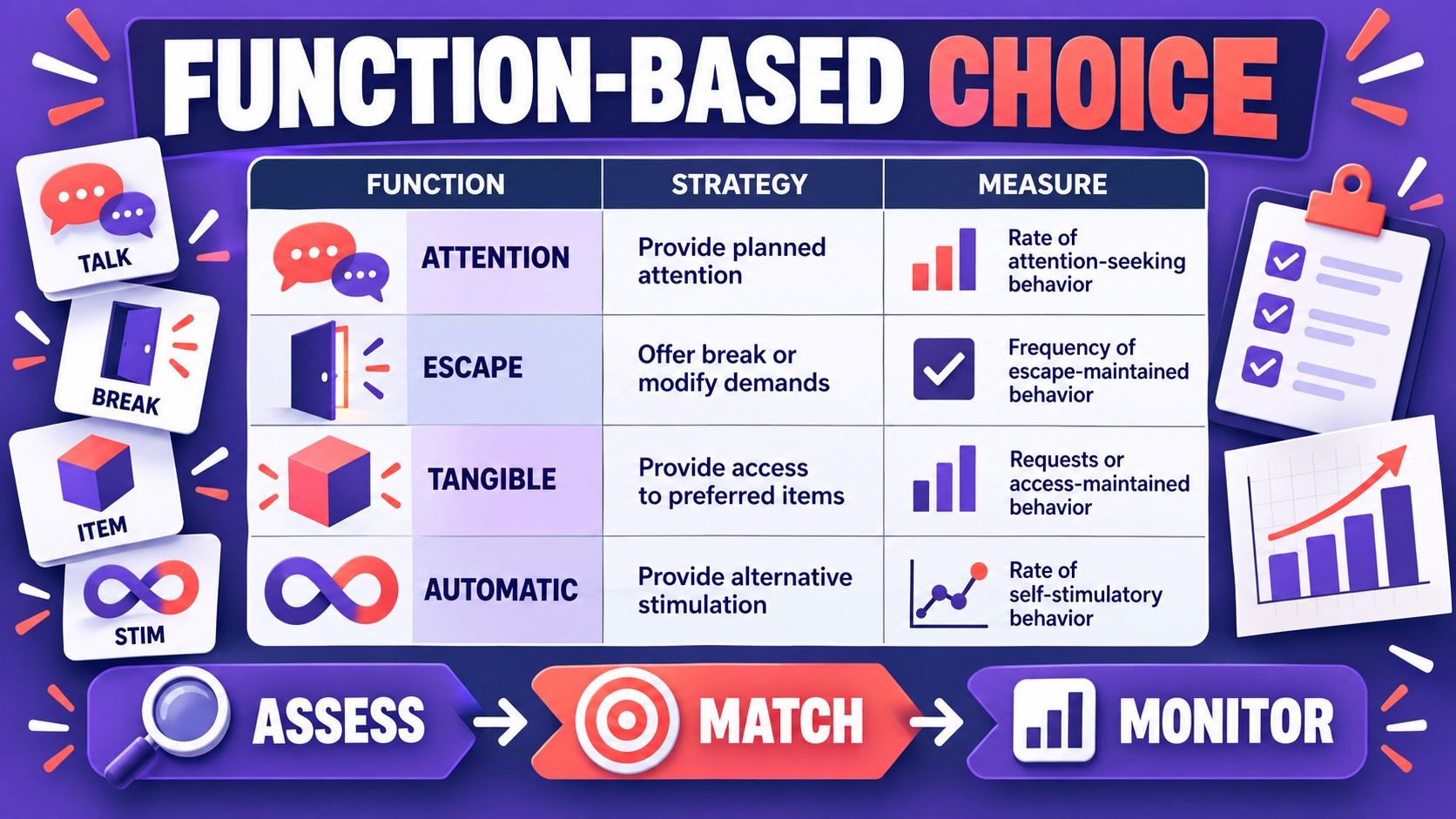
| Assessment pattern | Possible strategy direction | What to measure |
|---|---|---|
| Attention follows the target response | Teach an efficient attention request, arrange appropriate attention for desired behavior, and review whether the request contacts the intended reinforcer. | Target-response rate, independent requests, and appropriate attention-seeking across contexts. |
| Difficult demands precede behavior and escape follows | Teach a functional break or help request, adjust task conditions when justified, and reinforce task engagement or communication. | Latency to start, work completion, break requests, and target-response frequency. |
| Preferred items follow the behavior | Teach a clear item request, arrange predictable access for appropriate behavior, and measure whether requests become more efficient. | Independent requests, target-response rate, delay tolerance, and generalization. |
| The response produces automatic stimulation | Assess the context carefully, teach competing or functionally equivalent responses when appropriate, and evaluate environmental and skill variables. | Target rate, competing response, engagement, and meaningful participation—not merely adult reports of “calm.” |
The table is a study framework, not a prescription. A function label alone does not dictate one universal strategy. The professional must verify the assessment, consider risks and contextual fit, and monitor outcomes. Function-based planning research generally supports matching interventions to assessment information, while also showing why careful implementation and data review matter.
What does an intervention strategy look like in a scenario?
Consider a study scenario: during independent work, a student pushes materials away and calls for help. The behavior occurs most often after multi-step tasks, and the teacher usually removes the task. A weak answer says, “Use a token board because the student needs motivation.” That answer skips the functional pattern and does not specify what the student should do instead. A stronger strategy-level answer would include:
- Clarify the operational definition and confirm the pattern with direct data.
- Break or preview the task when that is consistent with the assessment and learning goal.
- Teach a help or break request that is faster and more efficient than pushing materials.
- Reinforce the request and task engagement according to a clearly stated criterion.
- Collect data on pushing, independent requests, task initiation, and completion.
- Review procedural integrity before concluding that the strategy did or did not work.
Notice that the strategy is a coordinated set of decisions, not a single named technique. A token system could be one component, but it would not explain the replacement response, the task conditions, or the measurement plan by itself.
How do you evaluate an intervention strategy?
Evaluation asks whether the strategy produced a meaningful change under the conditions in which it was intended to work. A graph is useful only when the target, measurement, criterion, and decision rule are clear.
- Measure the target accurately: select frequency, rate, duration, latency, interval, percentage, or another dimension based on the behavior and question.
- Measure the replacement: confirm that the desired alternative is increasing, not merely that adults report fewer problems.
- Check fidelity: determine whether the key steps were implemented as designed before interpreting a weak outcome.
- Review generalization: assess whether the change occurs with new people, settings, materials, and naturally occurring reinforcement.
- Use a decision rule: state what data pattern will lead to maintaining, modifying, fading, or reassessing the strategy.
For example, if the goal is independent help-seeking, track the percentage of opportunities in which the learner requests help without a prompt, the latency to request, the amount of work completed, and the frequency of the original response. If the strategy reduces pushing but also produces constant adult prompting, the team needs more information before calling the change successful.
Evaluation should also include social validity and risk. A strategy can change a graph while increasing response effort, reducing communication, or creating an unacceptable burden for the learner or team. The best BCBA exam answer usually considers both behavioral effect and ethical, contextual fit.
What intervention-strategy mistakes appear on the BCBA exam?
Use this checklist to separate a defensible strategy from a plausible-sounding distractor:
- Procedure before assessment: selecting an intervention because it is popular rather than because the data support it.
- Topography equals function: assuming every scream is attention-maintained or every refusal is escape-maintained.
- No replacement: attempting to suppress a response without teaching a more efficient way to contact the relevant outcome.
- Unmeasurable outcome: writing “be more appropriate” or “be calm” without an observable criterion.
- Fidelity blindness: changing the strategy before checking whether the implementer understood and used it.
- Generalization omission: treating one successful teaching context as proof that the skill is maintained everywhere.
- Automatic-tool error: assuming a software suggestion is clinically correct because it is formatted as a plan.
Quick review: Define the target, assess the relevant variables, identify a meaningful replacement or outcome, choose a function-consistent and contextually fit strategy, teach and reinforce the alternative, measure the target and replacement, check fidelity, and revise from data.
For additional independent practice, use the free BCBA mock exam to test whether you can select the strategy that best matches a scenario. It is a practice and feedback resource, not an official BACB product, does not reproduce official exam questions, and does not guarantee certification or exam performance.
Intervention strategy FAQ
Is an intervention strategy the same as an intervention?: The terms overlap in everyday writing, but “strategy” often describes the approach or decision direction, while “intervention” can mean the full package implemented for a person. Read the question’s context and identify whether it asks for a concept, a procedure, or a complete plan.
Is a token economy always a good intervention strategy?: No. A token economy can be useful in some contexts, but its appropriateness depends on the target, function, reinforcer assessment, implementation feasibility, and measurement plan. It should not be selected merely because it is familiar.
Can an intervention strategy include more than one procedure?: Yes. A function-based strategy commonly combines antecedent supports, teaching, reinforcement, and generalization or maintenance procedures. The components should have a clear purpose and should be evaluated rather than added as an unstructured bundle.
What is the fastest way to answer a strategy question?: Ask: What is the behavior? What happens before and after it? What does the person need to learn? Which option matches the likely function and the stated goal? What data would show whether it worked? This sequence prevents you from choosing a procedure based only on its name.
Bottom line: An intervention strategy is a function-informed, measurable approach to changing behavior or building skills. Strong BCBA reasoning connects assessment, function, replacement behavior, contextual fit, ethical implementation, and data-based revision instead of treating any single technique as a universal answer.
Take the Free BCBA Mock Exam
When you are ready to apply the idea, use the free practice resource below for additional feedback. Take the Free BCBA Mock Exam



