

A single worked behavior momentum ABA example, mapped step by step: what the antecedent arrangement was, what the learner did, what the data support, and how to avoid confusing high-p requests with motivation or reinforcement.
Table of Contents
- Worked Behavior Momentum ABA Example
- What the Example Shows—and What It Does Not Show
- Map the ABC and the High-p Sequence
- High-p Procedure vs. Behavioral Momentum Concept
- Alternative Explanations to Check
- Measure the Example Before Making a Claim
- Fade and Generalize the Example
- A Reusable BCBA Answer Template
- Common Example Mistakes
- Turn the Example Into Practice
- Frequently Asked Questions
- Quick Review Checklist
- Take the Free BCBA Mock Exam
A useful behavior momentum ABA example has more than a string of easy tasks followed by a hard task. It identifies the target response, the environmental change, the high-probability request sequence, the consequence, and the measure. Without those details, “momentum” can become a loose synonym for confidence or engagement rather than a behavior-analytic explanation.
The example below is an educational scenario for BCBA exam preparation. It is not a treatment recommendation for a particular learner. A real plan would require assessment, consent, competence, client and caregiver preferences, risk review, and data-based decisions. The current BACB Test Content Outline (6th ed.) names behavioral momentum as a way to understand response persistence, but the official outline and Ethics Code do not turn one example into a complete intervention.
Worked Behavior Momentum ABA Example
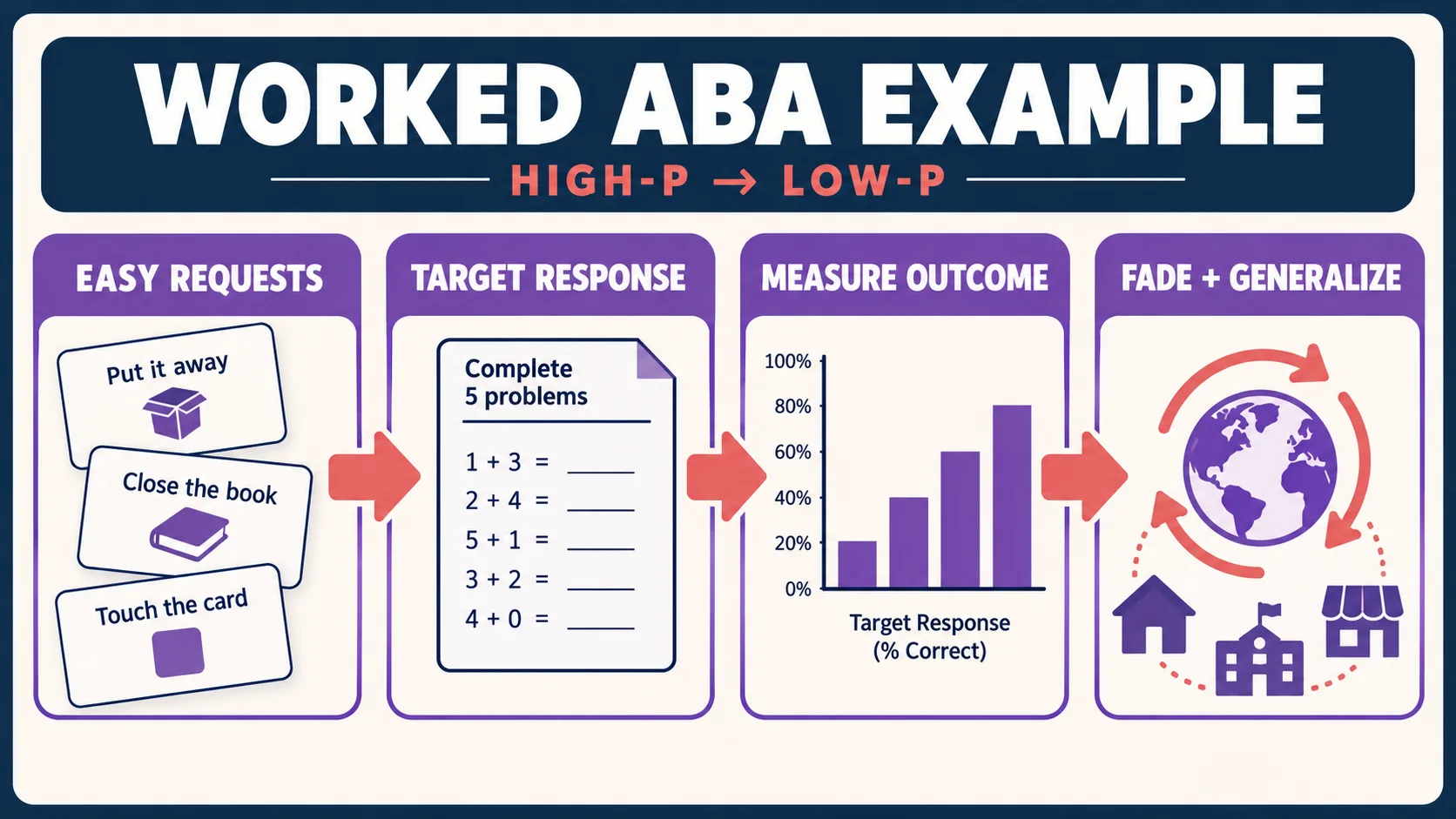
Scenario: During a structured learning period, a learner usually begins a worksheet within 30 seconds after an instruction on 2 of 10 baseline opportunities. The analyst first presents three mastered, one-step requests—“touch the red card,” “give me the pencil,” and “point to the window.” The learner completes each request quickly. Immediately afterward, the analyst presents the worksheet-start instruction and measures whether the learner begins within 30 seconds.
In one condition, the learner starts the worksheet on 8 of 10 opportunities and the average latency decreases. In another condition, the easy requests are omitted and the worksheet-start instruction is presented first; starting returns closer to baseline. The team repeats the comparison across planned sessions, checks whether the sequence was delivered as written, and considers whether the effect transfers to a different routine.
This is a high-probability request sequence example. It may be described as a momentum-based antecedent strategy because responding to the easy requests precedes the lower-probability target request. The data support a cautious statement: the sequence was associated with improved worksheet initiation under the tested conditions. They do not yet prove that every difficult task will improve, that the learner is more motivated in a general sense, or that the sequence is the only active variable.
What the Example Shows—and What It Does Not Show
The example shows an arranged relation between a series of high-probability responses and a later target response. It also shows why the target behavior needs an operational definition. “Was more willing” is not enough. “Began writing within 30 seconds of the worksheet instruction” gives the analyst a response and a latency measure.
The example does not show that easy tasks are inherently reinforcing, that praise was the cause, or that the sequence should be used whenever a learner hesitates. A consequence can affect future responding; an antecedent sequence can change the immediate probability of responding; and a motivating operation can change the value of a consequence. Analyze those relations separately.
Research on behavioral momentum and high-probability requests has examined compliance, latency, task duration, inter-instruction timing, programmed reinforcement, and generalization. Findings from a study or synthesis should inform careful reasoning, not replace assessment of the learner and setting in front of you.
Map the ABC and the High-p Sequence
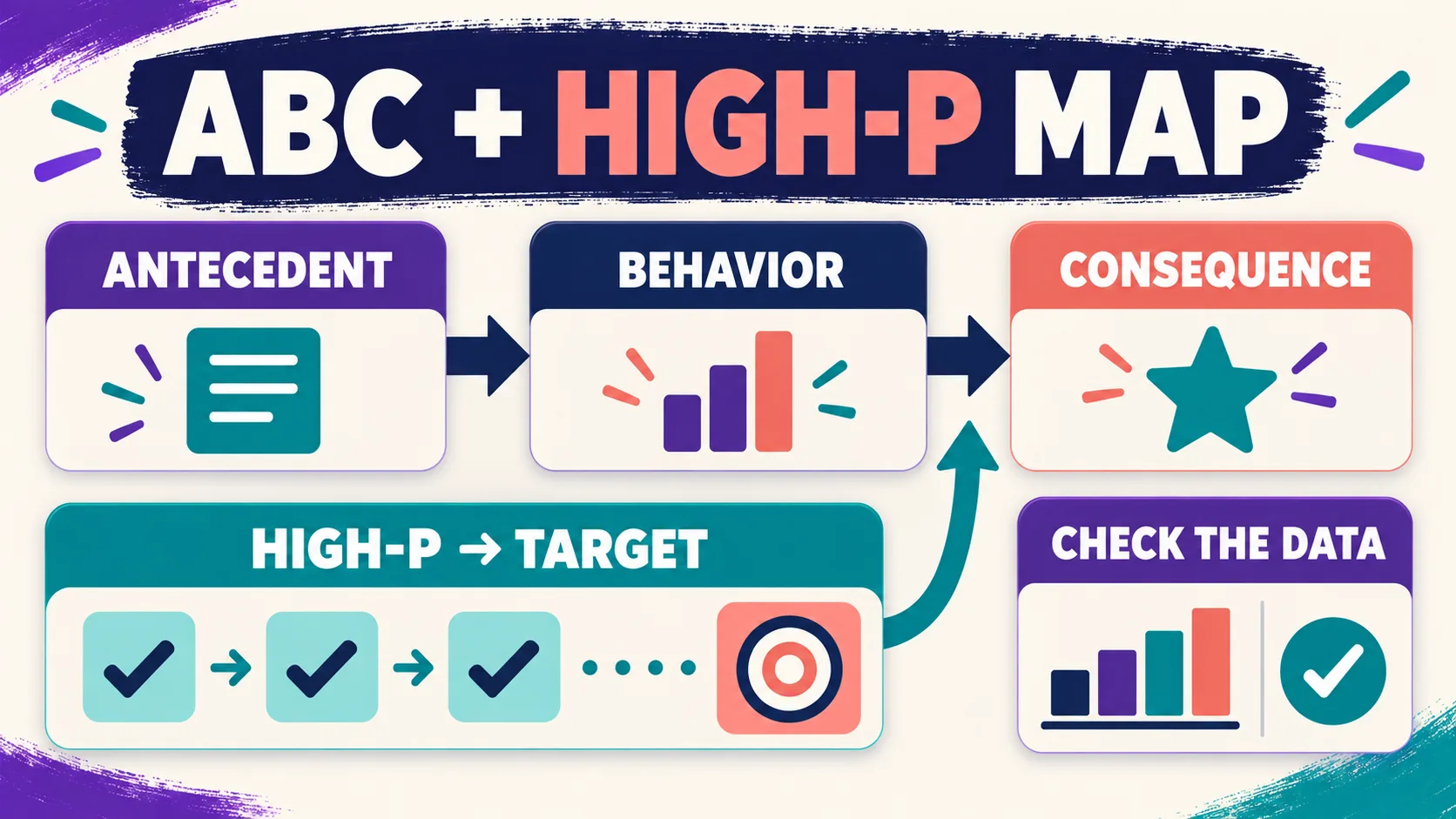
Break the scenario into the three-term contingency and the extra sequence details. The worksheet instruction is not automatically the “consequence” simply because it follows the easy requests. The easy requests are antecedent events for their own responses; the worksheet instruction is an antecedent for worksheet initiation. A later consequence may follow the target response and may or may not change future responding.
| Scenario element | What happened | How to classify it | What still needs evidence |
|---|---|---|---|
| High-p requests | Three mastered requests were presented in quick succession. | Antecedent arrangement for the later target request. | Were the requests actually high probability in this context? |
| Low-p target | The worksheet-start instruction followed the easy requests. | Antecedent for the target response of worksheet initiation. | Is the latency rule unchanged across conditions? |
| Target behavior | The learner began writing within the defined time. | Observable operant response measured for initiation and latency. | Does the response persist when the sequence is faded or the setting changes? |
| Later consequence | Praise, a break, or another planned event may follow initiation. | Potential consequence; reinforcement requires a future increase. | Was the consequence delivered, and did later initiation increase? |
This map prevents an answer choice from calling the entire episode “positive reinforcement” simply because the learner completed a task. The target response may be followed by a consequence, but the high-p sequence is an antecedent procedure. The term “behavior momentum” may describe the persistence pattern being examined, not the name of every event in the episode.
High-p Procedure vs. Behavioral Momentum Concept
The high-p sequence is a procedure: present two or more easy requests before a less likely request, then measure the target response. Behavioral momentum is a broader concept about persistence following a change in environmental conditions. In study materials, the terms are often linked because the procedure was developed and discussed in relation to momentum, but they answer different exam questions.
If the stem asks, “Which intervention should precede the difficult instruction?” the high-p sequence may be the best match. If it asks, “Which concept helps explain why responding continues after the condition changes?” the answer may be behavioral momentum or response persistence. If it asks, “What consequence increased later responding?” look for reinforcement evidence instead.
Alternative Explanations to Check
A strong BCBA example includes an alternative-explanation check. When worksheet initiation improves, ask what else changed at the same time. The analyst may have changed the materials, reduced the response effort, added attention, shortened the task, increased reinforcement, or delivered clearer instructions. Any of those variables could affect the outcome.
- Attention: Did the learner receive more interaction during the sequence than in baseline?
- Reinforcement: Were easy responses followed by praise or preferred items that could change later responding?
- Response effort: Did the worksheet become shorter, more familiar, or easier to start?
- Timing: Was the target request delivered immediately or after a longer pause?
- Instruction quality: Did the wording, prompt, materials, or position of the adult change?
- Setting events: Were sleep, hunger, illness, schedule, or competing activities different?
These questions do not make a high-p procedure useless. They make the conclusion more accurate. If the design deliberately manipulates the sequence while holding relevant variables steady, the evidence becomes stronger. If several features change together, say that the intervention package was associated with improvement rather than claiming one mechanism caused it.
Measure the Example Before Making a Claim
Use a measure that matches the behavior in the stem. For worksheet initiation, percentage of opportunities and latency may be more informative than total session frequency. For task completion, duration or percentage completed may matter. For quality, record errors, prompt level, or independent steps. The question is not “Did the learner look better?” but “What changed in the defined response under the defined condition?”
- Collect baseline on the target response before adding the high-p sequence when ethically and practically appropriate.
- Record whether each high-p request was completed and whether the target request was delivered as planned.
- Measure the target response with the same latency, duration, or completion rule across conditions.
- Check procedural integrity so a missed step is not mistaken for an ineffective concept.
- Graph the data and decide whether the pattern is replicated, maintained, or generalized.
Fade and Generalize the Example
If the sequence helps, the long-term question is whether the learner can respond with less support. The analyst may gradually reduce the number of high-p requests, vary the requests, change the materials, or test another instructor, while keeping the target definition and safety boundaries clear. The exact fading plan depends on assessment and data; there is no universal number of easy requests that guarantees success.
Generalization checks ask whether the response occurs across people, tasks, materials, routines, or settings. Maintenance checks ask whether it continues over time as the training arrangement changes. A learner who starts a worksheet only after three easy requests in one room has not yet demonstrated broad independent task initiation. That is why the example should end with a transfer probe, not the first successful trial.
A Reusable BCBA Answer Template
For a multiple-choice item, write a short internal answer before looking at the options:
- Behavior: “The target response is ___, measured by ___.”
- Antecedent: “The high-p sequence or environmental change is ___.”
- Concept: “This is best described as behavioral momentum/persistence or a high-p procedure because ___.”
- Boundary: “It is not automatically motivation or reinforcement because the stem does/does not show ___.”
- Decision: “The next step is to measure, replicate, fade, generalize, or reassess ___.”
This template turns a memorable story into behavior-analytic reasoning. It also helps when the answer choices use overlapping language. Choose the option that matches the evidence and the question’s requested level of analysis, not the option with the most familiar buzzword.
Common Example Mistakes
- Calling every easy-to-hard sequence behavioral momentum: identify whether the response persisted after a change and whether a high-p procedure was actually arranged.
- Using “compliance” without a definition: specify initiation, completion, latency, or another observable response.
- Ignoring reinforcement: check what followed the target response and whether later behavior increased.
- Ignoring response effort: a simpler worksheet or shorter task may explain improvement.
- Assuming generalization: test relevant settings and people instead of extending the claim automatically.
- Treating a worked example as a clinical prescription: use assessment, competence, consent, and safety procedures in real practice.
Turn the Example Into Practice
Use the Free BCBA Mock Exam to practice scenarios involving behavioral momentum, high-probability requests, reinforcement, motivating operations, persistence, and generalization. After each question, label the error as concept, antecedent, consequence, measurement, or ethical reasoning. That makes the next study session targeted. This page is intentionally a new, worked-example URL. It does not refresh or replace the site’s older behavior-momentum pages; those pages remain separate resources with their original URLs and media.
Frequently Asked Questions
What is a behavior momentum ABA example?
It is a scenario in which a defined response pattern persists after an environmental change, often illustrated with a high-probability request sequence before a less likely request. What is the easiest high-p example to remember?
Present several mastered requests that the learner usually completes, then present a target request with a lower baseline probability. Measure the target response rather than assuming the sequence worked. Is high-p the same as positive reinforcement?
No. High-p sequencing is an antecedent arrangement. Positive reinforcement requires adding a consequence that increases future behavior.
What should I include in a BCBA exam answer?
Name the observable response, the antecedent arrangement or environmental change, the relevant concept, the data, and the next decision. Do not add a function or mechanism that the stem does not support.
Bottom line: A strong behavior momentum ABA example is a measured relation, not a motivational slogan. Map the high-p sequence, define the target response, separate antecedents from consequences, check alternatives, and test persistence, fading, and generalization.
Quick Review Checklist
Use this final checklist to turn behavior momentum aba example into exam-ready reasoning. The goal is not to memorize a label in isolation; it is to identify the relevant evidence and explain why the best answer fits the scenario. Key ideas to review:
- State the central definition or decision point for behavior momentum aba example in your own words.
- Identify the detail that makes behavior momentum aba example different from its closest related ABA term.
- Separate the observable facts in a scenario from assumptions that are not supported by the facts.
- Write one example and one nonexample so you can recognize the concept in a new setting.
Exam application checks:
- Ask what the question is actually requesting before comparing the answer choices.
- Mark the antecedent, response, consequence, or other evidence that supports the selected answer.
- Look for a distractor that describes a related process but does not answer the specific question.
Final self-check:
- Explain how you would verify the interpretation with clear observations or data.
- Change one detail in the scenario and decide whether your answer should change.
- Give a one-sentence rationale that a supervisor or study partner could evaluate.
Take the Free BCBA Mock Exam
When you are ready to apply the idea, use the free practice resource below for additional feedback. Take the Free BCBA Mock Exam



