
If you are studying stimulus overselectivity ABA concepts, focus on the relation between a compound cue and the response it controls. A learner may respond accurately when several features appear together, yet later respond as if only one feature mattered. The important question is not whether the learner “looked” at the whole stimulus. It is whether the relevant features actually acquired stimulus control.
Table of Contents
- What Is Stimulus Overselectivity in ABA?
- What Does the Stimulus Overselectivity Pattern Look Like?
- How Do You Test for Overselective Stimulus Control?
- How Is Overselectivity Different From Faulty Control and Overgeneralization?
- What Data Should a BCBA Collect?
- How Can a BCBA Support Broader, More Accurate Stimulus Control?
- How Does Stimulus Overselectivity Appear on the BCBA Exam?
- Stimulus Overselectivity ABA FAQ
- Take the Free BCBA Mock Exam
Stimulus overselectivity is a technical description of narrow stimulus control, not a label for a person and not a conclusion that should be made from one error. It is especially useful when a BCBA is analyzing discrimination learning, receptive-language instruction, matching tasks, or generalization. This guide defines the pattern, shows how to test it, separates it from faulty stimulus control and overgeneralization, and connects the concept to respectful data-based teaching.
What Is Stimulus Overselectivity in ABA?
Stimulus overselectivity in ABA occurs when responding to a compound or complex stimulus is controlled by only a limited subset of the stimulus features that are present. Imagine a learner is taught to select a picture when a card contains a dog, a blue ball, and a particular background. If later testing shows that the learner responds accurately when the dog’s head is present but not when the dog’s body or the background is presented alone, the dog’s head may be carrying most of the control.
The term does not mean that the selected feature is irrelevant in every situation. It means that control is narrower than the teaching arrangement may have intended. A response can be correct during training because the correct feature is always bundled with other features. A feature-isolation probe is needed before the team claims that all parts of the compound cue control responding.
Research has used several terms for related patterns, including overselective stimulus control and restricted stimulus control. The literature also cautions that the concept can be difficult to distinguish from random variation, weak discrimination, or an inadequate test. That caution is important: the BCBA should operationally define the stimulus components, arrange a fair assessment, and interpret the data rather than infer a learning history from appearance alone.
What Does the Stimulus Overselectivity Pattern Look Like?
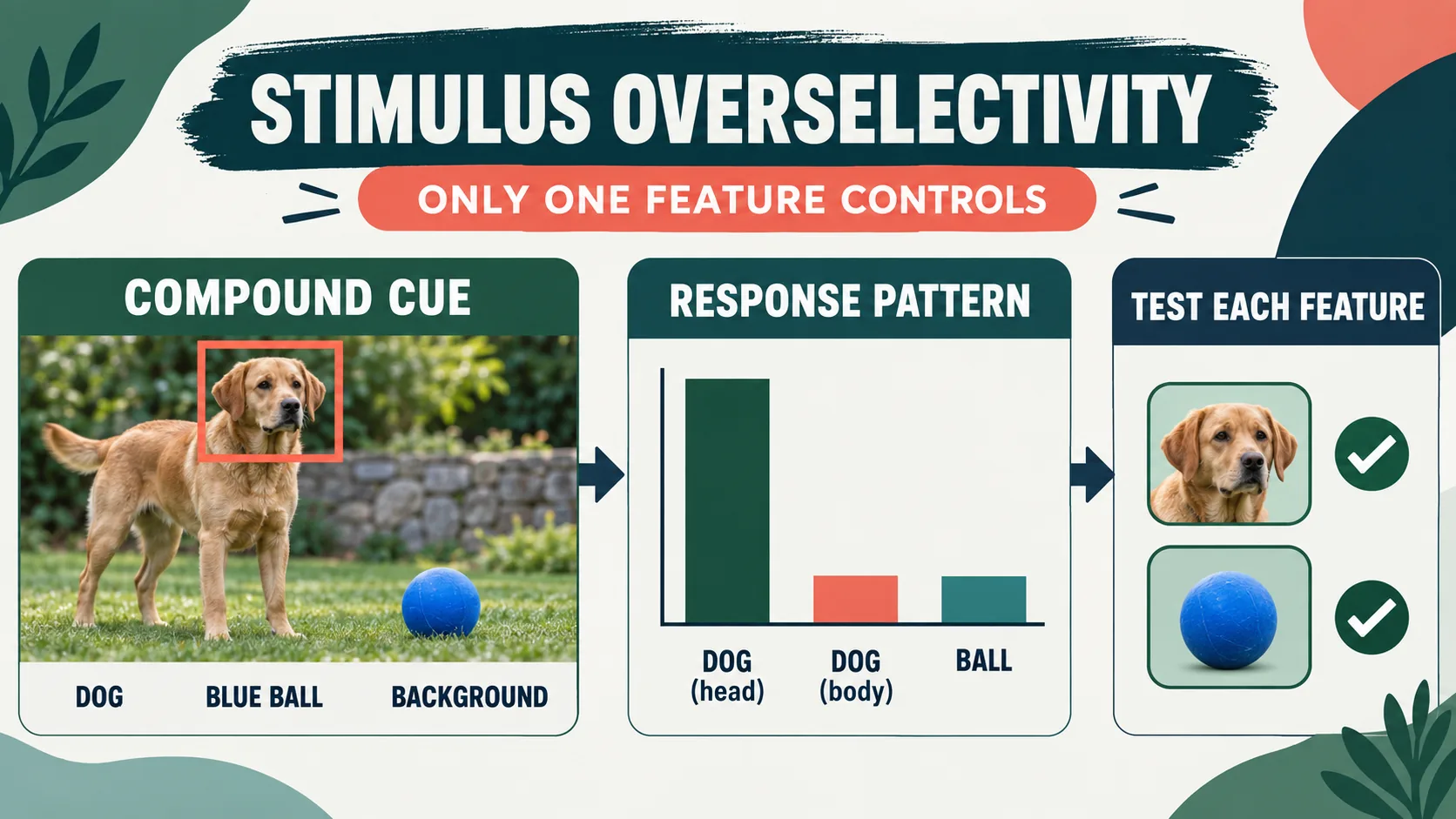
A simple pattern has three parts. First, the learner contacts a compound cue during teaching. Second, the response appears correct when the compound is intact. Third, the analyst tests the components separately or in new combinations and finds that responding changes sharply depending on one feature. The difference between the intact cue and the component probes is the reason the test matters.
- Compound training: two or more stimulus elements appear together while the response is reinforced.
- Component testing: the elements are presented alone or in controlled combinations.
- Response comparison: accuracy, latency, errors, and observing responses are compared across the probes.
- Interpretation: a large, reliable difference suggests that control may be concentrated in one feature rather than distributed across the compound.
Use neutral language in the record. “Responding was accurate when the dog card was intact and fell to 20% when the head cue was removed” is more useful than “the learner only sees the head.” The first statement identifies an observable relation and leaves room for further testing.
How Do You Test for Overselective Stimulus Control?
Testing should answer a specific question: which stimulus dimension or feature is controlling the response under the current conditions? Begin with a clear compound stimulus and define the response. Then plan probes that separate the features without changing several other variables at once.
- Map the components: list the color, shape, position, texture, spoken word, visual feature, or other dimensions that make up the cue.
- Hold the response requirement steady: keep the instruction, response topography, consequence, and prompt level as comparable as possible.
- Probe one feature at a time: present isolated components and carefully selected recombinations rather than changing the entire task.
- Measure more than accuracy: record latency, prompt level, observing responses, errors, and whether the learner contacts the intended consequence.
- Replicate the pattern: repeat probes across sessions, exemplars, or instructors before making a strong conclusion.
An observing response can be part of the assessment. If the learner must touch, look toward, scan, or otherwise sample the display before responding, define that behavior and measure it. A response can be correct for the wrong reason, and a low observing response can make a component test look like a discrimination failure. The assessment should separate those possibilities.
How Is Overselectivity Different From Faulty Control and Overgeneralization?
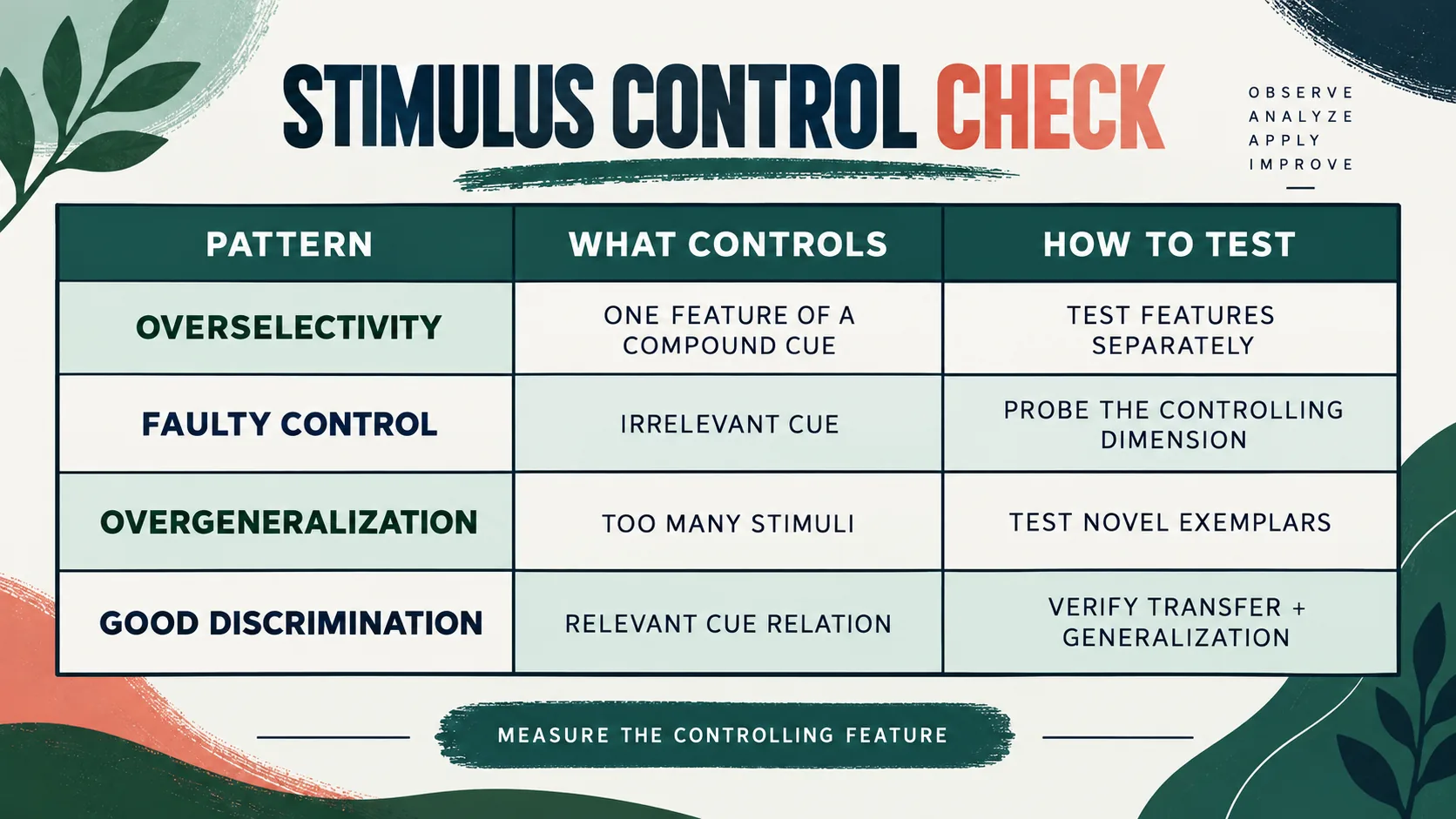
These patterns can look similar in a classroom because all three may produce errors. The classification depends on what controls responding and where the response occurs. The table below is a study aid; the actual case still requires an operational definition, a measurement plan, and a review of the teaching arrangement.
| Pattern | What controls | Useful test |
|---|---|---|
| Overselectivity | One feature or a small subset of a compound cue controls the response. | Test the features separately and compare the response pattern. |
| Faulty stimulus control | An unintended or irrelevant cue controls responding. | Vary the suspected irrelevant dimension while holding the intended cue constant. |
| Overgeneralization | The response occurs across stimuli or contexts that should not all evoke it. | Probe novel nonexamples and boundary conditions. |
| Discrimination failure | The relevant relation has not reliably controlled responding. | Review prerequisite skills, prompts, reinforcement, and the error pattern. |
For example, if a learner selects every card with a red border even though the programmed relation is the picture inside the border, that may be faulty control by an irrelevant cue. If a learner responds to many unrelated pictures after learning one target, overgeneralization may be the better description. If performance is accurate only when one part of a compound is present, overselectivity is the more precise hypothesis.
What Data Should a BCBA Collect?
The data system should make the stimulus relation visible. Record the exact stimulus arrangement and the response opportunity, not only a session percentage. A single overall accuracy score can hide the fact that one feature is doing all the work.
- Identify the stimulus components and the intended controlling dimension.
- Record correct, incorrect, prompted, and omitted responses by probe type.
- Track latency and observing responses when sampling or scanning may affect performance.
- Record the prompt, consequence, intertrial interval, and position of each component.
- Graph performance across intact compounds, isolated features, recombinations, and novel exemplars.
- Document the number of opportunities and whether the test was conducted across people, materials, and settings.
Position effects and repeated exposure matter. A feature may appear to control responding simply because it is always on the left, always closer to the learner, or always paired with a particular prompt. Randomize or counterbalance the relevant dimensions when practical. If the assessment changes too many variables at once, the team may discover that performance changed without discovering why.
How Can a BCBA Support Broader, More Accurate Stimulus Control?
Intervention should follow the assessment and the learner’s goals. The objective is not to force attention to every visual detail. The objective is to teach the relevant relation clearly, reduce accidental control by irrelevant features, and promote flexible responding across meaningful examples.
- Clarify the target relation: decide what feature, relation, or conditional rule should control the response.
- Vary noncritical features: change position, background, materials, and exemplars so the intended relation is not tied to one display.
- Use appropriate prompting: prompt the relevant observation or response, then fade prompts so they do not become the controlling cue.
- Reinforce accurate discrimination: make the programmed consequence contingent on the intended response while monitoring effort and frustration.
- Program generalization: test new people, materials, settings, and response forms after the relevant discrimination is stable.
- Check assent and access: offer reasonable breaks, observe communication, and avoid interpreting an assessment error as a character flaw.
Do not assume that adding more repetitions will solve overselectivity. More repetitions of the same compound can strengthen the very narrow relation that created the problem. A better plan changes the relevant teaching arrangement, tests the result, and uses data to decide whether the learner is contacting the intended relation.
How Does Stimulus Overselectivity Appear on the BCBA Exam?
On an exam scenario, identify the compound stimulus first. Ask what features are present, what response is being reinforced, and what the question says about performance when a feature is removed or changed. If one component reliably predicts correct responding while other components do not matter, choose the answer that describes restricted or overselective stimulus control.
- Look for the compound: the question may describe a picture, spoken instruction, array, or multifeature cue.
- Look for isolation: a feature is tested alone, removed, rotated, or recombined.
- Look for the response pattern: accuracy depends on one feature rather than the full relation.
- Rule out neighbors: irrelevant-cue control, overgeneralization, prompt dependence, and weak discrimination have different evidence.
- Choose the next measurement: feature-isolation probes and controlled recombinations are more informative than another undifferentiated practice trial.
Use the current BACB Task Lists as the exam boundary, and verify how your study materials map stimulus control, discrimination, prompts, and generalization to the current content outline. Research papers can explain the phenomenon, but they do not replace current BACB requirements.
Stimulus Overselectivity ABA FAQ
Is stimulus overselectivity the same as not paying attention?: No. The term refers to a pattern of stimulus control, not an informal judgment about attention. A learner may attend to a display and still respond under control of only one feature. The team should measure the relevant observing and response patterns before making an interpretation.
Does stimulus overselectivity occur only in autism?: No. Research has examined the pattern in different populations and developmental contexts. It may be relevant when a learner’s discrimination is narrow, but it should not be treated as inevitable or used as a diagnosis. Assess the individual relation and the teaching history.
What is the fastest way to remember the concept?: Remember: “compound cue, narrow control, feature test.” Ask whether the response is correct only while the full cue is present, then test which feature continues to control responding when the components are separated.
After you can identify the controlling feature, practice applying the distinction to scenario-based items. Our free BCBA mock exam can help you test stimulus control, discrimination, prompting, and generalization reasoning. When a question involves a current certification rule, return to the BACB source and record the version you used.
Take the Free BCBA Mock Exam
When you are ready to apply the idea, use the free practice resource below for additional feedback. Take the Free BCBA Mock Exam



