
Free ABA training for teachers is most useful when it builds classroom fluency, not when it promises a credential. Start with behavior basics, use reputable educator resources, protect student privacy, and involve the school’s BCBA or team when a question moves beyond general classroom support.
Table of Contents
- What Free ABA Training for Teachers Can Actually Provide
- Start With the Classroom Basics
- A Free ABA-Informed Training Path
- Free Resources to Compare
- Free, Paid, and Credentialed Training Are Different
- Classroom Safety, Privacy, and Role Boundaries
- How to Use an ABC Observation Without Overclaiming
- When to Involve the BCBA or School Team
- A Practical Next Step
- Frequently Asked Questions
- Sources and Scope
- Quick Review Checklist
- Take the Free BCBA Mock Exam
If you are searching for free ABA training for teachers, you probably want something practical: how to understand an ABC pattern, teach expectations, reinforce a replacement behavior, collect simple data, and collaborate with a behavior-analytic team. You may also be wondering whether a free module gives BACB credit or qualifies you to provide ABA services. It does not automatically do either. Free learning can be a strong starting point, but its purpose and limits should be clear.
The IRIS Center at Vanderbilt, the U.S. Department of Education’s IDEA behavioral-support resource page, and the Center on PBIS are useful places to begin. They provide educator-oriented learning and practice resources. They do not replace a student-specific assessment, an IEP or school-team process, supervision, or professional training required for a credential.
What Free ABA Training for Teachers Can Actually Provide
A good free resource can help a teacher learn the language and logic of behavior support. It can explain antecedents, observable behavior, consequences, reinforcement, prompting, shaping, generalization, and simple data collection. It can also provide classroom examples, self-check questions, worksheets, or a short sequence for planning routines.
That is different from learning to practice independently as a BCBA. A teacher-facing module usually does not provide supervised fieldwork, a competency assessment, authorization to conduct a functional analysis, or permission to change a student’s behavior plan outside the school’s procedures. The BACB supervision and training guidance describes separate pathways for certification, supervised experience, and specific training roles.
Use free training for three purposes: build shared vocabulary with the team, improve consistent classroom implementation of an approved plan, and identify better questions for the BCBA or IEP team. If a course advertises a certificate, read what the certificate actually verifies. Completion of a module is not the same as BACB certification, BACB Learning CE, or district approval.
Start With the Classroom Basics
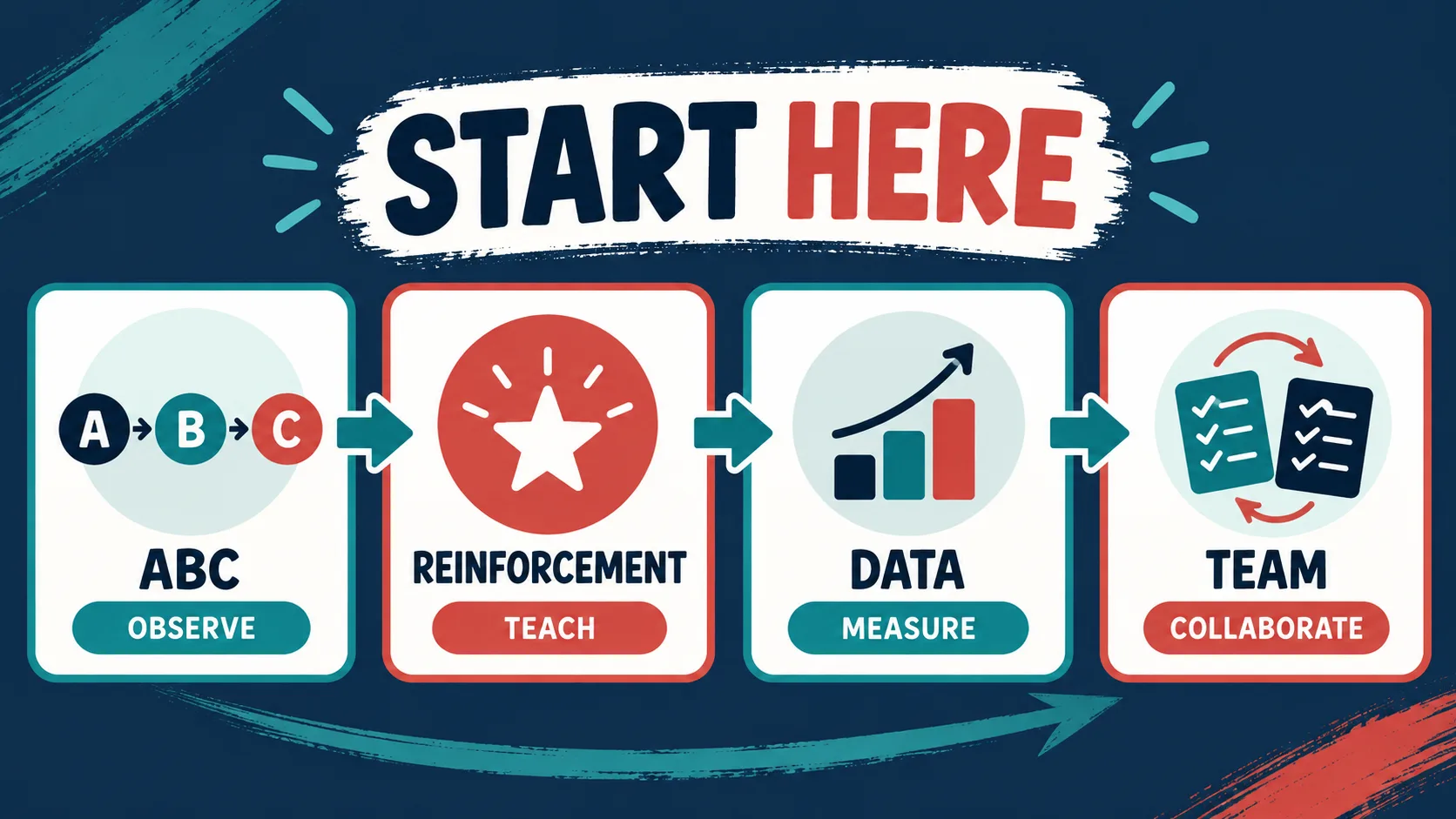
Before searching for advanced “ABA techniques,” learn the sequence that makes classroom support understandable. Begin with the routine, define the student response, identify what happens before and after it, and decide what data would show improvement. The goal is not to label a child. The goal is to describe a teachable situation accurately enough for the team to respond.
| Learning topic | Teacher should be able to | Useful classroom question | Boundary |
|---|---|---|---|
| ABC observation | Describe what happened before, what the student did, and what followed. | What changed in the routine right before the response? | An ABC note is an observation, not a confirmed function. |
| Reinforcement | Deliver an approved consequence consistently and watch whether the response changes later. | Did the future rate, duration, or independence change? | A preferred event is not automatically a reinforcer. |
| Prompting | Use the prompt written in the plan and record the level needed. | Can the student perform the skill with less help over time? | Do not invent a new prompt hierarchy without team agreement. |
| Generalization | Check whether the skill occurs with different materials, adults, or routines. | Where else should this skill be useful? | Transfer should be planned, not assumed. |
This foundation helps teachers avoid two opposite mistakes. One is doing nothing because behavior seems mysterious. The other is applying a technique from a video without checking the student’s plan, preferences, culture, communication needs, or safety risks.
A Free ABA-Informed Training Path
Work through free resources in a sequence instead of opening random technique videos. The following path is short enough for a team meeting and concrete enough to turn learning into a question for practice.
- Learn observable language. Replace “defiant” or “unmotivated” with a description that another adult could see and count, such as “pushes the worksheet away within 10 seconds of the instruction.”
- Review antecedent supports. Study clear directions, visual schedules, choice, task arrangement, transition warnings, and opportunities to respond. These supports should match the classroom plan and not be treated as a universal fix.
- Review reinforcement and replacement skills. Identify what the student is being taught to do instead of the problem response and how the approved consequence will be delivered.
- Practice one data rule. Choose a small measure—independent opportunities, latency, duration, or frequency—and use the same definition across observations.
- Check implementation. Ask whether the prompt, instruction, consequence, and timing were delivered as written. Inconsistent delivery can look like student inconsistency.
- Bring one question to the team. Share a brief, de-identified observation and ask the BCBA or IEP team what should remain stable, what may be adjusted, and what data they need.
Free Resources to Compare
The best free options are transparent about who they serve and what completion means. Start with resources built for educators rather than pages that promise instant expertise.
- IRIS Center: Explore its open educator modules and the classroom behavior-management series. The modules are designed for teachers and school personnel, and current certificate or professional-development terms should be verified on the site.
- IDEA behavioral-support resources: Use this federal resource page as a route to classroom behavior-management modules and related school supports.
- Center on PBIS teacher practice guide: Review the current guide for low-intensity teacher-delivered supports in K–5 settings. It is a practice resource, not a BACB certificate.
- School or district training: If your school already has a BCBA, special-education team, or behavior-support lead, ask which free module matches the student’s approved plan. Local fit is often more useful than a generic list of techniques.
Free, Paid, and Credentialed Training Are Different
“Free” describes the price, not the authority or the learning outcome. A free open module may be exactly right for teacher orientation. A paid course may offer instructor feedback, assignments, or a district tracking system. A credentialed pathway has its own admission, coursework, supervised experience, examination, or continuing-education requirements.
- Free open learning: useful for vocabulary, classroom examples, self-checks, and planning questions. Confirm whether a completion record is offered and what it represents.
- Paid professional development: may add live instruction, coaching, implementation feedback, or district documentation. Payment alone does not make a course BACB-authorized.
- BACB Learning CE: verify the provider in the BACB ACE Provider information and registry. Do not assume that an ABA topic, a certificate of attendance, or a free webinar counts as BACB Learning CE.
- Certification training: teacher orientation does not replace the requirements for becoming a BCBA, BCaBA, or RBT, and it does not authorize independent behavior-analytic practice.
A responsible page should say this plainly because teachers may be looking for “training” for very different reasons: classroom support, district professional development, a future career, or exam preparation. The next step depends on the reason.
Classroom Safety, Privacy, and Role Boundaries
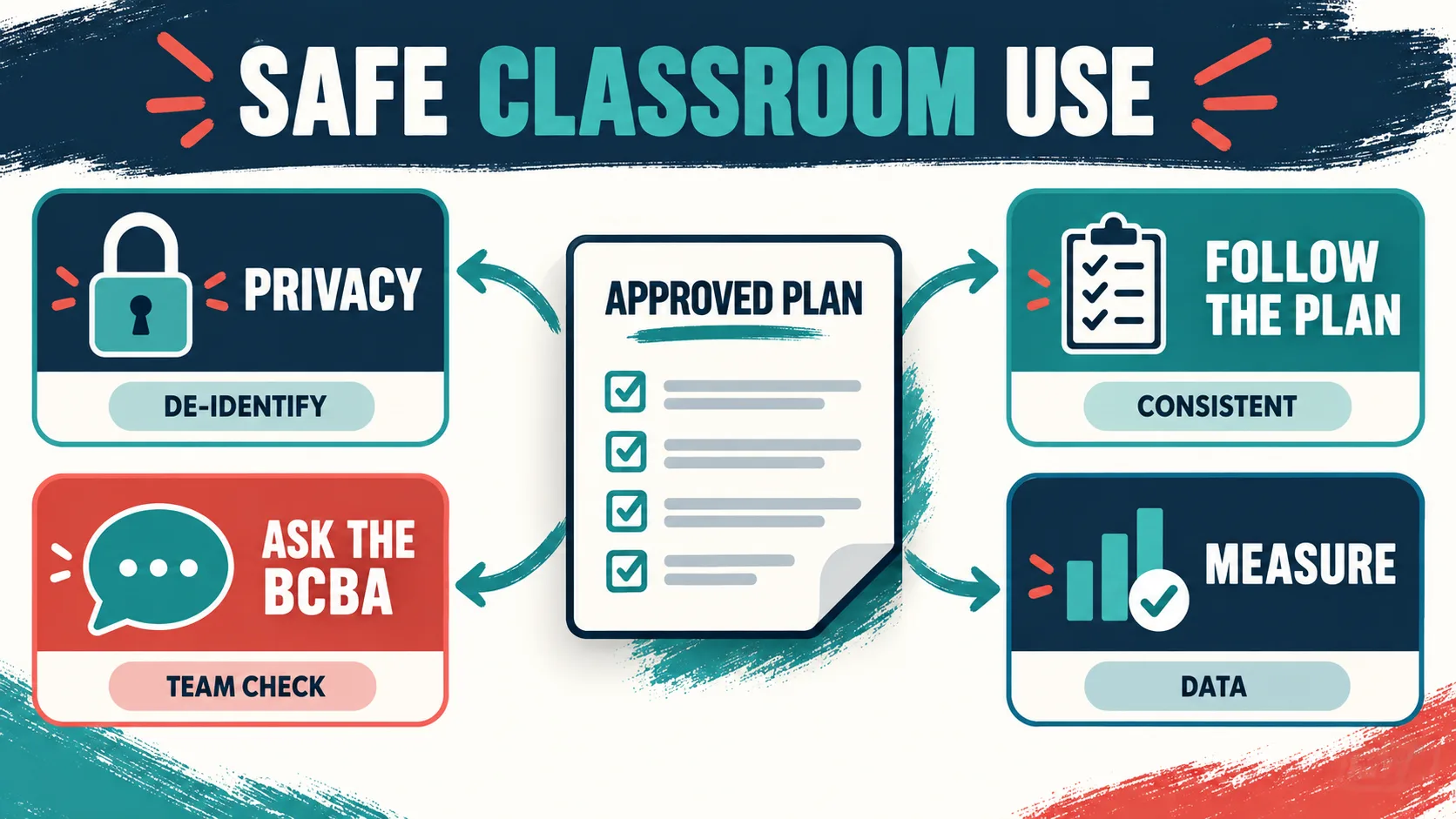
Free learning should increase coordination, not encourage a teacher to work around the student’s team. Use only the information needed for the educational task. Store notes according to school policy, avoid putting identifying details into public forums, and do not post a student’s name, image, diagnosis, or behavior data in a course discussion or social-media group.
The BACB Ethics Code for Behavior Analysts applies to behavior analysts, but its emphasis on client welfare, dignity, confidentiality, collaboration, and competence is a useful boundary for any team discussion. Teachers should follow their own professional code, school policy, consent process, and applicable education law as well.
Pause and ask for help when a situation involves injury risk, restraint or seclusion, medication, suspected abuse, a major plan change, a new assessment, or a behavior that the teacher cannot safely manage. A free module cannot evaluate a particular student. Bring the concern to the appropriate administrator, special-education team, BCBA, or other qualified professional.
How to Use an ABC Observation Without Overclaiming
Suppose a student leaves the reading table after a difficult passage is presented. A useful observation might record: the passage was placed on the desk; the teacher delivered the instruction; the student stood and walked toward the door; the teacher followed and removed the passage. That note helps the team ask whether task difficulty, escape, attention, or another event may be relevant. It does not prove a function by itself.
For a teacher, the next safe step is usually to collect the agreed data and report patterns to the team, not to add a new consequence independently. If the plan teaches a break request, record whether the request was prompted or independent, whether the break was delivered as written, and what happened next. This creates information the BCBA can use without turning a classroom observation into an informal diagnosis.
When to Involve the BCBA or School Team
Ask for team support when the behavior is new, escalating, unsafe, interfering substantially with learning, or not responding to the approved plan. Also ask when the student’s communication, sensory, medical, cultural, or trauma-related context may affect the interpretation. The teacher’s observation is essential, but no single observer has the whole picture.
Bring a short summary: the routine, the observable response, the immediate events before and after, the data rule, and what you tried from the existing plan. Avoid conclusions such as “the student was seeking attention” unless the team has evidence for that claim. Precise notes make collaboration faster and protect the student’s dignity.
A Practical Next Step
Choose one free module, complete one classroom behavior section, and write down one change you will make only if it fits the approved plan. Then prepare one de-identified question for your school team. If you are also studying BCBA terminology or collaborating with a BCBA candidate, the Free BCBA Mock Exam can help you practice ABC, reinforcement, prompting, measurement, and ethics vocabulary. It is exam practice—not teacher certification, supervision, or BACB CE.
Frequently Asked Questions
Where can teachers find free ABA-related training?: Start with the IRIS Center, the U.S. Department of Education’s behavioral-support resources, and Center on PBIS teacher guides. Check the current provider terms and choose modules designed for educators. Does a free ABA course make me a BCBA?: No. A free course cannot replace the education, supervised experience, examination, and other requirements for BCBA certification. Does a free certificate count as BACB CE?: Not automatically. Verify the event and provider through current BACB ACE information before recording Learning CE. A completion certificate may document participation without being BACB CE.
Can a teacher conduct a functional analysis after free training?: A short module does not authorize a teacher to conduct a student-specific functional analysis. Follow the school’s roles, policies, consent process, and qualified-team guidance. What should a teacher learn first?: Start with observable definitions, ABC observation, reinforcement, prompting, generalization, simple data, and privacy. Learn how those ideas fit the existing classroom and student-support plan.
Sources and Scope
This guide links to the IRIS Center, IDEA behavioral-support resources, Center on PBIS, and current BACB ethics and ACE information. Resource availability, certificates, district acceptance, and professional requirements can change. Use the current provider and school-team rules before relying on any training for credit or a student-specific decision.
Quick Review Checklist
Use this final checklist to turn free aba training for teachers into exam-ready reasoning. The goal is not to memorize a label in isolation; it is to identify the relevant evidence and explain why the best answer fits the scenario. Key ideas to review:
- State the central definition or decision point for free aba training for teachers in your own words.
- Identify the detail that makes free aba training for teachers different from its closest related ABA term.
- Separate the observable facts in a scenario from assumptions that are not supported by the facts.
- Write one example and one nonexample so you can recognize the concept in a new setting.
Exam application checks:
- Ask what the question is actually requesting before comparing the answer choices.
- Mark the antecedent, response, consequence, or other evidence that supports the selected answer.
- Look for a distractor that describes a related process but does not answer the specific question.
Final self-check:
- Explain how you would verify the interpretation with clear observations or data.
- Change one detail in the scenario and decide whether your answer should change.
- Give a one-sentence rationale that a supervisor or study partner could evaluate.
Take the Free BCBA Mock Exam
When you are ready to apply the idea, use the free practice resource below for additional feedback. Take the Free BCBA Mock Exam



