
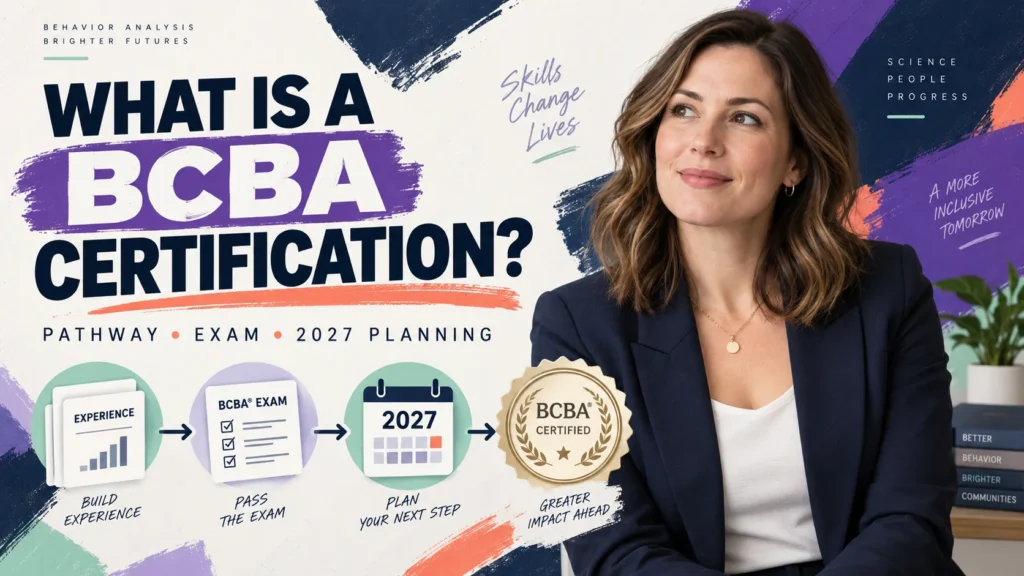
Understand what the BCBA credential means, how the certification pathway works, what changes in 2027, and which questions certification does not answer. If you searched whats a bcba certification, you probably want more than an acronym. You want to know what the credential represents, who awards it, what you must complete before the exam, and whether certification automatically lets someone practice in every state. The short answer is that BCBA certification is a graduate-level professional certification in behavior analysis issued by the Behavior Analyst Certification Board (BACB). It is an important credential, but it is not the same thing as a state license. Understand it as a sequence: choose an eligible pathway, complete education and supervised fieldwork, apply, pass the examination, and maintain the certification. Your application date matters because BACB requirements change on January 1, 2027.
Table of Contents
- What Is a BCBA Certification? Meaning and Scope — “whats a bcba certification”
- What Does BCBA Certification Qualify You to Do?
- How the BCBA Certification Pathway Works
- What Changes for BCBA Certification in 2027?
- Education and Coursework: What Must Match?
- Supervised Fieldwork: Why Documentation Matters
- The BCBA Exam Is One Step, Not the Whole Certification
- BCBA Certification vs. State Licensure
- How to Choose a Pathway Without Guessing
- Common Misunderstandings About BCBA Certification
- Use the Definition on the BCBA Exam
- Turn the Definition Into Exam Practice
- Frequently Asked Questions
- Take the Free BCBA Mock Exam
Date-sensitive note: The BACB says applicants must follow the requirements in effect when they apply and take the examination version in effect when they schedule. Compare your plan with the current BCBA Handbook and transition resources.
What Is a BCBA Certification? Meaning and Scope — “whats a bcba certification”
BCBA stands for Board Certified Behavior Analyst. The BACB describes BCBA certification as a graduate-level certification in behavior analysis. A BCBA is an independent practitioner who can provide behavior-analytic services and supervise the work of RBTs, BCaBAs, and other professionals who implement behavior-analytic interventions, subject to applicable requirements. That definition has three important parts:
- Graduate level: the credential is connected to graduate education and a qualifying eligibility pathway; it is not an entry-level certificate earned through a short workshop.
- Professional certification: the BACB evaluates eligibility, application materials, examination performance, and ongoing maintenance requirements.
- Behavior analysis: the credential signals training and examination in a defined professional discipline, not a blanket authorization to perform every health or educational service.
Certification is therefore best understood as a professional credential with a life cycle. You qualify, document, apply, test, represent your status accurately, complete continuing education, follow ethics requirements, and recertify. If one part of that life cycle is missing, the phrase “I have a BCBA certification” may be incomplete or outdated.
What Does BCBA Certification Qualify You to Do?
The credential identifies a professional who has met BACB requirements and passed the examination. It can answer “What professional certification does this person hold?” but not whether the person is licensed in a state, competent for every case, eligible for a payer, or active today. For a real-world decision or exam question, identify whether the issue is certification, licensure, competence, supervision, or payer authorization.
How the BCBA Certification Pathway Works
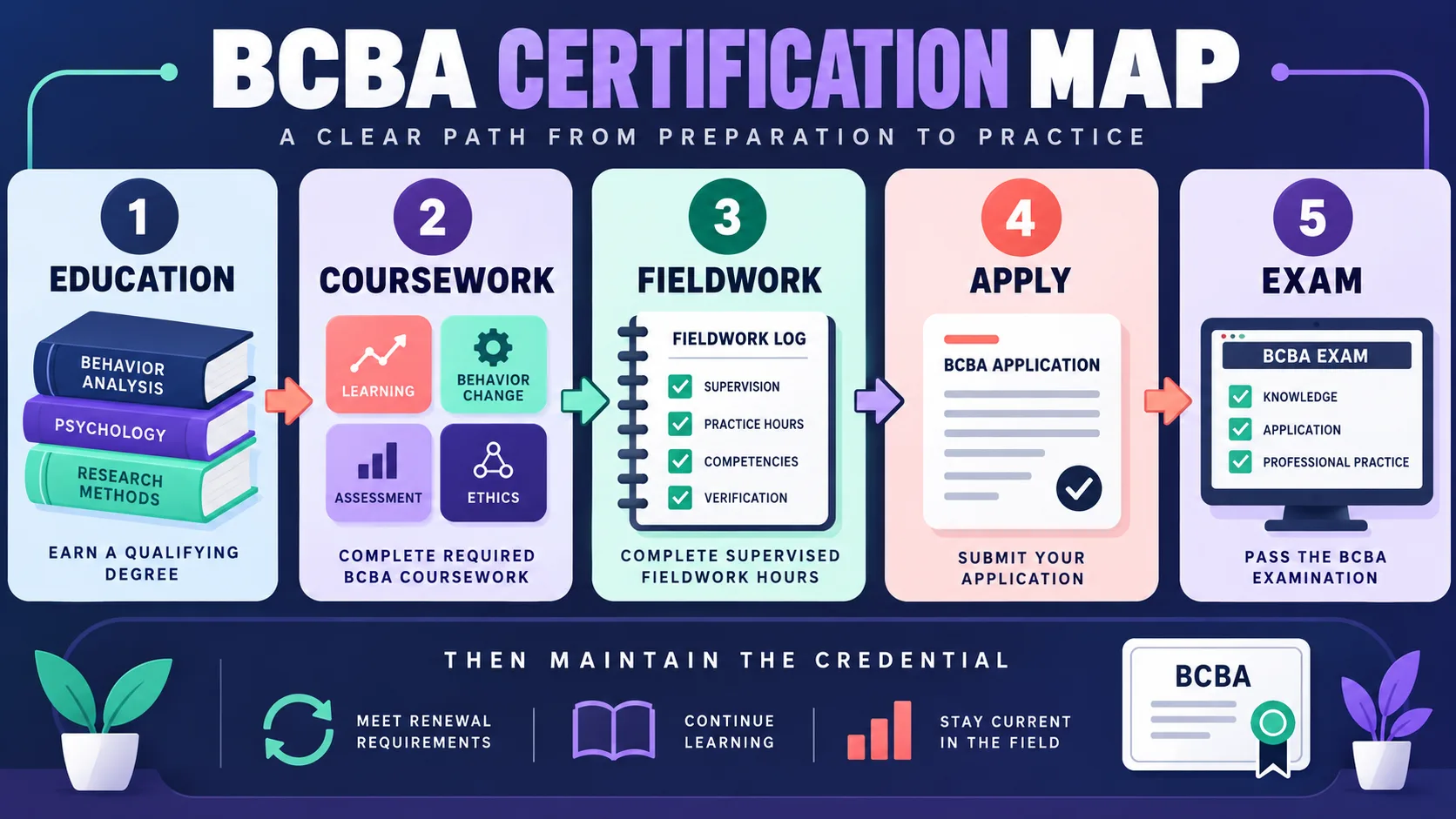
The pathway is easier to remember when you separate eligibility from examination. Passing an exam does not replace the degree, coursework, fieldwork, or application review that makes someone eligible to sit for it.
- Select the pathway: determine which BACB eligibility route fits your degree, program, coursework, fieldwork, and application timing.
- Complete the education requirement: earn the qualifying graduate degree and, when required, the behavior-analytic coursework or program-based content.
- Complete supervised fieldwork: accrue qualifying hours with the required supervision, observations, unrestricted activities, and documentation.
- Apply to the BACB: submit the application and supporting records using the current instructions and forms.
- Schedule and pass the examination: prepare for the test content outline and follow the current examination registration process.
- Maintain the credential: complete continuing education, ethics and supervision obligations when applicable, self-reporting duties, and recertification on time.
A mock exam is a readiness tool, not an eligibility shortcut. Use it to find gaps before the real exam.
What Changes for BCBA Certification in 2027?
The 2027 transition is the part of this topic most likely to create confusion. The BACB’s official summary says that, beginning January 1, 2027, applicants may use two eligibility pathways: Pathway 1, an accredited or recognized program pathway, and Pathway 2, a behavior-analytic coursework pathway. The transition guidance also says that applicants who want to use older pathways must apply and meet all requirements before January 1, 2027.
Do not treat the change as a reason to rush. Make a dated plan: your application year determines the requirements and forms. If the date is uncertain, discuss a plan that preserves records for both sets of requirements with your supervisor, advisor, or program coordinator.
| Planning question | Why it matters | Safe next step |
|---|---|---|
| When will I submit? | The application date controls which eligibility and fieldwork requirements apply. | Write down a realistic application window and review the current handbook. |
| Which pathway fits? | A qualifying degree or coursework pattern may fit one route but not another. | Match your transcript and program details to the official pathway definitions. |
| Which forms do I use? | The 2027 transition includes new monthly and final fieldwork verification forms. | Ask your supervisor which records to complete and retain for your application year. |
| Has the exam changed? | Certification-requirement changes and exam-content changes are related but not identical. | Use the current BACB exam and test-content-outline notices for your scheduled appointment. |
Education and Coursework: What Must Match?
Education is not just a box labeled “master’s degree.” Under the 2027 summary, Pathway 1 involves a qualifying master’s or doctoral degree from an APBA-accredited or ABAI-accredited or recognized program. Pathway 2 requires a master’s degree or higher plus behavior-analytic coursework completed under the specified conditions.
The 2027 Pathway 2 coursework summary lists 315 total instructional hours across basic principles of behavior, theory and philosophy, research methods, behavior assessment and intervention, organizational behavior management, and ethics in behavior analysis. Several areas must be covered in freestanding courses, so a transcript that contains similar words is not automatically enough. Course title, content, credit, timing, and the program’s relationship to the BACB requirements all matter. Do not decide from a generic program advertisement. Compare the documentation with the handbook and ask how each course maps to the pathway; “ABA” in a title does not automatically satisfy every requirement.
Supervised Fieldwork: Why Documentation Matters
Fieldwork is another reason certification cannot be reduced to passing an exam. Hours, supervision, observations, unrestricted activities, supervisor qualifications, and forms must match the application date. For the 2027 overview, both the standard and concentrated routes remain available, with 2,000 hours for supervised fieldwork or 1,500 hours for concentrated supervised fieldwork. The summary lists 5% supervision for the standard route and 7.5% for the concentrated route, with 20–160 fieldwork hours per supervisory period and at least 60 minutes or 90 minutes of client observation respectively. At least 60% of total supervised fieldwork hours must be unrestricted activities. These numbers are planning anchors, not permission to recreate records later. Keep documentation as hours occur, especially if your application may cross the 2027 transition. Your supervisor and current handbook remain the final sources.
The BCBA Exam Is One Step, Not the Whole Certification
The examination tests whether you can apply behavior-analytic knowledge and decision rules, but a passing score does not erase an eligibility problem. The BACB’s 2027 requirements summary states that applicants must pass the BCBA examination based on the BCBA Test Content Outline, 6th edition, which took effect January 1, 2025. The transition guidance separately notes that certification-requirement changes do not automatically mean the exam outline changes at the same time. Study in two tracks: practice the content under time pressure, and keep a separate eligibility checklist. Strong exam performance does not complete the certification process.
BCBA Certification vs. State Licensure
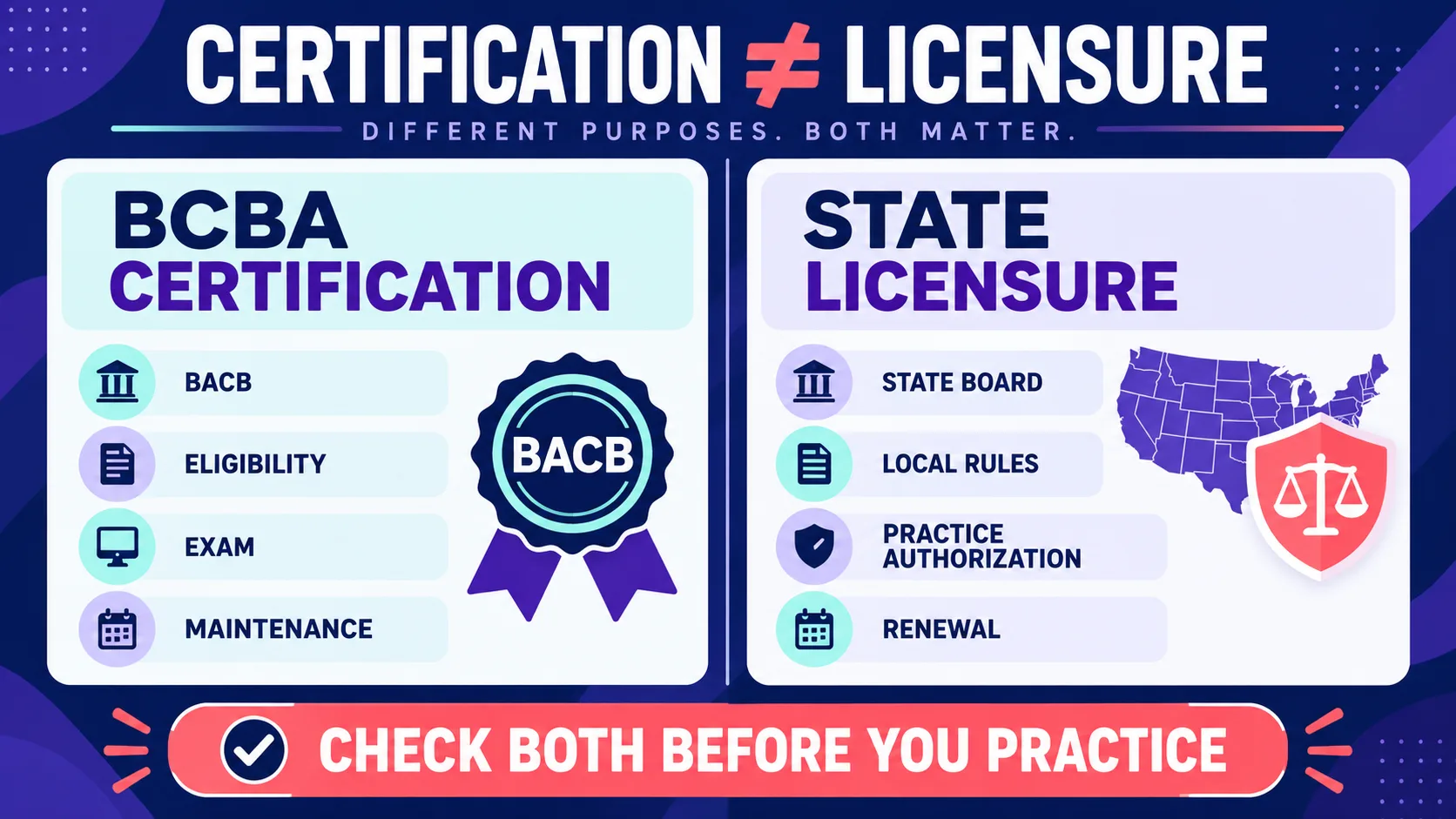
BCBA certification and state licensure are different credentials governed by different authorities. The BACB awards the certification. A state licensing board, department, or other jurisdictional authority may control whether a person can practice under a protected title, provide services, supervise, bill, or meet local professional requirements. Think of the distinction this way:
- BACB question: Has the person met the BACB’s certification requirements and maintained the credential?
- State question: Is the person authorized to practice in this state under the applicable law and rules?
- Employer or payer question: Does the person satisfy this organization’s credentialing, contracting, supervision, or billing requirements?
One positive answer does not automatically provide the other two. If a job posting says “BCBA required,” ask what the employer means by that phrase and whether state licensure is also required. If a client or payer needs a provider credential, confirm the specific documentation and date rather than relying on a general certification statement.
How to Choose a Pathway Without Guessing
Use a one-page pathway audit before you commit time or money:
- Write the date you expect to apply, not only the date you expect to graduate.
- List your degree institution, degree date, and whether the program’s accreditation or recognition matches the pathway you are considering.
- Map every behavior-analytic course to the required content area, instructional hours, grade, credit, and freestanding-course rule.
- Ask your supervisor which fieldwork route, forms, monthly limits, observation records, and unrestricted activities apply.
- Mark the current exam outline and application instructions you will use, then schedule a date to recheck the BACB resources before applying.
Common Misunderstandings About BCBA Certification
- “BCBA certification is a license.” It is a professional certification; state authorization is a separate question.
- “Passing the exam makes me a BCBA.” Exam performance is one step after eligibility and application requirements are satisfied.
- “Any ABA master’s degree works.” The pathway may depend on program recognition, coursework content, timing, and documentation.
- “The 2027 changes only affect new students.” Application timing and the requirements in effect at submission can affect people already completing coursework or fieldwork.
- “A current summary is enough.” BACB handbooks and transition documents are updated; use the current official version for a real application.
Use the Definition on the BCBA Exam
When an exam question asks what a BCBA certification means, start with the credential’s scope. It is a graduate-level behavior-analysis certification issued through the BACB. Then read the rest of the stem for the layer being tested: eligibility, fieldwork, examination, ethics, supervision, licensure, or maintenance. A useful four-question routine is:
- What credential is named? BCBA, BCBA-D, BCaBA, RBT, or something else?
- What time frame applies? Current rules, a 2027 application, certification maintenance, or a transition scenario?
- What authority owns the answer? BACB, state board, employer, payer, supervisor, or exam administrator?
- What does the question ask for? The definition, the first step, the best next action, or a practice authorization?
It prevents overbroad answers: passing a mock exam does not prove certification, and holding a master’s degree does not prove eligibility. Match evidence to the claim.
Turn the Definition Into Exam Practice
Practice the transitions between certification and licensure, eligibility and exam readiness, current and 2027 rules, and credential status and competence. After a miss, record the authority, date-sensitive rule, evidence, and distractor. Use the Free BCBA Mock Exam to test this skill under timed conditions. The goal is not just to recognize the phrase “BCBA certification.” The goal is to explain what the credential proves, identify what it does not prove, and select the correct next source when a scenario adds state, supervision, or payer requirements.
Frequently Asked Questions
What is a BCBA certification?: BCBA certification is a graduate-level professional certification in behavior analysis issued by the Behavior Analyst Certification Board. It identifies a person who has met the applicable eligibility and examination requirements and continues to meet maintenance obligations. It is not the same as a state license.
How do you get BCBA certification?: You generally select an eligible pathway, complete the required graduate education, coursework and supervised fieldwork, submit an application, and pass the BCBA examination. The exact requirements depend on the BACB rules in effect for your application and examination timing.
What changes for BCBA certification in 2027?: Beginning January 1, 2027, the BACB says applicants may use two eligibility pathways: an accredited or recognized program pathway and a behavior-analytic coursework pathway. The transition also includes updated coursework, fieldwork, and documentation details. Use the current BCBA Handbook and official transition guidance for your specific application date.
Does BCBA certification let you practice in any state?: No. BACB certification and state licensure or authorization are separate. Check the relevant state board, employer, payer, and supervision requirements before treating the credential as permission to practice in a particular jurisdiction.
Bottom line: A BCBA certification is a graduate-level BACB credential in behavior analysis. To plan responsibly, separate the credential’s meaning from eligibility, fieldwork, examination, state licensure, and ongoing maintenance—and use the current official handbook when the 2027 transition affects your timeline. For targeted review, use our whats a bcba certification practice questions to apply the concept in exam-style scenarios.
Take the Free BCBA Mock Exam
When you are ready to apply the idea, use the free practice resource below for additional feedback. Take the Free BCBA Mock Exam



