
Use the BACB Directory as a verification checklist: find the right credential, confirm current status and expiration, check reportable discipline, and separate certification from state licensure. When people search for a BACB directory, they usually want to answer a practical question: Is this person currently certified, and what exactly does the record prove? The safest answer starts with the official BACB Certificant Registry, not a copied profile, social-media bio, employer directory, or old certificate image.
Table of Contents
- BACB Directory: What to Check First
- Use the Official Certificant Registry
- Search by Name or Certification Number
- Confirm the Credential Type
- Read Status and Expiration Carefully
- Check Reportable Disciplinary Actions
- Registry vs. Verification Letter
- Certification Is Not State Licensure
- Choose the Right Verification Workflow
- Common BACB Directory Mistakes
- Use the Directory Concept on the BCBA Exam
- Practice Credential-Verification Questions
- Frequently Asked Questions
- Take the Free BCBA Mock Exam
The BACB says its online Certificant Registry is the primary resource for quickly verifying an individual’s certification status and determining whether reportable disciplinary actions are associated with that certification. The registry is updated daily. This article explains how to use that directory-style lookup for BCBA exam preparation, hiring, supervision, or consumer questions without confusing a BACB credential with a state license. Important boundary: A registry result is a credential check, not a complete clinical-quality review. Confirm the person’s role, scope, state requirements, supervision arrangement, and current information before making a practice or hiring decision.
BACB Directory: What to Check First
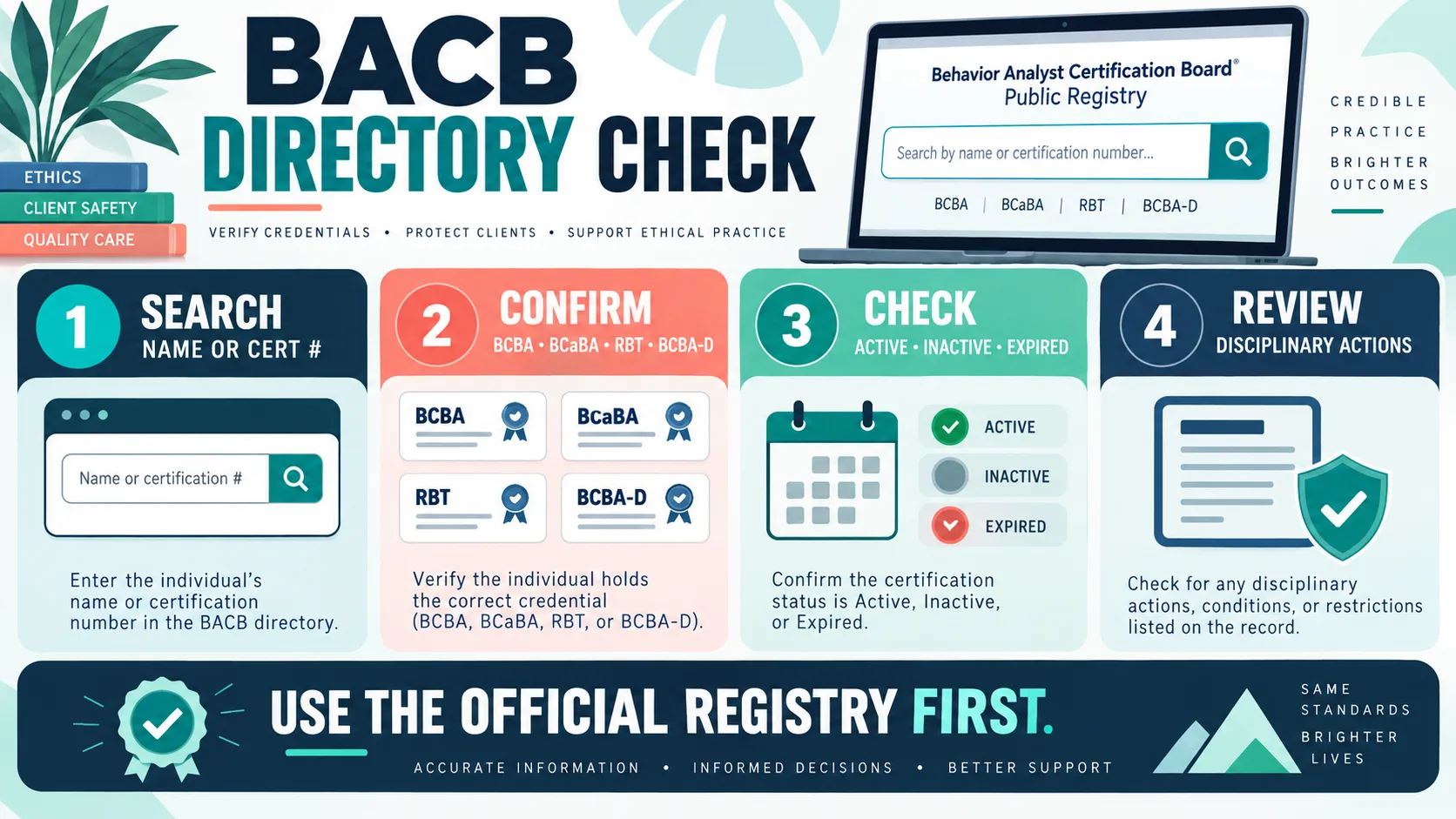
Before searching, define the decision you are trying to make. “Is this person a BCBA?” is different from “Can this person supervise my fieldwork?” or “Can this person practice in my state?” The directory can answer some credential questions, but it cannot answer every practice question. Use this order:
- Find the record: search the person’s name or certification number in the official registry.
- Confirm the credential: check whether the record says BCBA, BCBA-D, BCaBA, or RBT and whether that matches the role being claimed.
- Read the status: distinguish active, inactive, and expired rather than treating every search result as current authorization.
- Check the dates: note the expiration or recertification information shown for the record.
- Review public discipline information: look for reportable disciplinary actions and follow the BACB’s instructions if more detail is needed.
For a BCBA exam question, the same order prevents a common error: jumping to a conclusion from a title or a credential abbreviation without checking status, role, or the legal context.
Use the Official Certificant Registry
Start with the BACB’s Verify BACB Certification page. It links readers to the Certificant Registry and explains other verification options. The official page is the best source because certification status can change, and a third-party directory may be incomplete, delayed, or based on an old record.
The BACB also provides consumer information about certification and credential verification. Its Consumer Resources page explains that the registry can show certification status and reportable disciplinary actions. Use these official pages when a result is unclear, a name is common, or a professional’s public profile conflicts with the registry.
| Source | What it can help confirm | What it cannot replace |
|---|---|---|
| BACB Certificant Registry | Credential identity, certification type, status, dates, and public reportable-discipline information shown in the record. | A state license lookup, employment reference, clinical-quality audit, or scope-of-competence review. |
| BACB verification letter | A formal written verification requested through the BACB process for an identified purpose. | The need to check state licensure or the person’s current employment and competence. |
| State licensing board | Whether the person meets a jurisdiction’s separate authorization or licensing requirements. | The BACB record itself or a substitute for BACB certification verification. |
Search by Name or Certification Number
A name search can return more than one person. Compare the record details with the information you already have, such as the person’s full name, credential type, state, or certification number. If the number is available, use it as a stronger identifier than a common name.
Do not assume that a similar name is the right person. Check spelling, middle initials or other identifying details presented by the registry, and the context of the claim. Keep the result you relied on with the date you checked it, especially when the decision involves employment, supervision, payer enrollment, or a formal application.
For a study question, treat a search result as evidence that must be matched to the stem. If the question says the person is “listed in the directory,” that does not automatically mean the certification is active. If it says the record is expired, do not treat a historical certification as current practice authorization.
Confirm the Credential Type
The BACB offers different certification levels with different roles. A BCBA, BCBA-D, BCaBA, and RBT are not interchangeable labels. The record should match the responsibility the person is claiming.
- BCBA: a graduate-level behavior-analytic credential associated with independent behavior-analytic practice within applicable requirements.
- BCBA-D: a doctoral designation associated with a BCBA credential; it does not mean that every state’s licensing rules are automatically satisfied.
- BCaBA: an assistant behavior-analyst credential practiced under BCBA oversight as required by the relevant rules and arrangements.
- RBT: a technician credential with practice conducted under the required supervision and responsibility structure.
Those descriptions are study-level distinctions, not permission to practice in a particular jurisdiction. Always apply the state and organizational requirements that govern the situation.
Read Status and Expiration Carefully
Status is the part of a BACB directory result that most directly changes the decision. An active record, an inactive record, and an expired record are not equivalent. Read the status and the relevant date together rather than copying the credential title alone.
| Directory signal | Study interpretation | Next check |
|---|---|---|
| Active | The registry indicates a current status at the time of the lookup. | Confirm expiration, role, state license, and any role-specific requirements. |
| Inactive | The record exists, but the person may not be eligible to practice under the same conditions as an active certificant. | Read the reason and verify what the role or jurisdiction permits. |
| Expired | A past certification should not be presented as current certification. | Ask for current verification and check whether a separate license or reinstatement process applies. |
| Reportable action shown | The public record signals that additional disciplinary information may be relevant. | Follow BACB instructions and obtain the appropriate determination or explanation. |
Check Reportable Disciplinary Actions
The official verification page says the registry can help determine whether reportable disciplinary actions are associated with a certification. This does not mean that a blank result is a complete background check or that a public notation explains every detail. It means you should notice the public signal and use the appropriate official process for more information.
In an employment or supervision decision, do not make an unsupported conclusion from a symbol or a short status line. Confirm what the record says, what it does not say, and which person or office can provide the next document. Protect confidentiality and use only the information necessary for the decision.
Registry vs. Verification Letter
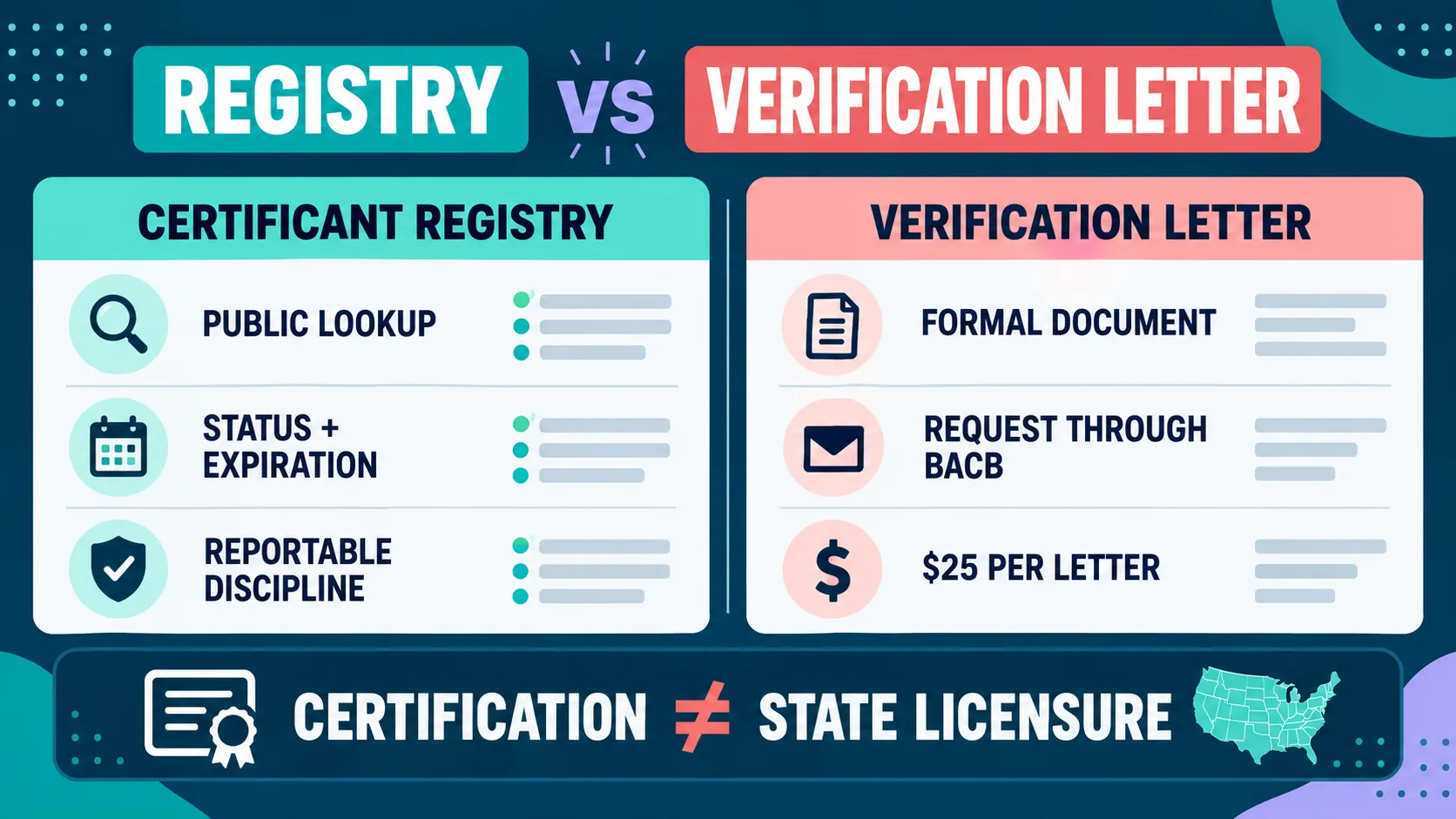
The Certificant Registry and a verification letter serve related but different purposes. The public registry is designed for quick lookup. The BACB also explains that a person can request a written verification letter, and the official verification page lists a $25 fee per letter with delivery by email after the request is processed.
Choose the registry when you need a quick public status check. Choose a formal letter when an employer, funder, licensing board, or application process specifically requires written verification. A letter does not eliminate the need to check the state’s rules or confirm that the information is still appropriate for the decision date.
Certification Is Not State Licensure
A BACB credential and a state license are separate questions. The BACB’s own consumer resources explain that certification is used by many funders and licensure boards, but local requirements still apply. A person may be BACB-certified and still need a state license, registration, supervision arrangement, or other authorization before practicing in a particular location.
On an exam, watch for the wording. “Is the person BACB-certified?” points to the registry. “May the person practice in this state?” points to the state licensing board and applicable law. “May the person supervise this trainee?” requires checking the relevant BACB and program requirements, not just finding a name in a directory.
Choose the Right Verification Workflow
Different readers use the BACB directory for different decisions:
- Consumer or caregiver: verify the credential, current status, and any public disciplinary information, then ask the provider about state licensure and the service arrangement.
- Employer or funder: verify the record on the decision date, request a formal letter if required, and separately confirm license, role, and contract requirements.
- BCBA candidate: use the distinction between certification and licensure to answer scenario questions about eligibility, supervision, and authorization.
- Supervisor or trainee: verify the supervisor’s credential and status, then check whether the supervision arrangement satisfies the current fieldwork or organizational rules.
Record the date of the lookup. “The directory showed active” is incomplete without “when,” because status and expiration information can change.
Common BACB Directory Mistakes
- Using an unofficial list as the final authority: third-party pages can be useful leads but should not replace the official registry.
- Confusing listed with active: a record can exist while the status is inactive or expired.
- Confusing certification with licensure: BACB certification does not by itself answer a state-practice question.
- Ignoring credential type: BCBA, BCBA-D, BCaBA, and RBT roles have different responsibilities.
- Skipping the date: a lookup without a check date is weak evidence for a time-sensitive decision.
- Overreading a public discipline notation: follow the official process instead of inferring facts that the result does not state.
Use the Directory Concept on the BCBA Exam
When a question includes a credential lookup, use a four-part scan: identity, credential, status, and authorization. First identify the person. Next confirm the credential type. Then read active, inactive, or expired status and the relevant date. Finally ask whether the question is actually about state licensure, supervision, employment, or another requirement outside the registry.
If two answer choices both say “verify,” choose the one that uses the correct source and sequence. A public registry may be the right first step; a formal verification letter may be the right next document; a state board may be the required authority for practice permission. The wording “first,” “best,” or “next” tells you which layer the question is testing.
Practice Credential-Verification Questions
After a missed question, write down four items: what the directory proves, what it does not prove, which source comes next, and what date matters. This turns a memorization problem into a source-selection skill. Use the Free BCBA Mock Exam for timed practice. When reviewing an item, explain why a BACB registry, verification letter, or state licensing board is the correct source before moving to the next question.
Frequently Asked Questions
What is the BACB directory?: People commonly use “BACB directory” to refer to the BACB Certificant Registry, the official public lookup for checking a certificant’s credential information, status, and public reportable disciplinary information. Start from the BACB verification page rather than an unofficial directory.
How do I verify a BCBA?: Use the official BACB Certificant Registry and search by the person’s name or certification number. Confirm the credential type, status, expiration information, and any public disciplinary notation. Then check state licensure separately when the decision involves practice authorization.
Is the BACB directory the same as a verification letter?: No. The registry is a public lookup tool. A verification letter is a formal document requested through the BACB process and may be required by an employer, funder, or licensing board. Use the source required by the specific decision.
Does BACB certification prove someone can practice in my state?: No. BACB certification and state licensure are separate. Check the relevant state licensing board, organizational rules, and any supervision or payer requirements before treating a credential as practice authorization. Bottom line: Use the official BACB Directory as a dated verification step: find the record, confirm the credential, read status and expiration, check public discipline information, and separate BACB certification from state licensure.
Take the Free BCBA Mock Exam
When you are ready to apply the idea, use the free practice resource below for additional feedback. Take the Free BCBA Mock Exam



