
A current, section-by-section study map for the BACB Ethics Code for Behavior Analysts, including scope, core principles, professional duties, supervision, public statements, research, and BCBA exam use. If you are searching for the BACB ethics code for behavior analysts, start with the official document rather than an old summary. The Ethics Code for Behavior Analysts is the BACB’s ethics document for BCBA and BCaBA applicants and certificants; it took effect on January 1, 2022.
Table of Contents
- What Is the BACB Ethics Code for Behavior Analysts?
- Who and What Does the Code Cover?
- Core Principles vs. Numbered Standards
- Use the Six Sections as a Study Map
- Section 1: Responsibility as a Professional
- Section 2: Responsibility in Practice
- Section 3: Responsibility to Clients and Stakeholders
- Section 4: Responsibility to Supervisees and Trainees
- Section 5: Responsibility in Public Statements
- Section 6: Responsibility in Research
- How to Read a BACB Ethics Standard
- Code, Law, Licensure, and Employer Policy
- Use the Code on the BCBA Exam
- Practice Ethics-Code Questions
- Frequently Asked Questions
- Quick Review Checklist
- Take the Free BCBA Mock Exam
This guide maps the Code’s six sections, what each protects, and how to use a standard’s exact wording on the BCBA exam. It is not individualized ethics advice; for danger, law, licensure, reporting, or complaints, use the relevant authority.
What Is the BACB Ethics Code for Behavior Analysts?
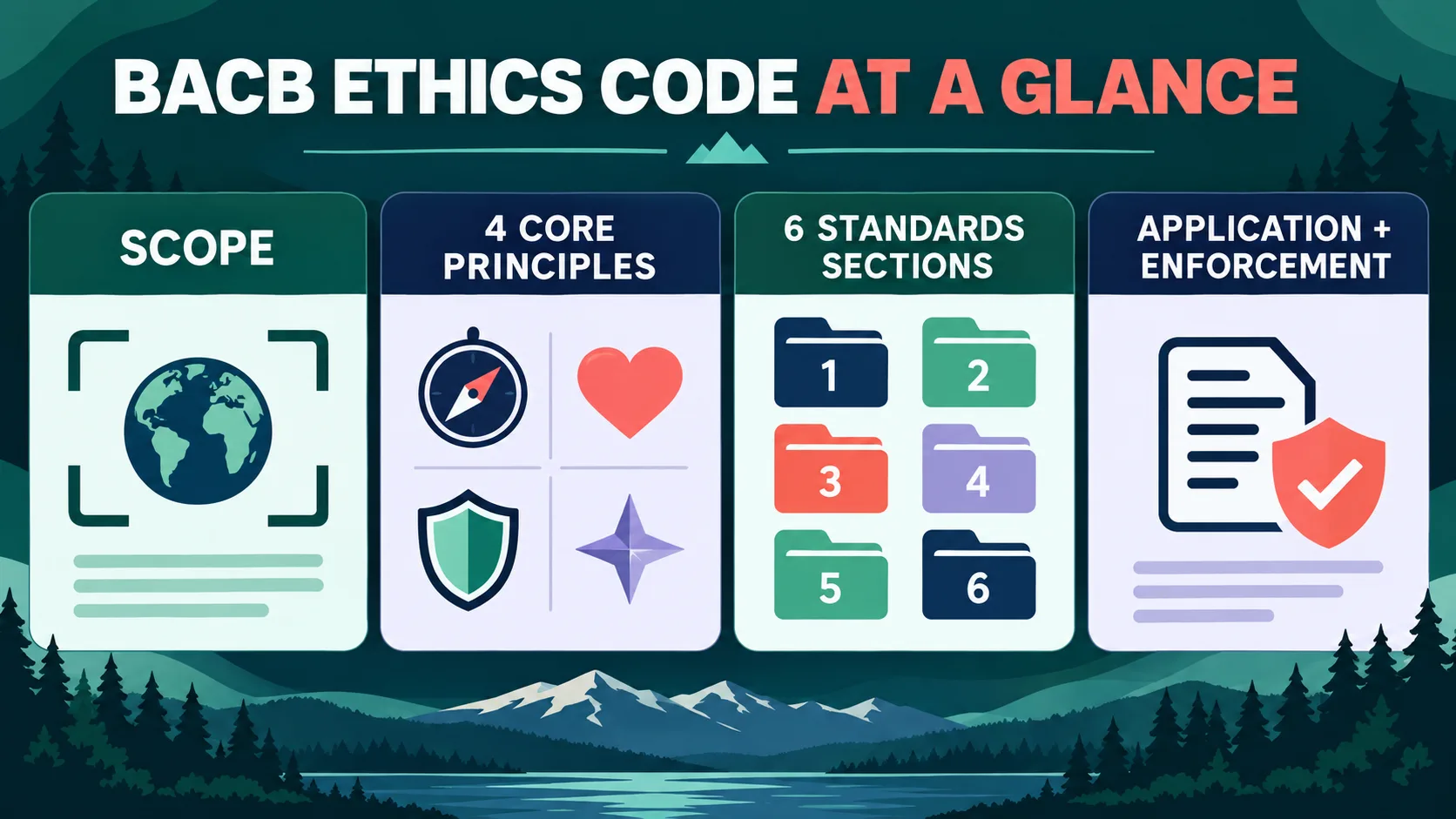
The BACB Ethics Code for Behavior Analysts is the set of ethics standards that BCBA and BCaBA applicants and certificants must follow while engaging in professional activities. The document replaced the 2014 Professional and Ethical Compliance Code. It is not a list of every possible ethical problem. Instead, it combines a scope statement, four core principles, application guidance, a glossary, and six sections of numbered standards.
The Code exists to protect clients, stakeholders, supervisees, trainees, and the public. It also gives behavior analysts a common framework for evaluating their own conduct and responding when a concern is raised. That means the best study method is not memorizing isolated numbers. It is learning what responsibility is being protected, which people are affected, and what the standard requires in context.
Who and What Does the Code Cover?
The Code applies to people who hold BCBA or BCaBA certification and people who have completed an application for those certifications. The BACB uses “behavior analyst” as a convenient term for people under that jurisdiction. The Code covers professional activities across settings and delivery modes, including direct services, consultation, supervision, training, management, research, peer review, email, text messages, and video conferencing.
It does not give the BACB separate jurisdiction over organizations or corporations, and it is not a rulebook for every private action. Personal behavior can become relevant when it clearly creates a potential health or safety risk to clients, stakeholders, supervisees, or trainees. On an exam, ask whether the conduct is professional, who is protected, and what risk the stem establishes.
Core Principles vs. Numbered Standards
The Code identifies four foundational principles: benefit others; treat others with compassion, dignity, and respect; behave with integrity; and ensure one’s competence. These principles help you interpret a numbered standard, especially when the facts do not fit a simple keyword match.
A numbered standard gives more specific direction, but the Code says the standards are not exhaustive. The absence of a behavior from the list does not automatically make it ethical or unethical. Use the wording, purpose, core principles, applicable law, and the facts together. This is why a scenario can require judgment even when you remember the section number.
Use the Six Sections as a Study Map
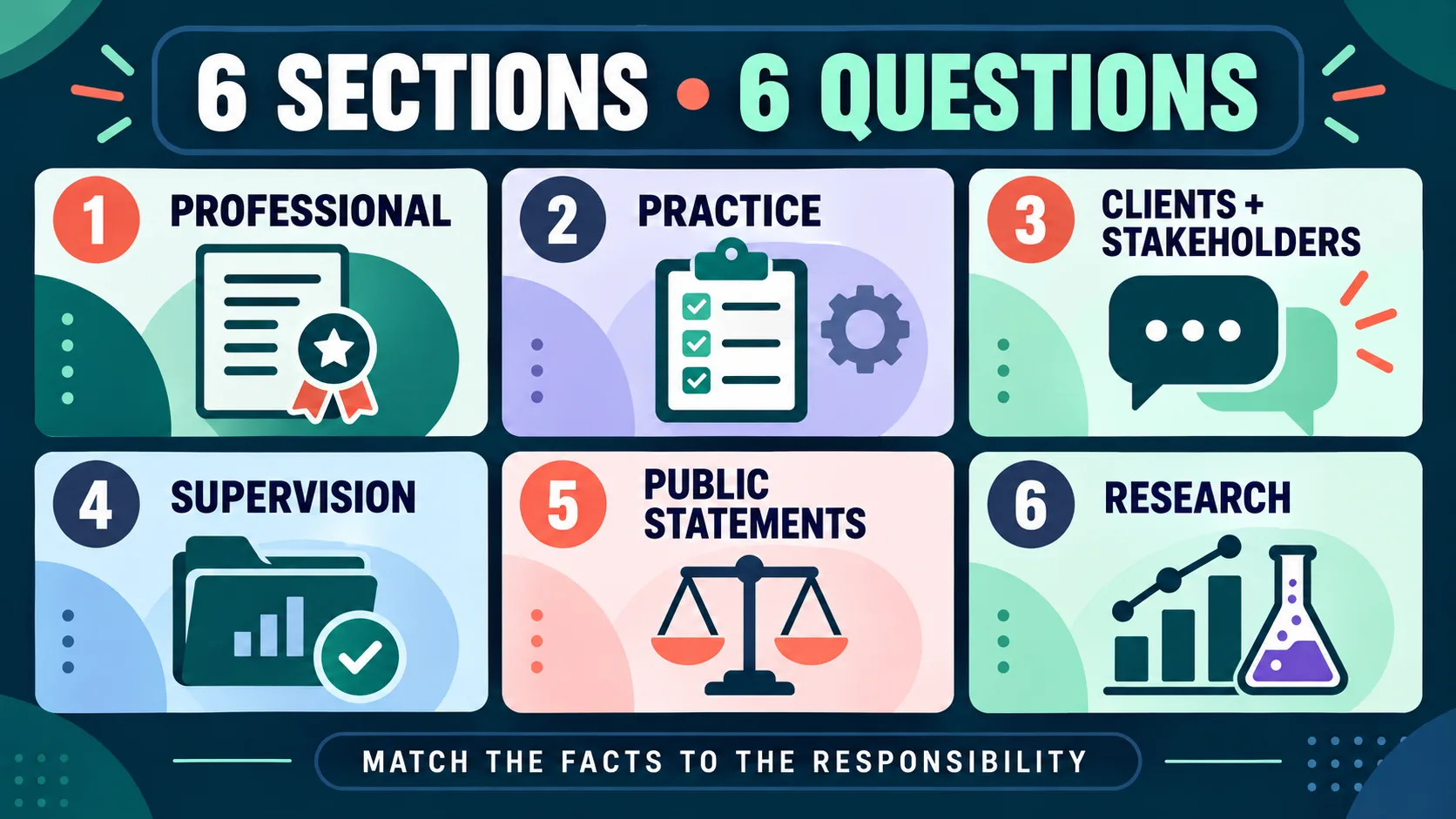
First learn the six section names. Then attach a question to each one. This lets you recognize the likely part of the BACB ethics code for behavior analysts without pretending that one section is the only rule that can apply.
| Code section | What it protects | Study question |
|---|---|---|
| 1. Professional | Integrity, competence, legal compliance, boundaries, and accountability. | Am I qualified, truthful, accountable, and working within my role? |
| 2. Practice | Effective, safe, documented, data-informed service delivery. | Is the service effective, consented to, measured, and risk-aware? |
| 3. Clients and stakeholders | Relationships, agreements, communication, referrals, and continuity. | Who is the client, who is affected, and what agreement governs services? |
| 4. Supervisees and trainees | Competent supervision, delegation, feedback, records, and transition. | Am I providing the supervision, training, and accountability required? |
| 5. Public statements | Privacy, accuracy, advertising, testimonials, websites, and digital content. | Could this public message mislead, expose, exploit, or misrepresent? |
| 6. Research | Review, consent, confidentiality, credit, data accuracy, and retention. | Are the research methods, participants, data, and credit handled responsibly? |
Section 1: Responsibility as a Professional
Section 1 covers the professional identity that makes ethical practice possible. Its standards address truthfulness, legal and professional compliance, accountability, competence, diversity, discrimination and harassment, bias, multiple relationships, gifts, coercion, requests, and self-reporting. Translate Section 1 into a boundary check: Are qualifications represented accurately, is the analyst working within competence, and could a relationship, gift, request, or bias affect judgment? A résumé claim or role conflict may test Section 1 before treatment details.
Section 2: Responsibility in Practice
Section 2 is the largest practice-focused cluster. It addresses effective and timely treatment, confidentiality, documentation, billing, communication, client involvement, collaboration, informed consent, medical needs, assessment, behavior-change interventions, risk minimization, data use, evaluation, and barriers to service delivery.
The Code connects human impact to technical process. A plan is not protected merely because it is called ABA: it must be accurately described, within competence, monitored with data, adjusted when ineffective, and designed to minimize risk. Data, consent, medical concerns, and effectiveness often signal Section 2.
Section 3: Responsibility to Clients and Stakeholders
Section 3 asks you to identify the people who receive services and the people affected by them. It includes responsibility to clients, identifying stakeholders, accepting clients, service agreements, financial agreements, consultation with other providers, third-party contracts, communication about contracted services, confidentiality limits, documenting professional activity, advocating for appropriate services, referrals, continuity, discontinuation, and transitions.
Do not treat “the person who pays” as automatically identical to “the client.” The Code distinguishes the direct recipient from stakeholders such as caregivers, authorized representatives, collaborators, employers, agencies, funders, and licensing boards. The facts determine which duties apply and what information can be shared.
Section 4: Responsibility to Supervisees and Trainees
Section 4 covers compliance with supervision requirements, supervisory competence and volume, accountability, supervision documentation, training, diversity, performance monitoring and feedback, delegation, evaluation of supervision effects, continuity, and termination. The theme is not simply “provide supervision.” It is to provide supervision that is competent, documented, responsive, and accountable.
A supervisor cannot transfer accountability by handing a task to a trainee. When a question contains a delegation problem, ask whether the task is appropriate, whether the trainee has been trained and observed, whether feedback is being delivered, and whether the supervisor is monitoring the result. The answer usually requires more than naming a supervision percentage.
Section 5: Responsibility in Public Statements
Section 5 applies the Code to public communication. It includes protecting the rights of clients, stakeholders, supervisees, and trainees; confidentiality in public statements; public statements by behavior analysts and by others; intellectual property; advertising nonbehavioral services; testimonials from current and former clients; social-media channels and websites; and digital content in public statements.
This section matters for websites, social accounts, course materials, videos, and marketing copy. A message can be technically true yet misleading if it hides a limitation, exposes a client, implies guaranteed outcomes, or misrepresents qualifications. Ask who could be identified, what claim is made, and whether the audience could be misled.
Section 6: Responsibility in Research
Section 6 covers laws and regulations in research, research review, research in service delivery, informed consent, confidentiality, competence, conflicts of interest, appropriate credit, plagiarism, documentation and data retention, and accuracy and use of data. The research section applies the same core principles to participants, collaborators, readers, and the scientific record.
Separate a service question from a research question. A data display used to evaluate a client’s intervention is not automatically a research project, but research still requires attention to review, consent, privacy, competence, credit, and data rules. A useful result does not excuse an invalid method or inaccurate report.
How to Read a BACB Ethics Standard
When you open a numbered standard, read it as an instruction with a context, not as a label. Use this five-part reading routine:
- Subject: Who has the responsibility—behavior analyst, supervisor, researcher, or another actor?
- Action: What must the person do, avoid, disclose, document, or evaluate?
- Context: What setting, relationship, service, public statement, or research activity is involved?
- Evidence: What fact in the stem proves the problem or shows that the duty was met?
- Next source: Does the situation also require law, licensure rules, an employer policy, or consultation?
Then compare the exact wording with the core principles. If two standards seem relevant, choose the response that protects clients and others, follows the law, reduces immediate risk, and preserves documentation. Do not choose a dramatic response merely because it sounds decisive.
Code, Law, Licensure, and Employer Policy
The BACB Ethics Code is not the same as a state law, licensing rule, payer contract, or employer policy. The Code itself tells behavior analysts to comply with applicable laws, licensure requirements, codes of conduct, reporting requirements, and professional practice requirements. A single situation can therefore involve multiple obligations.
| Question | Primary source | Do not assume |
|---|---|---|
| Does this violate a BACB ethics standard? | Current BACB Ethics Code and enforcement procedures. | That a blog summary or memory of an old number is current. |
| What must I report immediately? | The applicable law, emergency authority, licensure board, or reporting rule. | That reporting to the BACB is always the first or only step. |
| Can this person perform the role? | Certification, state authorization, competence, supervision, and employer requirements. | That certification alone answers scope, licensure, or payer questions. |
Use the Code on the BCBA Exam
For ethics questions, first identify the protected person and the responsibility type. Then locate the likely section, read the action verbs in the stem, and check whether law or immediate safety changes the sequence. The best answer usually reflects the Code’s purpose: protect clients and others, remain within competence, communicate accurately, reduce harm, consult appropriately, document, and evaluate the outcome.
Watch for distractors that skip the facts. “Report immediately” may be correct when there is immediate danger or a legal reporting duty, but it may be premature when the stem asks for the first step in confirming second-hand information. “Ask a colleague” can be appropriate consultation, but consultation is not a substitute for the analyst’s accountability. “Continue because the plan is authorized” ignores the Code’s requirements for effectiveness, risk, and data.
Practice Ethics-Code Questions
After each missed question, record the section, exact responsibility, controlling authority, and follow-up evidence. This creates a study log instead of a list of answer letters. Use the Free BCBA Mock Exam to practice the difference between recognizing a standard and applying it. Review the explanation after each item, then return to the current BACB Code instead of relying on a memorized shortcut.
Frequently Asked Questions
What is the BACB Ethics Code for Behavior Analysts?: It is the BACB’s current ethics document for BCBA and BCaBA applicants and certificants, with scope guidance, four core principles, a glossary, and six standards sections. When did the current Ethics Code take effect?: The BACB states that it took effect on January 1, 2022. Check the BACB ethics page for the current document and revisions. What are the six sections of the Ethics Code?: They cover professional responsibility, practice, clients and stakeholders, supervision, public statements, and research. Does the BACB Ethics Code replace state law?: No. Analysts must also follow applicable laws, licensure rules, reporting duties, contracts, and professional requirements. Bottom line: Know the scope, four principles, six sections, action verbs, and relationship to law; then match the facts to the responsibility.
Quick Review Checklist
Use this final checklist to turn bacb ethics code for behavior analysts into exam-ready reasoning. The goal is not to memorize a label in isolation; it is to identify the relevant evidence and explain why the best answer fits the scenario. Key ideas to review:
- State the central definition or decision point for bacb ethics code for behavior analysts in your own words.
- Identify the detail that makes bacb ethics code for behavior analysts different from its closest related ABA term.
- Separate the observable facts in a scenario from assumptions that are not supported by the facts.
- Write one example and one nonexample so you can recognize the concept in a new setting.
Exam application checks:
- Ask what the question is actually requesting before comparing the answer choices.
- Mark the antecedent, response, consequence, or other evidence that supports the selected answer.
- Look for a distractor that describes a related process but does not answer the specific question.
Final self-check:
- Explain how you would verify the interpretation with clear observations or data.
- Change one detail in the scenario and decide whether your answer should change.
- Give a one-sentence rationale that a supervisor or study partner could evaluate.
Take the Free BCBA Mock Exam
When you are ready to apply the idea, use the free practice resource below for additional feedback. Take the Free BCBA Mock Exam



