
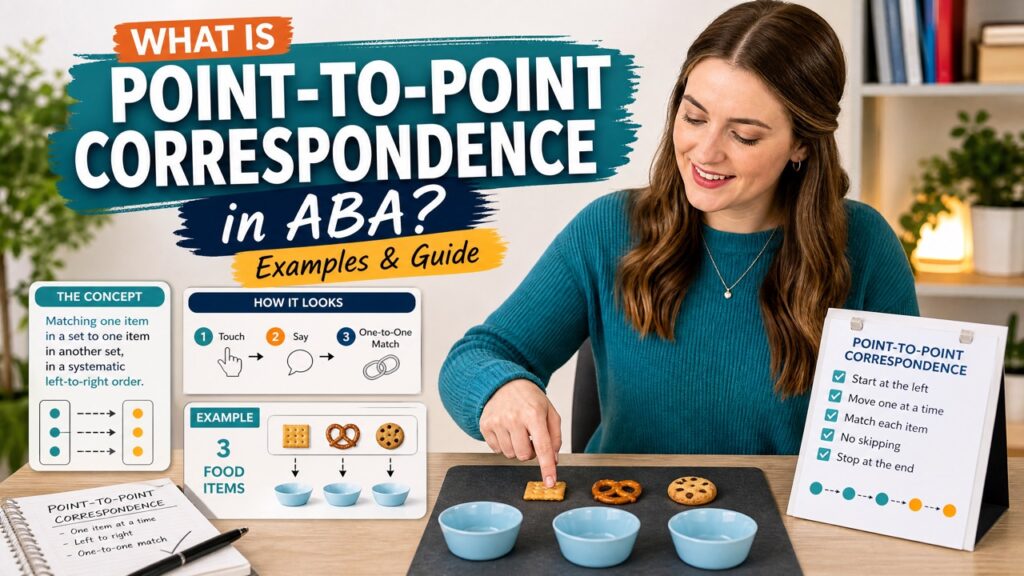
In applied behavior analysis (ABA), understanding verbal behavior is essential for effective assessment and intervention. One concept that often confuses students and practitioners is point to point correspondence aba. This comprehensive guide provides a precise definition, original examples, clear distinctions from related terms like formal similarity, and practical study tips. By the end, you will be able to identify point-to-point correspondence across various verbal operants and apply this knowledge in your practice or exam preparation. We will also link to our free BCBA mock exam for additional practice. Table of Contents
Table of Contents
- What Is Point-to-Point Correspondence in ABA?
- Point-to-Point vs. Formal Similarity: Key Differences
- Duplic vs. Codic Relations: Where Point-to-Point Fits
- Original Examples and Nonexamples
- Common Traps and Misconceptions
- Stimulus Control and Point-to-Point Correspondence
- Educational Context and Study Checklist
- Conclusion and Free BCBA Mock Exam
- Reference
What Is Point-to-Point Correspondence in ABA?
Point-to-point correspondence is a relation between a response product and an antecedent stimulus in which each part of the response corresponds to a specific part of the stimulus, and the order of those parts is preserved. In simpler terms, the response “matches” the stimulus in a structured, part-by-part way. This concept is a defining feature of certain verbal operants, such as the echoic, copying text, and textual behavior, but it is absent in others like the tact, mand, and intraverbal.
For example, if you hear the word “cat” and say “cat,” each sound in the response corresponds to each sound in the stimulus, and the order is the same. However, if you see a cat and say “cat,” the visual stimulus (the cat) and the vocal response (“cat”) do not share corresponding parts or order; the response is not a point-to-point match. This distinction is critical for identifying the function of verbal behavior.
Point-to-point correspondence is not a behavior itself; it is a property of the relation between a response and its controlling antecedent. It also is not a type of reinforcement. Instead, it helps behavior analysts classify verbal operants and design interventions. For instance, when teaching echoic skills, you rely on point-to-point correspondence to shape accurate vocal imitation, but the reinforcement for correct echoing is separate from the correspondence property.
Point-to-Point vs. Formal Similarity: Key Differences
A common trap is confusing point-to-point correspondence with formal similarity. Formal similarity requires both point-to-point correspondence AND that the stimulus and response product are in the same sensory modality. In other words, they must be physically similar (e.g., both visual or both auditory). Point-to-point correspondence can exist without formal similarity.
- Same modality: Echoic (hearing “cat” and saying “cat”) has both point-to-point correspondence and formal similarity because both are auditory.
- Different modality: Textual (seeing the written word “cat” and saying “cat”) has point-to-point correspondence but not formal similarity because the stimulus is visual and the response is auditory.
This distinction is not just academic. In practice, understanding whether an intervention requires formal similarity changes how you teach. For example, when teaching a learner to read aloud (textual), the response is not formally similar to the printed word, but you still expect point-to-point correspondence. If you used a program focused on formal similarity, you might incorrectly target echoic behavior instead.
Duplic vs. Codic Relations: Where Point-to-Point Fits
In verbal behavior, relations are categorized into duplic and codic based on correspondence and similarity. Understanding these categories helps you analyze verbal operants systematically.
- Duplic relations: The response product has point-to-point correspondence AND formal similarity with the antecedent stimulus. Examples include echoic (auditory-auditory) and copying text (visual-visual).
- Codic relations: The response product has point-to-point correspondence but NOT formal similarity. Examples include textual (visual stimulus, auditory response) and transcription (auditory stimulus, written response).
For example, when a student copies a written word from the board, both the stimulus and response are visual, so it is a duplic relation. However, when a student reads a word aloud, the stimulus is visual and the response is auditory, so it is a codic relation. Point-to-point correspondence remains present in both, but formal similarity differentiates them.
Original Examples and Nonexamples
To solidify your understanding, here are original examples and nonexamples of point-to-point correspondence in different verbal operants.
- Example (Echoic): A therapist says “ball,” and the learner says “ball.” Each phoneme corresponds, and order is preserved. Point-to-point correspondence: yes.
- Example (Textual): A learner reads the printed word “dog” aloud as “dog.” The visual stimulus parts (letters) correspond to the auditory response parts (sounds). Point-to-point correspondence: yes.
- Example (Transcription): A teacher dictates “cat,” and the learner writes “cat.” The auditory parts correspond to the written letters in order. Point-to-point correspondence: yes.
- Nonexample (Tact): A learner sees a real dog and says “dog.” The visual dog has no corresponding parts to the spoken word. Point-to-point correspondence: no.
- Nonexample (Intraverbal): A therapist says “Ready, set…,” and the learner says “go.” The response does not match the stimulus parts. Point-to-point correspondence: no.
These examples show that point-to-point correspondence is present in echoic, textual, and transcription, but absent in tact and intraverbal. This helps you identify the controlling variables for each verbal operant.
Common Traps and Misconceptions
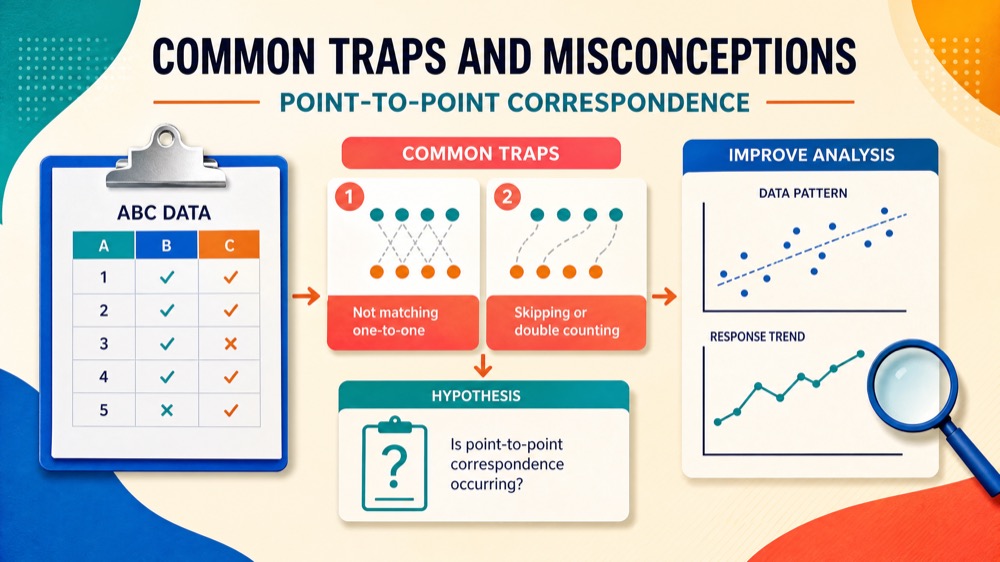
Many learners fall into specific misconceptions about point-to-point correspondence. Being aware of these traps will improve your analysis skills.
- Mistake 1: Thinking point-to-point correspondence equals formal similarity. They are different; formal similarity adds the same-modality requirement.
- Mistake 2: Believing all verbal operants require point-to-point correspondence. It is absent in tacts, mands, and intraverbals.
- Mistake 3: Treating point-to-point correspondence as a type of reinforcement. It is a property of stimulus-response relations, not a consequence.
- Mistake 4: Assuming the response must be identical to the stimulus in every way. Point-to-point correspondence only requires matching parts and order, not identical physical features (e.g., textual reading).
By avoiding these traps, you can correctly classify verbal operants and design more effective teaching procedures. For example, if a learner is struggling with echoic behavior, you need to ensure point-to-point correspondence is being reinforced, but reinforcement itself is a separate process.
Stimulus Control and Point-to-Point Correspondence
Point-to-point correspondence is intimately linked to stimulus control. In an echoic, the auditory verbal stimulus (e.g., the sound “cat”) exerts stimulus control over the response. The precise control is evidenced by the point-to-point correspondence: each part of the response is controlled by a specific part of the stimulus. This level of control is what allows for accurate imitation and reading.
In contrast, a tact (e.g., seeing a dog and saying “dog”) is under the control of a broader nonverbal stimulus, but the control is not point-to-point. The visual features of the dog do not correspond to the phonemes of the word. This difference is crucial for understanding how different verbal operants are acquired and maintained. When teaching, you must arrange the environment to support the correct type of stimulus control for each operant.
Educational Context and Study Checklist
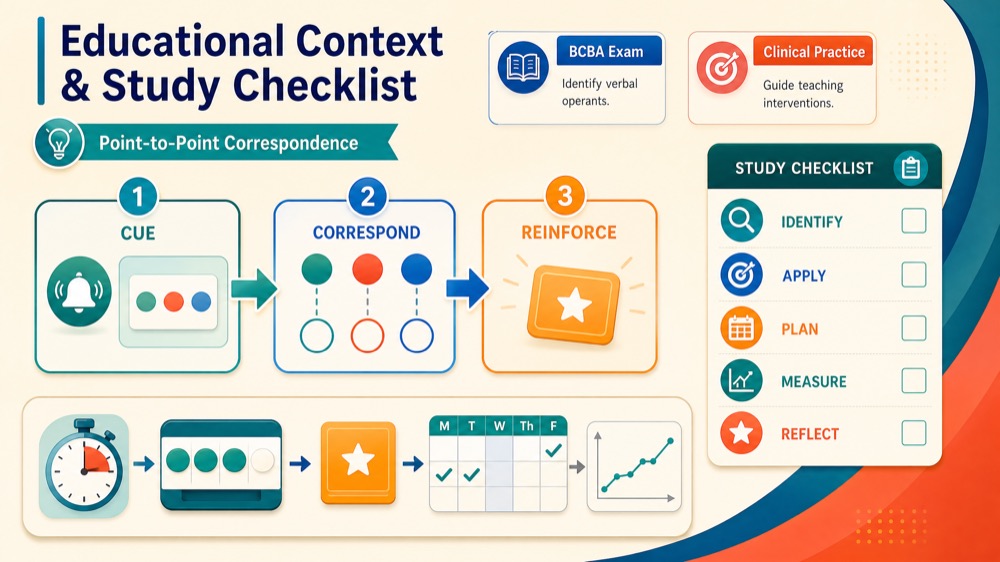
Understanding point-to-point correspondence is vital for BCBA exam preparation and clinical practice. It helps you identify verbal operants and guide teaching interventions. For example, if a learner echoes accurately, you know the echoic operant is intact. If they read words aloud, you know textual behavior is occurring, and you can teach accordingly. Here is a study checklist to master this concept:
- Define point-to-point correspondence in your own words.
- List at least three verbal operants that exhibit point-to-point correspondence.
- Explain the difference between point-to-point correspondence and formal similarity.
- Provide an original example of a codic relation and a duplic relation.
- Identify which verbal operants lack point-to-point correspondence and why.
- Describe how stimulus control relates to point-to-point correspondence in an echoic.
Regularly reviewing these points will reinforce your understanding. For more practice, consider taking our free BCBA mock exam, which offers feedback on your performance. Also, explore related concepts like stimulus generalization to build a broader foundation.
Conclusion and Free BCBA Mock Exam
Point-to-point correspondence is a fundamental concept in verbal behavior, distinguishing operants like echoic and textual from others. By mastering this definition, you improve your ability to analyze verbal behavior and design effective interventions. Remember that point-to-point correspondence is not formal similarity, not required for all verbal operants, and not a type of reinforcement.
Ready to test your knowledge? Take our free BCBA mock exam to practice with realistic questions and receive feedback. While we cannot guarantee that this specific topic will appear, our exam covers a broad range of ABA concepts to help you build confidence. Consistent study and practice are key to success.
Reference
Next step for BCBA exam prep
Turn this topic into exam-day practice
Use this topic as a focused review, then test it in exam-style conditions with a free mock before deciding whether five full-length mocks are the right next step.
Start the Free BCBA Mock Exam
Continue with Five Full-Length Mocks — $99
Review the included materials and access details before ordering. No pass guarantee is implied.



