
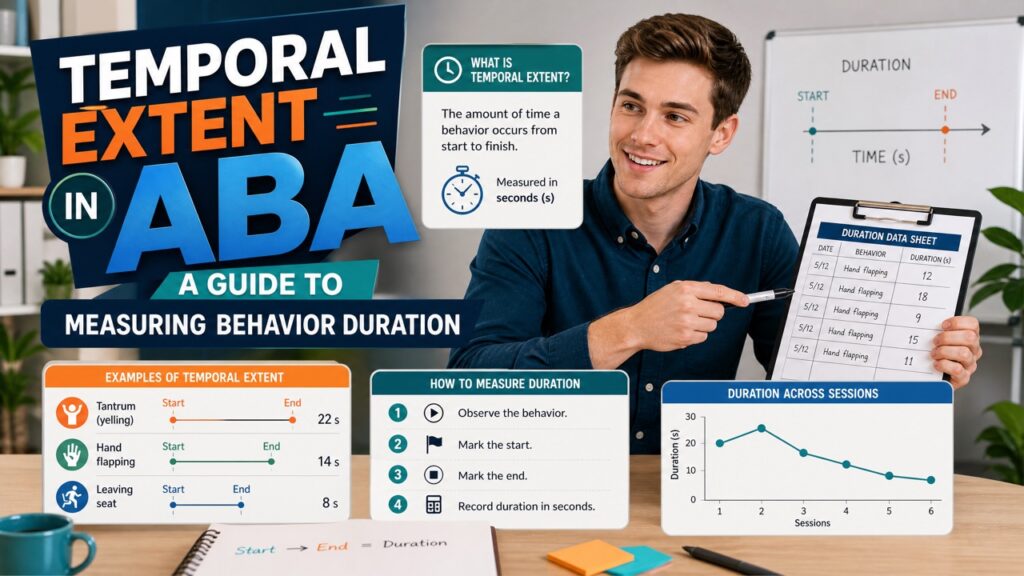
In applied behavior analysis (ABA), behavior analysts measure several dimensions of behavior to understand and change it. One of the most fundamental dimensions is temporal extent, which refers to the duration of a behavior—the total time from its onset to its offset. This guide explains what temporal extent is, how to measure it with continuous measurement, how it differs from related concepts like latency, and why it matters in practice. Whether you are a student, a practitioner, or preparing for the BCBA exam, mastering temporal extent is essential for accurate measurement and data-based decision making in applied behavior analysis. Table of Contents
Table of Contents
- What Is Temporal Extent in ABA?
- How to Measure Temporal Extent
- Practical Example: Measuring a Tantrum’s Duration
- Temporal Extent vs. Latency: Key Differences
- Common Measurement Errors and How to Avoid Them
- Why Temporal Extent Matters in ABA Practice
- Practical Cautions for Measuring Duration
- Study Checklist for Temporal Extent
- Conclusion and Call to Action
- Reference
What Is Temporal Extent in ABA?
Temporal extent is one of the three fundamental dimensions of behavior identified in ABA, alongside repeatability and temporal locus. Repeatability refers to how often a behavior occurs (count or rate), and temporal locus refers to when a behavior occurs in time (such as latency or interresponse time). Temporal extent, in contrast, focuses on how long a behavior lasts from beginning to end. It is a continuous measure that captures the total duration of a response or episode.
For example, if a student engages in a tantrum for 3 minutes, that 3 minutes is the temporal extent. If a learner remains on-task for 10 minutes, that duration is also temporal extent. This dimension is particularly useful for behaviors that are defined by their persistence, such as crying, out-of-seat behavior, or appropriate engagement.
To measure temporal extent accurately, you must clearly define the onset and offset of the behavior. Onset is the moment the behavior begins, and offset is the moment it ends. Without precise operational definitions, data become unreliable. For instance, for “on-task behavior,” you must specify what constitutes being on-task (e.g., looking at materials, writing) and when it starts and stops.
In practice, temporal extent is often reported as total duration (the sum of all durations in a session) or average duration per occurrence. These measures help identify changes in behavior over time and evaluate intervention effectiveness.
How to Measure Temporal Extent
Because temporal extent requires capturing the exact duration of a behavior, it demands continuous measurement. Unlike discontinuous methods such as momentary time sampling or partial-interval recording, continuous measurement records every instance of behavior and its duration throughout a session. This is typically done using a stopwatch, a timer, or specialized data collection software.
The simplest approach is to start a timer at the onset of the behavior and stop it at offset. If the behavior occurs multiple times, record each duration separately, then sum them for total duration or calculate the mean for average duration. For high-frequency behaviors, video recording and later coding can improve accuracy and allow for interobserver agreement (IOA) checks.
It is important to note that discontinuous methods are not appropriate for measuring temporal extent. Momentary time sampling, for example, only records whether behavior occurs at the end of an interval, missing the continuous duration. If a student leaves his seat for 5 seconds and returns before the interval ends, momentary sampling might miss the behavior entirely. Thus, continuous measurement is the gold standard for duration data.
Practical Example: Measuring a Tantrum’s Duration
Let’s walk through a practical example. A behavior analyst defines “tantrum” as “any instance of crying, screaming, and/or flopping to the floor lasting at least 5 seconds.” During a session, a child engages in a tantrum that starts at 10:15:30 AM and ends at 10:18:50 AM. The duration is calculated as follows:
- End time minus start time equals duration: 10:18:50 – 10:15:30 = 3 minutes 20 seconds.
- Convert to seconds for consistency: 3 minutes × 60 = 180 seconds plus 20 = 200 seconds.
- This duration can be recorded as 200 seconds or 3.33 minutes.
If the child has two more tantrums lasting 150 and 180 seconds, the total duration is 530 seconds, and the average duration is approximately 176.67 seconds. These calculations help ABA professionals track progress and make data-driven decisions.
Without a clear onset definition, measurement error is common. For instance, if the analyst does not specify whether crying includes silent tears, the timer might start later, underreporting duration. That is why operational definitions are critical.
Temporal Extent vs. Latency: Key Differences
A common source of confusion is the difference between temporal extent and latency. Latency is the time between a stimulus and the onset of a behavior—not the length of the behavior itself. For example, if a teacher gives a student an instruction and the student begins responding 30 seconds later, the latency is 30 seconds. Once the response starts, the time that the response continues is temporal extent.
Consider a scenario: A teacher tells a student to clean up, and the student starts cleaning after 30 seconds. The cleaning behavior then lasts 2 minutes. Here, latency = 30 seconds, temporal extent = 2 minutes. Both are temporal measures, but they answer different questions. Latency tells us about the speed of responding to a cue, while temporal extent reveals the persistence of the behavior.
Another related concept is interresponse time (IRT), which is the time between the end of one response and the start of the next. Like latency, IRT is a temporal locus measure, not extent. Understanding these distinctions is crucial for selecting the right measurement system in practice.
Common Measurement Errors and How to Avoid Them
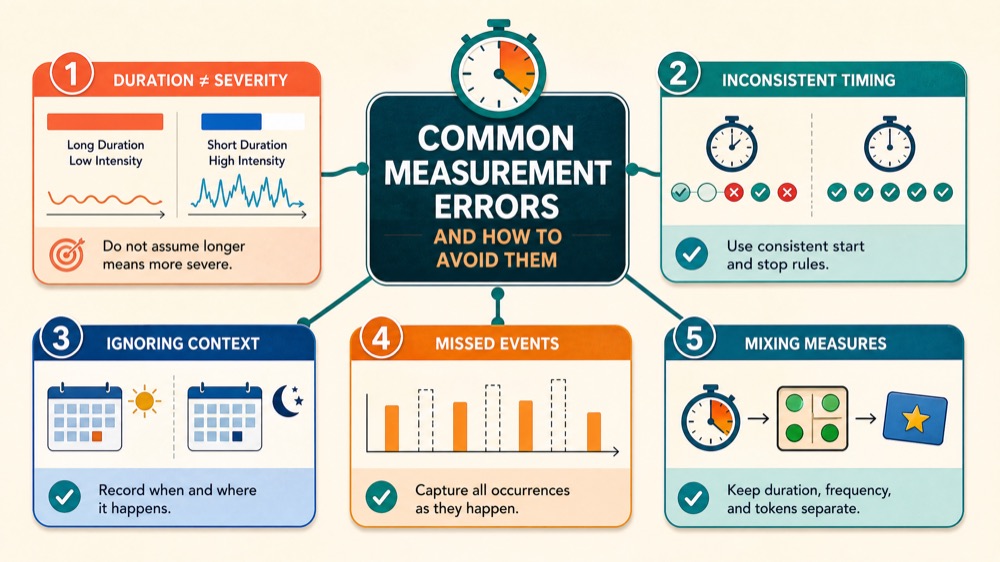
Even experienced behavior analysts can make measurement errors when dealing with temporal extent. Here are common pitfalls to avoid:
- Confusing temporal extent with latency: As noted, latency is the time before a response begins, not its duration.
- Using discontinuous measurement: Momentary time sampling and partial-interval recording cannot accurately capture duration; they may overestimate or underestimate.
- Poor operational definitions: Vague definitions of onset and offset lead to unreliable data. For example, “crying” might include distinct sobbing or silent tears, affecting measurement.
- Recording duration without context: Duration alone does not indicate intensity or function. A 10-minute hand-flapping episode may differ from a 1-minute aggressive outburst in impact.
- Forgetting environmental variables: Duration can be influenced by setting events, antecedents, and consequences; interpreting duration requires knowing the context.
Another misconception is that a longer duration always signals a more severe problem. However, a long but low-intensity behavior (e.g., humming) may be less concerning than a short but dangerous behavior (e.g., hitting). Therefore, temporal extent should be considered alongside other dimensions like rate, intensity, and social validity. Lastly, avoid assuming that temporal extent can be derived from rate. Rate (frequency/time) does not provide duration. Two behaviors with the same rate can have very different durations. Each dimension offers unique information.
Why Temporal Extent Matters in ABA Practice
Temporal extent is a critical measure for many socially significant behaviors. In educational settings, increasing the duration of on-task behavior is often a goal. In clinical settings, decreasing the duration of tantrums or self-injurious behavior is common. By tracking temporal extent, behavior analysts can evaluate intervention effectiveness objectively.
For example, if a token economy reduces tantrum duration from 5 minutes to 2 minutes, that improvement is measurable and meaningful. Similarly, if a student’s time spent reading increases from 10 to 20 minutes, the intervention is working. Continuous measurement of duration allows for progress monitoring and data-based decisions.
Moreover, temporal extent can reveal patterns. A behavior analyst might notice that a child’s out-of-seat behavior lasts longer during difficult math tasks. This suggests a possible avoidance function. Such insights are valuable for functional behavior assessments (FBAs) and behavioral intervention plans (BIPs).
Practical Cautions for Measuring Duration
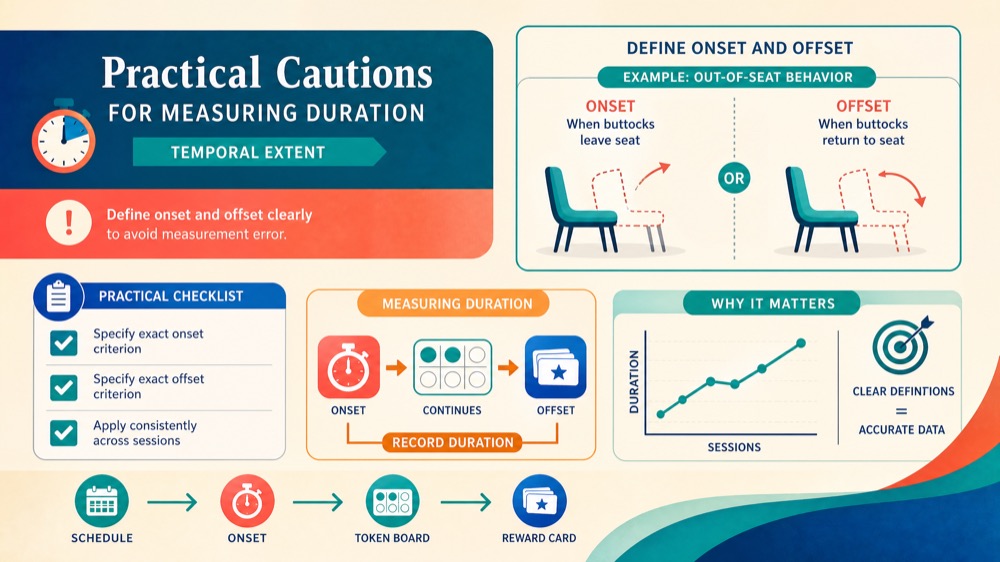
When measuring temporal extent, it is essential to define onset and offset clearly to avoid measurement error. For example, if you are measuring “out-of-seat” behavior, specify whether the behavior starts when the student’s buttocks leave the chair or when their weight is fully off the seat. Similarly, for “crying,” decide whether silent tears count as crying or only audible sobbing. These decisions affect the data.
Use temporal extent for behaviors where length is key, such as time spent out of seat, duration of crying, or time on task. For behaviors that are brief and discrete, such as a single eye blink, duration may be less meaningful than frequency. Choose the measurement dimension that best matches the behavior and the question you are asking.
Also, consider the context in which you are measuring. Duration can be influenced by setting events, antecedents, and consequences. For example, a child may cry longer when a preferred activity is removed than when a non-preferred task is presented. Interpreting duration requires knowing the context.
Study Checklist for Temporal Extent
- Define temporal extent and how it differs from repeatability and temporal locus.
- Explain why continuous measurement is required for duration.
- Calculate duration from start and end times, converting to a common unit.
- Differentiate between temporal extent, latency, and interresponse time in scenarios.
- Identify common measurement errors and how to avoid them.
- Understand how stimulus control can influence behavior duration.
- Review examples and practice questions to reinforce learning.
Conclusion and Call to Action
Mastering temporal extent is essential for effective ABA practice. Remember that duration is a fundamental dimension that provides unique insights into behavior. By using continuous measurement, clear definitions, and ongoing practice, you will become proficient in measuring and interpreting temporal extent. Ready to test your knowledge? Take our free BCBA mock exam to identify areas for improvement and build confidence.
Reference
Next step for BCBA exam prep
Turn this topic into exam-day practice
Use this topic as a focused review, then test it in exam-style conditions with a free mock before deciding whether five full-length mocks are the right next step.
Start the Free BCBA Mock ExamContinue with Five Full-Length Mocks — $99
Review the included materials and access details before ordering. No pass guarantee is implied.



