
What Is Negative Punishment in Psychology? A BCBA’s Perspective
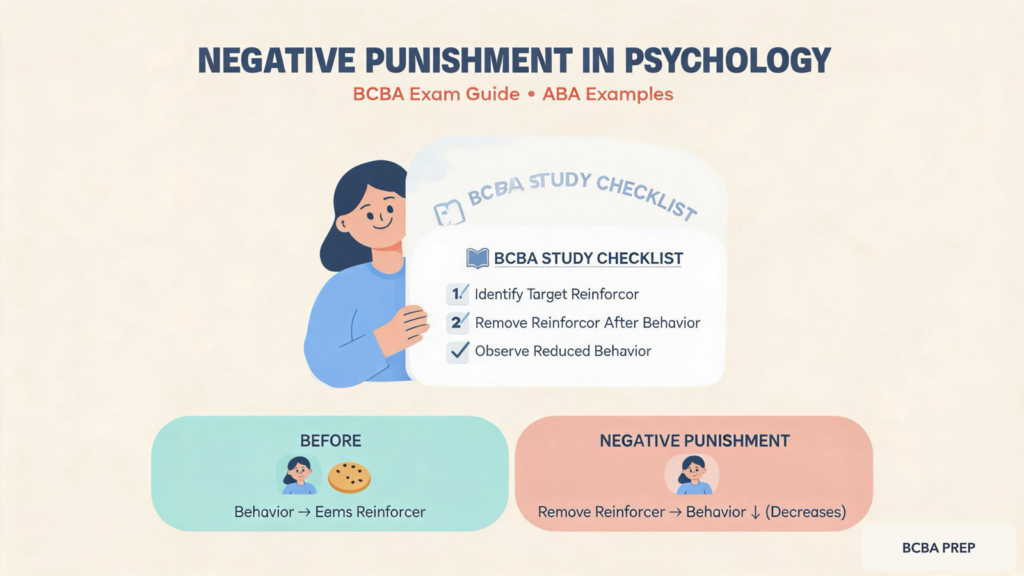
In the context of negative punishment psychology, a behavior is followed by the removal of a reinforcing stimulus, which decreases the future likelihood of that behavior. This definition is central to applied behavior analysis (ABA) and frequently appears on the BCBA exam. The term ‘negative’ refers to the removal of a stimulus, not the valence of the consequence. ABA practitioners use negative punishment procedures such as time-out from positive reinforcement and response cost to reduce challenging behaviors.
Practice this concept
Table of Contents
- What Is Negative Punishment in Psychology? A BCBA’s Perspective
- How Negative Punishment Works in ABA: The ABC Model
- Negative Punishment vs. Extinction: Know the Difference
- Exam Relevance and Common Traps
- Quick Checklist for Negative Punishment Scenarios
- Summary: Negative Punishment Psychology for the BCBA Exam
To master this concept, you must differentiate it from positive punishment and negative reinforcement. Both punishment procedures decrease behavior, while reinforcement increases it. In positive punishment, a stimulus is added; in negative punishment, a stimulus is removed. In negative reinforcement, a stimulus is removed following a behavior, but that removal increases the behavior. This is a common point of confusion for exam candidates.
Below is a quick comparison:
- Positive Punishment: Add an aversive stimulus after behavior → behavior decreases (e.g., reprimand).
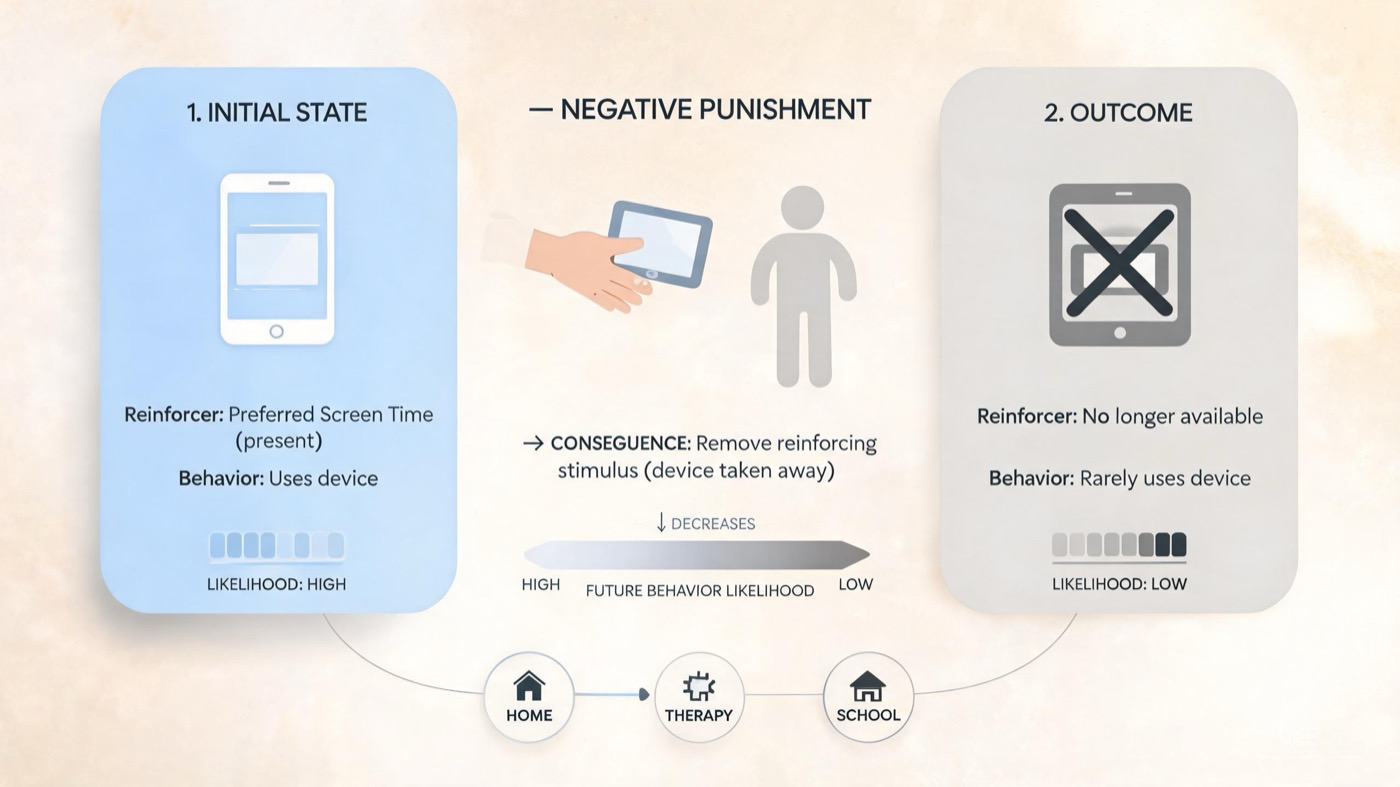
- Negative Punishment: Remove a reinforcing stimulus after behavior → behavior decreases (e.g., take away tablet).
- Negative Reinforcement: Remove an aversive stimulus after behavior → behavior increases (e.g., stop alarm when you wake up).
Remember: punishment = push down (decrease); reinforcement = repeat (increase). The ‘negative’ sign tells you something is removed.
How Negative Punishment Works in ABA: The ABC Model
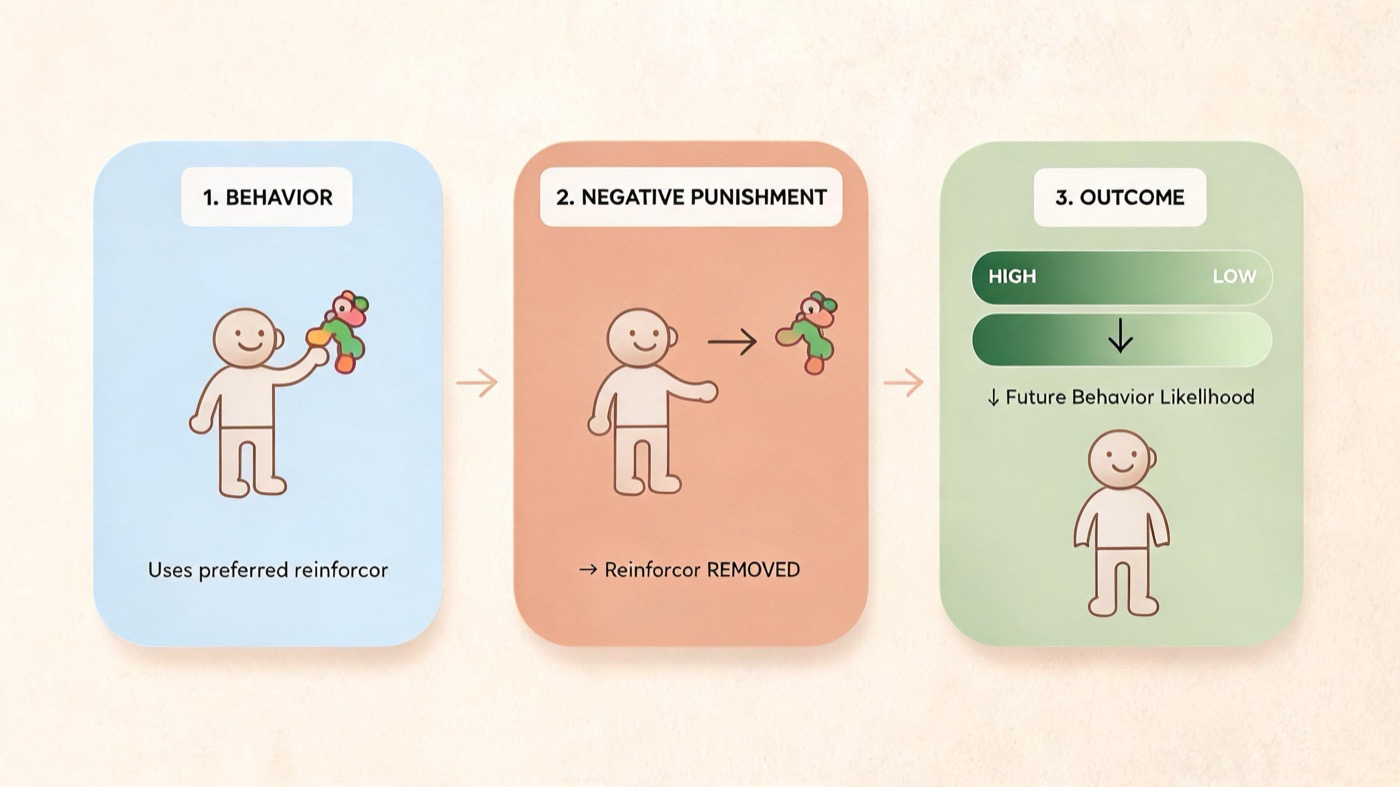
In ABA, every behavior intervention is understood through the three-term contingency: Antecedent-Behavior-Consequence (ABC). For negative punishment, the consequence is the removal of a reinforcer contingent on the behavior. The function of the behavior (why it occurs) must be identified before implementing punishment, because punishment is only ethical and effective when matched to function. Let’s examine two classic examples.
Example 1: Time-Out from Preferred Activity
Antecedent: Child is playing on an iPad. Behavior: Child screams at parent. Consequence: Parent takes away the iPad for 2 minutes. Over time, screaming decreases. In this scenario, the function of screaming might be escape from demands (parent was about to ask something) or access to attention. Time-out removes access to the iPad (a positive reinforcer), thereby punishing the screaming. Note: time-out is only a punishment procedure if the time-in environment is enriched (i.e., the child wants to be in that environment).
Example 2: Response Cost for Tantrum
Antecedent: Child is earning tokens for completing chores. Behavior: Tantrum occurs when asked to clean up. Consequence: The therapist removes 5 tokens from the child’s token board. The tokens are exchangeable for preferred items. Tantrum frequency decreases. This is response cost, a form of negative punishment. The function of the tantrum may be escape from task or access to tangibles. By removing tokens, the therapist decreases the likelihood of tantrum. Response cost is often combined with differential reinforcement of alternative behavior (DRA).
Example 3: Removal of Privileges for Aggression
Antecedent: Adolescent is told he cannot go to the movies tonight. Behavior: He pushes a sibling. Consequence: Parents revoke his weekend video game time (preferred activity). Aggression decreases. This common real-world example illustrates negative punishment: removal of a privilege (video games) contingent on aggression. The function may be access to tangible items or escape from denied access. Effective behavior plans identify the function and then apply punishment only when less intrusive interventions fail.
Negative Punishment vs. Extinction: Know the Difference
A frequent exam trap is confusing negative punishment with extinction. In extinction, the reinforcer that previously maintained the behavior is withheld completely. For example, if a child’s screaming is maintained by attention, extinction would involve ignoring the screaming (no attention delivered). In negative punishment, the reinforcer is not withheld; it is removed contingent on the behavior, but other reinforcers may still be available. Extinction does not involve the removal of a stimulus contingent on behavior; it involves the discontinuation of the maintaining reinforcer. The key difference: negative punishment requires a response-contingent removal, while extinction requires withholding the specific reinforcer that has maintained the behavior in the past. This distinction is tested directly on the BCBA exam.
Exam Relevance and Common Traps
The BCBA exam often presents scenarios and asks you to identify the procedure or to select the correct intervention based on function. Here are three traps to avoid:
Trap 1: Confusing Negative Punishment with Negative Reinforcement
Both involve removal, but one decreases behavior and the other increases it. Use this mnemonic: Punishment = Push away (decrease); Reinforcement = Repeat (increase). On the exam, read the consequence carefully: if the target behavior decreases over time, it’s punishment; if it increases, it’s reinforcement.
Trap 2: Labeling All Time-Out as Negative Punishment
Time-out from positive reinforcement is only a punishment procedure if the time-in environment is reinforcing. If a child is already in a barren, non-reinforcing environment, removing them does not constitute negative punishment because the removal does not reduce behavior. The exam may describe a scenario where a child is sent to a ‘quiet corner’ that is actually preferred—this would not be punishment. Always check whether the removed stimulus is a known reinforcer for that individual.
Trap 3: Forgetting to Assess Function Before Using Punishment
Ethical guidelines and the BACB task list require that punishment procedures be used only after function-based interventions (e.g., reinforcement, extinction) have been tried or considered. On the exam, you may be asked to identify the most appropriate intervention. If the question says ‘the behavior is maintained by attention,’ a negative punishment procedure that removes a tangible item may not be effective because it does not address the function. Always prioritize function-based interventions first.
Quick Checklist for Negative Punishment Scenarios
When evaluating a BCBA exam scenario, use this checklist to confirm whether negative punishment is being implemented correctly:
- Identify the behavior to be decreased. Write it down explicitly.
- Identify the stimulus removed after the behavior. Is it a known reinforcer? Check if the individual would choose that stimulus when given free access.
- Ensure the consequence is removal (not addition). If something is being added, it’s positive punishment.
- Verify that the behavior decreases over time. Without a decrease in behavior, it’s not punishment.
- Check if the procedure matches the function. For example, if behavior is maintained by attention, removing a tangible item may reduce behavior temporarily, but it may not be as effective as a function-matched intervention like time-out from attention (if attention is the reinforcer).
Summary: Negative Punishment Psychology for the BCBA Exam
Negative punishment is a core concept in negative punishment psychology and ABA. It involves the removal of a reinforcer contingent on a behavior to decrease that behavior. The two main procedures are time-out and response cost. On the BCBA exam, you’ll need to distinguish it from positive punishment and negative reinforcement, recognize when time-out is not actually punishment, and always consider the function of behavior before selecting an intervention. Use the quick checklist above to guide your analysis of scenarios. For further practice, check out our negative punishment ABA guide and our positive vs negative punishment comparison. Remember, punishment procedures should be used sparingly and always within ethical guidelines as outlined by the BACB. Review the BACB Ethics Code for more details. Good luck with your exam preparation!



