
What Is a Line Graph in ABA?
A line graph in ABA is a visual display of behavior data collected over time. It is the most common graph used in single-subject designs because it allows practitioners to analyze patterns in behavior systematically.
Table of Contents
- What Is a Line Graph in ABA?
- When Should You Use a Line Graph?
- ABA Examples: Line Graphs in Action
- Common Exam Traps When Interpreting Line Graphs
- Quick Checklist: Is a Line Graph Appropriate?
- Summary: When Is a Line Graph Used in ABA?
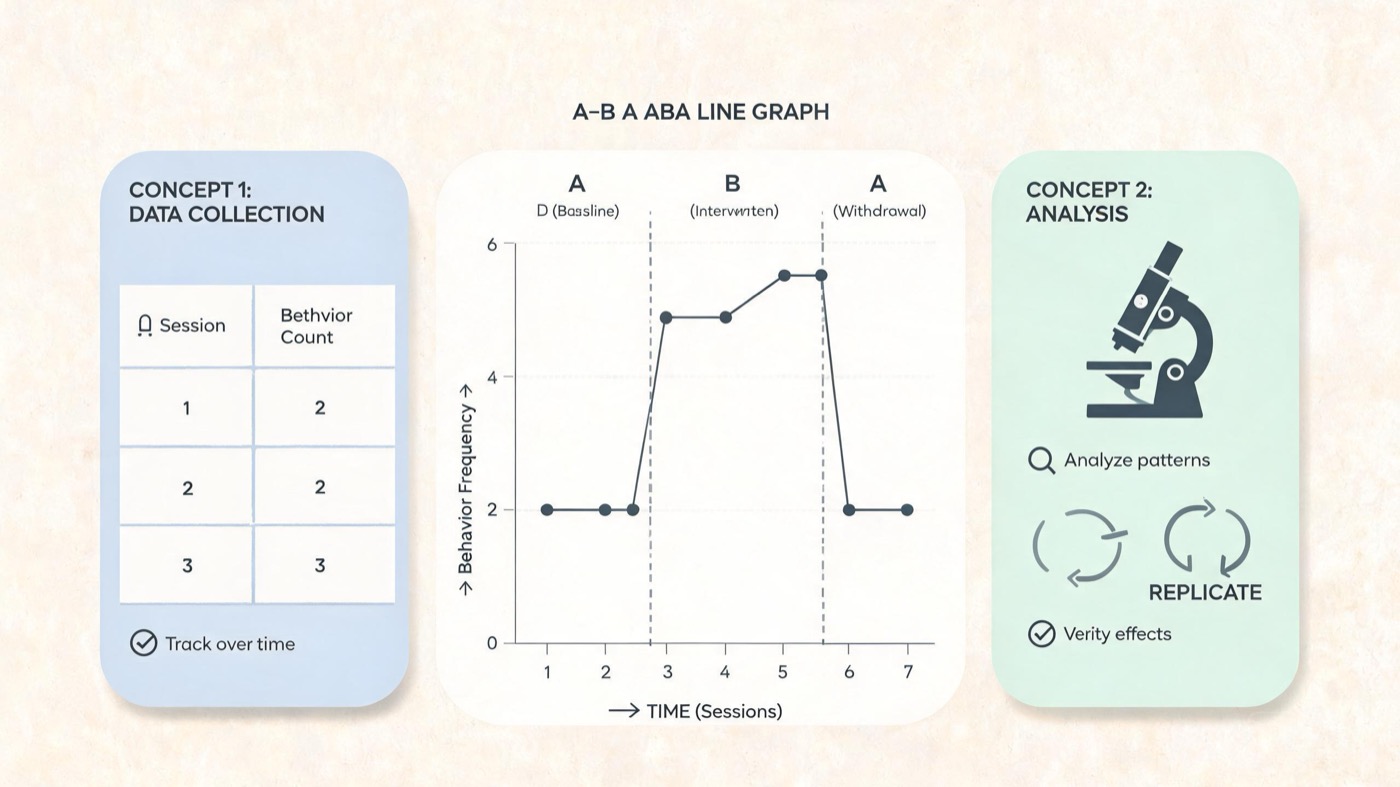
The graph plots a behavior measure (e.g., frequency, duration, rate) on the y-axis against time or sessions on the x-axis. Each data point represents a measurement from one observation session, and consecutive points are connected by a line.
Core Components: X-Axis, Y-Axis, Data Points, Condition Lines
- X-axis: Represents time (sessions, days, or trials). The unit must be consistent across the graph.
- Y-axis: Represents the dependent variable—the behavior being measured. Scale ranges from zero to the maximum expected value.
- Data points: Each point shows the behavior level during one session. Outliers or missing data can affect interpretation.
- Condition lines: Vertical lines (often dashed) separate baseline from intervention phases. Phase labels (e.g., Baseline, Intervention) are placed at the top.
- Trend lines: Sometimes added to highlight the direction of behavior change (e.g., increasing, decreasing, stable).
When Should You Use a Line Graph?
Line graphs are appropriate when you need to track continuous data over time and evaluate changes across conditions. They are the standard for most single-subject experimental designs in ABA.
Continuous Data Over Time
Use a line graph when behavior is measured repeatedly across sessions. For example, a BCBA tracks the frequency of aggression each day during baseline and then during a reinforcement-based intervention. The line graph shows how behavior changes from session to session.
Showing Trends, Level, and Variability
Examiners often ask how line graphs help detect trends (direction of data), level (mean value within a phase), and variability (range of data points). These three features are critical for visual analysis. For instance, a stable baseline with low variability makes it easier to detect a treatment effect.
ABA Examples: Line Graphs in Action
Here are three realistic scenarios from a BCBA’s practice, each illustrating when a line graph is the right choice.
Example 1: Reducing Self-Injurious Behavior
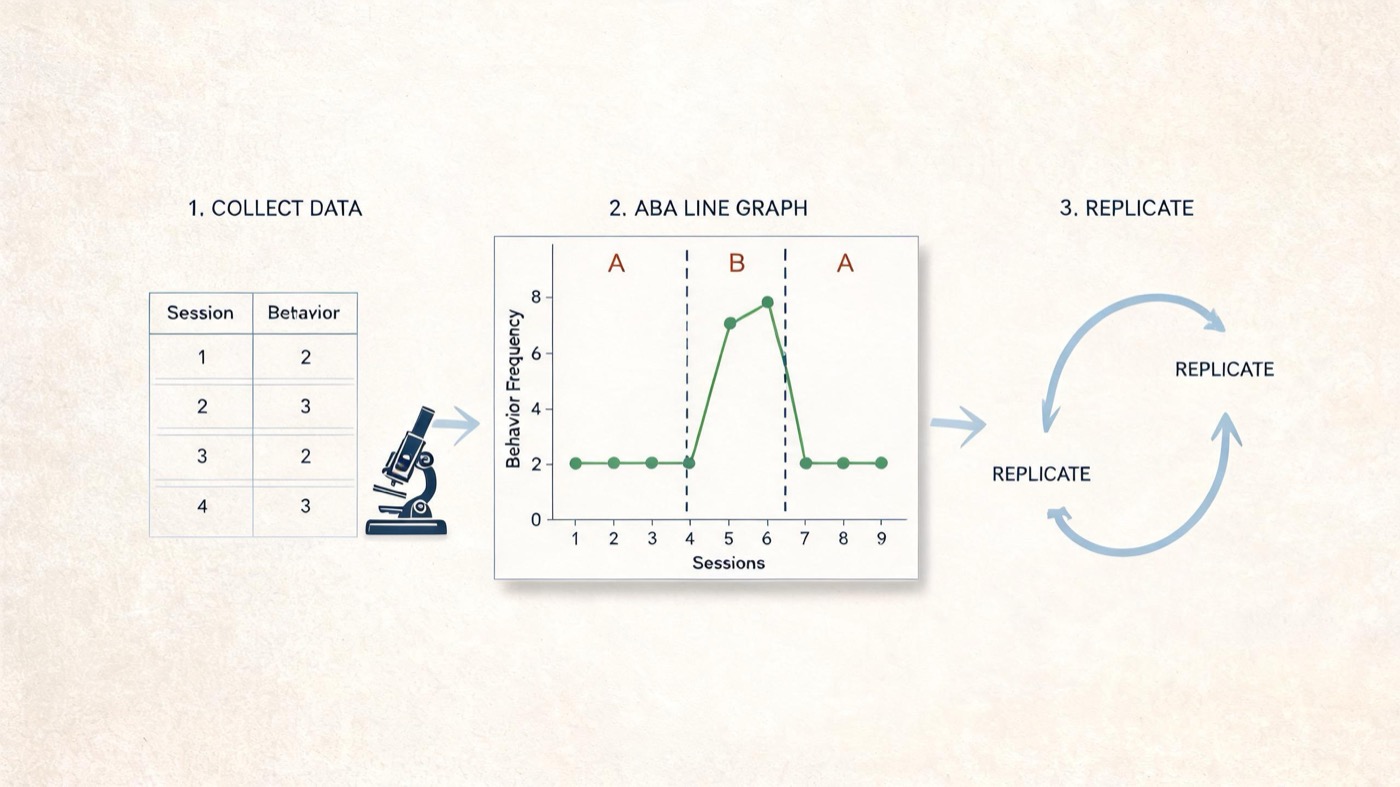
A BCBA measures the rate of head-hitting per hour for a child with autism. Baseline data (5 sessions) shows a stable rate of 8–10 responses/hour. An intervention using differential reinforcement of alternative behavior (DRA) is introduced. The line graph reveals a gradual decrease to 2 responses/hour over 10 sessions. The level shift and trend confirm the intervention’s effectiveness.
Example 2: Increasing On-Task Behavior in a Classroom
A behavior analyst uses momentary time sampling to record on-task behavior every 5 minutes during math. The line graph shows a baseline mean of 40%. After implementing a token economy, the data show an immediate increase to 70%, with low variability. The immediate change in level and stable trend support a functional relation.
Example 3: Teaching Social Initiations
A BCBA teaches a child to initiate greetings during recess. The line graph tracks the number of initiations per session. Baseline is near zero. After using video modeling, the data show a slow but steady increase. The trend line helps decide when to thin reinforcement.
Common Exam Traps When Interpreting Line Graphs
Exam questions often test your ability to spot errors in graph construction or interpretation. Here are typical traps:
- Ignoring scale breaks: A broken y-axis can exaggerate or minimize behavior change. Always check if the scale starts at zero.
- Misinterpreting variability: High variability can mask a real effect. Look for overlapping data ranges between phases.
- Confusing trend with level: A stable trend does not mean a change in level. Trend shows direction; level shows average performance.
- Overlooking condition lines: Without clear phase lines, you cannot determine which data belong to which condition.
- Assuming causation from one graph: A line graph shows patterns, but experimental control requires replication (e.g., reversal or multiple baseline designs).
For more on visual analysis, see our guide on graphing in ABA: level, trend, and variability.
Quick Checklist: Is a Line Graph Appropriate?
Use this checklist on exam day or in practice to decide whether a line graph fits the scenario:
- Is the data collected over multiple sessions or time points? If yes, line graph works.
- Do you need to show changes between phases (e.g., baseline vs. intervention)? Line graph is ideal.
- Is the behavior measured on a continuous scale (e.g., count, duration)? Yes, line graph handles it.
- Do you need to highlight trends or variability? Line graph is best.
- Are you comparing two or more conditions for the same participant? Use a line graph.
- Is the data from a group design with average scores? Consider a bar graph instead.
- Are there only two or three data points? A line graph may mislead; consider a table.
Summary: When Is a Line Graph Used in ABA?
In ABA, a line graph is used whenever you need to display behavior change over time and evaluate the effects of an intervention. It is essential for single-subject designs and visual analysis. On the BCBA exam, you will be asked to interpret graphed data, identify trends, and decide when a line graph is appropriate. Master the components and common traps, and you will be prepared.
For a deeper dive into experimental designs that rely on line graphs, check out our article on single-subject experimental designs.
Additionally, the Behavior Analyst Certification Board provides task list items that emphasize graphing and visual analysis.
Next step for BCBA exam prep
Turn this topic into exam-day practice
Use this topic as a focused review, then test it in exam-style conditions with a free mock before deciding whether five full-length mocks are the right next step.
Start the Free BCBA Mock ExamContinue with Five Full-Length Mocks — $99
Review the included materials and access details before ordering. No pass guarantee is implied.



