

Measurement is the cornerstone of effective Applied Behavior Analysis (ABA). Practitioners rely on valid and reliable data to make treatment decisions, evaluate progress, and demonstrate intervention effectiveness. Among the array of measurement methods, permanent product ABA offers a unique approach by focusing on the tangible outcomes left behind after a behavior occurs. This article defines permanent product recording, provides clear examples, highlights key differences from other methods, and prepares BCBA candidates for exam questions on this topic.
Table of Contents
- Definition of Permanent Product in ABA
- Examples of Permanent Products in ABA
- Permanent Product vs. Other Measurement Methods
- Validity, Reliability, and Common Measurement Traps
- When to Use Permanent Product Recording: A Decision Checklist
- Exam-Style Discrimination Examples
- Frequently Asked Questions
- Conclusion and Free BCBA Mock Exam
- References
Definition of Permanent Product in ABA
A permanent product is the observable, durable outcome or environmental effect that results from a behavior. Rather than observing and recording behavior as it happens, the practitioner measures what the behavior produced. The current BACB BCBA Test Content Outline (6th ed.) lists “direct measures, indirect measures, and product measures” as categories candidates must distinguish. Some coursework may use broader classifications, so use the terminology and context stated in the question. The product must have a consistent and well-defined relation to the target behavior. For example, the number of correctly completed problems can be scored from a finished worksheet; the product measure evaluates the recorded answers, not an assumed one-to-one count of every problem-solving response. Permanent product measurement can assess amount, accuracy, completeness, or quality, but it does not automatically measure behavior frequency unless the product corresponds one-to-one with each response.
Examples of Permanent Products in ABA
To apply permanent product recording correctly, it helps to recognize defensible examples across settings. Each product must be unambiguously linked to the target response and not be produced by another person or event.
- Academic work: Number of correctly completed math problems on a worksheet, essays written, or letters traced correctly.
- Vocational tasks: Number of assembled units meeting quality criteria, reports filed correctly, or inventory items counted.
- Self-care and domestic chores: Folded towels that meet a standard (e.g., all corners aligned), a made bed, or cleaned surfaces defined by observable criteria (e.g., no visible crumbs on counter).
- Community and ecological behaviors: Number of litter items collected and placed in a bin, or pieces of recyclable material sorted correctly.
- Written production: Number of correctly typed words saved in a document, completed data-entry records, or correctly addressed envelopes.
Each example shares a critical feature: the product is a lasting record that can be counted or evaluated after the behavior has ended. The practitioner should operationally define what constitutes a “correct” or “complete” product to ensure consistent measurement across observers and occasions.
Permanent Product vs. Other Measurement Methods
Understanding how permanent product recording compares with other measurement methods is essential for BCBA exam success. The table below summarizes key contrasts.
- vs. Event Recording: Event recording counts each occurrence of a behavior in real time (e.g., tallying each hand raise). Permanent product counts the outcomes after the fact. Event recording requires direct observation; permanent product can be measured later. When a validated one-to-one relation exists—such as one sealed, correctly addressed envelope per completed mailing response—the product count can estimate the response count. But if multiple responses produce a single product (e.g., a stack of folded towels from many folding responses), the product does not yield response frequency.
- vs. Duration Recording: Duration measures how long a behavior lasts. Permanent product provides no temporal information—it only indicates that the product exists, not how long the behavior took.
- vs. Latency Recording: Latency records the time between an antecedent and the onset of behavior. Permanent product cannot capture latency because it does not record when the product was produced.
- vs. Interval and Time Sampling: Interval methods (partial, whole, momentary) divide time into segments and record whether behavior occurred. Permanent-product data are scored from the retained outcomes according to a defined collection schedule; the mere presence of a product does not make the system continuous or discontinuous.
Permanent product recording is especially useful when direct observation is impractical or obtrusive. However, it does not by itself show when, how long, how intensely, or under what antecedent conditions the behavior occurred. These limitations must be considered when selecting a measurement method.
Validity, Reliability, and Common Measurement Traps
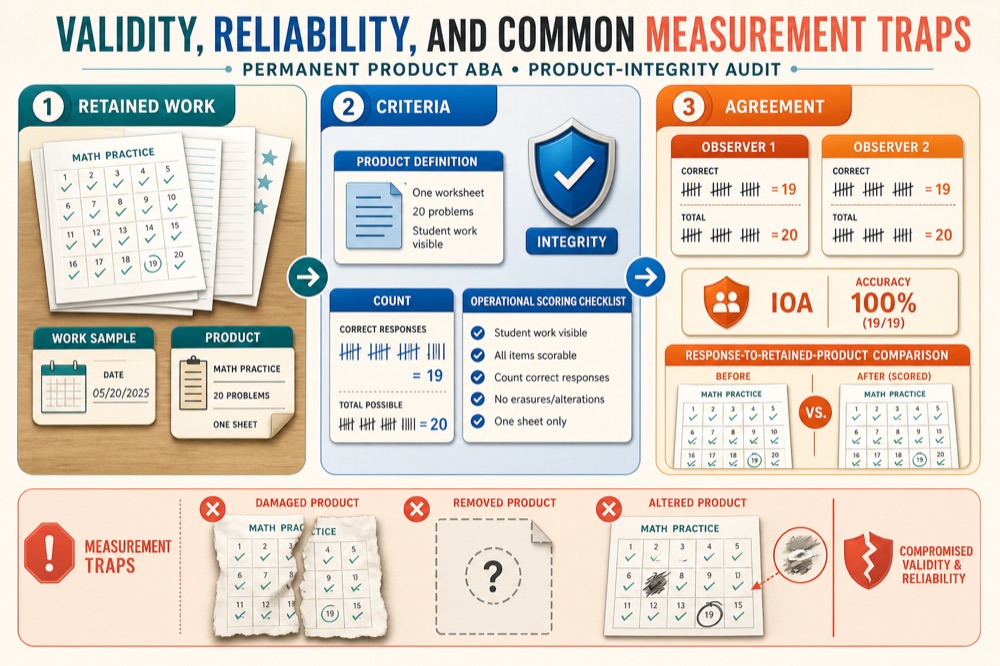
Like any measurement method, permanent product recording can be subject to validity and reliability threats. One threat is product integrity—the product may be damaged, removed, or altered by another person before measurement, leading to under- or overestimation. For example, if a client completes a worksheet but a sibling erases answers, the product no longer reflects the client’s behavior. Another threat is lack of operational definition: without precise criteria for what counts as a product, different observers may disagree. For instance, “clean room” must specify exactly which surfaces must be clear and what degree of mess is acceptable. Interobserver agreement (IOA) can be assessed by having two independent observers measure the same product set and comparing their counts. Additionally, permanent product recording does not automatically eliminate observer drift; if the definition changes over time, drift can still occur. Being aware of these pitfalls ensures that permanent product data are credible and meaningful.
When to Use Permanent Product Recording: A Decision Checklist
Selecting the right measurement method requires evaluating the behavior and context. The following checklist can guide your decision to use permanent product recording.
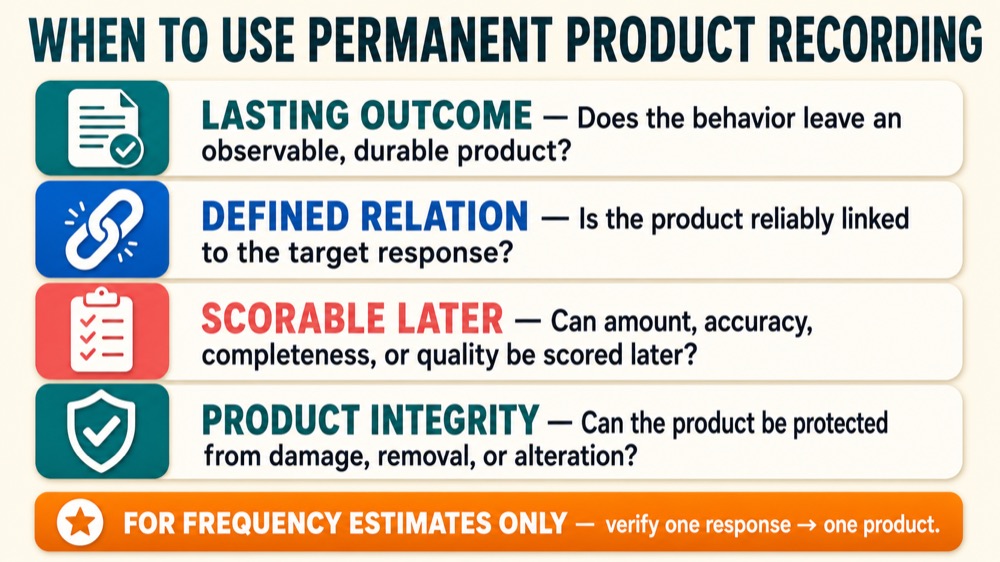
- Does the behavior reliably produce a tangible, observable product that lasts after the response?
- Is the product uniquely tied to the target response (not produced by others)?
- Can the product be measured accurately without real-time observation?
- Are you interested in measuring the outcome (amount, accuracy, quality) rather than the process (duration, latency)?
- Is direct observation impractical due to logistical constraints (e.g., behavior occurs in a separate location)?
If you answered yes to most questions, permanent product recording is likely a suitable choice. Remember that you still need to operationally define the product, train observers, and assess IOA periodically. Also, consider whether you need frequency data: if each product corresponds to one response, then the product count may estimate response frequency after the one-to-one relation and product integrity are verified; if not, use another method to capture response rate.
Exam-Style Discrimination Examples
BCBA-style questions may ask you to identify which measurement method fits a given scenario. Below are practice-style examples to sharpen your discrimination skills. (These are not actual exam questions but are modeled on typical content.)
- Example A: A teacher wants to measure how many times a student writes their name correctly. Each correct writing produces a legible signature on the paper. Which measure is most appropriate? (Answer: Permanent product recording—the signature is a lasting product of the writing behavior.)
- Example B: A BCBA wants to know how long a child engages in solitary play. The child leaves behind a completed puzzle. Is permanent product recording a good method? (Answer: No, permanent product does not measure duration; it would only indicate that a puzzle was completed, not how long play lasted.)
- Example C: An employee assembles products at a workstation. Each assembly produces a finished unit that is inspected. The BCBA wants to count the number of assemblies per hour. (Answer: Permanent product recording can be used if each assembly yields one unit, providing a count of responses per hour.)
When answering exam questions, focus on whether the scenario describes a tangible outcome that can be measured after the behavior ends. If the question asks about a dimension other than count or accuracy (e.g., latency, duration, intensity), permanent product may not be the best choice.
Frequently Asked Questions
Is permanent product recording considered direct or indirect measurement?
The current BACB Test Content Outline lists product measures alongside direct and indirect measures as categories candidates must distinguish. Some coursework may group measurement methods differently, so answer from the terminology and context supplied in the question rather than relying on an absolute label.
Can permanent product recording be used for behaviors that do not leave a product?
No. Permanent product is only appropriate when the behavior consistently produces a tangible, durable effect. For behaviors such as vocalizations, most motor movements, or social interactions, other measurement methods (e.g., event recording, interval recording) are needed.
How can I ensure the accuracy of permanent product data?
Operationally define the product with clear inclusion and exclusion criteria, train observers to apply the definition consistently, and schedule periodic IOA checks. Also, safeguard the product from tampering or environmental degradation between the occurrence and measurement.
Conclusion and Free BCBA Mock Exam
Permanent product recording is a valuable measurement tool for behaviors that produce lasting outcomes. By measuring observable products, behavior analysts can gather data even when real-time observation is not feasible. However, practitioners must carefully define the behavior-to-product relation, ensure reliability, and recognize the method’s limitations—particularly its inability to capture temporal dimensions or antecedent conditions. Mastery of permanent product recording will serve you well on the BCBA exam and in clinical practice. To test your knowledge across all measurement methods, take our free BCBA mock exam. Additional resources on measurement can be found in our measurement methods ABA guide.
References
- Behavior Analyst Certification Board. (2022). BCBA Test Content Outline (6th ed.). Retrieved from https://www.bacb.com/wp-content/bcba-outline-6thEd/
Complete BCBA Exam Prep
Turn this topic into exam-day practice
Practice concepts in context with five full-length 6th Edition mock exams, two bonus practice exams, a 6th Edition study guide, and key-term flashcards—all in one $120 USD package.
Get the $120 All-in-One Prep Pack
Review everything included on the product page before ordering. No pass guarantee is implied.



