
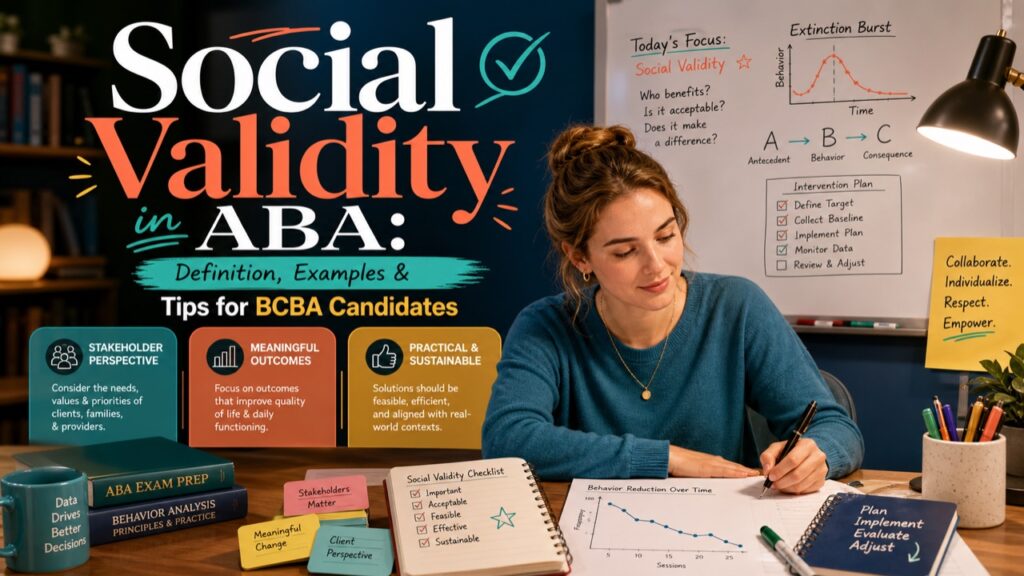
What Is Social Validity in ABA? A Foundational Definition
Social validity refers to the extent to which the goals, procedures, and outcomes of an intervention are acceptable, meaningful, and important to the client, their family, and other stakeholders. Coined by Wolf (1978), social validity ensures that ABA services are not only effective but also valued by those who receive them. It bridges the gap between empirical rigor and real-world relevance, a cornerstone of ethical and person-centered practice.
Table of Contents
- What Is Social Validity in ABA? A Foundational Definition
- Why Social Validity Matters in ABA Practice
- How Is Social Validity Assessed? Tools and Techniques
- Worked Examples of Social Validity in ABA Interventions
- Exam Relevance and Common Traps
- Quick Checklist for Evaluating Social Validity
- Summary: Key Takeaways for Your BCBA Exam
When an intervention lacks social validity, even the most data-driven success may be ignored or discontinued by stakeholders. For BCBA candidates, understanding social validity means recognizing that treatment acceptability and contextual fit are just as critical as functional control. This concept is embedded in the BACB Ethical Code, particularly in standards related to client autonomy and social significance.
The Three Dimensions of Social Validity: Social validity in ABA is typically broken down into three interconnected dimensions: social significance, social acceptability, and practicality. Each dimension addresses a different aspect of stakeholder experience and must be evaluated throughout the intervention process.
- Social significance — Are the goals of the intervention truly important to the client and their community? Goals should target meaningful, functional improvements (e.g., increasing communication, reducing severe self-injury) rather than arbitrary behaviors.
- Social acceptability — Are the intervention procedures considered appropriate and fair by those involved? Stakeholders should find the methods respectful, non-coercive, and aligned with cultural norms. For example, using a token economy may be acceptable in one setting but not in another.
- Practicality — Can the intervention be implemented with available resources and support? Practicality considers time, cost, training demands, and environmental fit. A highly effective but prohibitively expensive procedure may have low social validity.
These three dimensions form a framework that guides BCBA exam scenario questions. You must evaluate each dimension separately and consider how they interact. An intervention can score high on significance but low on practicality, leading to poor adoption.
Why Social Validity Matters in ABA Practice
Beyond ethical mandates, social validity directly impacts treatment adherence and long-term success. When stakeholders perceive an intervention as relevant and acceptable, they are more likely to implement it with fidelity and sustain it over time. This is especially important when working with families, teachers, or support staff who may have limited training or resources.
For BCBA candidates, a common exam trap is focusing solely on behavioral outcomes while ignoring stakeholder perspectives. The BACB Ethical Code (e.g., 2.11, 3.01) emphasizes active client involvement in goal selection and procedure choice. Demonstrating social validity is part of evidence-based practice and is often a point of discussion in supervision and case reviews.
How Is Social Validity Assessed? Tools and Techniques
Assessing social validity requires both direct and indirect measurement approaches. Indirect measures include rating scales, questionnaires, and interviews completed by clients, parents, teachers, or other stakeholders. Direct measures involve observing stakeholder behavior (e.g., frequency of intervention use, verbal complaints) as a proxy for acceptability.
One commonly cited tool is the Social Validity Scale (or its adaptations), which asks respondents to rate items such as “The goals of the intervention are important” and “I would recommend this intervention to others.” However, no single instrument is universal; BCBAs must select or develop measures that fit the specific context and client population.
Considerations When Assessing Social Validity: Effective social validity assessment requires attention to timing, respondent selection, and potential biases. Here are key considerations for the BCBA exam:
- Timing of assessment — Collect baseline acceptability before intervention, during implementation, and after intervention. Pre-post comparisons reveal changes as stakeholders experience the procedures.
- Who to ask — Include primary clients (if possible), caregivers, direct implementers, and other relevant community members. In school settings, also consider peer perspectives.
- Biases to avoid — Social desirability bias can inflate ratings. Use anonymous surveys and supplement with behavioral observations (e.g., treatment integrity, attendance).
- Practicality data — Collect objective indicators like cost, time spent, and required training hours. Compare these to available resources.
Integrating these methods gives a richer picture. A combination of Likert-scale questionnaires, open-ended interviews, and direct observation of implementer fidelity often yields the most valid social validity data.
Worked Examples of Social Validity in ABA Interventions
Exam questions often present vignettes where you must identify whether social validity is adequately addressed. Below are three examples with ABC analysis and hypothesized functions, followed by how social validity was assessed and improved.
Example 1: Teaching Communication Skills to a Nonverbal Child: Setting: A 4-year-old with autism who uses screaming and grabbing to request toys (access to tangibles).
- Antecedent: Peer playing with a desired toy.
- Behavior: Screaming and grabbing.
- Consequence: Parent gives the toy (social disapproval follows). Hypothesized function: Access to tangibles.
The intervention teaches the child to exchange a PECS card for the toy. Social validity assessment: Parent ratings on a 5-point scale about goal importance (mean = 4.5) and procedure acceptability (mean = 4.0). The child’s preference for the PECS system was measured by tracking independent card use during free play. Parents also reported minimal disruption to daily routines.
Example 2: Reducing Aggressive Behavior in a Classroom: Setting: A 10-year-old with intellectual disability who hits peers when seated nearby (escape from social demands).
- Antecedent: Peer proximity during group work.
- Behavior: Hitting.
- Consequence: Teacher removes the peer (escape from demand).
The intervention uses a differential reinforcement of alternative behavior (DRA) procedure: the child earns a break when requesting a break appropriately. Social validity assessment: Teacher rated the intervention as “very acceptable” on the Intervention Rating Profile (IRP-15), and the child’s aggression dropped by 80%. However, feasibility was rated lower due to the need for additional staff for fidelity monitoring. Adjustments were made to simplify the procedure.
Example 3: Promoting Independent Living Skills for an Adult with Developmental Disabilities: Setting: A 35-year-old adult living in a group home who needs to complete morning routine independently (automatic reinforcement of completing tasks).
- Antecedent: Visual schedule posted in the room.
- Behavior: Completes steps of morning routine (brushing teeth, dressing, making bed).
- Consequence: Natural praise from staff and self-reinforcement (feeling of accomplishment).
Social validity assessment: Client satisfaction was measured via a simple smiley-face scale after each morning routine. Caregiver feedback was collected through interviews, highlighting that the visual schedule was easy to implement and the client seemed more confident. The intervention was continued due to high social validity.
Exam Relevance and Common Traps
Social validity appears on the BCBA exam in multiple formats: multiple-choice questions about definitions, scenario-based questions asking you to identify which dimension is lacking, and ethical application vignettes where you must recommend an assessment method. The key is to differentiate social validity from similar constructs like treatment integrity (fidelity of implementation) or social skills (a target behavior, not a validity measure).
Common Student Mistakes: Use the points below as a quick study guide.
- Confusing social validity with treatment integrity. Treatment integrity measures whether the intervention was implemented as planned; social validity measures whether stakeholders value the goals, procedures, and outcomes. A high-integrity intervention can have low social validity if the goals are not meaningful to the client.
- Overlooking the social significance component. Many students focus only on acceptability of procedures but forget that goals must also be important to the client. On the exam, a vignette may describe a well-liked procedure that targets a low-priority goal — that indicates low social validity.
- Forgetting that practicality is part of social validity. An intervention may be acceptable and significant, but if it requires resources the family does not have (e.g., 20 hours of therapist time daily), it fails on practicality. Exam questions sometimes test this dimension explicitly.
- Assuming one assessment method is enough. Social validity should be assessed using multiple methods (surveys, interviews, direct observation) and at multiple time points. A single post-intervention survey may miss important changes in acceptability over time.
Quick Checklist for Evaluating Social Validity
Use this checklist when reviewing a case study or preparing for a BCBA scenario question. Each item corresponds to one of the three dimensions plus measurement quality.
- ☐ Are the intervention goals meaningful and important to the client and their family? (Social significance)
- ☐ Are the procedures acceptable and respectful to stakeholders? (Social acceptability)
- ☐ Can the intervention be implemented with available resources (time, cost, training)? (Practicality)
- ☐ Has social validity been assessed at multiple time points (pre-, during, post-intervention)?
- ☐ Have multiple respondents been included (client, caregiver, implementer, relevant others)?
- ☐ Have direct and indirect measures been used (e.g., rating scales plus observations)?
- ☐ Are the results used to modify the intervention if needed? (e.g., adjusting procedures to improve acceptability)
This checklist aligns with the BACB’s emphasis on client-centered practice and ethical conduct. For further study on how social validity fits into broader assessment and intervention frameworks, see our 7 Dimensions of ABA article, which includes the dimension of social significance.
Summary: Key Takeaways for Your BCBA Exam
Social validity in ABA is not an optional add-on — it is a core component of ethical and effective practice. Remember the three dimensions: significance (goals matter), acceptability (procedures are tolerable), and practicality (resources feasible). Assess it using multiple methods and at multiple time points, always including the client’s voice.
On the BCBA exam, distinguish social validity from treatment integrity and social skills. When you see a vignette, ask: “Are the goals important? Are the procedures acceptable? Is it practical?” If any answer is no, that intervention likely has low social validity. Practice with scenario questions to build fluency, and use the checklist above as a quick reference.
For more guided practice, consider our free BCBA mock exam practice questions that include social validity scenarios. Also review the BACB Ethics Code for specific standards related to client welfare and social validity. Finally, a comprehensive review article by Ferguson et al. (2022) on social validity measurement provides deeper insight into current practices.
Next step for BCBA exam prep
Turn this topic into exam-day practice
Use this topic as a focused review, then test it in exam-style conditions with a free mock before deciding whether five full-length mocks are the right next step.
Start the Free BCBA Mock ExamContinue with Five Full-Length Mocks — $99
Review the included materials and access details before ordering. No pass guarantee is implied.



