

To implement permanent product recording procedures, you do not simply look at whatever item is left on a desk and call it data. You first define the behavior, identify the product that reliably reflects it, decide exactly how the product will be scored, and document when the review occurs. The product is evidence of an outcome; it is useful only when the connection between the behavior and the outcome is clear.
Table of Contents
- What Permanent Product Recording Means
- How to Implement Permanent Product Recording Procedures
- When Is Permanent Product a Good Fit?
- How to Score and Record the Product
- Validity, Reliability, and Limitations
- BCBA and RBT Exam Connection
- Common Implementation Mistakes
- Quick Implementation Checklist
- FAQ
- Quick Review Checklist
- Take the Free BCBA Mock Exam
This phrase appears directly in the BACB RBT Test Content Outline, 3rd edition, beginning with the 2026 examination content. BCBA candidates also need the underlying idea because the BCBA TCO includes product measures, measurement selection, validity, reliability, and procedural-integrity decisions. The exam level and task wording are different, so this guide shows the shared measurement logic without pretending that the RBT TCO is the BCBA blueprint. Table of Contents
What Permanent Product Recording Means
Permanent product recording measures a lasting or observable result left by a behavior rather than requiring an observer to watch every response as it occurs. Examples can include a completed worksheet, a sorted set of objects, a cleaned area, a finished task sequence, or a recorded document. The product is scored after the behavior or activity has taken place.
That description does not mean that every finished item is a valid permanent product. The product must be connected to the target behavior in a way that can be defined and checked. If several people can create the same worksheet result, or if the item can disappear before the observer reviews it, the product may not represent the behavior accurately.
Compare two situations. A learner completes ten math problems, and the analyst counts the number correct on the worksheet. The worksheet is a reasonable product when the scoring rule is defined and the learner’s responses are the source of the marks. By contrast, a clean table may be a weak product for “followed the cleaning routine” if another person cleaned it, the routine was only partly completed, or the final appearance does not show the sequence or prompts used. The measurement question is therefore not just “What remains?” It is “What behavior produced this product, under what rules, and can the product support the decision I need to make?”
How to Implement Permanent Product Recording Procedures
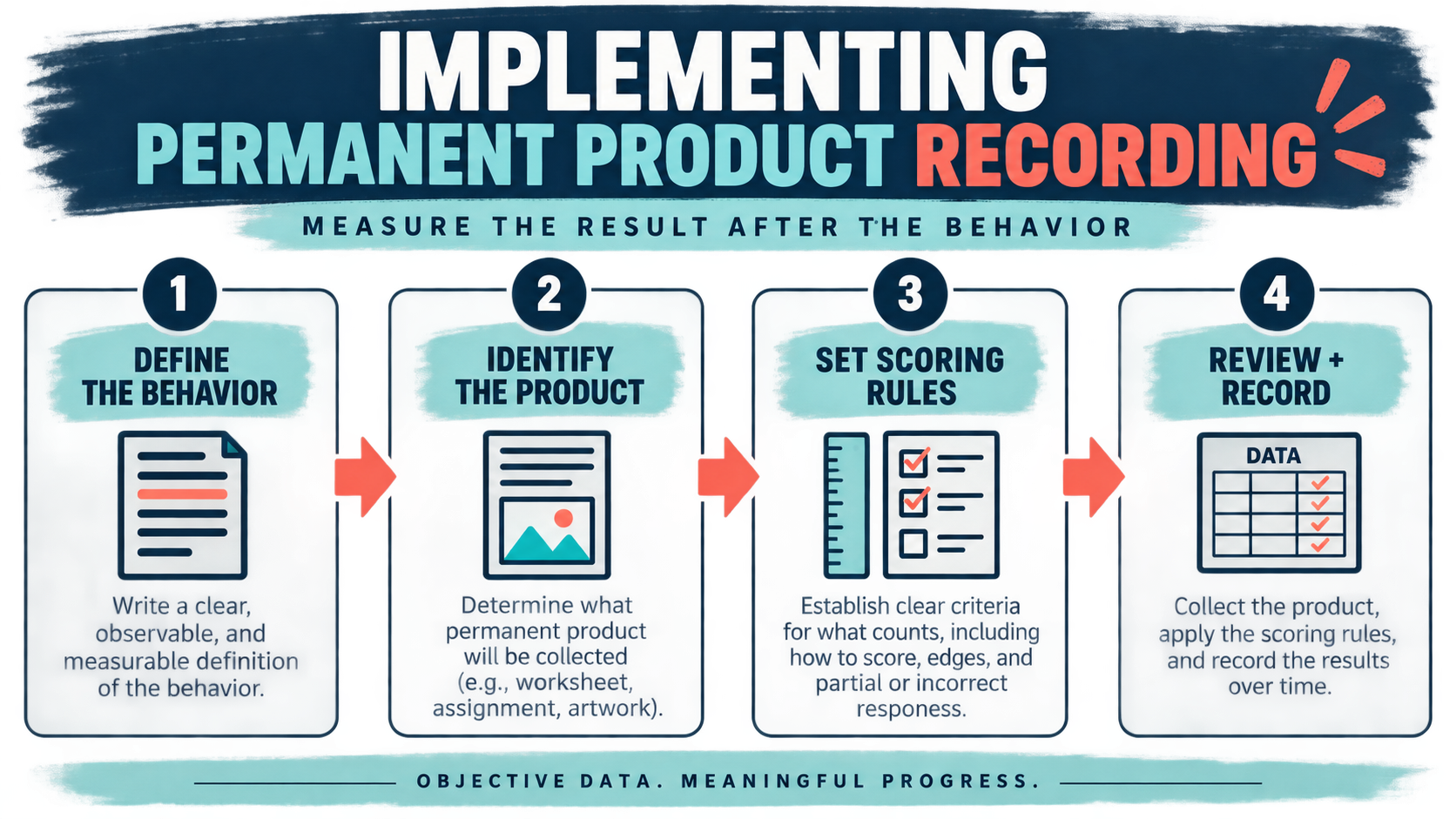
A reliable implementation can be organized into four connected steps. The order matters because a scoring sheet cannot repair an undefined behavior or a product that does not reliably represent the response.
| Step | Decision | Implementation question |
|---|---|---|
| 1. Define the behavior | Write an observable, measurable response definition. | What exactly must happen for the product to count? |
| 2. Identify the product | Select the tangible result that remains available for review. | Does the target behavior reliably produce this product? |
| 3. Set scoring rules | Define what counts, what does not count, and how partial products are scored. | Would two trained reviewers reach the same score? |
| 4. Review and record | Review the product on a defined schedule and enter the data consistently. | When, where, and by whom is the product scored? |
Step 1: Define the behavior: Start with a definition that describes what an observer could see or hear. “Completes homework” is broad. “Writes an answer in each of the ten assigned spaces before leaving the work area” is more measurable. Decide whether the target is the completed product, accuracy, amount, sequence completion, or another dimension.
Step 2: Identify the product: Specify the item or result that will be reviewed. It could be the worksheet, the number of correctly sorted objects, a cleaned area, or a digital record. State how the product is labeled, stored, photographed, or otherwise preserved so it can be checked at the planned time.
Step 3: Set scoring rules: Write the rule before reviewing the first product. For a worksheet, decide whether an erased answer, a correction, or an incomplete item counts. For a cleaned area, define the observable criteria rather than relying on “looks clean.” For a constructed item, define the required components and how a missing component affects the score.
Step 4: Review and record: Set the review time, the reviewer, the data field, and the response to missing products. Record the date, product identity, score, and relevant condition. If the product is not available, do not silently treat “not found” as “zero performance” unless the protocol defines that rule and the interpretation is justified.
When Is Permanent Product a Good Fit?
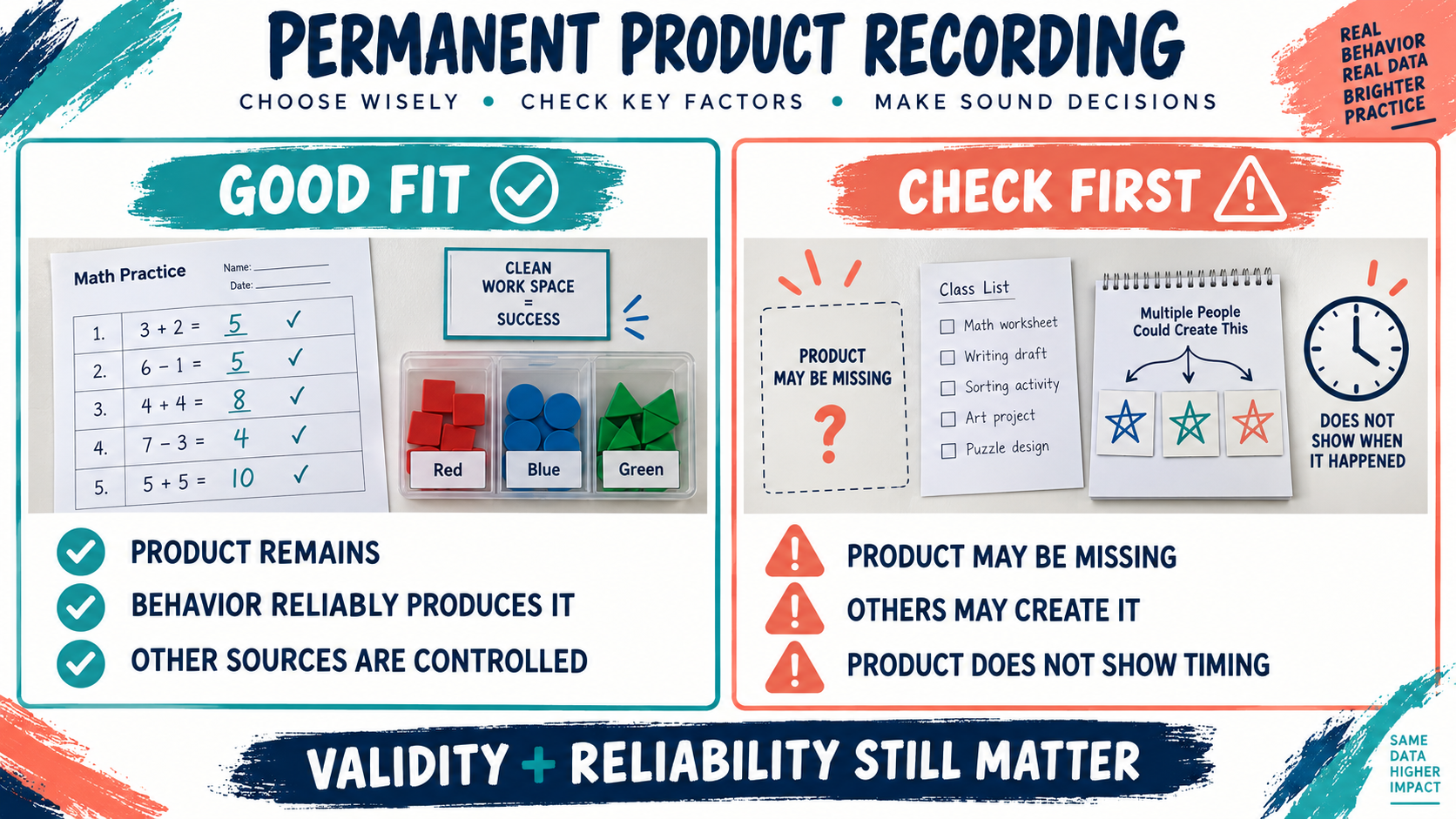
Permanent product can be a strong choice when direct observation is difficult, the product remains available, and the product is a dependable effect of the behavior. It can reduce the need to observe every response in real time, but it does not eliminate the need to plan measurement carefully. Ask three fit questions:
- Does the behavior reliably produce the product? If the response sometimes produces no visible result, the product may underestimate behavior.
- Can another behavior or person produce the same product? If yes, the product may not identify the target response without additional controls.
- Does the product contain the dimension you need? A final worksheet may show accuracy but not the timing, prompts, effort, or errors that occurred along the way.
Good examples include counting correct responses on a worksheet when the learner’s marks are clearly identifiable, measuring the number of items assembled under a defined task, or scoring the components of a completed routine when each component leaves a stable result. Poor fits include using a final clean room to infer every step of a cleaning chain or using a missing digital record to conclude that a behavior never occurred.
How to Score and Record the Product
Choose the scoring unit that matches the question. A worksheet may be scored as number correct, percentage correct, or completed items. A construction task may be scored as components present out of components required. A written routine may be scored as steps completed, but only if the product shows those steps and not merely the final appearance.
For example, if a learner produces 8 correct answers out of 10 opportunities, the record might include 8/10 correct and 80%. If the goal is simply completion, the record might be “10 of 10 spaces completed,” but that should not be reported as accuracy unless correctness was also scored. Do not let the product label decide the measurement dimension after the fact.
Record enough context to interpret the score: date, task or condition, product identifier, scoring rule, reviewer, and any relevant prompt or assistance information. De-identify examples when sharing training materials. If a product is used for procedural-integrity review rather than client behavior, label that purpose clearly; product review of a staff record answers a different question from product measurement of a learner response.
Validity, Reliability, and Limitations
Permanent product recording is indirect with respect to the behavior: the reviewer examines the effect after the response rather than observing every response in the moment. The method is useful when the behavior reliably produces the product and other events do not commonly produce the same result. If those conditions fail, the data may not be valid for the decision.
Reliability still matters. Train reviewers on the operational definition and scoring rule, compare scores on a sample of products, and resolve disagreements by revising the procedure rather than averaging away the problem. A scoring sheet with unclear rules can create disagreement even when the product itself is stable.
Also consider timing. A permanent product can show that a result exists, but it may not show when the behavior occurred, how long it lasted, or whether several responses were required to produce one result. If timing is the critical dimension, duration, latency, frequency, or another measure may be more representative. The BACB BCBA TCO emphasizes choosing a measurement procedure that accounts for the critical dimension of behavior and environmental constraints.
BCBA and RBT Exam Connection
The exact task phrase “implement permanent product recording procedures” is listed as A.3 in the BACB RBT Test Content Outline, 3rd edition, under Data Collection and Graphing. That is why many study resources present the phrase as an RBT implementation task.
For BCBA candidates, the closest current blueprint connection is the BCBA TCO’s Measurement, Data Display, and Interpretation domain. The BCBA TCO 6th edition asks candidates to distinguish direct, indirect, and product measures; select representative measurement procedures; and evaluate validity and reliability. A BCBA question may therefore ask you to critique the product measure, identify a confound, or choose a better measurement method rather than simply name the procedure.
This boundary matters for SEO and for study accuracy. Do not claim that one task phrase is a BCBA-only requirement. Explain which outline contains the wording, then show how the concept transfers to BCBA-level measurement decisions.
Common Implementation Mistakes
- Using a product without a definition: “finished work” is not a scoring rule. Define the required response and product criteria.
- Confusing completion with accuracy: a completed form may contain incorrect responses. Score the dimension the goal actually names.
- Ignoring alternative sources: if another person can complete the product, the product alone may not demonstrate the learner’s behavior.
- Scoring missing products as zero automatically: missing, destroyed, or unavailable evidence may be a data-collection problem, not a zero response.
- Failing to preserve products: an item that is discarded before review cannot support later verification unless the protocol provides another valid record.
- Using the method for the wrong dimension: a final product may show an outcome while hiding latency, duration, prompting, or response quality.
For more background, see our existing permanent product in ABA definition and examples page. This article’s focus is the implementation decision: how to turn a product into a defined, repeatable measurement procedure. For scenario practice, use our free BCBA mock exam. Practice questions can help you discriminate product measures from direct and discontinuous measures, but they do not replace the current BACB outline, handbook, or supervisor instruction.
Quick Implementation Checklist
- Define the target behavior in observable and measurable terms.
- Name the product and explain how it is preserved or identified.
- Confirm that the target behavior reliably produces the product.
- Check whether other people, events, or behaviors can create the same product.
- Write scoring rules for correct, incomplete, partial, and missing products.
- Choose the scoring dimension that matches the decision: count, accuracy, percentage, components, or another measure.
- Set the review schedule and record who scored the product.
- Train reviewers and check agreement on a sample.
- Reconsider the measurement if the product does not show the critical dimension of behavior.
FAQ
What does it mean to implement permanent product recording procedures?: It means using a planned procedure to measure a behavior through the lasting product or result it produces. The procedure includes a behavior definition, product definition, scoring rules, review schedule, and data-recording method.
Is a worksheet always a permanent product?: No. A worksheet can be a permanent product when the learner’s behavior produces identifiable marks or results and the scoring rules are defined. If someone else completed it or the worksheet does not show the behavior dimension of interest, it may not be a valid measure.
What is the biggest limitation of permanent product recording?: The product may not show the behavior directly or may be produced by another source. It can also hide timing, prompts, effort, or errors that matter to the clinical or exam question.
Is this an RBT or BCBA exam topic?: The exact wording is listed in the RBT TCO 3rd edition. BCBA candidates still need the related product-measurement and measurement-selection concepts in the BCBA TCO, but the two exams should not be described as having identical task lists.
To implement permanent product recording procedures well, treat the product as evidence that must earn your confidence. Define the response, protect the product, score it consistently, and verify that it represents the behavior and dimension you intend to measure.
Quick Review Checklist
Use this final checklist to turn implement permanent product recording procedures into exam-ready reasoning. The goal is not to memorize a label in isolation; it is to identify the relevant evidence and explain why the best answer fits the scenario. Key ideas to review:
- State the central definition or decision point for implement permanent product recording procedures in your own words.
- Identify the detail that makes implement permanent product recording procedures different from its closest related ABA term.
- Separate the observable facts in a scenario from assumptions that are not supported by the facts.
- Write one example and one nonexample so you can recognize the concept in a new setting.
Exam application checks:
- Ask what the question is actually requesting before comparing the answer choices.
- Mark the antecedent, response, consequence, or other evidence that supports the selected answer.
- Look for a distractor that describes a related process but does not answer the specific question.
Final self-check:
- Explain how you would verify the interpretation with clear observations or data.
- Change one detail in the scenario and decide whether your answer should change.
- Give a one-sentence rationale that a supervisor or study partner could evaluate.
Take the Free BCBA Mock Exam
When you are ready to apply the idea, use the free practice resource below for additional feedback. Take the Free BCBA Mock Exam



