
What Is Higher-Order Conditioning?
Higher-order conditioning is a Pavlovian, or respondent, learning procedure in which a stimulus acquires the capacity to evoke a conditioned response through its relation with another conditioned stimulus. Searchers often type high order conditioning, but higher-order conditioning is the standard form. The defining feature is indirect conditioning: the newer stimulus is not directly paired with the original unconditioned stimulus during the higher-order phase.
Table of Contents
- What Is Higher-Order Conditioning?
- The Two-Phase Second-Order Conditioning Sequence
- Higher-Order Conditioning Versus Related Processes
- Defensible Examples and Limits of Inference
- Common Conceptual Errors
- Exam-Style Discrimination Practice
- Higher-Order Conditioning Study Checklist
- Frequently Asked Questions
- Test Your Discrimination With a Free BCBA Mock Exam
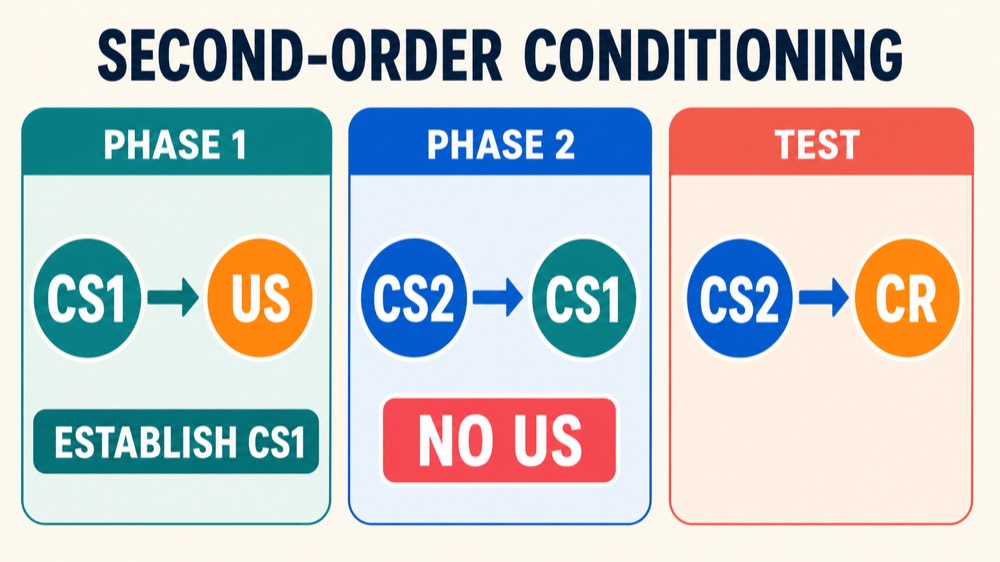
The clearest starting point is second-order conditioning. First, a stimulus called CS1 is paired with an unconditioned stimulus, or US, until CS1 can evoke a conditioned response. Next, a different stimulus, CS2, is paired with CS1 while the US is omitted. A later test asks whether CS2 now evokes a conditioned response. This sequence separates higher-order conditioning from ordinary first-order conditioning and from operant response chains.
The Two-Phase Second-Order Conditioning Sequence
Accurate labeling matters because the same event can play different roles in different arrangements. An unconditioned stimulus produces an unconditioned response without the specific learning history being studied. After repeated or otherwise effective CS1–US pairings, CS1 can evoke a conditioned response. Only then does the higher-order phase pair CS2 with CS1. During that phase, CS2 is not paired directly with the US.
- Phase 1—first-order conditioning: Present CS1 in relation to the US. For example, a tone precedes food, and food naturally produces salivation.
- Phase 1 test: Present the tone without food and confirm that the tone now evokes salivation or another defined conditioned response.
- Phase 2—second-order conditioning: Present a light, CS2, followed by the established tone, CS1, while omitting food, the original US.
- Second-order test: Present the light alone. Salivation to the light provides evidence that CS2 acquired control over a conditioned response through its relation with CS1.
Second-order conditioning is one member of the broader higher-order category. In principle, additional orders can be studied by relating a new stimulus to an already conditioned stimulus. In practice, the strength and form of responding depend on details such as timing, number of trials, stimulus properties, prior learning, and the test procedure. It is therefore unsafe to memorize an absolute rule that every higher-order response must be weaker or must extinguish faster.
Higher-Order Conditioning Versus Related Processes
The higher order conditioning psychology definition becomes easier to use when it is compared with procedures that can produce superficially similar behavior. The crucial questions are when each relation was established and whether the behavior is respondent or operant. A stimulus sequence is not automatically a response chain, and a newly effective stimulus is not automatically an SD or a conditioned reinforcer.
- First-order respondent conditioning: A previously neutral stimulus is paired directly with the US. There is no intermediary conditioned stimulus.
- Second-order conditioning: CS1 is first related to the US; afterward, CS2 is paired with CS1 without the US; CS2 is then tested.
- Sensory preconditioning: Two initially neutral stimuli are paired first. One of them is later paired with the US, and the other is tested. The phase order is reversed relative to second-order conditioning.
- Stimulus generalization: Responding occurs to a stimulus that resembles a trained CS. No separate CS2–CS1 pairing is required to define generalization.
- Operant response chaining: A sequence of responses is linked through consequences and discriminative stimuli. The unit being organized is a response sequence, not a hierarchy of Pavlovian CS–CS relations.
- Conditioned reinforcement: A consequence increases future operant behavior because of a learning history. That functional definition should not be replaced with respondent terminology merely because stimulus pairing occurred somewhere in the history.
Sensory preconditioning is an especially useful contrast. In a simplified arrangement, a light and tone are paired while both are neutral. The tone is then paired with an air puff, and finally the light is tested for a blink response. In second-order conditioning, by contrast, the tone–air-puff relation would be established before the light–tone pairings. The same stimuli can therefore participate in different procedures depending on phase order.
For a broader comparison of the two major learning frameworks, review operant versus classical conditioning. That distinction prevents a common category error: describing a child completing several taught steps, earning tokens, or requesting a break as higher-order respondent conditioning when the relevant relation is actually operant.
Defensible Examples and Limits of Inference
A laboratory example can cleanly arrange the required phases. Suppose a brief tone, CS1, reliably precedes an air puff, the US, and the air puff produces a blink. After the tone evokes a blink on its own, a geometric icon, CS2, is presented before the tone across trials with no air puff. If the icon later evokes blinking when presented alone, the result is consistent with second-order conditioning.
An applied human example must be stated more cautiously because uncontrolled learning histories are difficult to reconstruct. Imagine a hypothetical assessment in which a particular medical instrument already evokes a respondent fear reaction after prior painful procedures. If a distinct waiting-room odor is subsequently paired with that instrument in the absence of pain and the odor later evokes a similar reaction, higher-order conditioning is one possible account. Observation alone would not prove the exact conditioning history.
The research review by Honey and Dwyer summarizes higher-order procedures and the questions researchers use to distinguish learned associations and performance effects. Their discussion is useful because it treats second-order conditioning and sensory preconditioning as experimentally defined arrangements rather than interchangeable labels. See the open-access review of higher-order conditioning for the underlying procedural analysis.
Common Conceptual Errors
Many weak explanations begin with a correct CS1–CS2 vocabulary and then drift into unrelated operant claims. A reliable review method is to diagram every phase before choosing a label. If the diagram cannot show what functioned as CS1, CS2, and US—and whether the US was absent during CS2–CS1 pairings—the scenario may not demonstrate higher-order conditioning at all.
- Calling every multi-step performance a conditioning chain: Handwashing, dressing, and task-analysis sequences are operant response chains unless a separate respondent arrangement is demonstrated.
- Pairing CS2 directly with the US: That arrangement establishes first-order conditioning to CS2 rather than the defining second-order relation.
- Using a token economy as a clean example: Tokens are typically analyzed as conditioned reinforcers within operant contingencies, so a token story does not by itself establish higher-order respondent conditioning.
- Confusing a conditioned stimulus with an SD: A CS is defined by a respondent relation; an SD signals a different availability of reinforcement for an operant response.
- Treating extinction outcomes as fixed laws: Removing CS1 or extinguishing one relation does not justify a universal prediction about CS2 without considering the exact procedure and what association controls test performance.
- Claiming a learning history from one observation: A response to CS2 can be compatible with several processes. The observation must be interpreted in light of arranged pairings and plausible alternatives.
Another error is to say that higher-order conditioning “works in both respondent and operant conditioning.” Higher-order conditioning, as defined here, refers to relations among Pavlovian conditioned stimuli. Operant conditioned reinforcers may have histories involving stimulus relations, but their defining effect is an increase in future operant behavior. Keeping the two levels of analysis separate produces clearer answers and safer applied interpretations.
Exam-Style Discrimination Practice
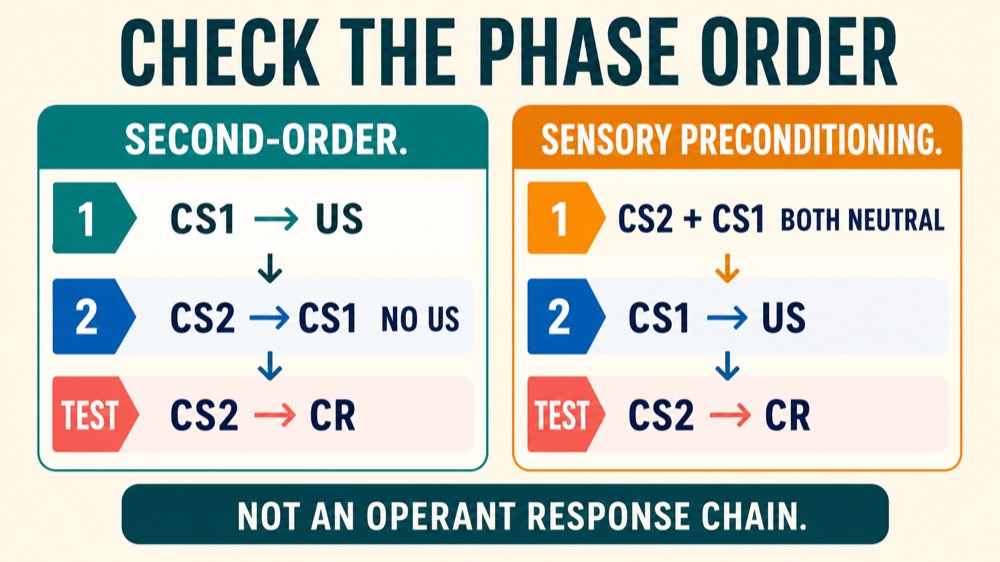
The following original scenarios are study exercises, not recalled or reproduced BACB questions. Read the phase order before reading the answer label. This method prevents keywords such as “paired,” “chain,” or “conditioned” from overriding the actual contingency. It also supports the broader respondent-versus-operant discrimination reflected in the current BACB BCBA Test Content Outline, without implying that the outline explicitly names this narrower procedure.
- Scenario A: A buzzer is paired with an air puff until the buzzer evokes blinking. A blue square is then paired with the buzzer without the air puff. The square later evokes blinking. This is second-order conditioning.
- Scenario B: A blue square and buzzer are paired while both are neutral. The buzzer is later paired with an air puff. The square then evokes blinking. This is sensory preconditioning.
- Scenario C: A learner turns on water, applies soap, scrubs, rinses, and dries; each completed step sets the occasion for the next response. This is an operant response chain, not higher-order conditioning.
- Scenario D: After one white coat has been paired with a painful procedure, similar white uniforms evoke distress without separate pairings. This pattern is more consistent with stimulus generalization than with a demonstrated CS2–CS1 procedure.
Notice that the answer does not depend on whether the example involves an animal, a clinic, or a classroom. It depends on the functional arrangement. For second-order conditioning, CS1 must already have a respondent relation with the US, CS2 is then paired with CS1 without the US, and a test of CS2 demonstrates the target effect. Changing that order changes the appropriate label.
Higher-Order Conditioning Study Checklist
Use the checklist as a compact decision tool. It is more reliable than memorizing a single story because it transfers across stimulus modalities and settings. When a scenario omits one of these elements, state what information is missing instead of forcing the example into the higher-order category.
- Identify the US and the unconditioned response before labeling any conditioned stimulus.
- Confirm that CS1 was related to the US and can evoke a conditioned response before the higher-order phase.
- Identify the new stimulus, CS2, and verify that it was paired with CS1 rather than directly with the US.
- Check that the original US was omitted during the CS2–CS1 phase.
- Look for a test of CS2 alone and a clearly defined conditioned response.
- Compare the phase order with sensory preconditioning before selecting an answer.
- Rule out stimulus generalization, verbal instruction, direct conditioning, and operant response chaining.
- Avoid absolute predictions about response strength or extinction unless the scenario supplies the relevant procedural details.
Frequently Asked Questions
Are higher-order conditioning and second-order conditioning identical?: Second-order conditioning is the most common example of higher-order conditioning, but the broader term can include conditioning beyond the second order. In a second-order procedure, CS2 acquires its relation through an established CS1. The broader label emphasizes that conditioning is mediated through an already conditioned stimulus rather than a direct CS–US pairing.
Is sensory preconditioning a type of second-order conditioning?: The procedures are related but differ in phase order. Second-order conditioning establishes CS1 with the US before CS2 is paired with CS1. Sensory preconditioning pairs two neutral stimuli first and conditions one of them with the US later. Diagramming the phases is the fastest way to distinguish them.
Test Your Discrimination With a Free BCBA Mock Exam
Strong concept learning means identifying the controlling relation, not matching a scenario to one memorized phrase. After diagramming CS1, CS2, the US, and the phase order, practice distinguishing respondent conditioning from operant procedures in our Free BCBA Mock Exam. Use each explanation to check why the selected process fits and why the alternatives do not.



