
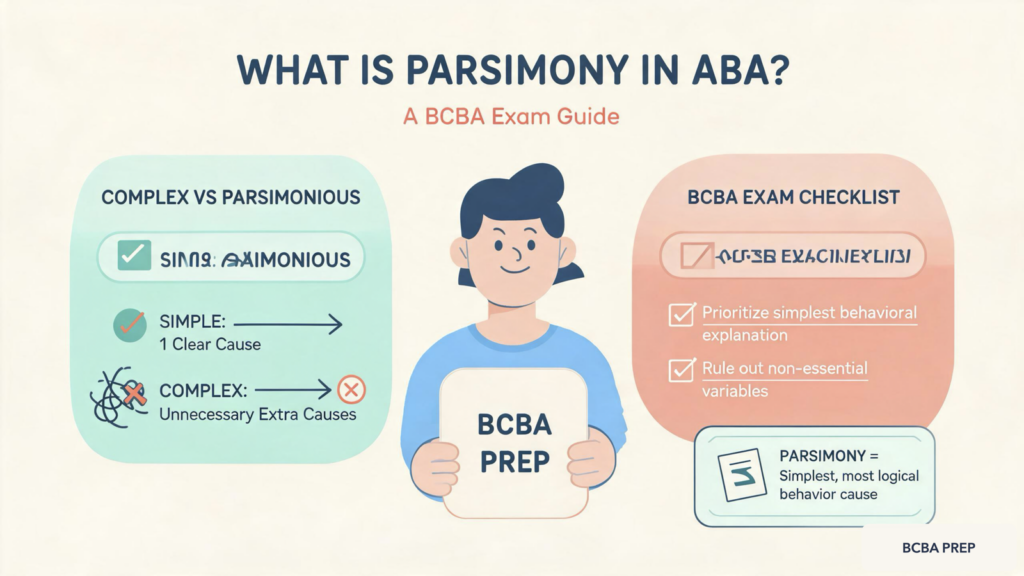
What Is Parsimony? Definition for the BCBA Exam
When you conduct a functional behavior assessment or interpret behavioral data, you are essentially forming hypotheses about why a behavior occurs. The principle of parsimony in ABA guides this process: among competing explanations, select the one that makes the fewest assumptions while still accounting for the observed data. This concept, rooted in Occam’s razor, is a cornerstone of scientific thinking in behavior analysis.
Table of Contents
- What Is Parsimony? Definition for the BCBA Exam
- Worked ABA Examples of Parsimony
- Common Exam Traps and How to Avoid Them
- Quick Parsimony Checklist for the BCBA Exam
- Summary: Parsimony and Your BCBA Success
Parsimony does not mean oversimplifying. It means starting with the simplest, most evidence-based explanation and only moving to more complex accounts when data require it. For the BCBA exam, understanding parsimony helps you answer questions about functional analysis, intervention design, and ethical decision-making.
Parsimony as a Scientific Principle
In behavior analysis, parsimony ensures that our explanations remain grounded in observable events. If a child cries when given a math worksheet and the worksheet is removed, the most parsimonious hypothesis is that crying is maintained by negative reinforcement (escape from demands). Proposing that the crying is due to a sensory-seeking condition without any evidence violates parsimony. This principle aligns with radical behaviorism’s focus on environmental variables rather than hypothetical inner causes.
Why Parsimony Matters in Behavior Analysis
Parsimony matters for several reasons. First, it prevents overcomplication of behavior, which can lead to unnecessary or ineffective interventions. Second, it promotes efficient hypothesis testing: you rule out simple, socially mediated functions before exploring automatic reinforcement or biological causes. Third, parsimony is tied to ethical practice; the BACB ethics code requires behavior analysts to use evidence-based, least restrictive procedures (see BACB Ethics Code 2.01). By applying parsimony, you avoid attributing behavior to unverified internal states, respecting the client’s dignity and minimizing assumptions.
Worked ABA Examples of Parsimony
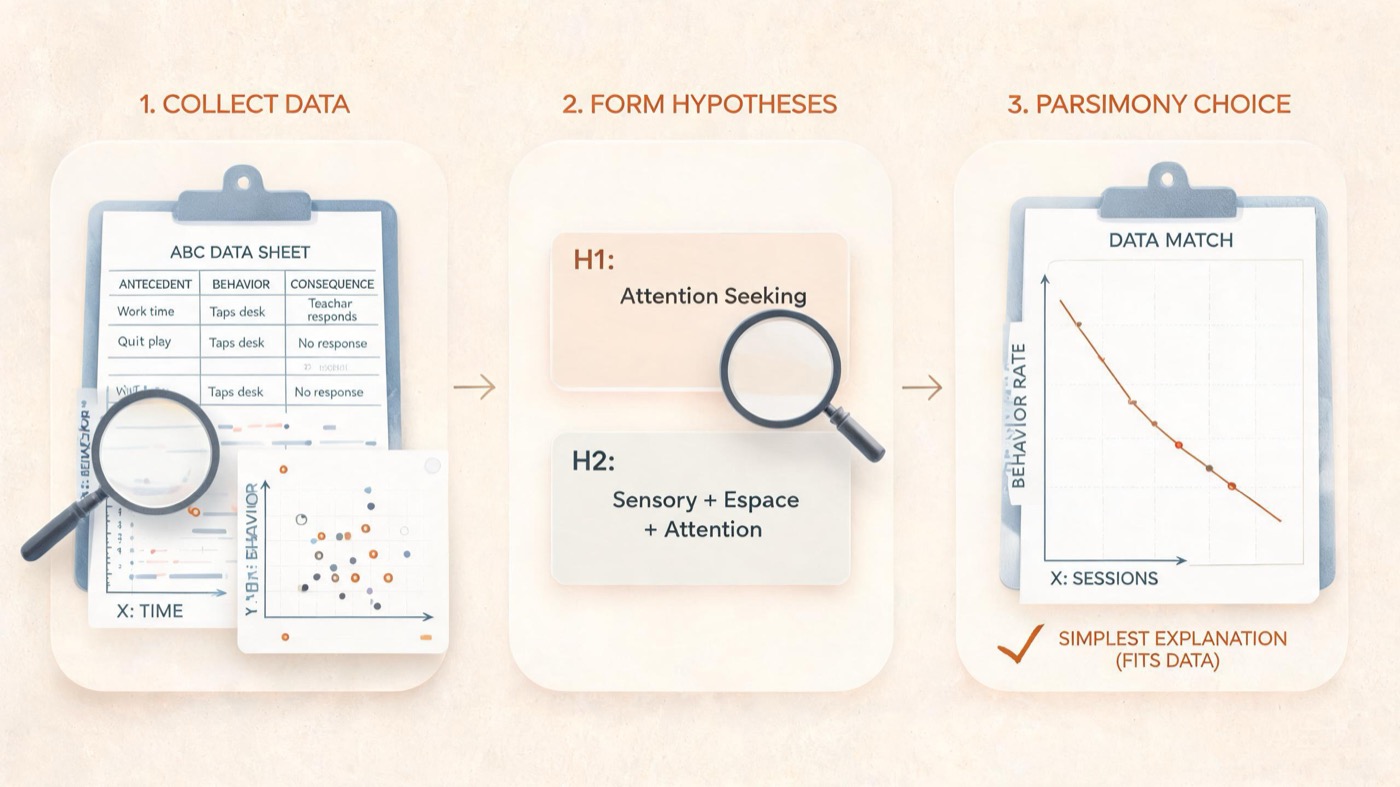
Let’s apply parsimony to three common scenarios you might encounter on the BCBA exam or in practice. Each example compares a parsimonious hypothesis with a more complex alternative that lacks supporting data.
Example 1: Escape from Demands
ABC data: Antecedent = teacher gives a math worksheet. Behavior = student yells and throws pencil. Consequence = teacher removes worksheet and tells student to calm down. The simplest explanation: yelling is maintained by negative reinforcement (escape from demands). A non-parsimonious hypothesis would be that the yelling is caused by a headache or sensory overload, but there is no data supporting those internal states. Stick with the data you have.
Example 2: Attention-Maintained Hitting
ABC data: Antecedent = peer ignores the target child. Behavior = child hits peer. Consequence = peer turns and scolds the child. The parsimonious hypothesis is that hitting is maintained by positive reinforcement (attention). A more complex hypothesis might suggest the child is seeking proprioceptive input, but without a functional analysis showing automatic reinforcement, this is not justified. Simpler is better when data align.
Example 3: Tangible Access to a Toy
ABC data: Antecedent = adult removes a preferred toy. Behavior = crying and whining. Consequence = adult returns toy. The parsimonious interpretation is that crying is maintained by access to tangible items. Proposing that crying is automatically reinforced (e.g., self-stimulatory) would ignore the clear contingency. Always start with the function that directly follows from the consequence.
Common Exam Traps and How to Avoid Them
The BCBA exam often tests parsimony indirectly through questions about functional hypotheses, design of interventions, and interpretation of graphs. Here are three traps to watch for.
Trap 1: Over-Hypothesizing Functions
Students sometimes choose complex functions when a simpler one fits the data. For example, on a question where an individual engages in hand-flapping during low-demand situations, the most parsimonious hypothesis might be automatic reinforcement. But if the same hand-flapping occurs only in social settings, the simpler hypothesis could be attention. Always rule out social-positive and social-negative reinforcement first before considering automatic reinforcement.
Trap 2: Ignoring Parsimony in FBA
When conducting a functional behavior assessment (FBA), some practitioners jump straight to complex assessments without considering direct observation data. The parsimonious approach is to start with indirect assessments and descriptive ABC data. Only if those do not yield a clear function should you consider a functional analysis or more invasive procedures. This saves time and resources.
Trap 3: Misapplying Parsimony to Treatment
Parsimony applies to explanations, not necessarily to treatment intensity. A parsimonious hypothesis might lead to a simple intervention (e.g., extinction of escape-maintained behavior), but sometimes the simplest explanation still requires a robust treatment package (e.g., FCT plus extinction). Do not confuse parsimony with minimal intervention; intervention should be based on function and data, not on simplicity alone.
Quick Parsimony Checklist for the BCBA Exam
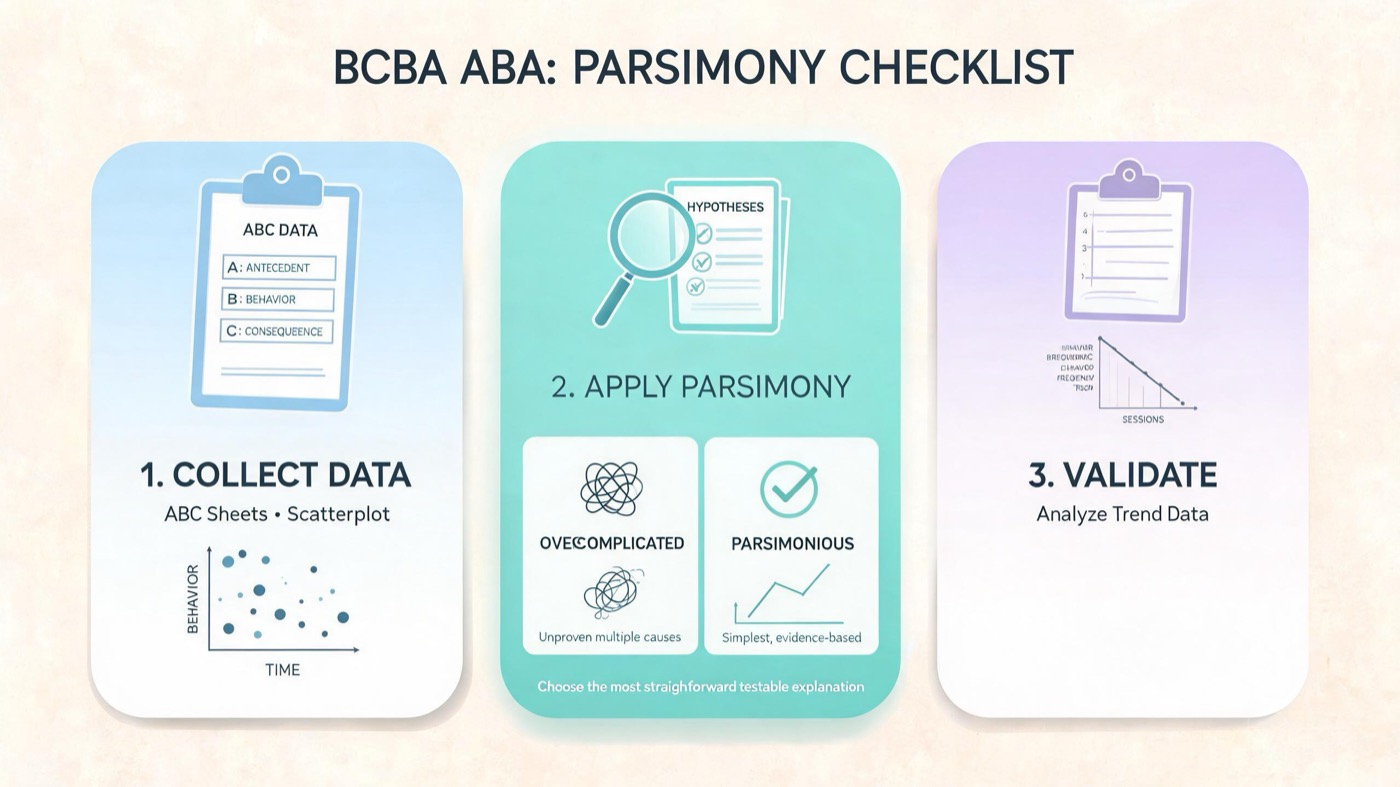
Use this checklist when analyzing a behavioral scenario on the exam. It will help you avoid overcomplicating and stay aligned with the principle of parsimony.
- Does the hypothesis match the ABC data without adding extra assumptions?
- Have you ruled out the three socially mediated functions (escape, attention, tangible) before considering automatic reinforcement?
- Are you using all available data (indirect, descriptive, and if needed, functional analysis)?
- Could the behavior be explained by basic operant principles (reinforcement, punishment, extinction)?
- Would a more complex hypothesis require evidence that is not present in the data?
Summary: Parsimony and Your BCBA Success
Parsimony is not just a theoretical concept; it is a practical tool that sharpens your clinical judgment and exam performance. By always starting with the simplest, evidence-based explanation, you will make more accurate functional assessments and choose interventions that are both effective and ethical. For more on foundational ABA concepts, check out our guide on the 7 dimensions of ABA and the radical behaviorism perspective. For external reading, see the BACB’s Ethics Code for Professional Conduct (BACB Ethics) and Baer, Wolf, & Risley’s (1968) seminal article on the dimensions of applied behavior analysis. Master parsimony, and you will not only pass the exam but also become a more thoughtful, data-driven behavior analyst.
Complete BCBA Exam Prep
Turn this topic into exam-day practice
Practice concepts in context with five full-length 6th Edition mock exams, two bonus practice exams, a 6th Edition study guide, and key-term flashcards—all in one $120 USD package.
Get the $120 All-in-One Prep Pack
Review everything included on the product page before ordering. No pass guarantee is implied.



