
What Is the Dependent Variable? A Quick Definition
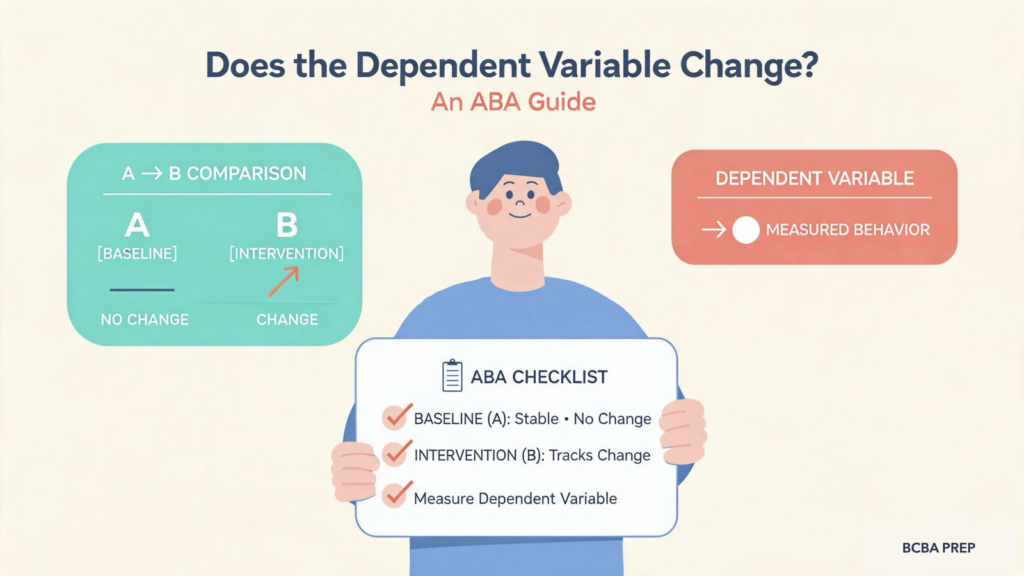
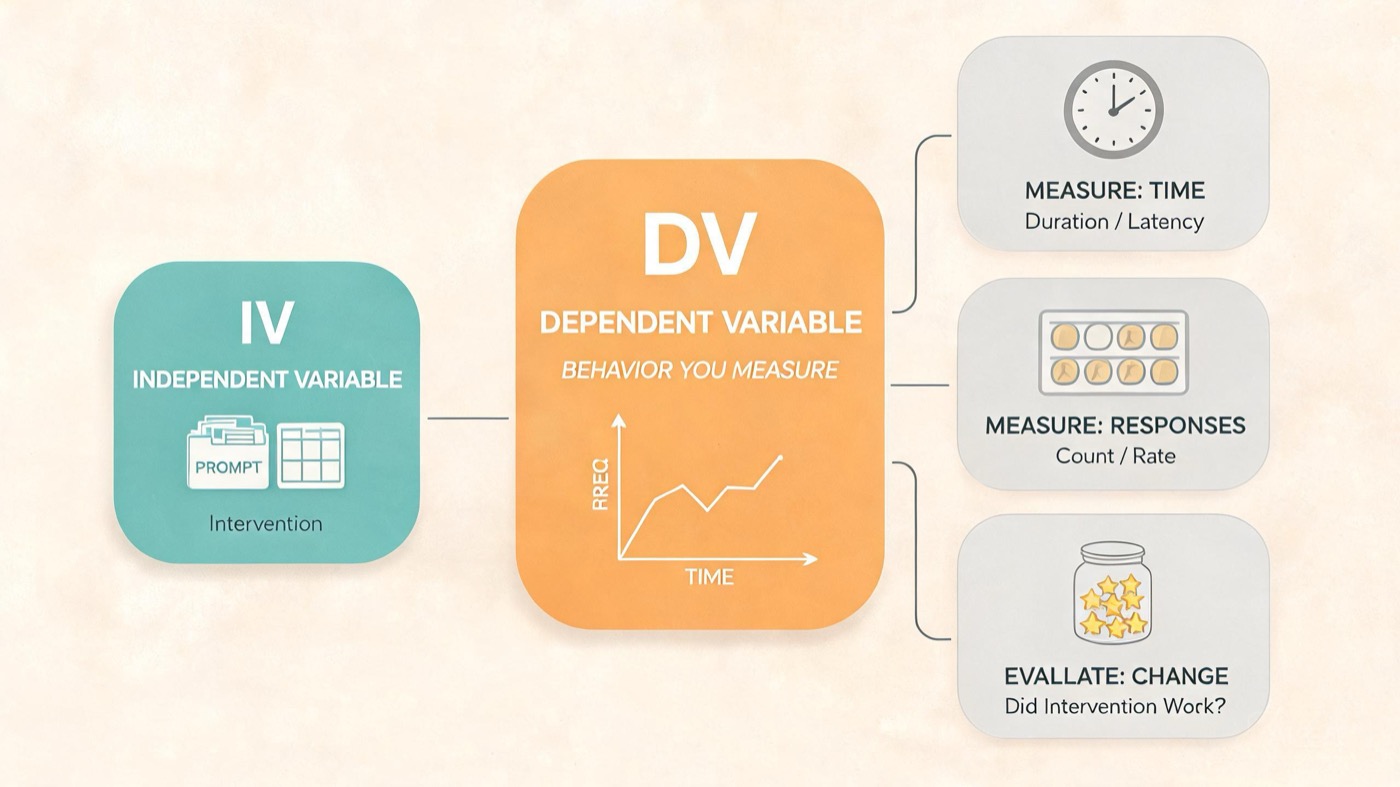
In applied behavior analysis, every experiment has two key variables: the independent variable and the dependent variable. The dependent variable is the behavior you measure. It is the outcome you track to see if your intervention worked. The question ‘does the dependent variable change?’ is central to evaluating experimental effects.
Table of Contents
- What Is the Dependent Variable? A Quick Definition
- ABA Examples: Does the Dependent Variable Change?
- Quick Checklist for BCBA Candidates
- Exam Relevance and Common Traps
- Summary: Does the Dependent Variable Change?
Dependent Variable vs. Independent Variable
The independent variable is the intervention you manipulate (e.g., a token economy, differential reinforcement). The dependent variable is the target behavior that you measure (e.g., aggression, on-task behavior). In a well-designed study, a functional relation is demonstrated when changes in the independent variable produce reliable changes in the dependent variable. Candidates often confuse the two on the exam, so distinguishing them is essential.
Why the Dependent Variable Changes in ABA Experiments
The dependent variable is expected to change if the intervention is effective. For example, if you implement a DRA procedure to reduce aggression, you expect the rate of aggression (dependent variable) to decrease. If the dependent variable does not change, it suggests the intervention was ineffective or the functional relation was not established. However, no change can also be meaningful—for instance, maintaining a stable baseline. Understanding this nuance is key for interpreting single-subject experimental designs.
ABA Examples: Does the Dependent Variable Change?
Let’s examine three practical examples using the ABC format and hypothesized function to illustrate dependent variable change.
Example 1: Decreasing Aggression
- ABC: Antecedent (demand), Behavior (aggression), Consequence (escape from task).
- Function: Escape-maintained.
- Intervention: Functional communication training (FCT) to teach a replacement request.
- Dependent variable: Frequency of aggression per session.
- Expected change: Decrease as the learner uses the alternative response. The dependent variable changes as a result of the intervention.
Example 2: Increasing Requesting
- ABC: Antecedent (preferred item visible), Behavior (whining), Consequence (item delivered).
- Function: Access to tangibles.
- Intervention: Differential reinforcement of alternative behavior (DRA) to reinforce functional requests.
- Dependent variable: Frequency of whining per session.
- Expected change: Decrease. Here, the dependent variable (whining) changes as requesting increases.
Example 3: On-Task Behavior
- ABC: Antecedent (group instruction), Behavior (looking away from work), Consequence (peer attention).
- Function: Attention-maintained.
- Intervention: Token economy for on-task behavior, with extinction for off-task.
- Dependent variable: Percentage of intervals with on-task behavior.
- Expected change: Increase. The dependent variable changes when the intervention is applied.
Example 4: Decreasing Self-Injurious Behavior (SIB)
- ABC: Antecedent (alone in room), Behavior (head hitting), Consequence (sensory stimulation).
- Function: Automatic reinforcement (sensory).
- Intervention: Environmental enrichment (provide preferred leisure items).
- Dependent variable: Rate of SIB per minute.
- Expected change: Decrease. This example illustrates that even with automatic reinforcement, the dependent variable can change if the intervention offers a competing reinforcer.
Quick Checklist for BCBA Candidates
When analyzing a BCBA exam scenario, use this checklist to confirm your understanding of the dependent variable.
- Identify the behavior measured: Is it the target behavior you are tracking?
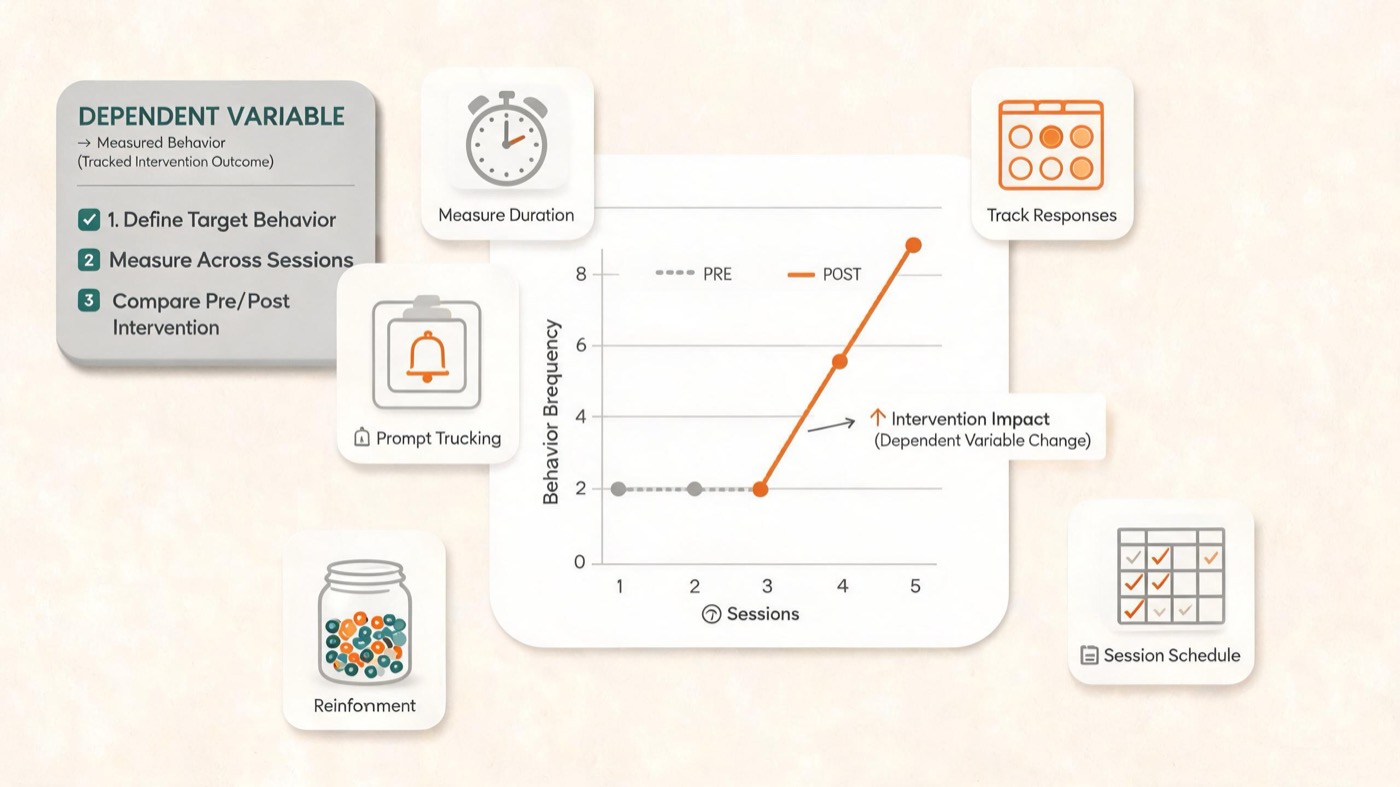
- Check if it changes: Does the data path show a shift in level, trend, or variability after the intervention?
- Link to independent variable: Is the change temporally related to the introduction of the intervention?
- Rule out confounds: Could other factors account for the change? (e.g., maturation, history)
- Consider no change: If no change occurs, does the data indicate a stable baseline or ineffective intervention?
- Refer to experimental design: Does the design (ABAB, multiple baseline) demonstrate replication of effect?
Exam Relevance and Common Traps
The BCBA exam frequently tests your ability to identify the dependent variable and determine whether it changed. Understanding this concept is foundational for interpreting graphed data and designing interventions.
Why This Concept Matters for the BCBA Exam
Many questions present a scenario and ask you to identify the dependent variable or predict the outcome. You must differentiate the behavior being measured from the intervention applied. For example, a question might describe a teacher providing praise after every five correct responses; the dependent variable is the rate of correct responses, not the praise. Mastering this distinction boosts your score on the measurement and experimental design sections of the task list.
Common Trap 1: Confusing Dependent and Independent Variables
One of the most frequent exam errors is swapping the two. The independent variable is what you manipulate (e.g., a token system). The dependent variable is what you measure (e.g., on-task behavior). To avoid this trap, ask yourself: ‘What am I counting?’ The answer is the dependent variable. Then ask: ‘What am I changing in the environment?’ That is the independent variable. For additional practice, review our guide on independent and dependent variables.
Common Trap 2: Assuming No Change Means No Effect
In some experimental designs, the dependent variable may not change if the intervention is ineffective or if baseline is already stable. However, no change can also be a meaningful result. For example, if a behavior is already at zero, a ceiling effect may obscure further change. Exam questions may present data where the dependent variable remains unchanged, and you must conclude that the intervention did not produce a functional relation. Do not assume that every effective intervention changes the dependent variable; sometimes the goal is maintenance, which means no change is the desired outcome.
Common Trap 3: Overlooking Variability in the Dependent Variable
Even when the dependent variable changes, you must consider variability. A change in mean level may be misleading if data points are highly variable. The BCBA exam may show graphs with overlapping data paths; in such cases, a clear change has not been demonstrated. Always assess level, trend, and variability before concluding that the dependent variable changed.
Summary: Does the Dependent Variable Change?
To answer the question directly: Yes, the dependent variable can change, and in most experiments, a change is expected if the intervention is effective. However, the absence of change is also informative—it indicates that the intervention did not produce a functional effect or that maintenance is occurring. On the BCBA exam, correctly identifying the dependent variable and interpreting its change (or lack thereof) is critical. Use the checklist above and practice with our free BCBA mock exam questions to solidify your understanding. Remember, the dependent variable is always the behavior you measure—and that behavior may change, or it may not. Both outcomes tell you something about the intervention’s effectiveness. For further reading, explore the BACB website for the task list and official resources.



