
What Are Conditioned Stimulus and Conditioned R
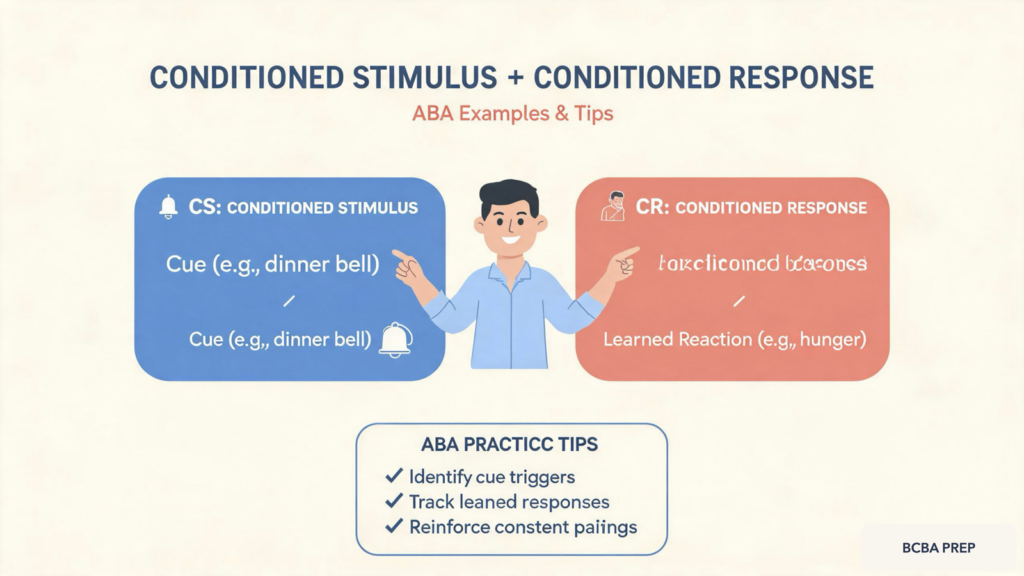
In applied behavior analysis, understanding the conditioned stimulus conditioned response pair is fundamental for analyzing respondent behavior. A conditioned stimulus (CS) is a previously neutral stimulus that, after being paired with an unconditioned stimulus (US), begins to elicit a learned response. That learned response is the conditioned response (CR). Unlike unconditioned responses, which occur naturally, the CR is acquired through experience and is often similar—but not identical—to the unconditioned response.
Table of Contents
- What Are Conditioned Stimulus and Conditioned R
- The Process: How Conditioned Stimuli and Responses Develop
- Worked ABA Examples with ABC Analysis and Hypothesized Function
- Exam Relevance and Common Traps
- Quick Checklist: Conditioned Stimulus and Conditioned Response
- Summary
- How to Study conditioned stimulus and conditioned response for BCBA-Style Questions
- How to Study conditioned stimulus and conditioned response for BCBA-Style Questions
- Take the Free BCBA Mock Exam
- References
For example, a child who hears a bell (neutral) before receiving a shot (US) may later cry (CR) at the sound of the bell alone. The bell is now a CS, and crying is the CR. This process is known as respondent conditioning (Pavlovian). The key distinction from operant conditioning is that the CS elicits the CR automatically, without requiring reinforcement.
The Process: How Conditioned Stimuli and Responses Develop
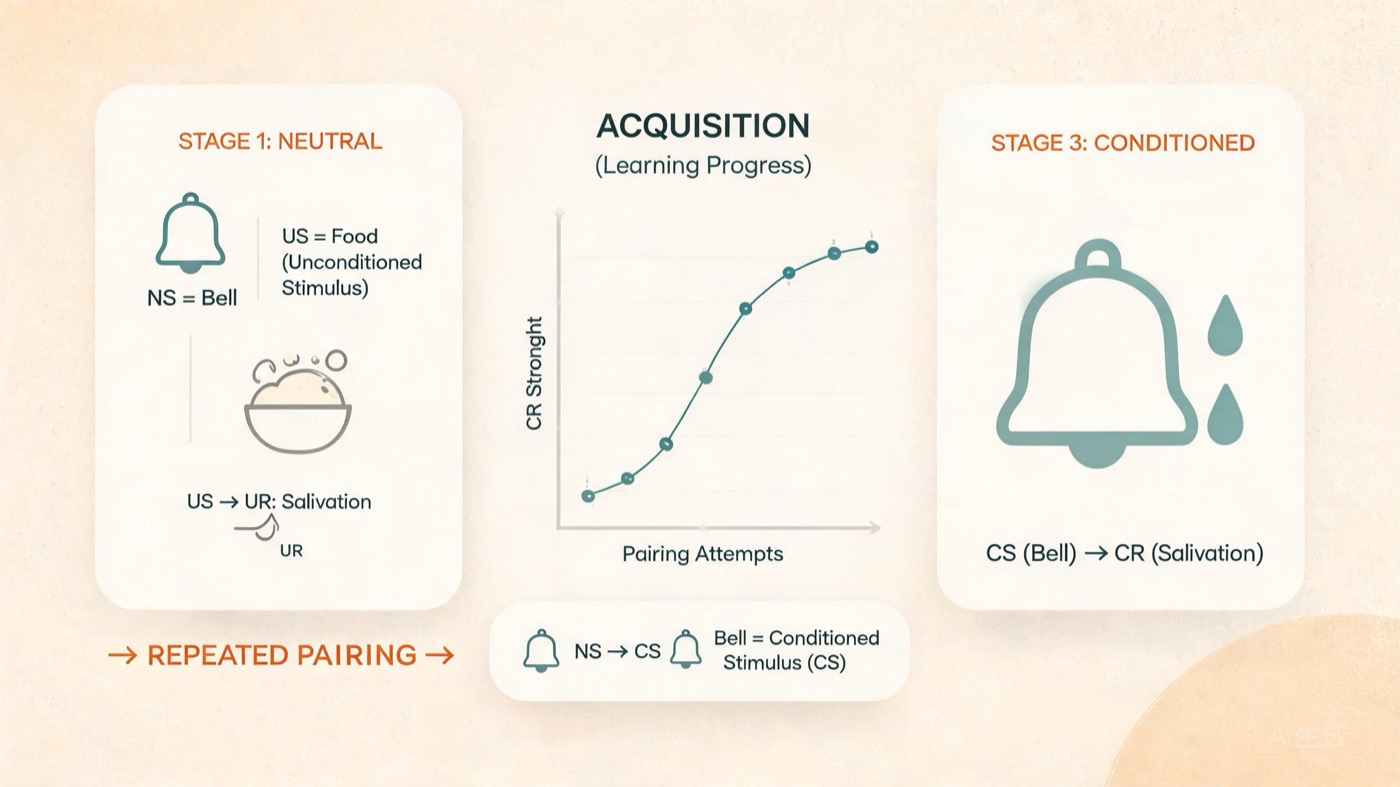
Acquisition via Stimulus-Stimulus Pairing: Acquisition occurs through repeated pairing of a neutral stimulus (NS) with an unconditioned stimulus (US). Over time, the NS becomes a CS that reliably elicits a CR. In Pavlov’s classic experiment, the bell (NS) + food (US) → salivation (UR) eventually produced salivation to the bell alone (CR). In ABA practice, you might pair a clicker (CS) with praise (US) to condition a child to respond positively to the clicker.
- Pairing must be temporal: The NS typically precedes the US by a fraction of a second to establish strong conditioning.
- Contiguity is necessary but not sufficient: Contingency (predictability) matters more than simple pairing.
- Multiple pairings strengthen the CS-CR association, especially early in acquisition.
Extinction and Spontaneous Recovery: When the CS is presented repeatedly without the US, the CR gradually weakens and eventually ceases—this is extinction of the conditioned response. However, after a pause, the CR may suddenly reappear, a phenomenon called spontaneous recovery. This is a common exam point: spontaneous recovery is temporary and does not indicate reconditioning.
- Extinction does not erase the CS-US association; it suppresses the CR temporarily.
- Spontaneous recovery suggests the original learning remains.
Worked ABA Examples with ABC Analysis and Hypothesized Function
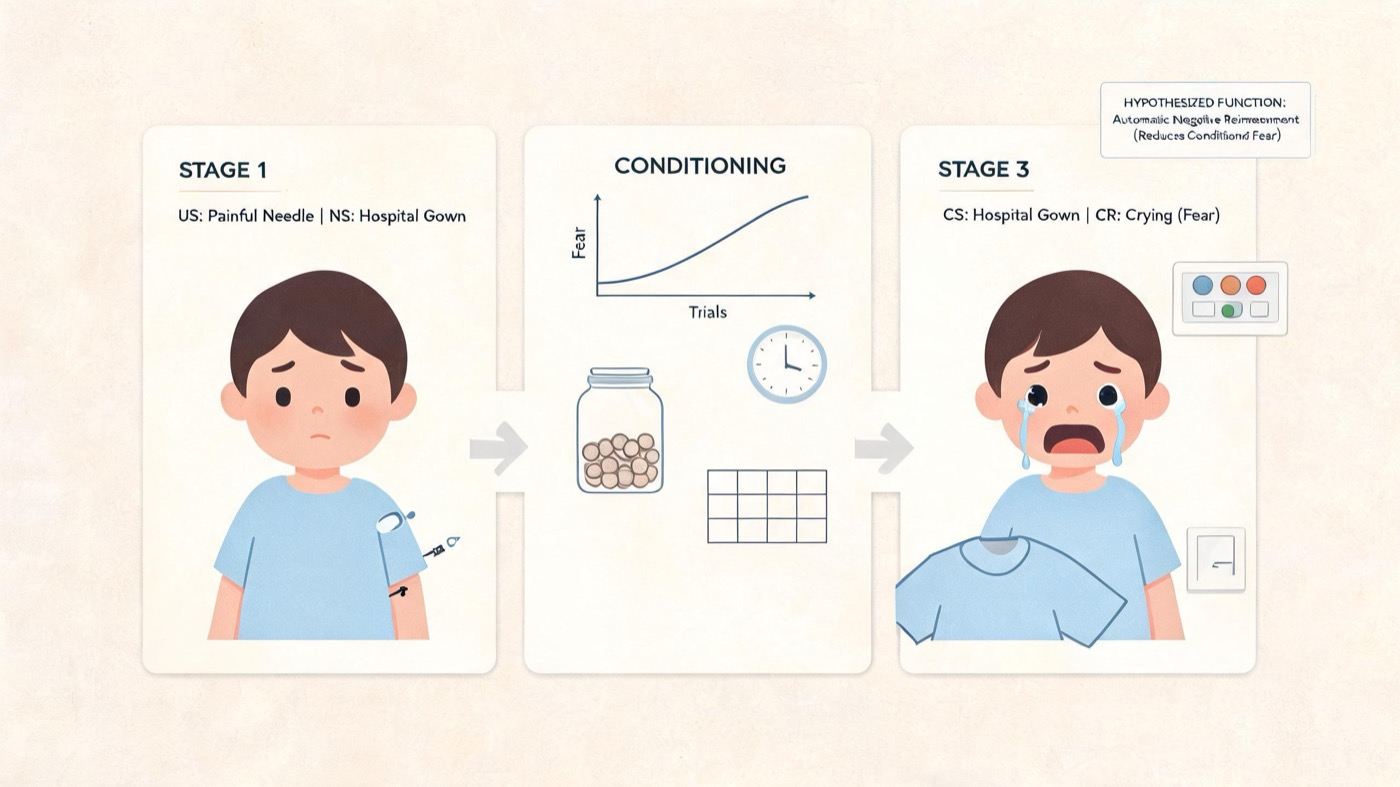
Example 1: Hospital Gown as Conditioned Stimulus: A child who previously experienced a painful needle (US) while wearing a hospital gown (NS) begins to cry (CR) just by seeing the gown (CS). Here is the ABC analysis:
- Antecedent: Hospital gown appears.
- Behavior: Crying, clinging to parent.
- Consequence: Parent comforts; child escapes gown removal.
Hypothesized function: Automatic negative reinforcement (reduction of conditioned fear). For the BCBA exam, distinguish that this is respondent behavior, not operant—the crying is elicited by the CS, not emitted for reinforcement. Example 2: Key Jingle as Conditioned Stimulus for Feeding: A dog hears the jingle of keys (NS) before being fed (US). After several pairings, the dog salivates (CR) at the sound of keys (CS). ABC analysis:
- Antecedent: Keys jingle.
- Behavior: Salivation, approaching food bowl.
- Consequence: Food is delivered.
Note: salivation is a respondent behavior, not an operant. The dog does not decide to salivate; it is automatically triggered by the CS. Example 3: Ticking Sound from a Medical Pump (for exam practice): A patient in a hospital hears a ticking sound from a pump (NS) just before receiving a dose of nausea-inducing medication (US). After a few pairings, the ticking sound alone (CS) triggers nausea (CR). ABC analysis:
- Antecedent: Ticking sound.
- Behavior: Gagging, looking visibly uncomfortable.
- Consequence: Nurse stops the pump temporarily.
Hypothesized function: Automatic positive reinforcement? No—the CR is elicited. The nausea is not operant. This scenario tests your ability to identify respondent conditioning even in a medical context.
Exam Relevance and Common Traps
Distinguishing Respondent vs. Operant Conditioning: The biggest trap on the BCBA exam is confusing conditioned responses with operant behaviors. Remember: CR is elicited (respondent); operant behavior is emitted (controlled by consequences). For example, if a child cries because they want attention, that is operant. If they cry because a conditioned stimulus triggers fear, that is respondent.
- Key question: Is the behavior automatically triggered by a prior stimulus? If yes, suspect respondent.
- Key question: Does the behavior produce a consequence that maintains it? If yes, suspect operant.
Not All Pairings Produce Lasting Conditioning: Factors like blocking (a prior CS blocks conditioning to a new NS) and overshadowing (a more salient NS prevents conditioning to a less salient one) can limit acquisition. Also, contingency (predictability) is more important than contiguity (timing). Exam questions often test whether a CS will become effective given these variables.
Identifying CS/CR vs. US/UR in Scenarios: You will be asked to identify which stimulus is the CS and which response is the CR. A mnemonic: CS is the new trigger; CR is the learned reaction. The US is the original biologically significant stimulus; the UR is the natural response to it.
- Example: In Pavlov, food is US, salivation to food is UR. Bell is CS, salivation to bell is CR.
- Exam twist: Scenarios may include both respondent and operant elements—read carefully.
Quick Checklist: Conditioned Stimulus and Conditioned Response
- Identify whether pairing has occurred (NS + US → CS).
- Determine if the response is elicited (respondent) or emitted (operant).
- Check for extinction: is the US omitted? Then CR should weaken.
- Watch for spontaneous recovery after a time delay.
- Don’t confuse conditioned with unconditioned: CS is learned, US is innate.
Summary
The conditioned stimulus conditioned response relationship is central to respondent conditioning. A CS is a neutral stimulus that acquires the ability to elicit a CR through pairing with a US. The CR is learned, often similar but not identical to the UR. For the BCBA exam, practice distinguishing respondent from operant, and memorize the key concepts of acquisition, extinction, and spontaneous recovery. Use the worked examples above to deepen your understanding. For more review, see our respondent conditioning guide and respondent vs. operant comparison.
How to Study conditioned stimulus and conditioned response for BCBA-Style Questions
When you review conditioned stimulus and conditioned response, do not stop at the definition. The exam usually tests whether you can apply the concept inside a short scenario, separate it from similar terms, and choose the most behaviorally precise answer. A strong study routine should connect the term to observable behavior, environmental context, measurement, and likely consequences.
- Define the response: identify exactly what the learner or client does, not just the broad skill area.
- Find the context: note the antecedent, setting, materials, people, or condition that makes the concept relevant.
- Check the consequence: ask what changes after the response and whether that change supports the answer choice.
- Compare close terms: write one sentence explaining why the best answer is not a related but different ABA concept.
For practice, turn each example into a quick discrimination exercise. Ask, “What would make this answer wrong?” and then change one detail in the scenario. This builds flexible exam reasoning instead of memorizing a single phrase.
How to Study conditioned stimulus and conditioned response for BCBA-Style Questions
When you review conditioned stimulus and conditioned response, do not stop at the definition. The exam usually tests whether you can apply the concept inside a short scenario, separate it from similar terms, and choose the most behaviorally precise answer. A strong study routine should connect the term to observable behavior, environmental context, measurement, and likely consequences.
- Define the response: identify exactly what the learner or client does, not just the broad skill area.
- Find the context: note the antecedent, setting, materials, people, or condition that makes the concept relevant.
- Check the consequence: ask what changes after the response and whether that change supports the answer choice.
- Compare close terms: write one sentence explaining why the best answer is not a related but different ABA concept.
For practice, turn each example into a quick discrimination exercise. Ask, “What would make this answer wrong?” and then change one detail in the scenario. This builds flexible exam reasoning instead of memorizing a single phrase.
Take the Free BCBA Mock Exam
Ready for more practice? Use the free mock exam to keep testing your accuracy with realistic BCBA-style items. Take the Free BCBA Mock Exam



