
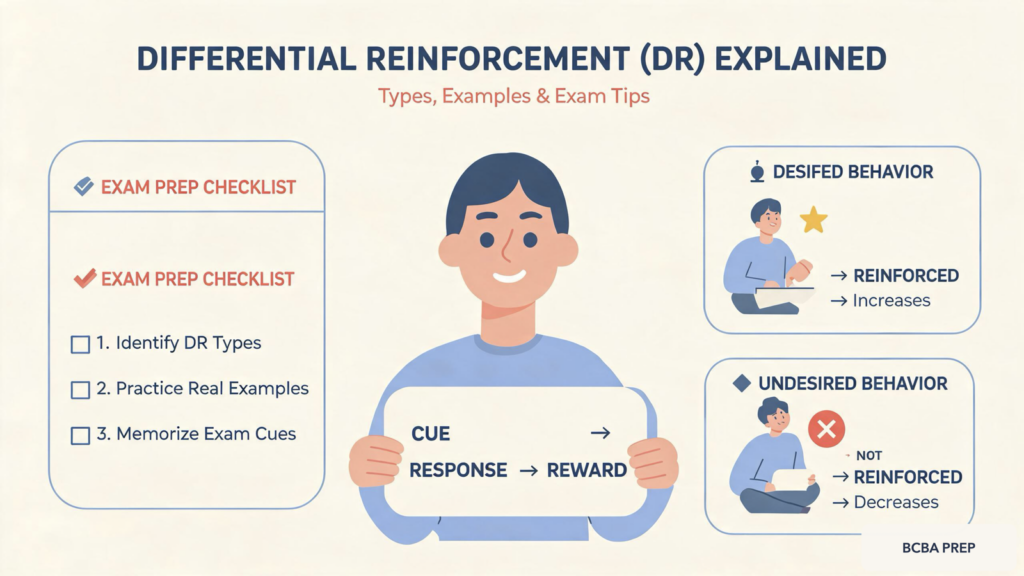
Understanding Differential Reinforcement in Applied Behavior Analysis
Differential reinforcement is a fundamental procedure in Applied Behavior Analysis (ABA) that involves reinforcing a specific target behavior while withholding reinforcement for another behavior. This process strengthens desired behaviors and reduces undesired ones using a combination of reinforcement and extinction. For BCBA candidates, mastering differential reinforcement is essential because it appears frequently on the exam and forms the basis of many behavior intervention plans.
Table of Contents
- Understanding Differential Reinforcement in Applied Behavior Analysis
- Five Types of Differential Reinforcement You Must Know
- Common Exam Traps and Misapplications
- Quick Checklist: Applying Differential Reinforcement
- Summary: Differential Reinforcement for BCBA Success
Core Components: Reinforce One, Extinguish Another
At its core, differential reinforcement means you reinforce the behavior you want to increase and do not reinforce the behavior you want to decrease. The problem behavior is placed on extinction—meaning it no longer produces the reinforcing consequence it once did. Without the extinction component, the procedure would simply be reinforcement, not differential reinforcement.
Why It Matters for the BCBA Exam
The BCBA exam often tests your ability to distinguish between different types of differential reinforcement and apply them correctly in clinical scenarios. You must know each type’s definition, when to use it, and common pitfalls. Questions may present a case description and ask you to identify the appropriate procedure or predict the outcome.
For a deeper dive into how reinforcement works, check out our guide on reinforcement in ABA.
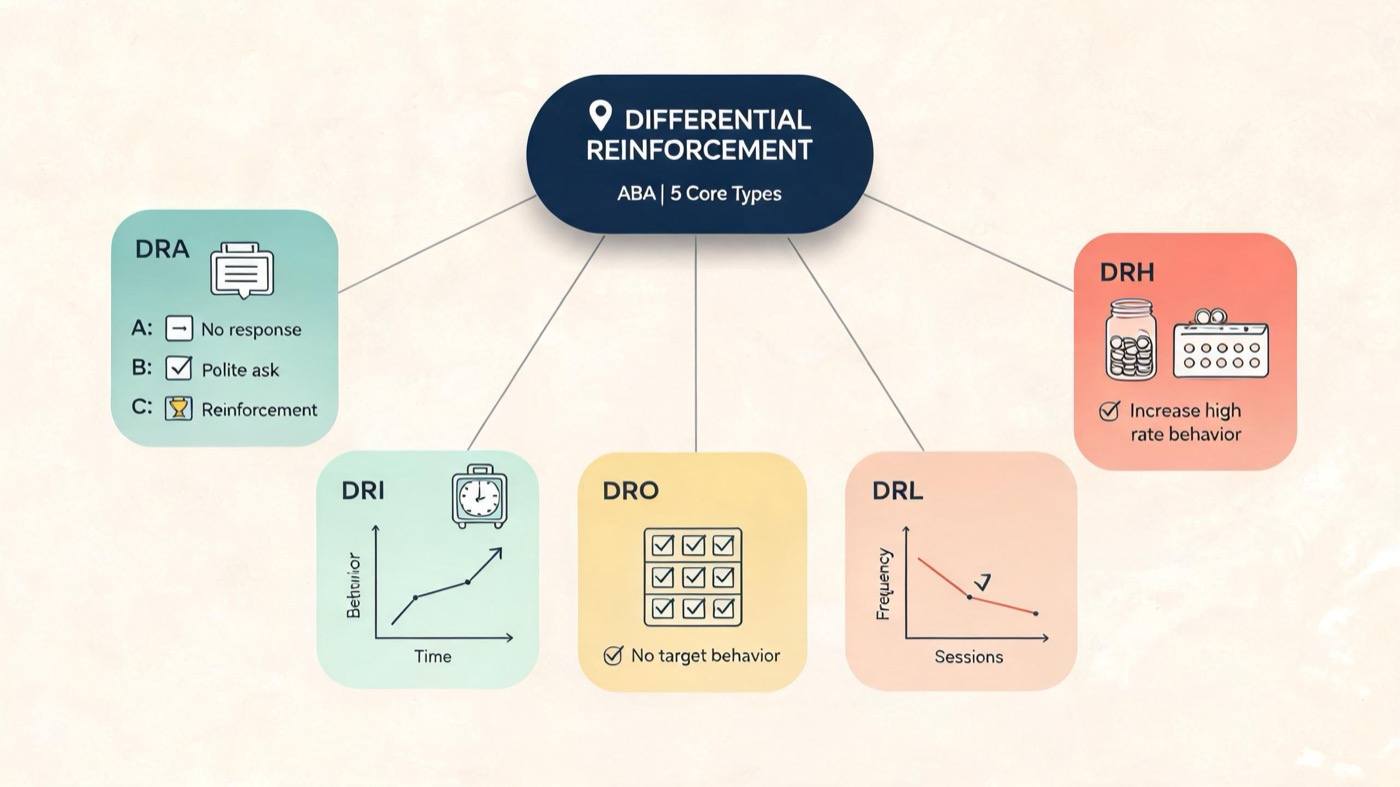
Five Types of Differential Reinforcement You Must Know
There are five main types of differential reinforcement, each with a distinct purpose and application. Below we describe each type with a definition, an ABC example (including hypothesized function), and an exam tip.
DRA – Differential Reinforcement of Alternative Behavior
DRA involves reinforcing a behavior that serves as a functionally equivalent alternative to the problem behavior. The alternative behavior must access the same reinforcer as the problem behavior.
- ABC Example: A child screams for attention (function: attention). The intervention teaches the child to raise their hand to get the teacher’s attention. Antecedent: teacher is busy with another student. Behavior: child raises hand. Consequence: teacher immediately praises and provides attention. The problem behavior (screaming) is placed on extinction.
- Exam Tip: DRA requires identifying a replacement behavior that matches the function. On the exam, look for key phrases like “reinforce a different behavior that produces the same result.”
DRO – Differential Reinforcement of Other Behavior
DRO delivers reinforcement when the target behavior has not occurred for a specified interval. Any behavior other than the target is acceptable; the specific behavior does not matter.
- ABC Example: A student hits peers to get attention. The teacher sets a timer for 5 minutes. If no hitting occurs during that interval, the student earns a sticker (attention via praise). If hitting occurs, the timer resets.
- Exam Tip: DRO uses a time-based criterion and a reset rule. Remember that DRO reinforces the absence of behavior, not a specific alternative. It is often used when no clear replacement is available.
DRI – Differential Reinforcement of Incompatible Behavior
DRI reinforces a behavior that is physically incompatible with the target behavior—they cannot occur simultaneously.
- ABC Example: A child runs around the classroom (target). The teacher reinforces sitting in a chair (incompatible behavior). While sitting, running is impossible.
- Exam Tip: DRI is a subtype of DRA, but the alternative is specifically incompatible. On the exam, if the alternative behavior prevents the problem behavior from occurring, it is DRI, not DRA.
DRL – Differential Reinforcement of Low Rates of Behavior
DRL reduces the rate of a behavior that is acceptable at lower frequencies but problematic when too frequent. Reinforcement is delivered when the behavior occurs at or below a predetermined rate.
- ABC Example: A student asks for help too often (e.g., 10 times per class). The teacher reinforces asking for help no more than 3 times per class session. If the student asks only 2 times, they earn preferred computer time.
- Exam Tip: DRL uses a rate criterion. It does not eliminate the behavior; it reduces it. Common schedules include full-session DRL (count across the session) and spaced-responding DRL (time between responses).
DRH – Differential Reinforcement of High Rates of Behavior
DRH increases the rate of a desirable behavior that occurs too infrequently. Reinforcement is provided when the behavior occurs at or above a specified rate.
- ABC Example: A student completes only 2 math problems in 10 minutes. The teacher sets a criterion of completing 10 problems in 5 minutes. When the student meets the criterion, they earn a break.
- Exam Tip: DRH is the opposite of DRL. It uses a response-rate schedule. Watch for phrases like “increase the frequency of a behavior” in exam scenarios.
Common Exam Traps and Misapplications
Many BCBA candidates make similar mistakes when answering differential reinforcement questions. Being aware of these traps can save valuable points on the exam.
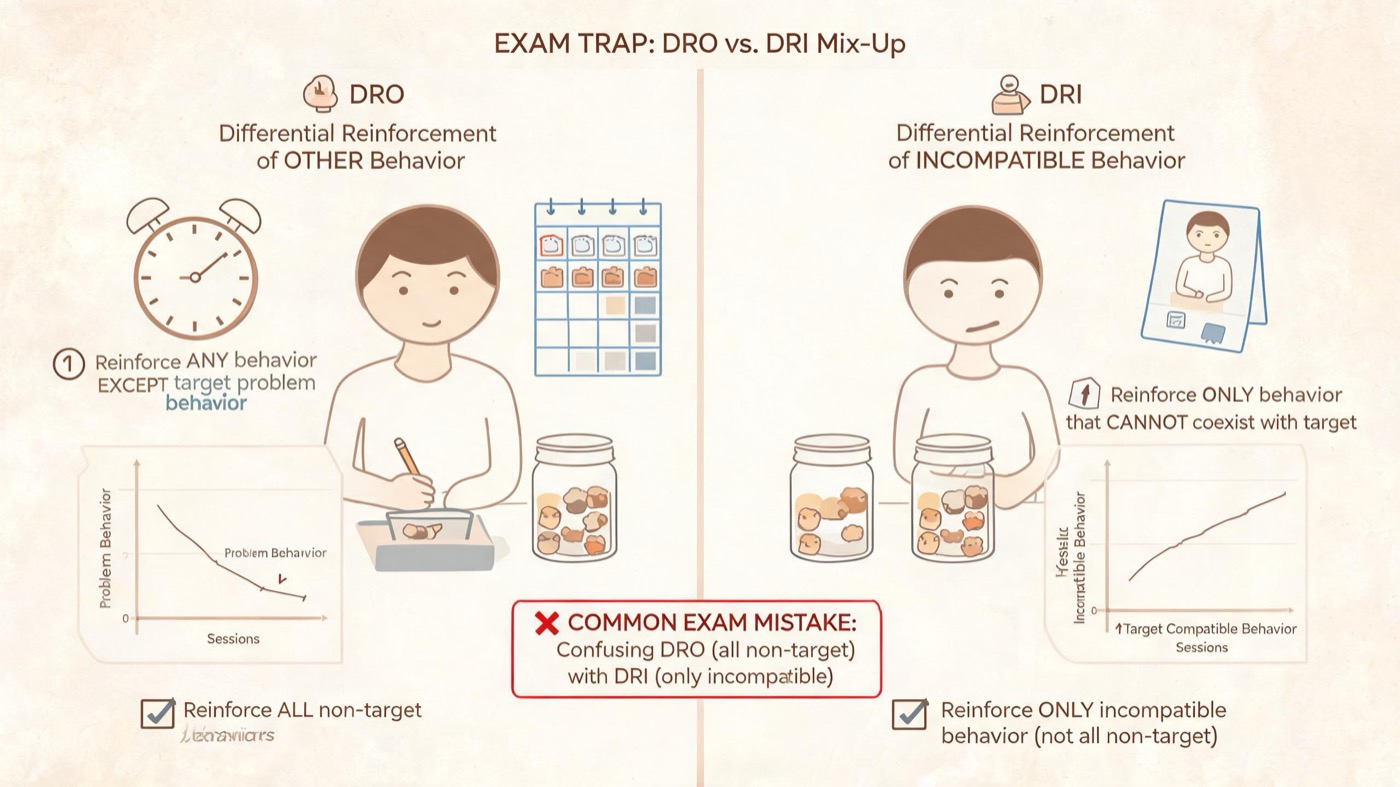
Confusing DRO with DRI
A frequent error is mixing up DRO and DRI. DRO reinforces any behavior other than the target (e.g., “reinforce any behavior except hitting”). DRI reinforces a specific incompatible behavior (e.g., “reinforce keeping hands in pockets”). On the exam, read carefully: if the description says “any other behavior,” it is DRO; if it specifies a particular behavior that is physically incompatible, it is DRI.
Forgetting the Extinction Component
Some students think differential reinforcement only involves reinforcing the desired behavior. However, the problem behavior must be placed on extinction. Without extinction, the procedure is just reinforcement, not differential reinforcement. Look for wording like “withhold reinforcement for the problem behavior” or “do not provide the reinforcer for the target behavior.”
Misidentifying the Schedule in DRL/DRH
DRL and DRH are often confused regarding the schedule type. DRL typically uses a spaced-responding schedule (reinforce after a time interval without the behavior) or a full-session schedule (rate per session). DRH uses a response-rate schedule (reinforce after a fixed number of responses within a time limit). Know the difference: DRL wants fewer responses; DRH wants more.
To further strengthen your understanding, explore our article on schedules of reinforcement.
Quick Checklist: Applying Differential Reinforcement
Use this checklist during exam prep or when designing interventions in practice.
Steps to Implement DR
- Define the target behavior clearly and objectively.
- Identify the function of the target behavior (e.g., attention, escape, access to tangibles, sensory).
- Select the appropriate DR type based on the goal: DRA/DRI if a replacement is available; DRO if any other behavior is acceptable; DRL to reduce rate; DRH to increase rate.
- Ensure the problem behavior is on extinction—no longer produces the reinforcer.
- Choose a powerful reinforcer that matches the function and is strong enough to compete with the problem behavior.
- Deliver reinforcement consistently according to the planned schedule and monitor data to adjust criteria as needed.
When to Use Each Type
- DRA: When a functionally equivalent replacement behavior is known and can be taught.
- DRO: When any other behavior is acceptable, and you simply want to reduce the target behavior.
- DRI: When an incompatible behavior is easy to perform and naturally prevents the problem behavior.
- DRL: To reduce but not eliminate a behavior that is appropriate at low rates (e.g., asking for help, raising hand).
- DRH: To increase a behavior that occurs too infrequently (e.g., completing tasks, participating in class).
Summary: Differential Reinforcement for BCBA Success
Differential reinforcement is a powerful, ethical strategy that combines reinforcement and extinction to shape behavior. On the BCBA exam, you must be able to distinguish the five types—DRA, DRO, DRI, DRL, and DRH—and apply them in clinical vignettes. Always consider the function of the behavior, ensure extinction for the problem behavior, and avoid common traps like confusing DRO with DRI or forgetting the extinction component.
For additional practice and mock exam questions, visit our free BCBA mock exam questions. For authoritative guidelines, refer to the Behavior Analyst Certification Board (BACB) and the Journal of Applied Behavior Analysis for evidence-based practices.
Keep this guide handy as a quick reference during your exam preparation. Mastering differential reinforcement will not only help you pass the exam but also make you a more effective behavior analyst.
Complete BCBA Exam Prep
Turn this topic into exam-day practice
Practice concepts in context with five full-length 6th Edition mock exams, two bonus practice exams, a 6th Edition study guide, and key-term flashcards—all in one $120 USD package.
Get the $120 All-in-One Prep Pack
Review everything included on the product page before ordering. No pass guarantee is implied.



