
When studying for the BCBA exam, understanding the reinforcer in ABA is essential. A reinforcer is not simply a reward; it is defined by its function. This guide covers the definition, types, practical examples, and common exam traps to help you master this core concept.
Table of Contents
- What Is a Reinforcer? ABA Definition
- Types of Reinforcers in Applied Behavior Analysis
- ABA Examples of Reinforcers in Action (with ABC Analysis)
- Common BCBA Exam Traps Involving Reinforcers
- Quick Checklist: Identifying and Using Reinforcers
What Is a Reinforcer? ABA Definition
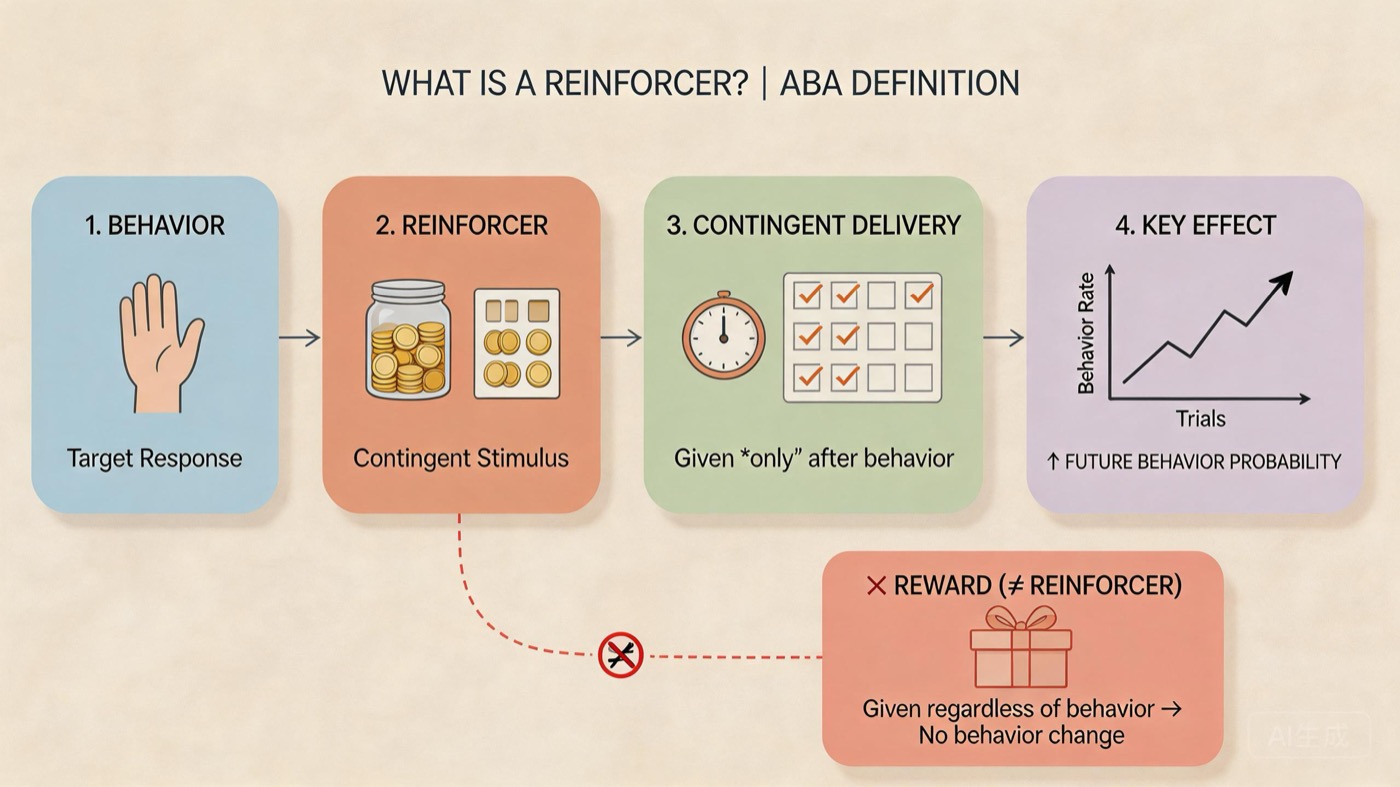
A reinforcer is any stimulus that, when presented contingent upon a behavior, increases the future probability of that behavior. Unlike a reward, which may be given without a behavior change, a reinforcer is defined solely by its effect. The three-term contingency (Antecedent-Behavior-Consequence) illustrates this: the consequence must strengthen the behavior.
For the BCBA exam, remember that a stimulus is only a reinforcer if it increases behavior. If it does not, it is not a reinforcer, regardless of how appealing it seems. This functional definition is a cornerstone of applied behavior analysis. For example, if you give a child a piece of candy after they complete a task, but the child’s future task completion does not increase, the candy was not a reinforcer—it was simply a reward. Always ask: Did the behavior increase? Without data showing an increase, you cannot confirm a reinforcer. This distinction is frequently tested on the exam, so be prepared to analyze scenarios where a stimulus appears desirable but fails to strengthen behavior.
Types of Reinforcers in Applied Behavior Analysis
Primary vs. Secondary (Conditioned) Reinforcers
Primary reinforcers are biologically relevant, such as food, water, and sleep. They require no learning history. Secondary reinforcers (or conditioned reinforcers) acquire their reinforcing value through pairing with primary reinforcers. Examples include praise, tokens, and money. On the exam, you may be asked to identify which category a stimulus belongs to based on the learner’s history. A key distinction is that secondary reinforcers can lose their effectiveness if not periodically paired with primary reinforcers—a process called extinction of conditioned reinforcement. For instance, token boards can lose their value if tokens are never exchanged for backup reinforcers. Understanding the maintenance of conditioned reinforcers is crucial for effective behavior intervention plans.
Positive vs. Negative Reinforcement
Both positive reinforcement and negative reinforcement increase behavior. Positive reinforcement involves adding a preferred stimulus (e.g., giving a child a sticker for completing homework). Negative reinforcement involves removing an aversive stimulus (e.g., turning off a loud alarm after buckling a seatbelt). A common exam trap is confusing negative reinforcement with punishment. Remember: negative reinforcement increases behavior, while punishment decreases it. Let’s clarify with an example: A student whines to escape a difficult task. The teacher removes the task, and the whining increases. This is negative reinforcement (removal of an aversive task increases whining). If instead the teacher reprimands the student and whining decreases, that is punishment. The key is whether the behavior increases (reinforcement) or decreases (punishment).
ABA Examples of Reinforcers in Action (with ABC Analysis)
Using the three-term contingency clarifies how reinforcers function. Here are two examples:
- Example 1: Social Positive Reinforcement. Antecedent: Teacher asks, ‘What is 2+2?’ Behavior: Student says ‘4.’ Consequence: Teacher praises ‘Great job!’ Future behavior: Student is more likely to answer questions.
- Example 2: Automatic Negative Reinforcement. Antecedent: Loud noise in the environment. Behavior: Child covers ears. Consequence: Noise is muted. Future behavior: Child is more likely to cover ears when noise occurs.
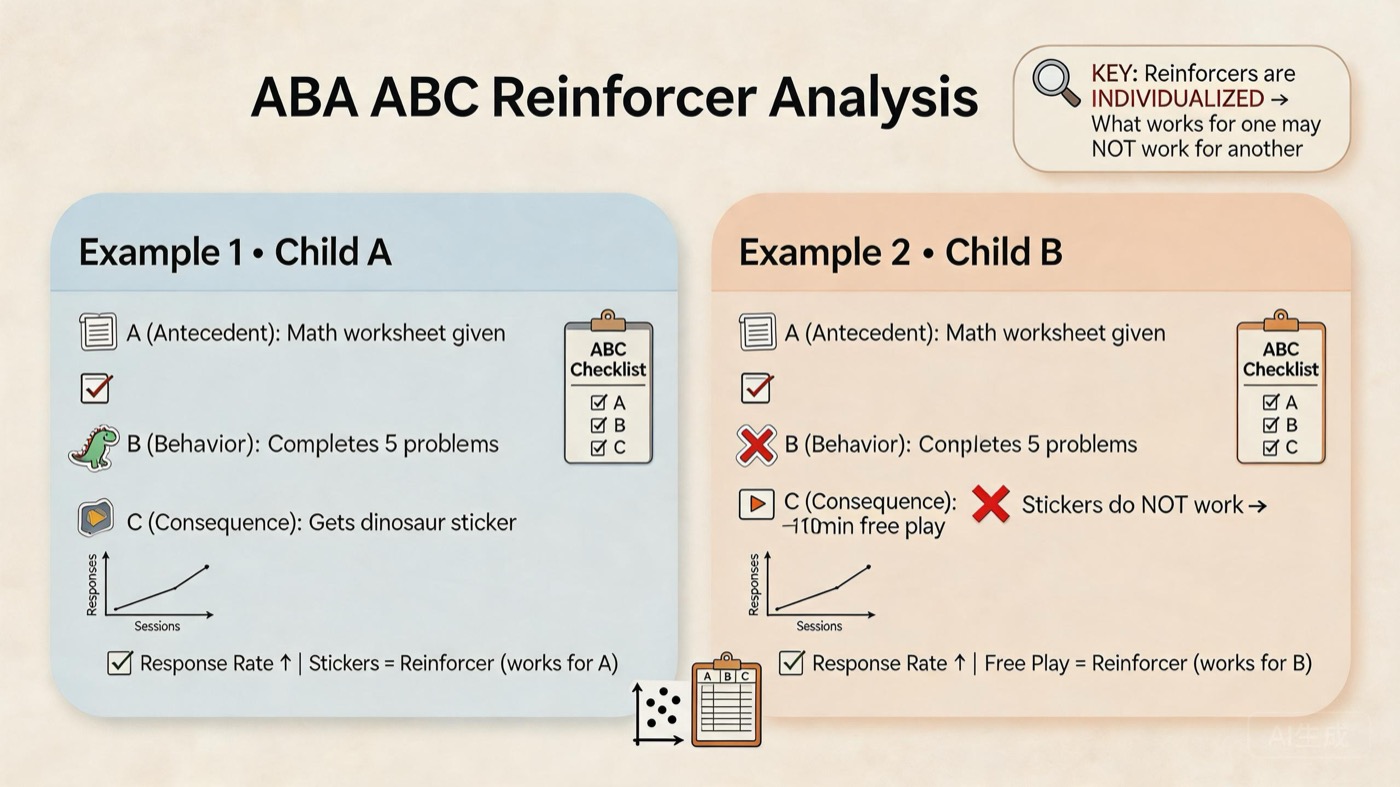
These examples highlight that a reinforcer is individualized. What reinforces one person may not reinforce another. The BCBA exam often presents scenarios where you must hypothesize the function based on the consequence. Consider a third example: a child scratches their arm because it itches (antecedent: itchy skin). Scratching behavior temporarily relieves the itch (consequence: removal of aversive sensation). This is automatic negative reinforcement—the behavior is maintained by the removal of the itch without social mediation. Recognizing automatic reinforcement is important for designing interventions for self-stimulatory or self-injurious behaviors.
Common BCBA Exam Traps Involving Reinforcers
Exam trap 1: Confusing reinforcement with reward. A reward is given regardless of its effect; a reinforcer must increase the behavior. Always look for the data showing a future increase.
Exam trap 2: Thinking negative reinforcement is punishment. Negative reinforcement removes something aversive and increases behavior. Punishment either adds aversives or removes preferred items to decrease behavior. A quick memory aid: both negative reinforcement and punishment involve aversive stimuli, but reinforcement always strengthens the behavior. On the exam, if you see a scenario where an aversive stimulus is removed and a behavior increases, it’s negative reinforcement.
Exam trap 3: Assuming a stimulus is a reinforcer without verification. A reinforcer is only a reinforcer if it works. Conduct preference assessments and probe the effect on behavior. For more on preference assessments, see our guide on ABA preference assessments.
Exam trap 4: Overlooking motivating operations. The effectiveness of a reinforcer depends on current motivating operations (establishing and abolishing operations). For example, food is a strong reinforcer when a person is hungry (establishing operation) but weak when they are full (abolishing operation). The exam may test your ability to identify how motivating operations alter reinforcer effectiveness. For instance, if a child just ate a large meal, candy may not function as a reinforcer at that moment.
Quick Checklist: Identifying and Using Reinforcers
- The stimulus must increase the future frequency of the behavior.
- The stimulus must be contingent on the target behavior.
- Individualization is key: what works for one learner may not work for another.
- A reinforcer is not the same as a reward; rewards can be given without behavior change.
- Negative reinforcement increases behavior, it does not punish.
- Consider motivating operations: a reinforcer’s effectiveness can vary based on deprivation or satiation.
- Use preference assessments to identify potential reinforcers, then test their effect on behavior.
For more BCBA exam prep, check out our mock exams and review the latest research from the BACB.
Complete BCBA Exam Prep
Turn this topic into exam-day practice
Practice concepts in context with five full-length 6th Edition mock exams, two bonus practice exams, a 6th Edition study guide, and key-term flashcards—all in one $120 USD package.
Get the $120 All-in-One Prep Pack
Review everything included on the product page before ordering. No pass guarantee is implied.



