
What is a Dependent Variable in ABA?
When you design a behavior intervention plan, you need to measure something. That something is the dependent variable in ABA — the behavior you track to see if your intervention works. On the BCBA exam, you must pick the dependent variable out of a scenario and understand how it differs from the independent variable.
Table of Contents
- What is a Dependent Variable in ABA?
- Dependent Variable vs Independent Variable: A Clear Distinction
- Worked ABA Examples: Dependent Variable in Action
- Exam Relevance and Common Traps
- Quick Review Checklist for the Exam
- Final Summary
- References
Definition of Dependent Variable
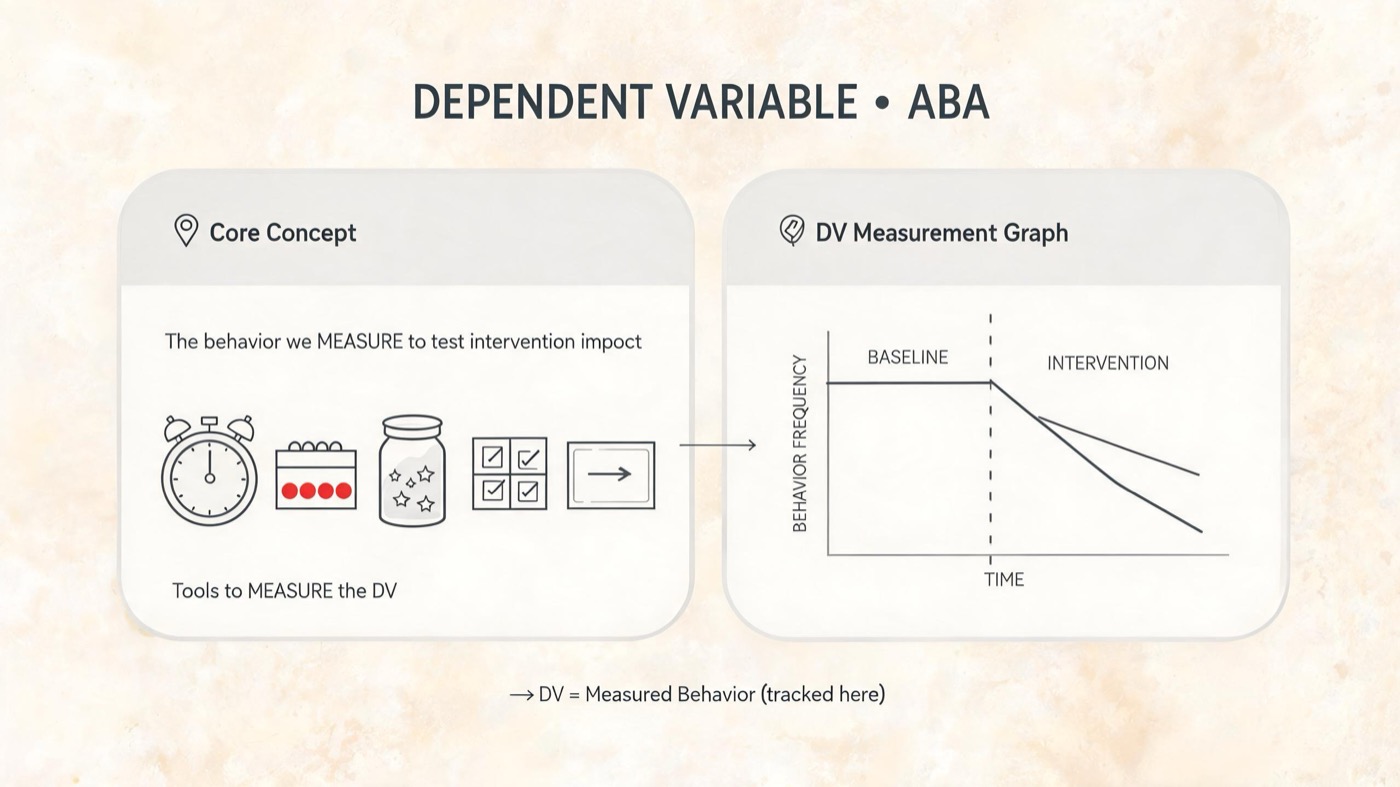
The dependent variable is the target behavior being measured. It is the variable that is expected to change as a result of manipulating the independent variable (the intervention). In single-subject designs, the dependent variable is repeatedly measured across phases to determine if a functional relation exists.
For example, if you implement a token system to increase on-task behavior, the percentage of intervals with on-task behavior is the dependent variable. The dimension you measure (frequency, duration, latency, etc.) depends on the behavior and the goal.
Why It Matters for the BCBA Exam
Exam questions often ask you to identify the dependent variable in a vignette. They may also present graphs and ask which data path represents the dependent variable. Review the Behavior Analyst Certification Board (BACB) Task List, specifically items under A-2 and A-4, which cover measurement concepts. Being able to distinguish the dependent variable from the independent variable is a foundational skill for the entire exam.
Dependent Variable vs Independent Variable: A Clear Distinction
One of the most common errors on the BCBA exam is swapping the dependent and independent variables. Here is a straightforward way to keep them straight.
How to Identify the Dependent Variable
- Ask: What behavior am I measuring? The dependent variable is always the behavior you are collecting data on.
- Ask: What do I expect to change? The dependent variable is the outcome you want to improve (increase or decrease).
- Ask: Which variable is on the vertical axis (y-axis) of my graph? In ABA graphs, the dependent variable is plotted on the y-axis.
Common Misconceptions on the Exam
One common trap is confusing the dependent variable with the intervention. The intervention (e.g., differential reinforcement, token system) is the independent variable, not the dependent variable. Another trap is selecting a broad label (like “behavior”) instead of the specific measured dimension (like “frequency of aggression per session”). The exam will expect you to choose the most precise, measurable definition.
Also, remember that the dependent variable must be observable and measurable. Avoid vague terms like “feeling calm” or “understanding.” Stick to operational definitions of the target behavior.
Worked ABA Examples: Dependent Variable in Action
Let’s look at three realistic scenarios to see how the dependent variable is identified within an ABC framework, a hypothesized function, and a measurement plan.
Example 1: Decreasing Aggression
- Target behavior: Aggression (hitting, kicking).
- Dependent variable: Frequency of aggression per session.
- Independent variable: Differential reinforcement of alternative behavior (DRA) plus extinction.
- ABC data: Antecedent — demand is placed; Behavior — aggression; Consequence — escape from demand.
- Hypothesized function: Escape from demands (negative reinforcement).
Example 2: Increasing On-Task Behavior
- Target behavior: On-task behavior (defined as eyes on materials, writing, or responding).
- Dependent variable: Percentage of intervals with on-task behavior (measured via momentary time sampling).
- Independent variable: Token system with a token board and backup reinforcers.
- ABC data: Antecedent — teacher instruction; Behavior — on-task; Consequence — token delivered.
- Hypothesized function: Access to tangibles (tokens exchangeable for preferred items).
Example 3: Reducing Self-Injurious Behavior (SIB)
- Target behavior: Self-injury (head hitting).
- Dependent variable: Rate of SIB per hour.
- Independent variable: Noncontingent reinforcement (NCR) with attention.
- ABC data: Antecedent — alone/no attention; Behavior — head hitting; Consequence — caregiver attention (reprimand).
- Hypothesized function: Positive reinforcement in the form of attention.
Example 4: Teaching Mands
- Target behavior: Independent mands (vocal requests for preferred items).
- Dependent variable: Frequency of independent mands per session.
- Independent variable: Time-delay prompting.
- ABC data: Antecedent — preferred item in view; Behavior — mand; Consequence — item delivered.
- Hypothesized function: Access to tangibles.
Exam Relevance and Common Traps
The BCBA exam frequently assesses your ability to identify the dependent variable in scenarios and on graphs. Here is how the concept appears and the traps you must avoid.
How the BCBA Exam Tests Dependent Variables
- Multiple-choice scenarios: You read a description and choose the dependent variable from a list.
- Graph interpretation: You are shown a line graph and must identify which data path represents the dependent variable.
- Experimental design questions: You must determine if a functional relation exists by analyzing the dependent variable across phases.
- Measurement questions: You select the appropriate dimension (e.g., count, duration) to measure the dependent variable.
These questions appear in Task List items A-1 (measurement), A-2 (continuous measurement), A-4 (discontinuous measurement), and A-7 (designing data collection). Being fluent with the dependent variable is essential for success.
Top 4 Traps to Avoid
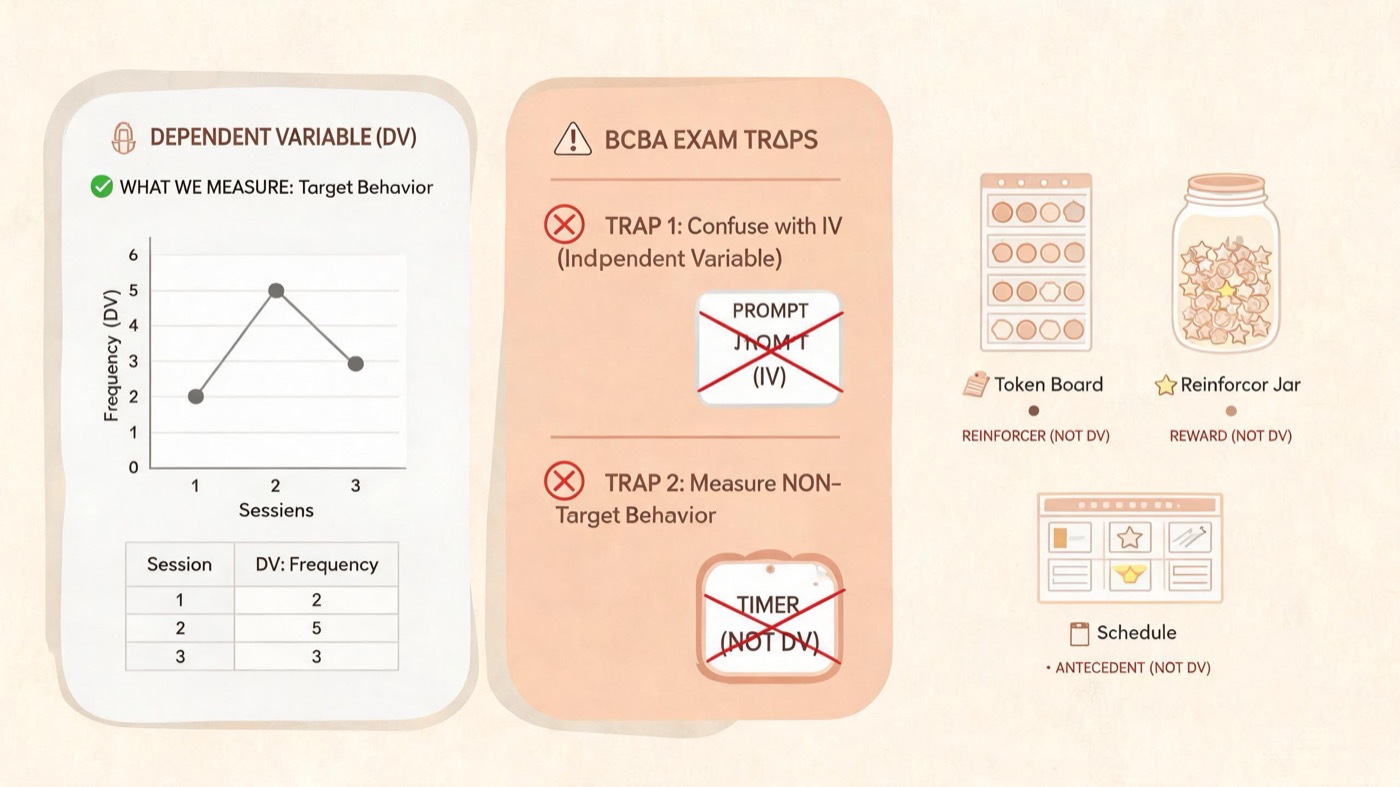
- Confusing DV with IV: The dependent variable is what you measure; the independent variable is what you manipulate. Do not pick the intervention as the answer.
- Not specifying the measurement dimension: The exam may ask for the specific measurable dimension (e.g., “frequency of behavior” vs. “duration”). Choose the dimension that matches the scenario.
- Overlooking extraneous variables: Be alert to confounding variables that could affect the dependent variable. The correct answer will reflect the target behavior under controlled conditions.
- Choosing a behavior that is not operationally defined: If the behavior is vague (e.g., “aggressive mood”), it is likely a distractor. Always select the operationally defined, measurable behavior.
Quick Review Checklist for the Exam
Use this checklist to confirm you have correctly identified the dependent variable in any scenario.
Dependent Variable Checklist
- Define the behavior in observable, measurable terms.
- Identify the dimension (frequency, duration, rate, percentage, etc.)
- Confirm it is the variable being measured (not the intervention).
- Ensure the independent variable is systematically manipulated to see if the DV changes.
- Distinguish from confounds — check for extraneous variables that might influence the DV.
- Check the graph — the DV is always on the y-axis.
Final Summary
The dependent variable in ABA is the behavior you measure to evaluate the effect of your intervention. It must be operationally defined, measured reliably, and graphed on the y-axis. On the BCBA exam, you will need to identify the DV in vignettes, avoid common traps (like confusing it with the IV or forgetting the measurement dimension), and interpret its changes across conditions. For more help with experimental design and measurement, visit our guide on independent and dependent variables. Practice with mock scenarios to build fluency — knowing the dependent variable is a cornerstone of behavior-analytic reasoning.



