
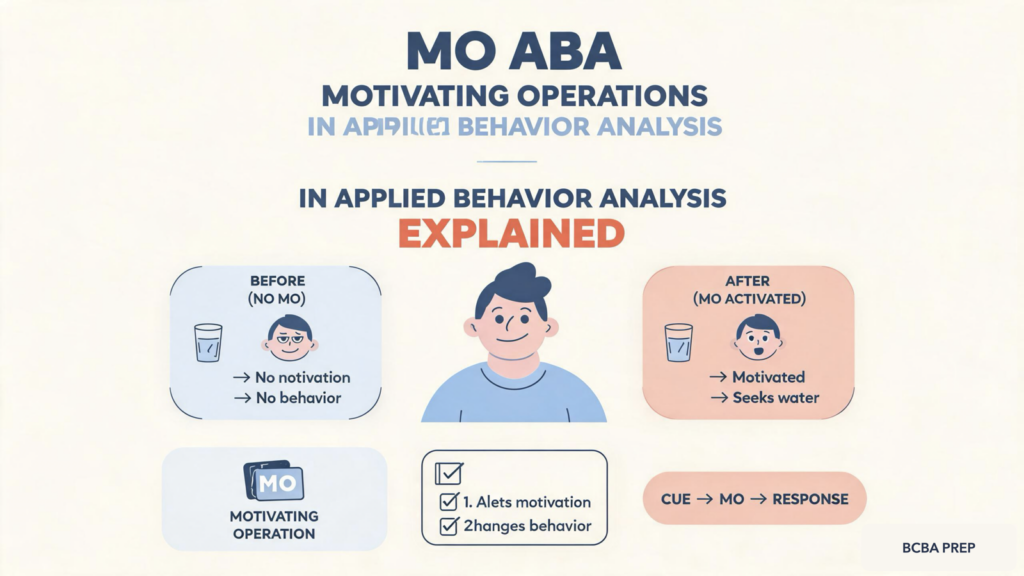
What Is a Motivating Operation in ABA?
A Motivating Operation (MO) is an environmental event that alters the value of a reinforcer or punisher and changes the frequency of behavior that has previously led to that consequence. In simple terms, an MO makes a reward more or less desirable, which in turn makes you more or less likely to act to get it. The concept is central to applied behavior analysis and is frequently tested on the BCBA exam.
Practice this concept
Table of Contents
- What Is a Motivating Operation in ABA?
- How MO Differs From SD in ABA
- MO in ABA: Real-World Examples With ABC Analysis
- Common Exam Traps When Identifying MOs
- Quick Checklist for MO Identification
- Summary: Why MO Matters for the BCBA Exam
MOs are divided into two types: establishing operations (EO) and abolishing operations (AO).
Establishing Operations (EO): Making Reinforcers More Valuable
An establishing operation increases the reinforcing value of a stimulus and evokes behavior that has produced that stimulus in the past. For example, food deprivation makes food more valuable, so a person is more likely to engage in behaviors that have been followed by food. On the BCBA exam, you may be asked to identify the EO in a scenario, such as a child who has not received attention for several hours — attention becomes a more powerful reinforcer, and behavior to gain attention increases.
Abolishing Operations (AO): Reducing Reinforcer Value
An abolishing operation decreases the reinforcing value of a stimulus and abates behavior that has previously produced it. For instance, after a large meal, food is less reinforcing, so the individual is less likely to work for it. A common AO example is satiation: if a child has just played with a favorite toy for an hour, the toy is temporarily less valuable, and the child may not engage in behavior to obtain it.
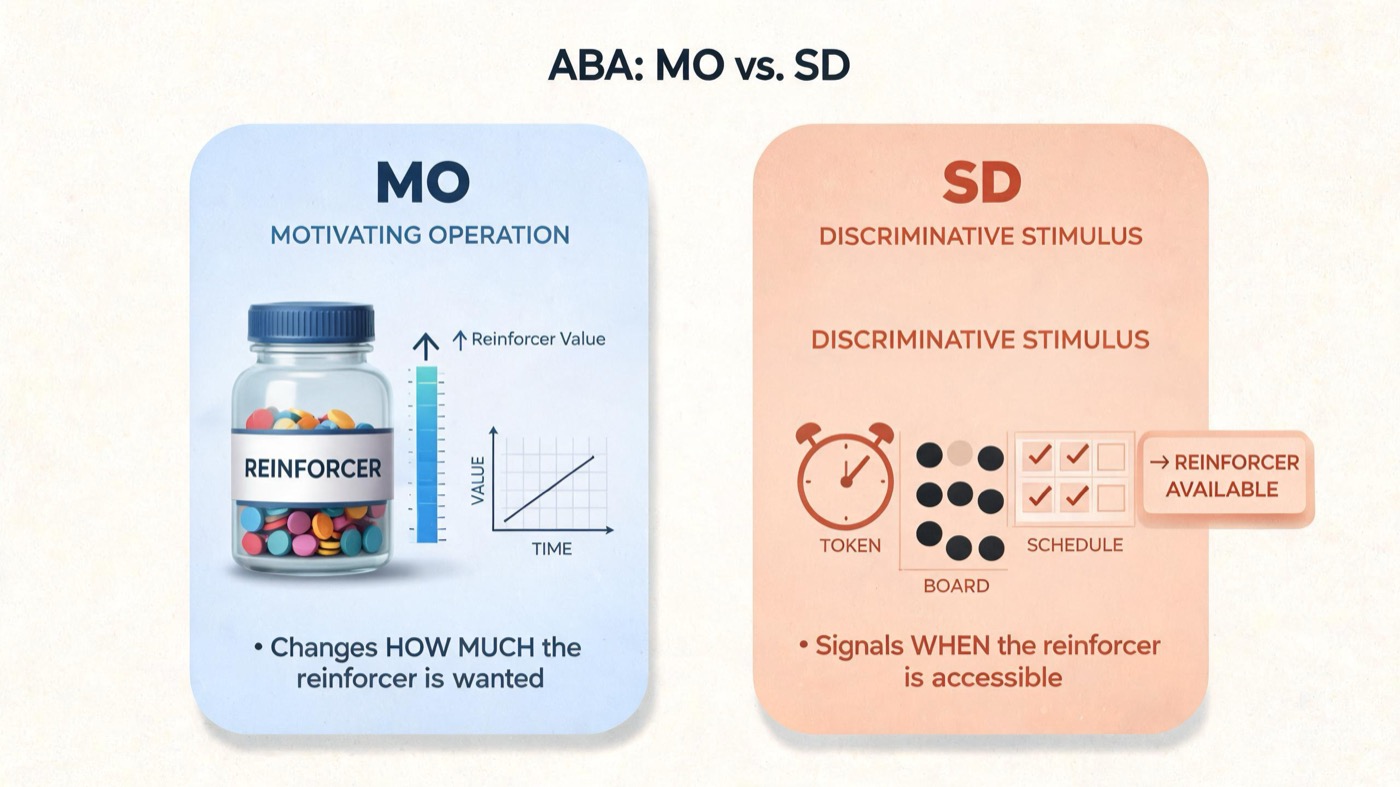
How MO Differs From SD in ABA
A frequent point of confusion on the BCBA exam is the difference between a Motivating Operation (MO) and a Discriminative Stimulus (SD). While both are antecedents, they play distinct roles.
MO Alters Value, SD Signals Availability
The core distinction: an MO changes how much an individual wants the reinforcer (value-altering effect), whereas an SD indicates that the reinforcer is available if the behavior occurs. An SD evokes behavior because it signals that reinforcement is available; an MO evokes behavior because it makes the reinforcer more potent. For example, if a student is hungry (MO for food), they may ask for a snack. The presence of the lunch bell (SD) signals that food is now available — but without the MO (hunger), the SD alone wouldn’t evoke the asking behavior.
Worked Example: MO vs SD in a Classroom
Consider a student who works for praise. If the student has received little praise today (EO for praise), they may work harder to get the teacher’s attention. When the teacher looks at them (SD for praise), that signals that praise is available. The EO made praise valuable; the SD signaled the opportunity. Both are necessary for the behavior to occur. On the exam, always ask: does this antecedent alter the value of the consequence (MO) or signal its availability (SD)?
MO in ABA: Real-World Examples With ABC Analysis
On the BCBA exam, you will often need to identify the MO within an ABC (antecedent-behavior-consequence) sequence. Here are three common examples that parallel test questions.
Example 1: Escape from Demands
- Antecedent (MO): Teacher presents a difficult worksheet (aversive task; escape becomes a more powerful reinforcer).
- Behavior: Student whines and pushes the worksheet away.
- Consequence: Teacher removes the worksheet (negative reinforcement).
- Function: Escape from demands. The MO (difficult task) made escape valuable.
Example 2: Attention-Seeking Behavior
- Antecedent (MO): Parent is on the phone (deprivation of attention; attention becomes more valuable).
- Behavior: Child tantrums.
- Consequence: Parent hangs up and gives attention.
- Function: Access to attention. The MO (low attention) made seeking attention reinforcing.
Example 3: Access to Tangible Items
- Antecedent (MO): Favorite toy is placed out of reach (restriction; the toy becomes more valuable).
- Behavior: Child cries.
- Consequence: Parent retrieves the toy.
- Function: Access to tangibles. The MO (restriction) increased the value of the toy.
For more on function-based analysis, see our guide to the four functions of behavior.
Common Exam Traps When Identifying MOs
BCBA candidates often stumble on these nuances. Watch out for them on test day.
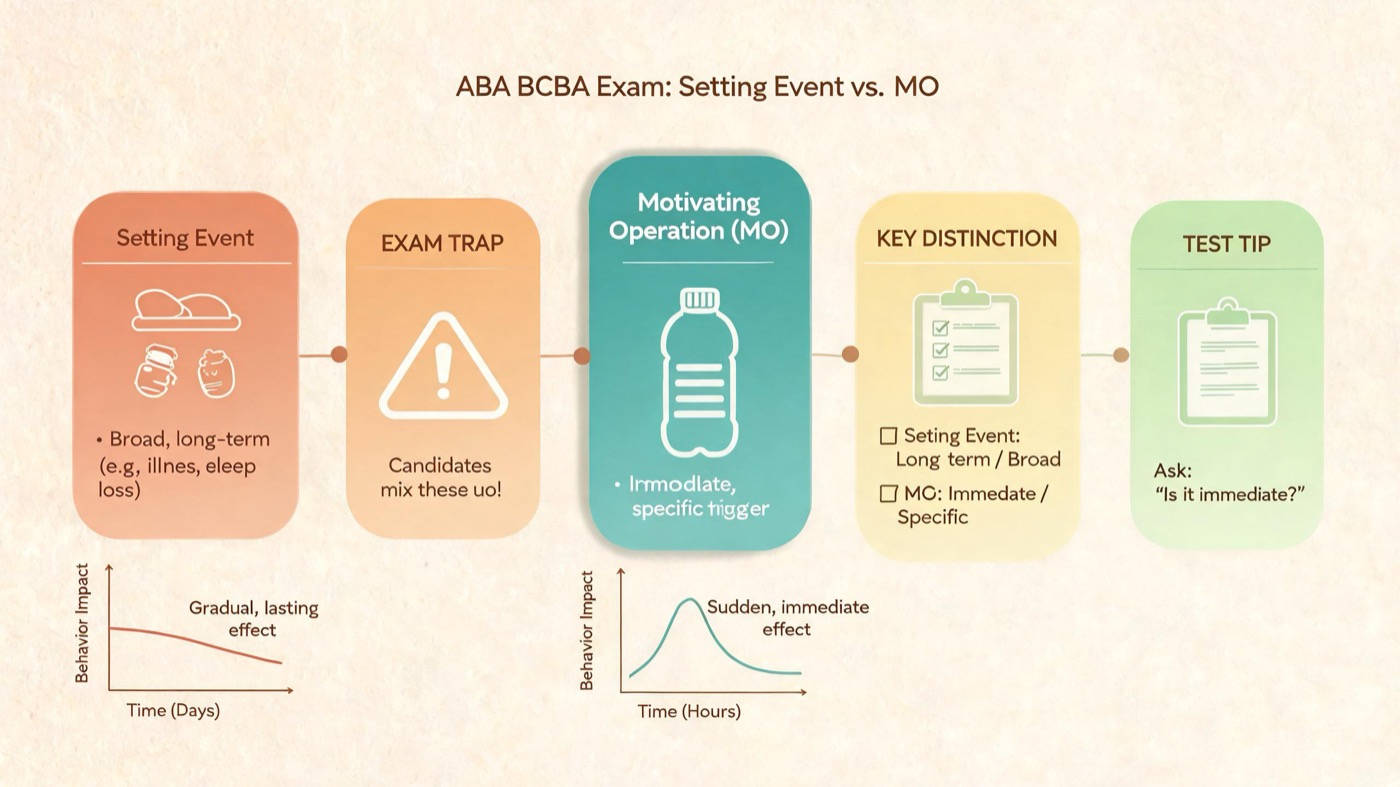
Confusing MO With Setting Events
A setting event is a broader context (e.g., illness, lack of sleep) that affects behavior over time. An MO is more immediate and specific. For example, being ill (setting event) may generally reduce motivation, whereas hunger (MO) specifically increases the value of food. The exam may ask you to differentiate: if the antecedent directly alters reinforcer value in the moment, it’s an MO; if it’s a more global influence, it’s a setting event.
Overlooking Unconditioned vs. Conditioned MOs
Unconditioned Motivating Operations (UMOs) are unlearned, such as pain, hunger, or thirst. Conditioned Motivating Operations (CMOs) are learned through pairing, like token economies or monetary incentives. Both appear on the BCBA task list. For instance, a token board may function as a CMO if tokens have been paired with backup reinforcers. For a deeper dive, see our article on conditioned motivating operations.
Quick Checklist for MO Identification
Use this rapid reference when analyzing exam scenarios:
- Identify the reinforcer: What consequence is being sought or avoided?
- Ask: Is the value of that reinforcer changed? Look for deprivation, satiation, pain, or other immediate shifts.
- Distinguish MO from SD: Does the antecedent alter value (MO) or signal availability (SD)?
- Classify as EO or AO: Does it increase (EO) or decrease (AO) the reinforcer’s value?
- Check for UMO vs. CMO: Is the MO unlearned (e.g., hunger) or learned (e.g., tokens)?
Summary: Why MO Matters for the BCBA Exam
Mastering MO ABA is essential for behavior assessment and intervention. The BCBA exam tests your ability to identify MOs in functional behavior assessments and to design interventions that manipulate MOs (e.g., providing noncontingent access to attention to reduce attention-seeking behavior). Understanding MOs also helps you avoid common confusions with SDs and setting events. Review the examples above and practice with mock questions — a strong grasp of motivating operations will boost your exam confidence and your clinical skills. For more exam prep, check out our BCBA exam prep guide. You can also review the official BACB website for the task list and ethics code.
Next step for BCBA exam prep
Turn this topic into exam-day practice
Use this topic as a focused review, then test it in exam-style conditions with a free mock before deciding whether five full-length mocks are the right next step.
Start the Free BCBA Mock ExamContinue with Five Full-Length Mocks — $99
Review the included materials and access details before ordering. No pass guarantee is implied.



