
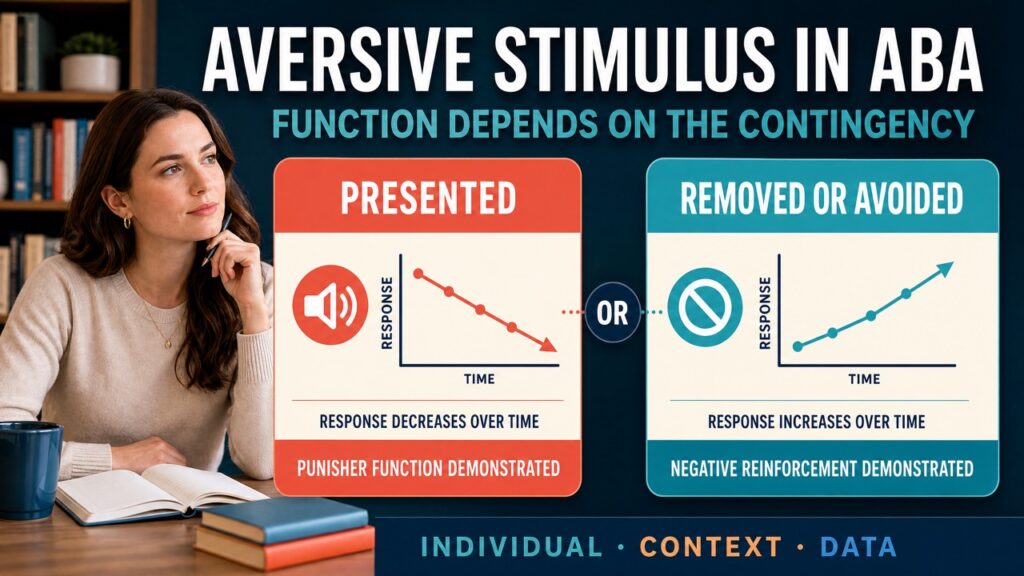
In applied behavior analysis (ABA), an aversive stimulus is a core concept connected to punishment, negative reinforcement, and ethical practice. But what exactly does the term mean? It is easy to assume that an aversive stimulus is anything unpleasant, painful, or uncomfortable. However, behavior analysts define it functionally: its status as aversive depends on its demonstrated effect on behavior, not on its appearance or physical features. This article explains the functional definition, provides two original examples, distinguishes related technical terms, and outlines the ethical safeguards that apply when aversive stimuli are used in intervention.
Table of Contents
- What Is an Aversive Stimulus in ABA? A Functional Definition
- Examples of Aversive Stimuli in Operant Contingencies
- Distinguishing Aversive Stimulus, Punisher, and Negative Reinforcement
- Functional Analysis and Aversive Stimuli
- Ethical Considerations When Using Aversive Stimuli
- Respondent Conditioning and Aversive Properties
- Study Checklist: Key Points to Remember
What Is an Aversive Stimulus in ABA? A Functional Definition
In behavior analysis, an aversive stimulus is defined by its function in an operant contingency. A stimulus is considered aversive when it meets one of two conditions. First, when presented contingent on a response, it may function as a punisher, decreasing the future probability of that response. Second, when removed or avoided contingent on a response, it may function as a negative reinforcer, increasing the future probability of that response. The critical idea is that the stimulus’s status is determined empirically—by observing whether behavior changes under the relevant contingency.
This definition differs from a layperson’s understanding. An aversive stimulus is not defined by its sensory qualities, such as volume, texture, or brightness. A loud noise might be aversive for one individual but reinforce approaching behavior for another who enjoys loud music. A demanding task might be aversive in one context but welcomed in another. Therefore, you cannot identify an aversive stimulus by simply looking at it; you must analyze the functional relation between the stimulus and behavior.
To apply this concept correctly, keep these points in mind:
- An aversive stimulus is a stimulus class, not a specific event.
- Its function is determined by its effect on behavior in a given contingency.
- It may serve as a punisher in one contingency and a negative reinforcer in another.
- Physical intensity or presumed unpleasantness does not define it.
Examples of Aversive Stimuli in Operant Contingencies
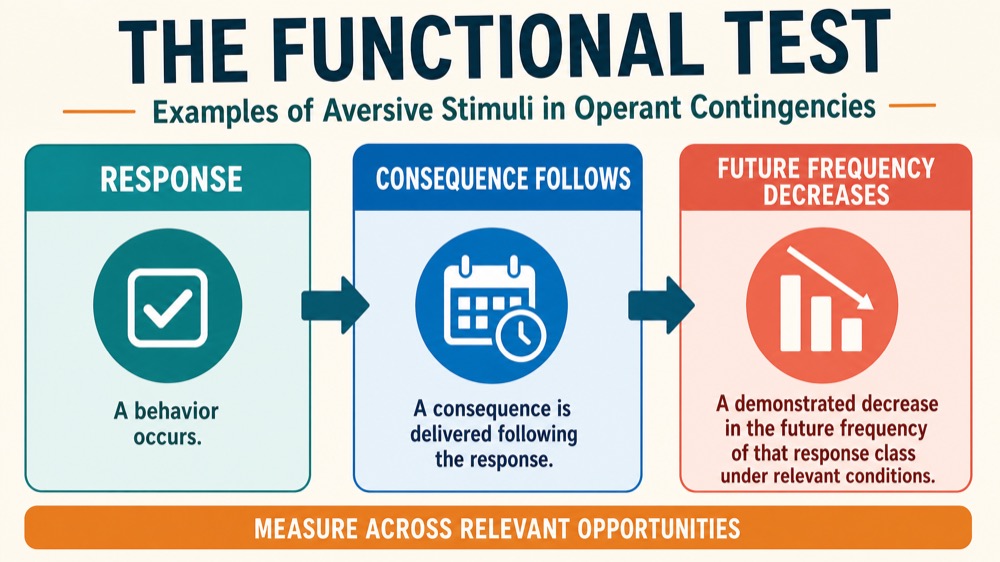
To clarify how an aversive stimulus functions in operant contingencies, consider two original examples. The first demonstrates an aversive stimulus used as a punisher, and the second shows its removal functioning as negative reinforcement.
Example 1: Aversive Stimulus as Punisher in a Positive Punishment Contingency: Imagine a classroom where a student frequently calls out answers without raising a hand. The teacher decides to present a brief, moderately loud tone immediately after each call-out. Over two weeks, the frequency of call-outs decreases consistently. Here, the tone functioned as a punisher because its presentation contingent on the behavior reduced that behavior. This arrangement is an example of positive punishment: a stimulus (the tone) is added following a response, and that response decreases over time.
The tone is only an aversive stimulus for this student because it demonstrably reduced call-outs. If the tone had no effect, or if it inadvertently increased the behavior (for example, because the student found the disruption reinforcing), it would not be functionally aversive in this context. This example illustrates that the functional definition requires observing a behavior change, not assuming the stimulus is punishing based on its features.
Example 2: Aversive Stimulus Removal as Negative Reinforcement: Now consider a child who refuses to complete a writing task. The teacher presents the instruction, “Complete the first paragraph.” For this child, the demand itself may function as an aversive stimulus. When the child begins writing, the teacher says, “You can take a five-minute break now,” and removes the task. Over successive sessions, the child’s compliance with instructions increases. Here, the removal of the demand was contingent on the behavior and reinforced that behavior—a clear demonstration of negative reinforcement.
Notice the difference: in the first example, the aversive stimulus was presented to decrease behavior. In the second, its removal increased behavior. Both processes rely on an aversive stimulus, but the contingencies are distinct. This distinction is essential for understanding how the same stimulus class can function in opposite ways depending on the arrangement.
For further clarity on how stimuli acquire control over behavior, you may find our guide on stimulus control in ABA helpful.
Distinguishing Aversive Stimulus, Punisher, and Negative Reinforcement
Students often use the terms aversive stimulus, punisher, and negative reinforcement interchangeably, but they refer to different levels of analysis. An aversive stimulus is a stimulus class that, in a given context, has been shown to have punishing or negative reinforcing effects. A punisher is a functional term: a stimulus that, when presented contingent on a behavior, decreases the future probability of that behavior. Negative reinforcement is a contingency in which a behavior is strengthened by the removal, avoidance, or reduction of a stimulus, often an aversive one.
Let’s break down the distinctions:
- Aversive stimulus: the stimulus itself, defined by its functional effects.
- Punisher: the effect of presenting that stimulus contingent on behavior (decrease in behavior).
- Negative reinforcement: the effect of removing or avoiding that stimulus contingent on behavior (increase in behavior).
Think of it this way: an aversive stimulus is like a variable with two possible functions. When presented, it may act as a punisher; when removed, it may act as a negative reinforcer. However, calling a stimulus a punisher is only correct when its presentation consistently reduces behavior. Similarly, negative reinforcement is only correctly identified when the removal or avoidance of a stimulus is contingent on a response and that response subsequently increases under relevant conditions.
For example, a therapist might use a brief, neutral tone as a punisher to reduce a client’s disruptive vocalizations. In a different scenario, the therapist might allow a client to avoid a demanding task when they request a break using a communication card, and that request behavior increases. In both cases, the same type of stimulus—the demand or the tone—could be involved, but its function differs based on the contingency.
Functional Analysis and Aversive Stimuli
An aversive stimulus often plays a central role in functional analysis, a systematic assessment method used to identify the variables maintaining problem behavior. In the escape condition of a functional analysis, for instance, the therapist presents demands to the individual. If the individual’s problem behavior reliably results in the removal or avoidance of those demands, the behavior is said to be escape-maintained. In this context, the demands function as aversive stimuli because their removal strengthens the problem behavior.
The escape contingency is a specific type of negative reinforcement: the behavior results in the termination or postponement of an aversive event. In this case, the aversive event is the demand presentation. The therapist carefully observes whether problem behavior occurs more often in the escape condition compared to other conditions, such as attention or tangible. This empirical comparison is what allows the analyst to conclude that the demands function as aversive stimuli for that individual.
Understanding the role of aversive stimuli in functional analysis is essential for interpreting assessment results and designing function-based interventions. When a behavior is escape-maintained, treatment often focuses on teaching alternative behaviors that access the same negative reinforcement, such as requesting a break, rather than using aversive procedures.
Ethical Considerations When Using Aversive Stimuli
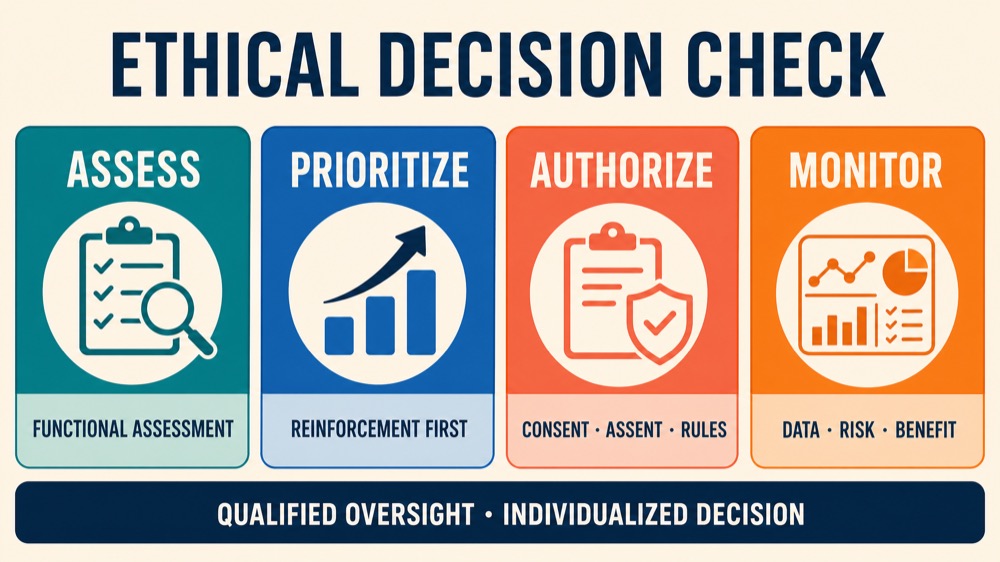
The use of aversive stimuli in behavior-analytic interventions raises significant ethical and regulatory concerns. The Behavior Analyst Certification Board (BACB) Ethics Code requires that behavior analysts prioritize reinforcement-based procedures and use the least restrictive interventions that are likely to be effective. Aversive procedures should only be considered after reinforcement-based methods have been tried and found insufficient, or when the risk of harm is high and alternative approaches are not feasible. Any use of aversive stimuli must be based on a functional assessment, a risk-benefit analysis, and the analyst’s competence. Informed consent from clients or guardians is essential, and the procedures must comply with BACB ethics guidelines and state regulations.
For example, a behavior analyst might consider using a brief, mild aversive stimulus to reduce severe self-injury that has not responded to reinforcement-based interventions. Before doing so, they must document that reinforcement-based procedures were ineffective, conduct a functional assessment to ensure the aversive is not contraindicated, and obtain the necessary consent. They must also have the training and supervision needed to implement the procedure correctly. Always consult the latest BACB resources, such as the BACB BCBA Test Content Outline, and applicable state laws, as requirements may vary by jurisdiction.
Respondent Conditioning and Aversive Properties
Some stimuli may acquire aversive properties through respondent conditioning (also called classical conditioning). For example, if a neutral stimulus is repeatedly paired with a painful event, that stimulus may come to elicit physiological responses similar to those produced by the pain itself. However, this respondent history does not automatically determine the stimulus’s function in an operant contingency. In operant terms, a stimulus is only an aversive stimulus if its presentation or removal produces a change in operant behavior.
Consider a child who has had a frightening experience with a dog. The sight of a dog may elicit fear responses (respondent). But in an operant context, if approaching the dog is followed by a preferred toy or praise, the child may begin to approach the dog. The dog is not inherently an aversive stimulus; its function depends on the current contingencies. This distinction is important for accurate behavioral assessment: respondent mechanisms may explain why a stimulus evokes certain responses, but it is the observed relation to behavior that defines its function as aversive in an operant analysis.
To learn more about how stimuli can acquire generalized relations, you might review our article on stimulus generalization in ABA.
Study Checklist: Key Points to Remember
When reviewing this concept, keep the following points in mind:
- Define an aversive stimulus functionally, not topographically.
- Differentiate between an aversive stimulus, a punisher, and negative reinforcement.
- Identify examples of positive punishment and negative reinforcement involving aversive stimuli.
- Understand that aversive stimuli may be implicated in escape-maintained behavior during functional analysis.
- Recognize that ethical use requires reinforcement-based procedures first and proper safeguards if aversive stimuli are considered.
- Remember that a stimulus’s function must be empirically demonstrated; it is not determined by appearance or assumed unpleasantness.
Use these points as a foundation for applying the concept to scenario-based practice questions. To test your understanding with feedback, try our free BCBA mock exam—it provides practice and feedback to help you identify areas for improvement.



