
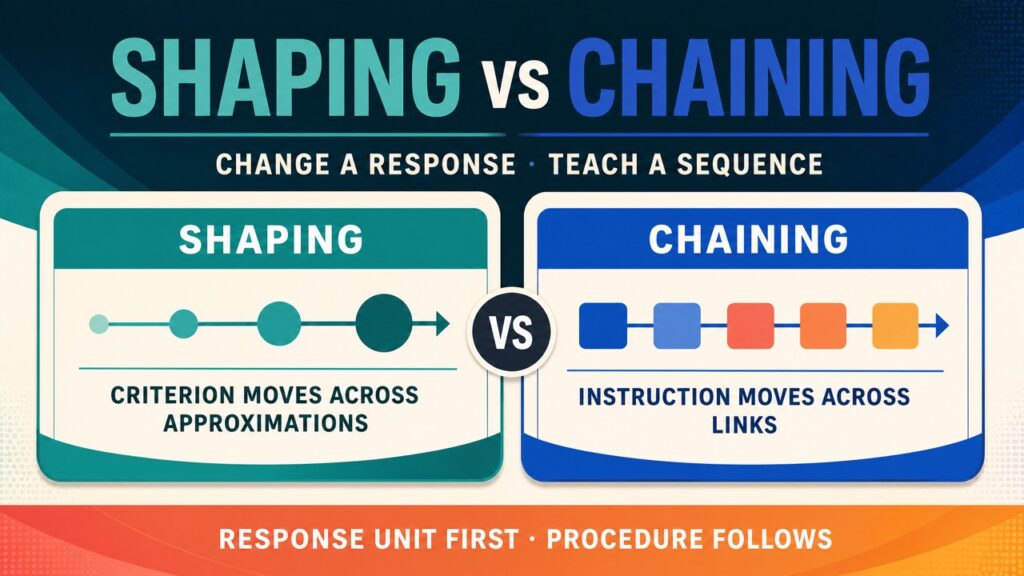
If you are studying applied behavior analysis, you have likely asked: what is the difference between shaping and chaining in ABA? Both procedures involve reinforcement and are used to build new skills, but they target different units of behavior. Shaping changes a measurable dimension of a single response, while chaining arranges instruction for an ordered response sequence. This guide explains the key distinctions, offers original examples, and outlines data-based decisions for each. For a deeper look at each procedure, see our guides on shaping in ABA and chaining in ABA.
Table of Contents
- Defining Shaping in ABA
- Defining Chaining in ABA
- Key Differences Between Shaping and Chaining
- Practical Examples and Clarifications
- Combining Shaping and Chaining Without Confusion
- Data-Based Decisions: Measuring Progress and Making Adjustments
- Common Traps to Avoid
- Considerations for Practice
- Conclusion
Defining Shaping in ABA
Shaping is a procedure in which you differentially reinforce successive approximations toward a clearly defined terminal response or a specific value of a response dimension. Differential reinforcement means that responses meeting the current criterion produce reinforcement, while responses that do not meet that criterion do not. As the learner meets the current criterion, you advance it to require a closer match to the terminal goal. This process continues until the terminal response is achieved. Shaping is not limited to changing response topography; it can also alter measurable dimensions such as duration, latency, rate, force, distance, or variability, provided that the dimension is relevant and objectively measured.
For example, suppose a learner engages in independent academic work for only one minute. Your terminal goal is fifteen minutes of continuous engagement. You set a current criterion of one minute. When the learner works for that duration, you deliver reinforcement. Then you gradually increase the criterion to one minute and thirty seconds, then two minutes, and so on. In this illustration, the programmed reinforcer follows responses that meet the current criterion; other durations are recorded, and the next decision depends on performance and context. The example values are not a universal progression or terminal criterion. This is shaping because you are changing a single response dimension—duration—through differential reinforcement of successive approximations.
Defining Chaining in ABA
Chaining is an instructional arrangement for teaching an ordered response sequence identified through a task analysis. The sequence, called a behavior chain, consists of component responses that occur in a specific order. Each component response produces a stimulus change that may function as a conditioned reinforcer for the preceding link and as a discriminative stimulus for the next link, with a terminal consequence following completion of the entire sequence. However, these stimulus functions should be attributed only when supported by relevant data; they should not be assumed merely from the planned task-analysis order. Evaluate acquisition and performance data to determine whether such functions are operative.
It is essential to distinguish a task analysis, a behavior chain, and a chaining teaching procedure. A task analysis is the ordered breakdown of a skill into smaller steps. A behavior chain is the functional sequence of responses and stimulus changes that operate together. Forward chaining, backward chaining, and total-task teaching are arrangements for teaching or assessing performance across the links. Additionally, response chaining differs from a chained schedule of reinforcement, which is a reinforcement schedule with multiple components in sequence.
Key Differences Between Shaping and Chaining
The table below summarizes the main differences. Keep in mind that shaping and chaining are not mutually exclusive; they can be combined, but they remain distinct procedures.
| Aspect | Shaping | Chaining |
|---|---|---|
| Unit changed | Single response or response dimension | Ordered response sequence |
| Prerequisite assessment | Assess current level of the response dimension | Assess performance of each component response |
| Criterion movement | Systematically advance approximations or dimensional values | Link-level independence and assistance change according to the selected forward, backward, or total-task arrangement |
| Typical instructional arrangement | Deliver reinforcement for each successive approximation | Use forward chaining, backward chaining, or total-task teaching |
| Reinforcement location | Reinforcement follows the target response when it meets criterion | Reinforcement follows completion of trained links or the whole chain, depending on the arrangement |
| Prompting and fading | May use prompts to evoke approximations, then fade | Prompts often used for unmastered links, then faded |
| Measurement | Measure target dimension, criterion met, and reinforcer deliveries | Record independent, prompted, incorrect, or omitted performance per step, prompt level, and sequence errors |
| Common failure patterns | Criterion too large, reinforcer ineffective, extinction of approximations | Prompt dependence, unclear task analysis, components not in repertoire |
| Evidence for procedural change | Lack of progress toward terminal criterion | Stalled acquisition, sequence errors, or high prompt dependence |
Four decision questions keep the comparison operational:
- Response unit: Is the target one response or dimension, or an ordered sequence of distinguishable links?
- Criterion: Does reinforcement depend on closer approximations or dimensional values, or on performance within a task-analyzed sequence?
- Instruction: Are prompts and prompt fading arranged for particular links under forward, backward, or total-task teaching?
- Combination: Does a weak component need shaping before or while it is incorporated into the behavior chain?
Practical Examples and Clarifications
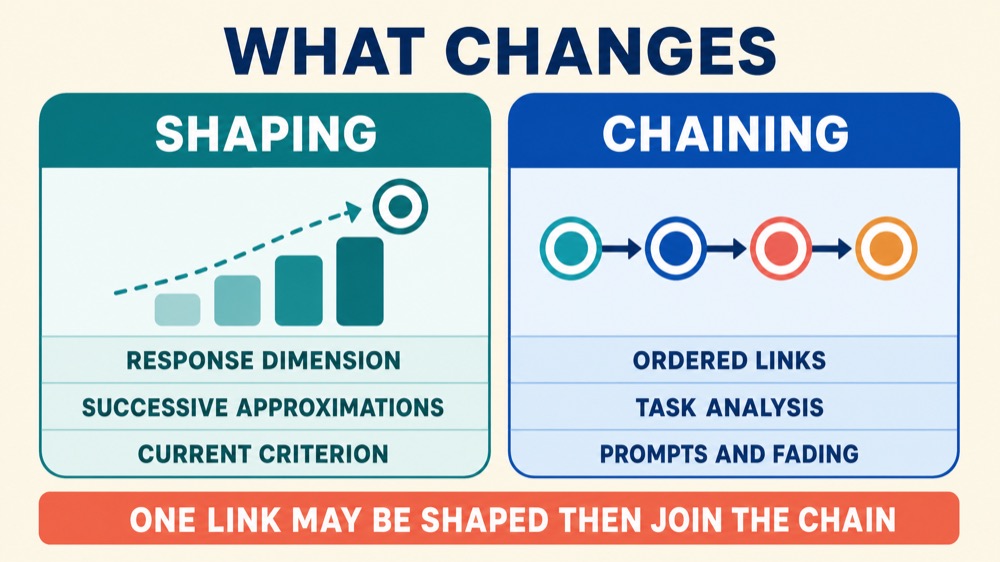
Shaping Example: Increasing Work Duration. As described above, shaping can increase the duration of an existing behavior by setting progressively higher duration criteria and reinforcing only responses meeting the current criterion. This illustrates changing a single response dimension.
Chaining Example: Teaching a Snack Preparation Routine. Consider a task analysis for preparing a simple snack: (1) gather materials, (2) open the container, (3) scoop or pour the snack, (4) close the container, (5) return materials to their storage place. Using backward chaining, you might first teach the last step (returning materials) while you complete the earlier steps. The learner only needs to perform the final link, and reinforcement is delivered after that step. Once the learner masters that link, you move to the second-to-last link, and so on. This is chaining because you are teaching a sequence of distinct responses in a fixed order.
Clarifying the Toy-Bin Example. A common misunderstanding arises with an example like touching a toy, grasping it, carrying it, and releasing it into a bin. Some might label this as shaping because the behavior appears to improve gradually. However, these are distinguishable ordered response units—touch, grasp, carry, release—each with its own topography. They can constitute distinct ordered links and therefore support a chaining analysis. Shaping would be the better label only when the programmed contingency advances a defined approximation or dimension of a target response, such as increasing reach distance or refining a grasp. The label follows the programmed contingency and measured unit, not the instructor’s intention or the visual appearance of gradual improvement.
Combining Shaping and Chaining Without Confusion
Sometimes you may need both procedures. For example, if a component response in a chain is weak or missing, you can shape that specific response dimension first, then incorporate it into the chain. For instance, if a learner cannot maintain a grasp for a sufficient duration, you might shape grasp duration before teaching the chain that includes grasping. This does not make the two procedures the same; you are using shaping to establish a component behavior and chaining to arrange the sequence. You might also use prompts, modeling, or stimulus fading for individual links. Component responses do not need to be independently mastered before starting a chaining procedure, but you should assess them to determine the teaching strategy.
Data-Based Decisions: Measuring Progress and Making Adjustments
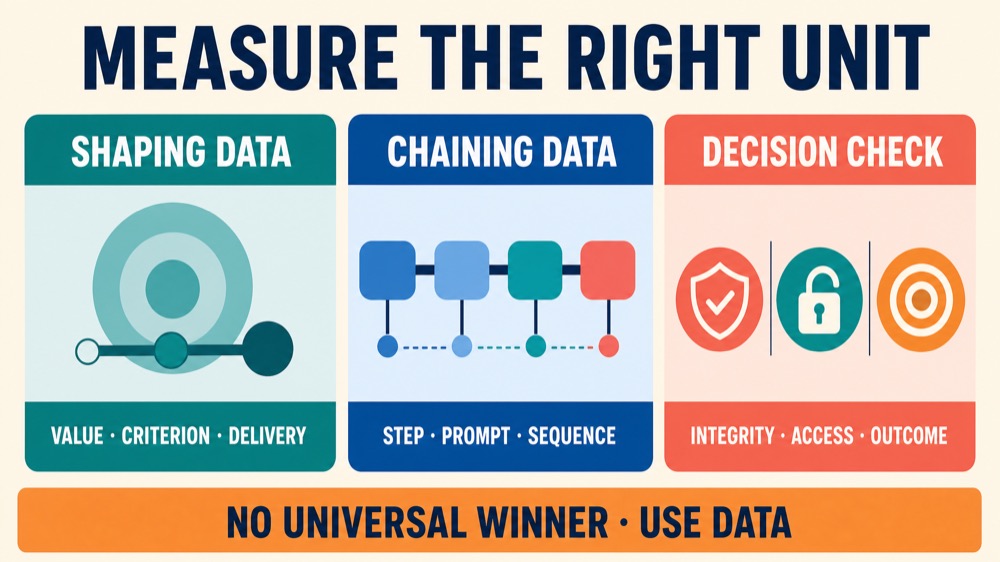
For shaping, record the response dimension or approximation, the current reinforcement criterion, the distribution of performances, obtained reinforcer deliveries, latency when relevant, and procedural integrity. If progress stalls, examine whether the criterion jump was too large, the reinforcer is ineffective, or the learner lacks prerequisite skills. These data can support holding, revising, or returning to an earlier criterion and evaluating the reinforcement arrangement.
For chaining, record each step’s independent, prompted, incorrect, or omitted performance, the prompt level, the number of opportunities, sequence errors, latency or total completion time, and procedural integrity. Percentage of independently completed steps can summarize performance, but do not rely on it alone; look at link-level patterns. For example, if a learner consistently fails on step 3, that indicates a need for additional teaching or task analysis revision.
Several small studies illustrate these concepts. One study examined shaping with percentile schedules to quantify changing duration criteria in academic engagement; the larger comparison distribution was most effective in that application. Another compared forward and backward chaining for teaching motor sequences; learners acquired the tasks under both arrangements, with no consistent efficiency advantage. A third study explored procedural variations in forward chaining, showing that what happens to untrained steps can affect efficiency. These examples highlight the importance of individualization and data.
Common Traps to Avoid
- Assuming every gradual improvement is shaping: Label the procedure based on the programmed contingency and response unit, not visual appearance.
- Confusing response chain with chained schedule: A behavior chain involves successive responses each producing stimulus changes; a chained schedule is a reinforcement schedule with multiple components in sequence.
- Requiring all component responses to be mastered before chaining: Chaining can begin with unmastered links, using prompting and prompt fading.
- Believing stimulus changes automatically acquire function: Attribution of conditioned-reinforcing and discriminative functions requires relevant functional and performance evidence rather than the planned task-analysis order alone.
- Using vague criteria like “better” or “closer”: Always define the current criterion and terminal criterion operationally.
Considerations for Practice
- Monitor observable assent or withdrawal indicators throughout teaching.
- Prioritize client and stakeholder values, accessibility, feasibility, and social validity.
- Consider risks and ensure qualified individualized oversight in procedural selection.
These examples are educational illustrations, not do-it-yourself treatment protocols. Work within the applicable professional scope and consult current BACB resources such as the BACB BCBA Test Content Outline, which separately lists shaping dimensions of behavior (G.11) and selecting and implementing chaining procedures (G.12). See also the original research on shaping with percentile schedules, the comparison of forward and backward chaining, and the procedural variations in forward chaining for further context.
Conclusion
In summary, the difference between shaping and chaining in ABA lies in the unit of behavior: shaping changes a single response dimension through differential reinforcement of successive approximations; chaining teaches an ordered sequence of responses identified via task analysis. Both are powerful, evidence-based procedures, but they are not interchangeable. Use data to make decisions and individualize teaching. For additional practice and feedback, visit our Free BCBA Mock Exam to test your understanding of these and other ABA concepts.



