

In applied behavior analysis (ABA), successive approximations are the series of responses that progressively resemble a terminal behavior during the shaping process. Each approximation is reinforced because it moves the learner closer to the final target. Understanding successive approximations is essential for skill acquisition across verbal behavior, motor skills, and social skills. This guide provides a clear definition, a step-by-step example, decision points, and a comparison with task analysis, helping you apply this behavioral procedure with precision.
Table of Contents
- Defining Successive Approximations in ABA
- The Role of Shaping in Using Successive Approximations
- Practical Example: Shaping a Child to Say “Please”
- Decision Points: When to Advance or Withhold Reinforcement
- Successive Approximations vs. Task Analysis and Chaining
- Nonexamples and Common Errors
- Applying Successive Approximations Across Skill Areas
- Conclusion and Next Steps
Defining Successive Approximations in ABA
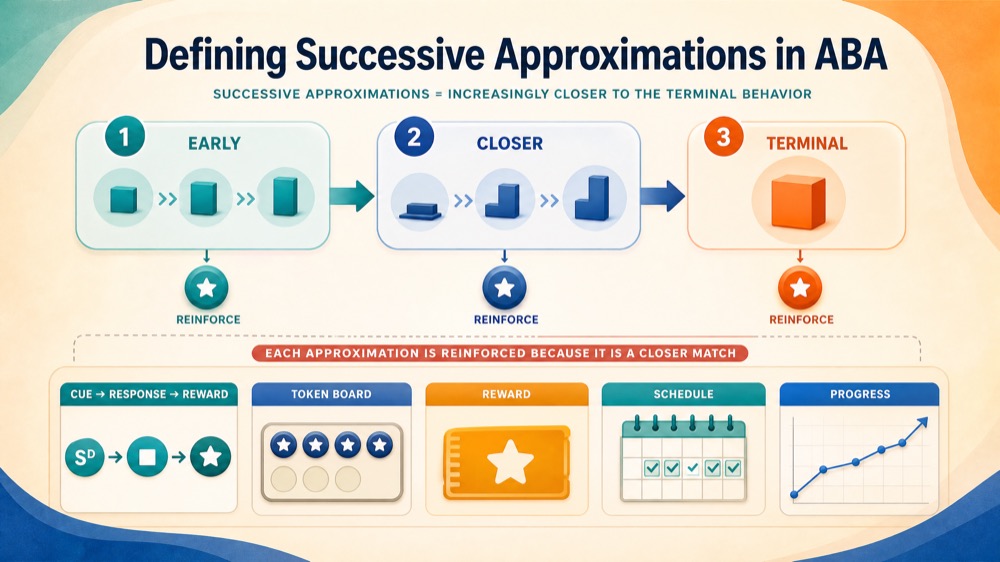
Successive approximations are the specific responses emitted by a learner that increasingly match the terminal behavior—the final response you want to establish. In shaping, each of these approximations is reinforced because it is a closer match to the target. For example, if the goal is for a child to say the full word “please,” the initial approximation might be a simple vocalization like “ah,” followed by “puh,” then “plee,” and finally “please.” Each step is a successive approximation.
It is important to understand that successive approximations are not a stand-alone procedure. Rather, they are a component of shaping, which is the systematic application of differential reinforcement. Differential reinforcement involves delivering reinforcement for responses that meet a specific reinforcement criterion while withholding reinforcement for responses that do not. The reinforcement criterion defines exactly what a response must look like to be reinforced at each stage. As the learner meets the current criterion, the requirement is gradually raised to prompt an even closer approximation.
A functional definition of successive approximations highlights their role: they are the ordered set of response variants that serve as the intermediate targets in shaping. They are defined by their response topography—the physical form or characteristics of the behavior—rather than by a fixed sequence of steps. The process begins with an initial behavior that already occurs in the learner’s repertoire, ensuring that reinforcement can be delivered immediately. Before shaping begins, the terminal behavior must be precisely defined so that progress can be measured objectively.
- Terminal behavior: The final target response, defined in observable terms.
- Initial behavior: A response that the learner already emits and that can serve as the starting point.
- Reinforcement criterion: The specific requirement a response must meet to be reinforced at each step.
- Differential reinforcement: Reinforcing closer approximations while withholding reinforcement for less accurate ones.
The Role of Shaping in Using Successive Approximations
Shaping is the behavioral procedure that uses differential reinforcement to develop successive approximations toward a terminal behavior. The process involves several steps: define the terminal behavior, assess the learner’s current repertoire, select an initial behavior, and then gradually change the reinforcement criterion to require closer approximations. Throughout shaping, data collection is critical to determine when the learner is ready to advance.
Shaping is not a haphazard process. It requires careful observation and systematic adjustment. The behavior analyst must decide when to reinforce a current approximation and when to withhold reinforcement to encourage a closer one. This decision is guided by the learner’s performance data. If the learner is emitting the current approximation reliably and without errors, it may be time to raise the criterion. Conversely, if the learner is struggling, the criterion may need to be adjusted to a smaller step. The goal is to move steadily, but not so quickly that the learner becomes frustrated or so slowly that progress stalls.
Practical Example: Shaping a Child to Say “Please”
Consider a concrete example of shaping a child to say “please” when making a request. The terminal behavior is that the child says the full word “please” in the presence of a request context, such as when asking for a toy. The initial behavior might be any vocalization, as long as it occurs in the context of a request. The behavior analyst would reinforce any vocalization immediately after the child reaches for an item.
Once the child emits vocalizations consistently, the reinforcement criterion is raised. The analyst now reinforces only vocalizations that include a consonant, such as “ba” or “pu.” After the child reliably produces these, the criterion shifts to require a closer approximation to “please,” such as “plee” or “ple.” Finally, only the exact sound “please” is reinforced. The reinforcement criteria for each step are outlined below.
- Step 1: Reinforce any vocalization (e.g., “aa”) within 3 seconds of a request.
- Step 2: Reinforce only vocalizations that include a consonant (e.g., “ba” or “puh”).
- Step 3: Reinforce only vocalizations that approximate “plee” (e.g., “plee” or “ple”).
- Step 4: Reinforce only the exact sound “please.”
Throughout this process, the analyst records data on the child’s vocalizations. If the child is producing the current approximation at a high rate, the criterion is raised. If the child stops emitting the approximation after a criterion change, the analyst may temporarily return to the previous step to re-establish the behavior. This example illustrates how successive approximations are systematically built through shaping.
Decision Points: When to Advance or Withhold Reinforcement
Deciding when to change the reinforcement criterion is a critical skill in shaping. The general principle is to require a closer approximation only when the current approximation occurs consistently and without hesitation. If the learner is not yet fluent in the current approximation, advancing too soon may lead to errors or extinction bursts. Conversely, if the learner has been emitting the current approximation at a high rate for several sessions, it is time to raise the criterion.
Withholding reinforcement for the previous approximation is a key component of differential reinforcement. When the criterion is raised, responses that meet the old criterion no longer receive reinforcement. This extinction of the previous approximation often prompts the learner to try a more accurate response. However, the analyst must be careful not to withhold reinforcement for too long, as this may cause the learner to disengage or become frustrated. The balance between moving too quickly and too slowly is guided by data.
For example, if a child is successfully saying “ba,” but the analyst immediately requires “please” without an intermediate step, the child may fail and stop trying. On the other hand, if the analyst waits too long to raise the criterion, the child may continue to say “ba” indefinitely. Data on the current level of performance must guide the decision to advance. If the child is not making progress, the analyst may need to revert to a previous approximation or adjust the reinforcement.
Another important consideration is the use of prompts. While shaping focuses on the response itself, prompts can be used temporarily to encourage a closer approximation. For instance, the analyst might model the sound “please” to prompt the child. However, prompts are typically faded as the response becomes more independent. The goal is for the terminal behavior to occur under the natural discriminative stimulus, such as the presence of a desired item.
Successive Approximations vs. Task Analysis and Chaining
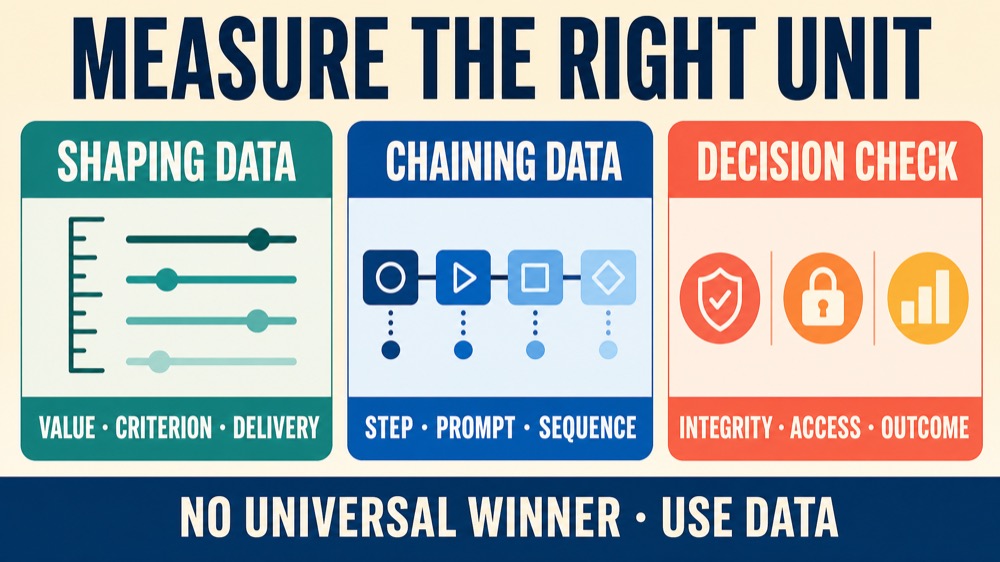
It is common to confuse successive approximations with task analysis, but they are distinct concepts. Task analysis breaks down a complex behavior into a sequence of discrete steps that are already in the learner’s repertoire. Each step is a separate response that the learner can perform, and reinforcement is delivered for completing the entire chain or a portion of it. In contrast, successive approximations involve changing the response topography or quality of a single behavior over time.
For example, teaching a child to tie shoelaces through task analysis would involve steps like making a loop, wrapping the lace, and pulling through. Each step is a discrete behavior that is already mastered. Shaping, on the other hand, might be used to teach a child to write the letter “A” by reinforcing closer and closer approximations of letter formation, such as a straight line, then an angled line, and finally the complete letter.
- Successive approximations: Repeatedly reinforcing closer approximations of a single response, focusing on response topography.
- Task analysis: Breaking a behavior into a sequence of discrete, already-known steps; reinforcement is delivered for completing the chain or a portion.
- Example of task analysis: Washing hands: turn on water, wet hands, apply soap, scrub, rinse, turn off water.
- Example of shaping: Teaching a child to say “ball” by reinforcing “buh,” then “ba,” then “ball.”
Thus, task analysis and chaining are about sequencing known behaviors, while successive approximations are about refining a single response. Both are used in skill acquisition, but they serve different purposes. Understanding this distinction helps in selecting the appropriate intervention for a learner’s needs.
Nonexamples and Common Errors
Behavior analysts should be aware of common errors that undermine shaping. One error is reinforcing the same response repeatedly without changing the criterion. This is not shaping; it is simply maintaining an existing behavior. Another error is reinforcing random variations without a systematic progression toward the terminal behavior. For example, if a teacher occasionally reinforces any vocalization regardless of how close it is to “please,” the child may not develop a clearer approximation.
- Reinforcing every response regardless of quality, which does not promote closer approximations.
- Attempting to shape without a clearly defined terminal behavior.
- Selecting an initial behavior that is completely novel to the learner; the initial behavior must already occur.
- Failing to use extinction for previous approximations when advancing the criterion.
- Assuming the same shaping process works for every learner.
- Moving too quickly, causing frustration and extinction bursts.
A nonexample of shaping is a therapist who reinforces a child for saying “da” every time but never changes the requirement. This is not shaping because the criterion stays constant. Another nonexample is a teacher who reinforces every vocalization, whether it is “ah,” “ba,” or “za,” without a plan to require closer sounds. This is not using successive approximations because there is no systematic progression.
Applying Successive Approximations Across Skill Areas
Successive approximations are widely used in skill acquisition to teach verbal behavior, motor skills, and social skills. For verbal behavior, shaping can be used to refine articulation or increase vocalizations. For motor skills, shaping might be used to teach a child to hold a pencil correctly or to throw a ball with increasing accuracy. In social skills, shaping can help a child make eye contact, take turns, or use appropriate greetings.
Data on the current level must guide when to advance to the next approximation. This is a behavioral procedure that requires careful observation and adjustment. By using successive approximations, behavior analysts can help learners acquire complex skills that might otherwise be out of reach.
Conclusion and Next Steps
Ready to test your knowledge? Take a free BCBA mock exam to practice applying these concepts. While the exam may not focus exclusively on successive approximations, it offers a variety of questions to help you prepare for the BCBA exam. For more on related topics, explore our guide on shaping behavior in ABA.
For official information on the BCBA exam content, refer to the BACB BCBA Test Content Outline.



