
If you are asking what does the BACB say about communication and multiple relationships, the short answer is that these duties work together. A behavior analyst must communicate in a way clients and stakeholders can understand, involve the right people in decisions, obtain and maintain informed consent when required, and identify or manage relationships that could impair objectivity, professional judgment, or client welfare.
Table of Contents
- What does the BACB say about communication and multiple relationships?
- What the BACB expects in communication
- A communication ethics map: explain, involve, consent, document
- What counts as a multiple relationship?
- A multiple-relationship decision path
- Scenario triage and documentation
- Digital communication and public content
- How to study the distinction for the BCBA exam
- FAQ
- Sources and scope
- Take the Free BCBA Mock Exam
The BACB Ethics Code for Behavior Analysts is the controlling professional reference. This article translates the relevant ideas into a practical review process; it does not replace the Code, supervision, consultation, an employer policy, or legal advice. Always check the official BACB Ethics Codes page and the current Ethics Code for Behavior Analysts for the exact wording and current version.
What does the BACB say about communication and multiple relationships?
The BACB does not treat communication as a courtesy that sits apart from ethics. Communication is part of how a behavior analyst protects client welfare, supports informed choice, keeps stakeholders involved, and notices conflicts early. A technically correct service can still create ethical risk if the explanation is confusing, a relevant stakeholder is excluded, consent is assumed, or a second relationship is hidden.
Multiple relationships are not limited to an obvious personal friendship. The concern is a second role or relationship with a client, stakeholder, supervisee, student, or other person connected to services when that role could affect professional decisions or create a risk of exploitation or harm. A family member might also be a friend, business contact, landlord, employee, or member of the same small community. The label alone does not answer the ethics question; the analyst must consider the nature and impact of the relationship, communicate relevant risks, use safeguards, and document the process. A useful one-sentence rule for study and practice is: communicate clearly, involve the people who need to participate, identify role conflicts early, protect boundaries, and record the decision and its outcome.
What the BACB expects in communication
For communication about services, the Code points behavior analysts toward understandable language, accurate descriptions, and attention to whether the recipient actually understands. That means explaining the scope and conditions of services, the procedures being considered, meaningful benefits and risks, and results in a form the client or stakeholder can use. A handout or signature is not automatically proof of informed understanding.
The communication question is therefore more specific than “Did I send the information?” Ask whether the message was accessible, current, culturally and linguistically appropriate, and sufficient for the decision being made. When communication involves a role conflict, disclose the relevant facts before asking people to rely on the analyst’s judgment. If the relationship changes later, communicate again rather than treating the original conversation as permanent permission.
| Ethics focus | Communication question | Practice evidence |
|---|---|---|
| Services and results | Can the client or stakeholder explain what is being offered, under what conditions, and what limitations apply? | Plain-language explanation, questions invited, comprehension checked, and material changes communicated. |
| Stakeholder involvement | Who has relevant responsibility, information, or decision authority for the service? | Roles and communication expectations identified at the outset and revisited when circumstances change. |
| Consent and assent | What must be explained before proceeding, and how will understanding, consent, or assent be respected? | Consent process, questions, refusal or pause signals, and relevant updates documented promptly. |
| Multiple relationships | Could another role make the communication less objective, less private, or more pressuring? | Potential risk disclosed, consultation obtained, safeguards or referral considered, and outcome recorded. |
For exam questions, notice that “the person signed” is rarely the best stopping point. Stronger answers usually include understandable communication, stakeholder involvement, informed consent or assent when applicable, and documentation that matches the decision.
A communication ethics map: explain, involve, consent, document
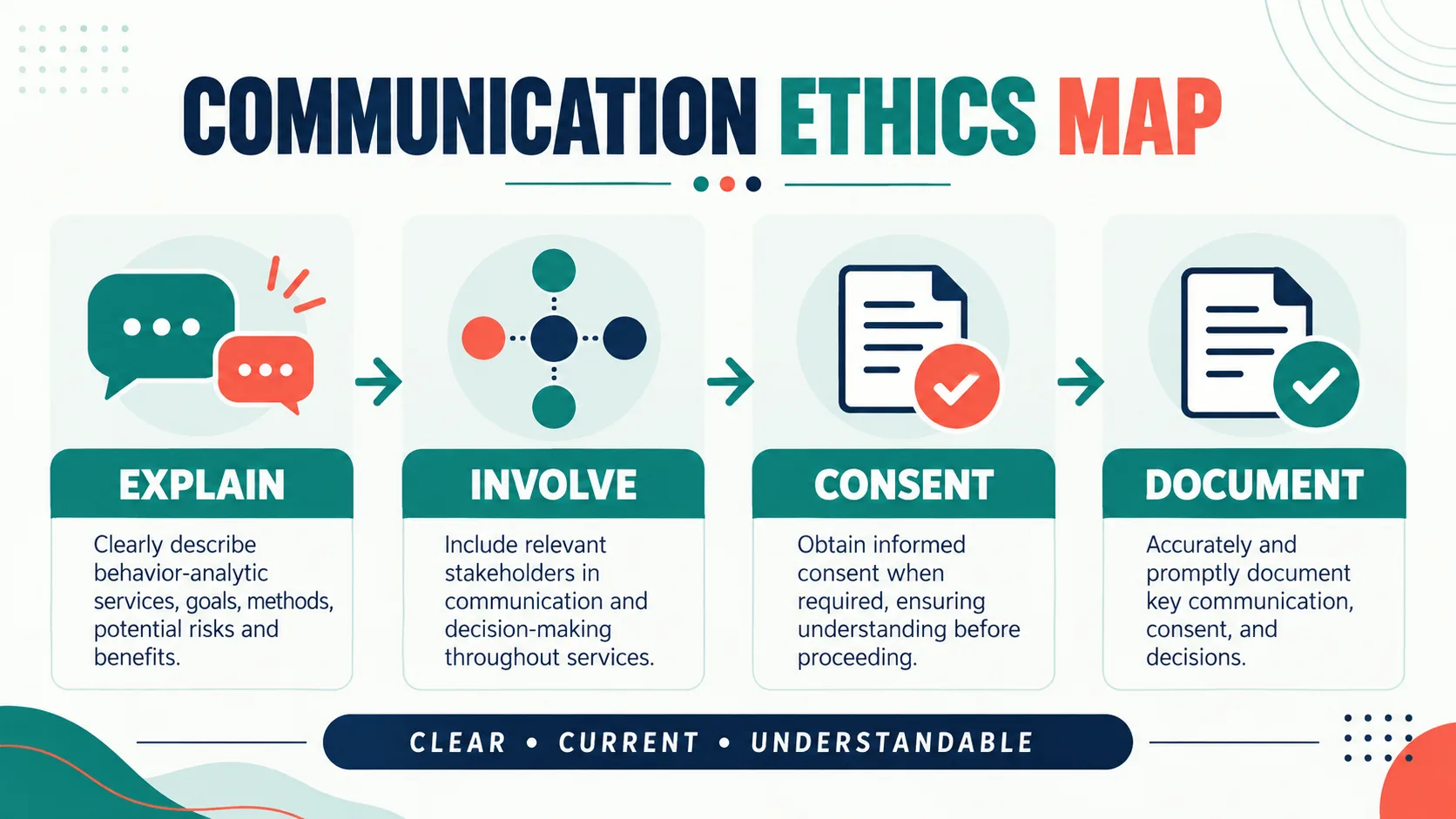
Use the four-part map whenever a service decision could affect a client, family, supervisee, or other stakeholder:
- Explain: describe the service, role, goal, procedures, foreseeable risks, expected benefits, and important limits without hiding behind jargon.
- Involve: identify the people whose responsibilities, knowledge, preferences, or rights are relevant. Involvement does not mean every person receives every private detail; it means the decision process respects the correct roles and confidentiality boundaries.
- Consent: obtain informed consent when required and respect assent, refusal, or a request to pause when applicable. Revisit consent when the service, risk, role, or setting changes.
- Document: record what was explained, who participated, questions or concerns, the decision, safeguards, consultation, and later outcome. Documentation should allow another qualified reviewer to understand the reasoning.
Communication also includes what the analyst does not promise. Avoid suggesting that a single strategy guarantees a result, that a client must accept an additional role because it is convenient, or that privacy can be guaranteed in a small community or online setting. Accuracy and transparency reduce the chance that a relationship becomes coercive or confusing.
What counts as a multiple relationship?
A multiple relationship exists when a behavior analyst has more than one role with a person or with someone closely connected to services. Some situations may be unavoidable, especially in small communities or specialized settings. “Unavoidable” does not mean “automatically harmless.” The analyst still needs to assess foreseeable risk, communicate relevant concerns, establish boundaries, consult when appropriate, and monitor the arrangement.
Examples can include serving a client while also being a family friend, entering a business arrangement with a caregiver, supervising someone who is also a close personal acquaintance, accepting a role in a community organization that creates divided duties, or communicating with a client through a personal social-media account. The ethical analysis changes with the nature, intensity, duration, power difference, privacy risk, and likely impact on objectivity and welfare.
- Identify the primary professional role and the additional role.
- Ask who could be pressured, confused, exploited, or disadvantaged.
- Consider access to confidential information and whether privacy can be protected.
- Estimate whether the added role could change recommendations, fees, supervision, or termination decisions.
- Consult a qualified supervisor, ethics consultant, employer process, or relevant professional resource when the risk is unclear.
- Set boundaries that are specific enough to follow and review them as the relationship evolves.
A multiple-relationship decision path
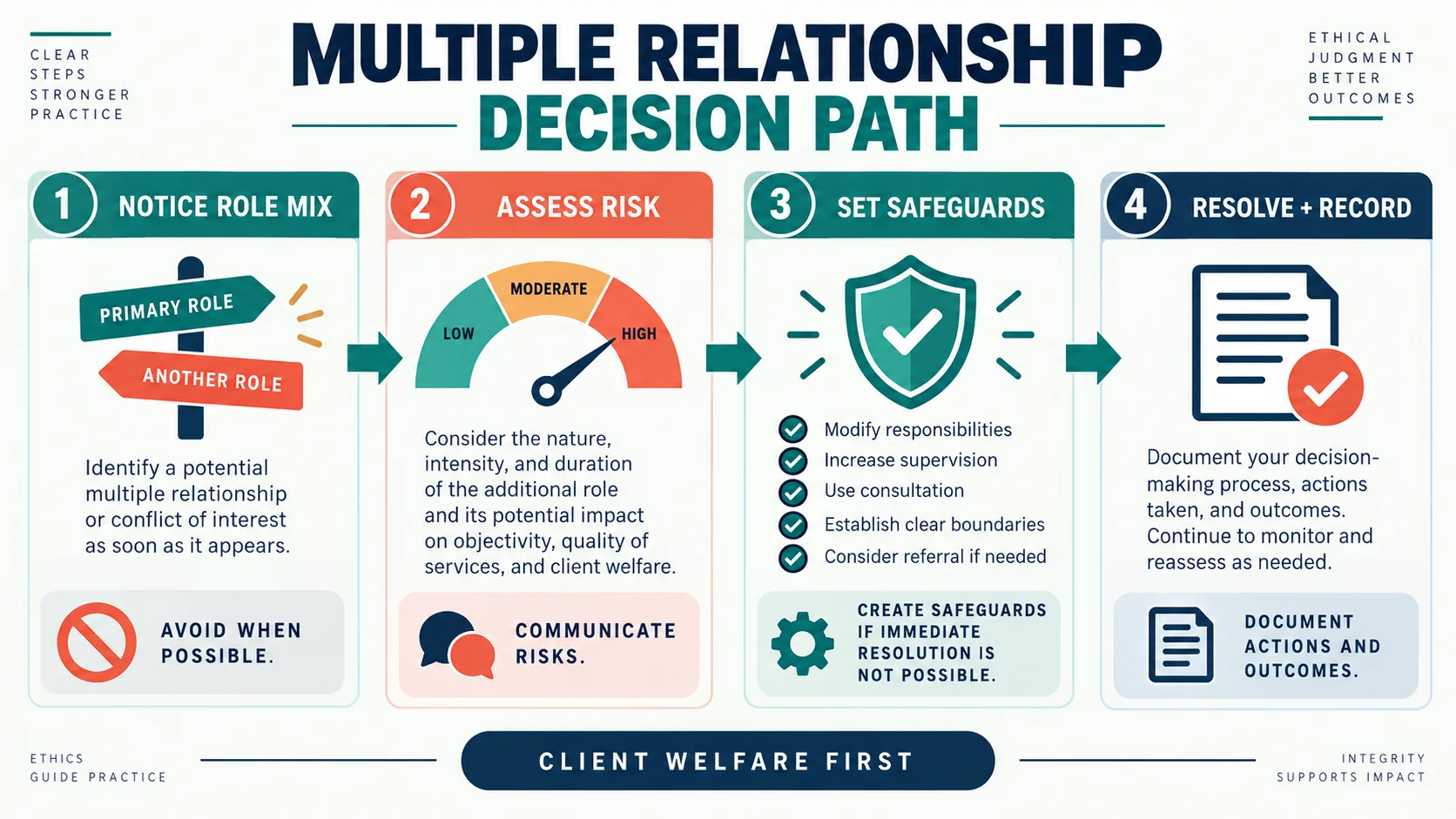
The BACB’s multiple-relationship standard emphasizes avoiding harmful or exploitative relationships when possible. If a potential conflict appears, do not wait for a complaint to decide whether it matters. Use a short, repeatable path:
- Notice the role mix: write down the professional role and the second role in neutral language.
- Assess risk: consider power, vulnerability, confidentiality, objectivity, financial or personal interests, and the likely effect on client welfare.
- Communicate: explain the concern to the people who need to understand it, using language appropriate to the audience. Do not use consent language to pressure someone into accepting an unsafe arrangement.
- Set safeguards: modify responsibilities, increase supervision, use a formal communication channel, limit access to information, separate decision-making duties, or arrange referral when appropriate.
- Resolve and record: if the conflict cannot be eliminated immediately, document interim safeguards, continue monitoring, and record the final action and outcome.
Safeguards are not a magic phrase. They should directly address the identified risk. For example, “be professional” is weaker than a written plan that identifies who communicates decisions, which channel is used, who reviews billing, how private information is restricted, and when the arrangement will be reassessed.
Scenario triage and documentation
Use the following table to organize an initial response. It is a study tool, not a substitute for a case-specific ethics consultation.
| Situation | First ethical question | Reasonable next step |
|---|---|---|
| Family friend asks for services | Could the friendship affect objectivity, privacy, fees, or the family’s freedom to disagree? | Disclose the concern, consult, consider referral, and document the decision and any safeguards. |
| Client sends a personal social request | Would accepting create a second relationship or expose private information? | Use the professional channel, explain the boundary respectfully, and follow the practice’s digital policy. |
| Community has few providers | What risk cannot be avoided, and what protection can reduce it? | Increase consultation, clarify roles and privacy limits, set a review date, and consider referral or transition if risk rises. |
| Stakeholder disagrees with the plan | Was the plan explained and were relevant stakeholders involved without overriding confidentiality or assent? | Clarify the disagreement, revisit goals and consent, consult, and document the communication and decision path. |
A useful documentation note answers five questions: What changed? Who was involved? What information and risks were explained? What safeguards or consultation were used? What happened afterward? Keep the note factual, timely, and limited to information that belongs in the record.
Digital communication and public content
Online communication can create multiple-relationship risk quickly because a personal account may combine social access, public visibility, marketing, and confidential information. Before posting, messaging, reviewing, or sharing content, check the intended audience, consent, privacy, professional purpose, and whether the content could identify a client or imply a testimonial. A public post can remain searchable even after deletion.
Professional websites and social media should accurately represent services and protect confidentiality. Digital educational content should not be presented as a client-specific recommendation. When discussing ethics online, link to the current official Code, identify the limits of general information, and avoid turning a case into a recognizable story. If a client or caregiver requests a personal connection, a respectful explanation of the professional channel is usually safer than an informal exception.
- Use approved professional channels for service communication.
- Do not post identifiable client details, screenshots, or stories without appropriate authorization.
- Separate general exam education from individualized treatment advice.
- Review whether a public claim is accurate, current, and supported.
- Document important digital consent, boundary, and correction decisions.
How to study the distinction for the BCBA exam
When a practice question includes both communication and multiple relationships, avoid choosing the answer that only sounds friendly or only says “get consent.” First identify the ethical risk, then select the action that makes the risk visible and reduces it. Strong options often combine disclosure, stakeholder involvement, consultation, safeguards, and documentation. Use this five-question review checklist:
- What are the analyst’s roles?
- Who needs understandable information?
- What consent, assent, or refusal issue is present?
- Could the second relationship affect welfare, privacy, or objectivity?
- What action and documentation would make the decision defensible?
For focused practice, you can use the Free BCBA Mock Exam to test whether you can distinguish communication duties, consent, stakeholder involvement, and multiple-relationship safeguards under time pressure. Treat the practice result as a study signal, then return to the official BACB Code for exact standards and wording.
FAQ
Does explaining a conflict make a multiple relationship acceptable?
Not automatically. Communication is necessary, but the analyst must still assess risk, avoid harm or exploitation, establish safeguards, consult when appropriate, and monitor the outcome. Is every contact outside a session an ethics violation?
No. The context matters. The relevant questions include role, power, privacy, objectivity, client welfare, foreseeable harm, and whether the contact creates a second relationship or blurs professional boundaries.
Can informed consent remove all boundary concerns?
No. Consent does not authorize exploitation, coercion, confidentiality breaches, or a relationship that the analyst should avoid. Consent is part of an ethical process, not a blanket waiver.
What should I do when I am unsure?
Pause any avoidable expansion of the relationship, protect immediate welfare and confidentiality, consult a qualified supervisor or ethics resource, follow applicable employer procedures, and document the facts and decision path.
Sources and scope
The official BACB Ethics Code is the primary authority for the standards discussed here. Additional professional and research context includes the caregiver-implemented intervention review, a review of parent-delivered instruction, and the parent-training systematic review and meta-analysis. These sources provide context; they do not change the Code or turn this article into individualized ethics advice. For targeted review, use our what does the bacb say about communication and multiple relationships practice questions to apply the concept in exam-style scenarios.
Take the Free BCBA Mock Exam
When you are ready to apply the idea, use the free practice resource below for additional feedback. Take the Free BCBA Mock Exam



