
If you are researching the requirements to become a BCBA, start with the date you expect your complete application to be received. The BACB has announced a major eligibility transition on January 1, 2027. To be reviewed under the current 2022 requirements, the BACB says your complete application—including payment and all required documents—must be received by December 31, 2026. If you apply on or after January 1, 2027, you must meet the new requirements in effect at that time.
Table of Contents
- Requirements to become a BCBA: the short answer
- Choose the application timeline first
- The 2027 BCBA requirements at a glance
- Pathway 1: accredited or recognized degree
- Pathway 2: behavior-analytic coursework
- Supervised fieldwork requirements
- Plan the 2027 transition and protect your records
- Application, documents, and examination
- BCBA certification versus state licensure
- A practical candidate checklist
- FAQ
- Official sources and scope
- Take the Free BCBA Mock Exam
The basic sequence is still recognizable: meet an eligibility pathway, complete the required degree or coursework and supervised fieldwork, submit an application with supporting documents, and pass the BCBA certification examination. The details matter, especially for Pathway 2 coursework and fieldwork records. This guide is an orientation, not an eligibility determination. Use the current BACB BCBA Handbook, your program advisor, and your supervisor to confirm your situation.
Requirements to become a BCBA: the short answer
The requirements to become a BCBA are a combination of education, behavior-analytic preparation, supervised fieldwork, an application, and a passing examination result. The exact pathway depends on the rules in effect when you submit a complete application and on the route for which your degree and training qualify. For a candidate planning around the 2027 transition, the most useful checklist is:
- identify whether your target application date is before or after January 1, 2027;
- confirm whether your graduate degree fits Pathway 1 or Pathway 2;
- audit your coursework by content area, hours, freestanding-course rules, and program contact;
- accrue supervised fieldwork under the requirements that match your application plan;
- retain official transcripts, verification forms, supervision records, and audit documentation;
- submit the correct application and payment through your BACB Portal account;
- prepare for and pass the current BCBA examination.
Do not use a generic “master’s degree plus experience” rule as your final answer. The BACB evaluates the specific degree, institution, coursework, fieldwork documentation, and application materials. A program website or a study guide cannot make that determination for you.
Choose the application timeline first
The transition date changes which requirements and forms apply. The most important distinction is between having started coursework or fieldwork and having a complete application received by the BACB. If your plan depends on the current 2022 requirements, verify the deadline and completeness directly with the BACB rather than assuming that a partially submitted application will preserve the older rules.
| Planning question | Current 2022 route | 2027 route |
|---|---|---|
| When does it apply? | The BACB states that the complete application, payment, and required documents must be received by December 31, 2026 to be reviewed under the current requirements. | Applications submitted on or after January 1, 2027 must meet the requirements then in effect. |
| Eligibility pathways | The current handbook describes four routes, including accredited/recognized degree, behavior-analytic coursework, faculty teaching and research, and postdoctoral experience. | Two routes remain: Pathway 1, accredited or recognized degree program; and Pathway 2, behavior-analytic coursework. |
| What should be checked? | Use the 2022 pathway, coursework, fieldwork, and verification-form requirements that match the application. | Check the 2027 handbook, revised coursework structure, fieldwork details, and the forms required for the new rules. |
The BACB’s 2027 requirements announcement explains the date boundary. If your timeline is uncertain, ask your advisor to review your transcripts and fieldwork records against the newer rules.
The 2027 BCBA requirements at a glance
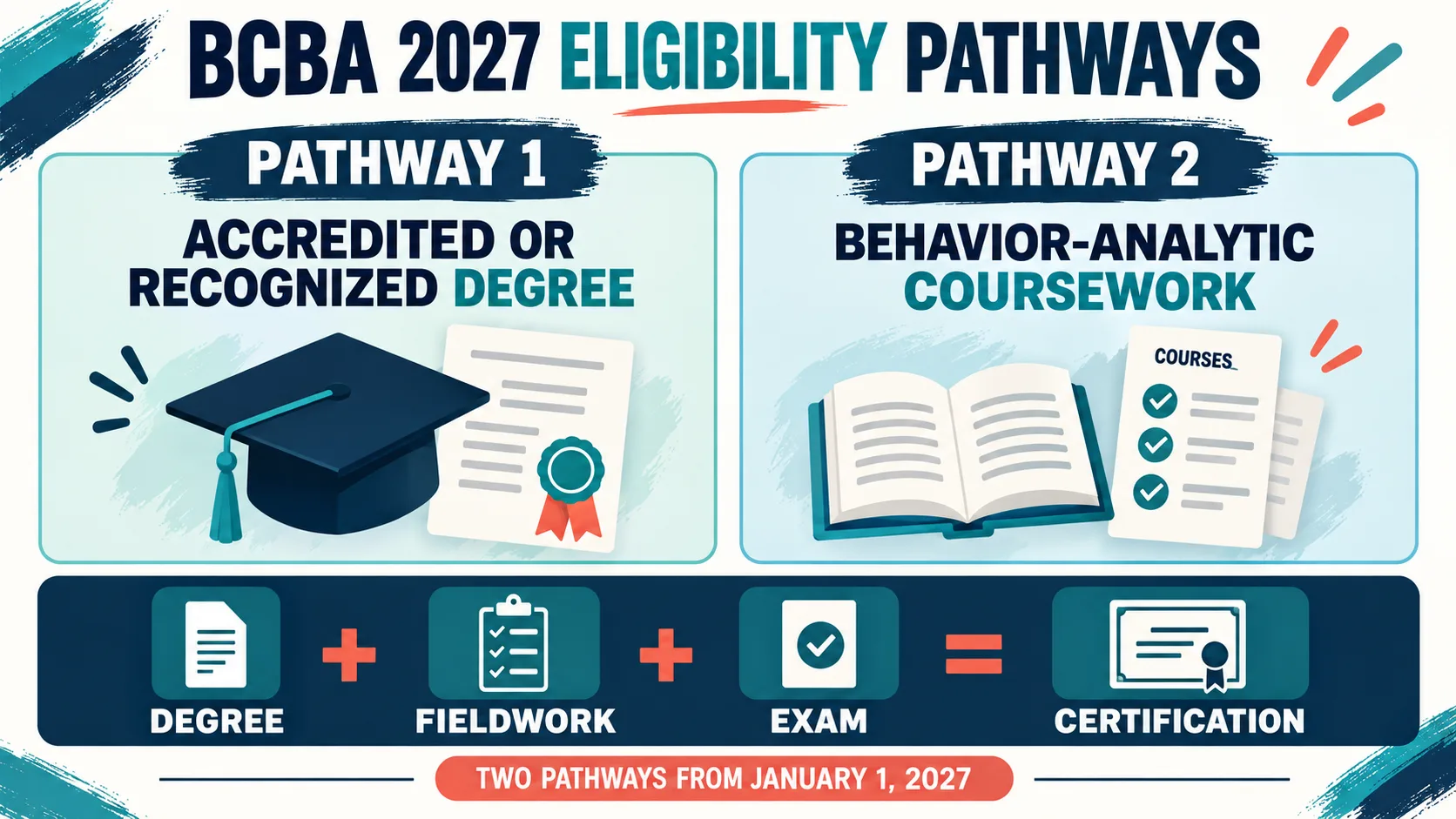
Beginning January 1, 2027, the BACB describes two BCBA eligibility pathways. Both require the candidate to complete the applicable degree requirement, practical fieldwork in applied behavior analysis, and the BCBA certification examination. Pathway 1 uses a qualifying master’s or doctoral degree from an APBA-accredited program or an ABAI-accredited or recognized behavior-analysis degree program under the listed ABAI tiers. The degree route is tied to the status of the program and the date the degree was earned, so verify the program’s recognition rather than relying on a school’s general marketing language.
Pathway 2 uses a master’s degree or higher from a qualifying institution plus behavior-analytic coursework and supervised fieldwork. The graduate degree may be in another field, but the behavior-analytic coursework must satisfy the BACB’s content, hour, timing, and documentation rules. The 2027 BCBA Requirements document gives the overview; use the handbook for definitions, forms, application details, and maintenance obligations.
Pathway 1: accredited or recognized degree
Under the 2027 framework, Pathway 1 requires a qualifying graduate degree from an APBA-accredited program or an ABAI-accredited or recognized behavior-analysis degree program. The BACB’s handbook explains the relevant program status and degree timing, including the recognition tiers listed for ABAI programs. You still need qualifying supervised fieldwork and must pass the BCBA examination. Before enrolling, verify the degree level, conferral date, program status, official-transcript process, and the fieldwork and examination rules that will apply when you submit.
For international degrees or degrees earned outside the BACB’s jurisdiction, the handbook describes a degree-equivalency process. Do not substitute an unrelated evaluation service or assume that a university’s accreditation in another country is enough. Use the BACB’s own process and current instructions.
Pathway 2: behavior-analytic coursework
Pathway 2 begins with a master’s degree or higher from a qualifying institution. Under the 2027 requirements, the degree and the entire behavior-analytic coursework sequence may not be completed in less than one calendar year. The BACB defines that period as three consecutive primary semesters, four consecutive primary quarters, or twelve consecutive months under another academic model.
The 2027 coursework totals 315 instructional hours. The content must be delivered in the required freestanding-course structure, and the institution must have a designated Pathway 2 Program Contact who can submit the coursework attestation. The content areas are:
- Basic Principles of Behavior: 45 hours in one freestanding course.
- Theory and Philosophy in Behavior Analysis: 45 hours in one freestanding course.
- Research Methods in Behavior Analysis: 45 hours in one freestanding course.
- Behavior Assessment and Intervention: 90 hours across two freestanding courses.
- Organizational Behavior Management: 45 hours in one freestanding course.
- Ethics in Behavior Analysis: 45 hours in one freestanding course.
This is where many transition plans fail. A 2022 course title may sound similar to a 2027 content area but still not satisfy the new freestanding-course arrangement. If you completed some coursework under the older rules, compare your transcript and syllabi with the BACB 2027 transition guidance. The BACB specifically recommends reviewing content hours with a program advisor.
Supervised fieldwork requirements
Both 2027 pathways require supervised fieldwork in applied behavior analysis. The 2027 overview lists 2,000 hours for Supervised Fieldwork or 1,500 hours for Concentrated Supervised Fieldwork. Those totals are only the starting point: the hours must also meet supervision, observation, monthly-range, individual-supervision, unrestricted-activity, documentation, and supervisor-qualification rules.
| Fieldwork element | 2022 requirements | 2027 requirements |
|---|---|---|
| Supervised Fieldwork | 2,000 hours; 5% supervision; 20–130 hours per month; one client observation per month. | 2,000 hours; 5% supervision; 20–160 hours per month; 60 cumulative minutes of client observation per month. |
| Concentrated Fieldwork | 1,500 hours; 10% supervision; 20–130 hours per month; one client observation per month. | 1,500 hours; 7.5% supervision; 20–160 hours per month; 90 cumulative minutes of client observation per month. |
| Records to protect | Use the forms and records required for the 2022 application rules. | Track both contact counts and observation duration when planning across the transition; use the forms that match the application rules. |
The 2027 fieldwork rules also retain the important safeguards that at least 50% of supervised hours be individual and at least 60% of total supervised fieldwork hours be unrestricted activities. A qualified supervisor must meet the BACB’s current certification and consultation conditions. The handbook and transition guide—not a generic hour tracker—should control your plan.
Plan the 2027 transition and protect your records
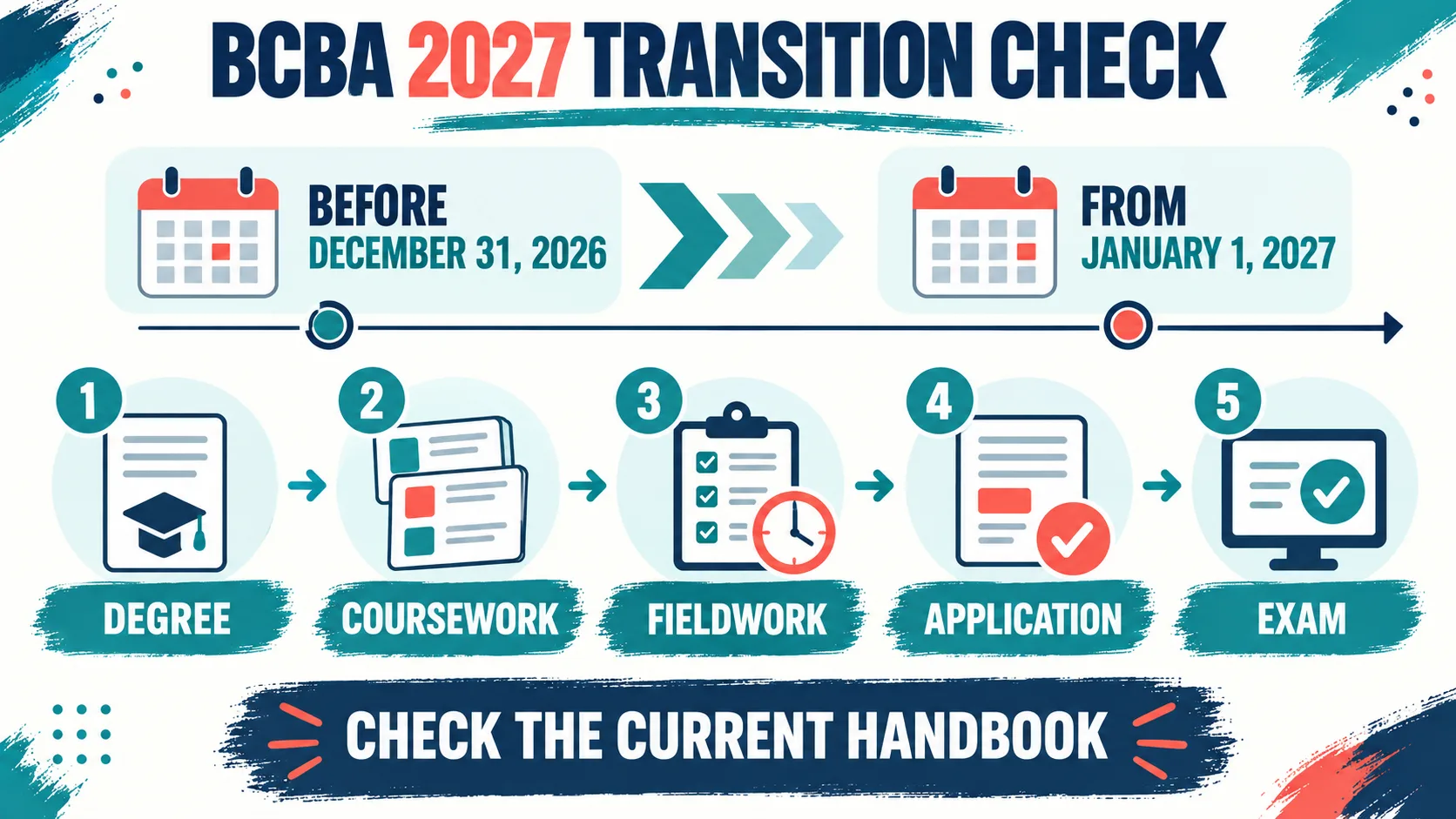
If you are accruing hours while deciding when to apply, the BACB recommends planning to meet both sets of fieldwork requirements when possible. That means tracking the percentage of supervision, monthly hours, the number and duration of client observations, and the applicable forms. The transition guidance says fieldwork documentation should be retained for at least seven years and made available to the BACB upon request. A practical transition plan includes:
- ask your supervisor which application date your current records are designed to support;
- track both observation contacts and observation minutes each month;
- keep the applicable 2022 and 2027 monthly forms separate when your plan spans the transition;
- check whether concentrated supervision meets the percentage required by your chosen application rules;
- save supervision contracts, logs, verification forms, and correction notes in an organized system;
- confirm that all qualifying hours fall within the BACB’s allowed time window.
The BACB can audit fieldwork, so organized records make it easier to support the numbers on a final verification form and answer an action item without rebuilding your history from memory.
Application, documents, and examination
Once you meet the applicable eligibility requirements, submit the BCBA Certification Application through your BACB Portal account, choose the correct pathway, provide the required documentation, and pay the fee. Official transcripts must come from the institution; Pathway 2 applicants also need the appropriate coursework attestation from the designated program contact.
After the BACB receives the paid application and required documents, staff review the submission and may audit fieldwork. If approved, you receive instructions for scheduling the examination with Pearson VUE. The current exam is based on the BCBA Test Content Outline, 6th edition, effective January 1, 2025. The outline contains 175 scored questions and 10 unscored questions, with four hours to complete the exam.
The official BCBA Test Content Outline organizes the exam into nine content areas, including concepts and principles, measurement, ethics, assessment, behavior-change procedures, intervention selection, and personnel supervision. The 2027 certification transition does not automatically mean that the exam outline changes; the BACB states that examination and certification-requirement updates can occur independently.
When you are ready to measure exam readiness, use the Free BCBA Mock Exam as a practice resource. It cannot determine whether your degree, coursework, or fieldwork qualifies, but it can show which content areas deserve more review.
BCBA certification versus state licensure
BCBA certification and state licensure are related but not interchangeable. The BACB certifies the professional under its certification requirements; a state, province, or other jurisdiction may impose separate licensing, registration, scope-of-practice, supervision, or payer rules. Before offering services, check the rules where you intend to practice and confirm whether your employer or funder requires additional credentials. Meeting the BACB requirements does not by itself answer questions about insurance enrollment, independent practice, title use, telehealth, or local service delivery. Check the BCBA certification page and the relevant jurisdiction’s regulator separately.
A practical candidate checklist
Use this checklist before choosing a program or submitting an application:
- Write down the date by which you expect the BACB to receive a complete application.
- Choose the pathway that matches your degree and training evidence.
- Obtain an official transcript review from your institution or program advisor.
- For Pathway 2, map every course to the required content area, hours, and freestanding-course rule.
- Confirm that the Pathway 2 Program Contact can provide the correct attestation.
- Review the supervisor’s qualifications and the fieldwork structure before accruing hours.
- Track monthly hours, supervision percentage, observations, individual supervision, and unrestricted activities.
- Retain both the monthly and final verification records that match your application date.
- Check the current application-processing page before sending documents.
- Study the current TCO and use practice questions to identify gaps.
FAQ
What degree do I need to become a BCBA?
For 2027 Pathway 1, the degree must come from an APBA-accredited or ABAI-accredited/recognized behavior-analysis program under the applicable BACB rules. For Pathway 2, the BACB requires a master’s degree or higher from a qualifying institution plus the required behavior-analytic coursework and supervised fieldwork. How many fieldwork hours are required?
The 2027 overview lists 2,000 hours for Supervised Fieldwork or 1,500 hours for Concentrated Supervised Fieldwork, with additional supervision, observation, monthly-range, individual-supervision, unrestricted-activity, and documentation requirements.
Are the BCBA requirements changing in 2027?
Yes. Beginning January 1, 2027, only two eligibility pathways remain, Pathway 2 coursework is reorganized into the 315-hour structure, and fieldwork documentation and some fieldwork conditions change. The BACB says a complete application received by December 31, 2026 may be reviewed under the current 2022 requirements.
Can a blog tell me whether I qualify?
No. A blog can help you organize questions, but the BACB handbook, official documents, program advisor, supervisor, and—when needed—the BACB’s formal review process should control an eligibility decision.
Official sources and scope
The primary references for this guide are the BACB’s current BCBA Handbook, 2027 BCBA Requirements, 2027 transition guidance, and the BACB application-processing updates. Requirements and forms can change, so confirm the current version before enrolling, accruing hours, or applying.
Take the Free BCBA Mock Exam
When you are ready to apply the idea, use the free practice resource below for additional feedback. Take the Free BCBA Mock Exam



