
Where to get BCBA supervision hours is a sourcing decision before it is a scheduling decision. You may find a fieldwork opportunity through an employer, university or practicum program, an independent BCBA, a remote supervision provider, or a marketplace. The best option is the one that can connect your actual work to a qualified supervisor, appropriate client contact, required observations, a written contract, and records you can defend later.
Table of Contents
- Where to Get BCBA Supervision Hours: A Source-by-Source Search Plan
- Start With the Fieldwork Requirements, Not a Marketplace
- Compare Five Places to Find Supervision
- Ask Screening Questions Before You Commit
- Check the Contract, Client Access, and Documentation
- Build a Monthly Fieldwork Record
- Evaluate Remote or Paid Supervision Without Guessing
- Use a Two-Stage Search Workflow
- Red Flags and FAQ
- Sources for Further Study
Use this guide as a search-and-screening plan. It does not replace the current BACB Handbook, the requirements that apply to your application date, state or employer rules, or the professional judgment of a qualified supervisor. Existing guides on this site cover supervision requirements, online mechanics, cost, and duration; this page focuses on where to look and what to verify before you commit.
Where to Get BCBA Supervision Hours: A Source-by-Source Search Plan
Start with five search channels: an ABA employer, a university or practicum program, an independent local BCBA, a remote supervision provider, or a fieldwork marketplace and professional network. None is automatically valid simply because it advertises “BCBA hours.” Your first call should determine whether the source can support the fieldwork arrangement you actually need, not just sell a meeting or a course.
| Search channel | Potential advantage | First verification question |
|---|---|---|
| ABA employer | May combine paid work, clients, supervision, and feedback in one setting. | Will the employer provide a written fieldwork contract and a supervisor who meets the current rules? |
| University or practicum | May offer structured coursework, site agreements, and faculty coordination. | Does the placement provide actual client-linked activities and the observations required for your pathway? |
| Independent BCBA | May fit a local school, clinic, home, or community setting already available to you. | Which client, setting, activities, supervision contacts, and forms will the supervisor personally oversee? |
| Remote provider | Can help when local supervisor availability is limited. | How will live client observation, site permission, privacy, and supervisor feedback work at a distance? |
| Marketplace or network | Can expand the number of supervisors or sites you can contact quickly. | Who is the actual supervisor, what is the site, and what happens if the match ends? |
A good lead produces specific answers. “You will get your hours” is not a fieldwork plan. Ask for the supervisor’s name, the setting, client access, observation method, meeting schedule, documentation system, fees or employment conditions, and the written contract before counting anything.
Start With the Fieldwork Requirements, Not a Marketplace
The BACB’s supervision and fieldwork materials are the boundary conditions. Before you search, write down the application date you are planning for, the fieldwork pathway you are using, the type of fieldwork you expect to accrue, and any state or employer requirements that affect client contact. The current handbook and transition materials control; a provider’s website cannot waive a requirement. Also separate three things that are often blended together in advertisements:
- Supervision contact: the individual or group supervision activity and feedback you receive.
- Fieldwork activity: the applied work, training, measurement, assessment, intervention, or other activity that may be eligible under the applicable rules.
- Client observation: the direct observation and setting access required by the fieldwork arrangement and current documentation rules.
A monthly meeting by itself is not the same thing as a complete fieldwork site. Likewise, a job title such as behavior technician or special-education staff does not automatically make every task eligible. The supervisor and trainee should map the actual activities and documentation before the first month begins.
Compare Five Places to Find Supervision
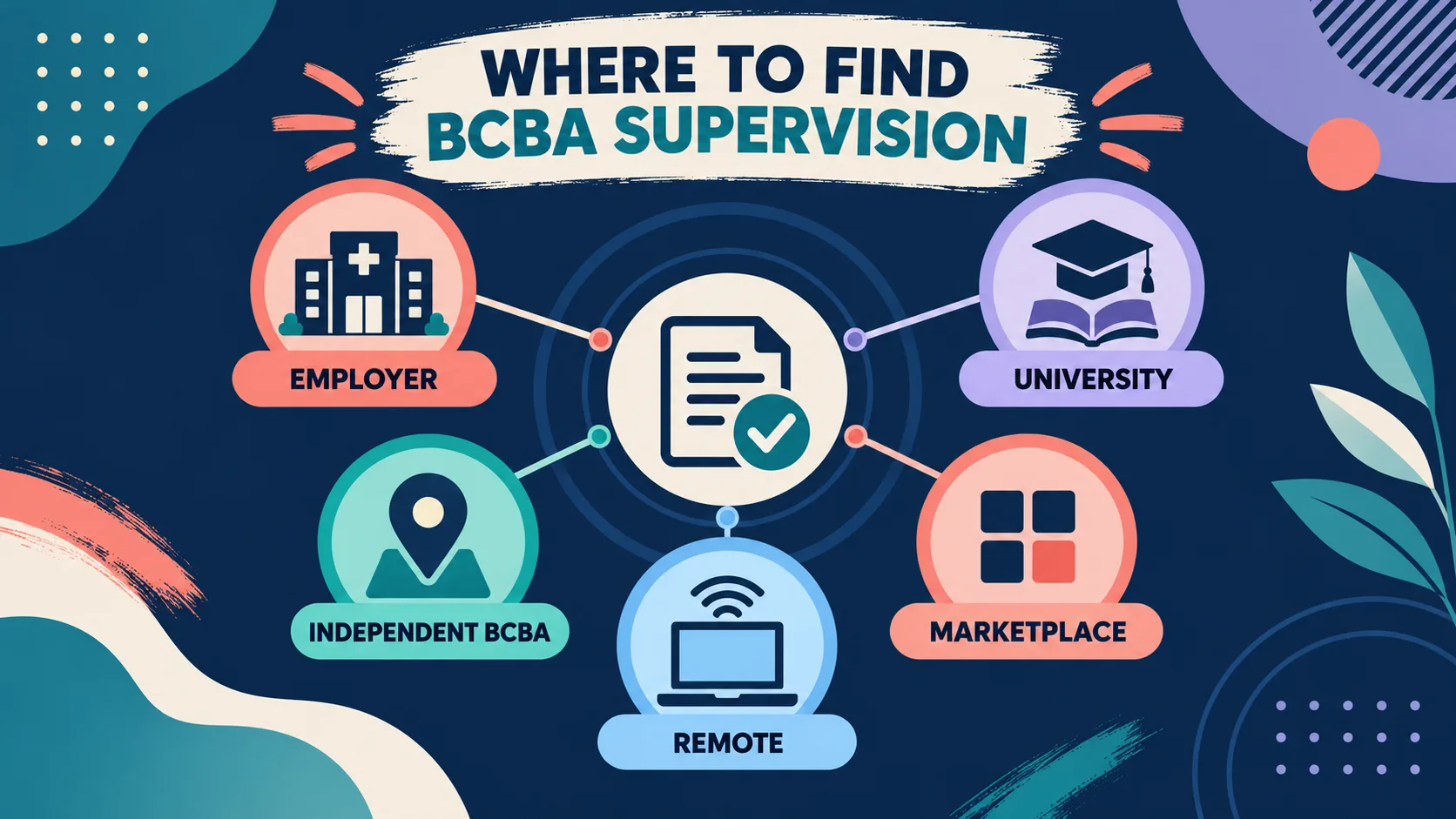
1. Ask your current or target employer first: An employer may be the simplest starting point because the worksite, clients, team, and schedule already exist. Ask whether supervision is included, whether the supervisor is an employee or contractor, whether you may accrue both restricted and unrestricted activities, and whether the employer will allow observations and maintain required records. Clarify whether supervision is available during the shifts you actually work.
2. Check university and practicum pathways: University programs, ABA departments, and practicum coordinators may maintain approved sites or relationships with local providers. Ask whether the placement is a real fieldwork arrangement or only a class observation, who signs the forms, and how the site handles absences, holidays, changes in caseload, and supervisor turnover. A university connection is useful, but it still needs a written, client-linked plan.
3. Contact independent local BCBAs: Search professional directories, local ABA organizations, school networks, clinics, and referrals from instructors. An independent BCBA may supervise at a site where you already work or may help identify a permissible setting. Confirm that the supervisor will personally direct the activities, observe when required, provide feedback, and sign only records that can be supported.
4. Evaluate remote supervision providers: Remote supervision can expand access, but it does not remove site responsibilities. You still need an appropriate client or service context, permission for observation, privacy safeguards, reliable technology, and a plan for live contact and feedback. Ask whether the provider supplies a site, works with your existing employer, or expects you to arrange every client and observation detail yourself.
5. Use a marketplace as a lead source, not as proof: A marketplace or social network can help you compare availability, geography, specialty, and price. Treat the listing as an introduction. The actual agreement is between you, the supervisor, and the fieldwork setting. Request the supervisor’s full name, contract, qualifications, cancellation policy, documentation process, and plan if the match ends before you finish.
Ask Screening Questions Before You Commit
Use a short call or email to turn a vague lead into a verifiable arrangement. The following questions are more valuable than asking only “How many hours will I get?”
| Screening area | Questions to ask | Evidence before starting |
|---|---|---|
| Supervisor | Who is responsible, what is their role, and what training or qualifications apply? | Name, role, current status, supervision arrangement, and written responsibilities. |
| Client and site | Which clients and settings are available, and who authorizes observation? | Site permission, privacy process, client-linked activity plan, and observation access. |
| Schedule | When are individual, group, and observation contacts available? | A realistic monthly calendar that matches your work and school commitments. |
| Records | What system records hours, activities, feedback, supervision, and forms? | Sample blank log, monthly review process, copy-retention plan, and form responsibilities. |
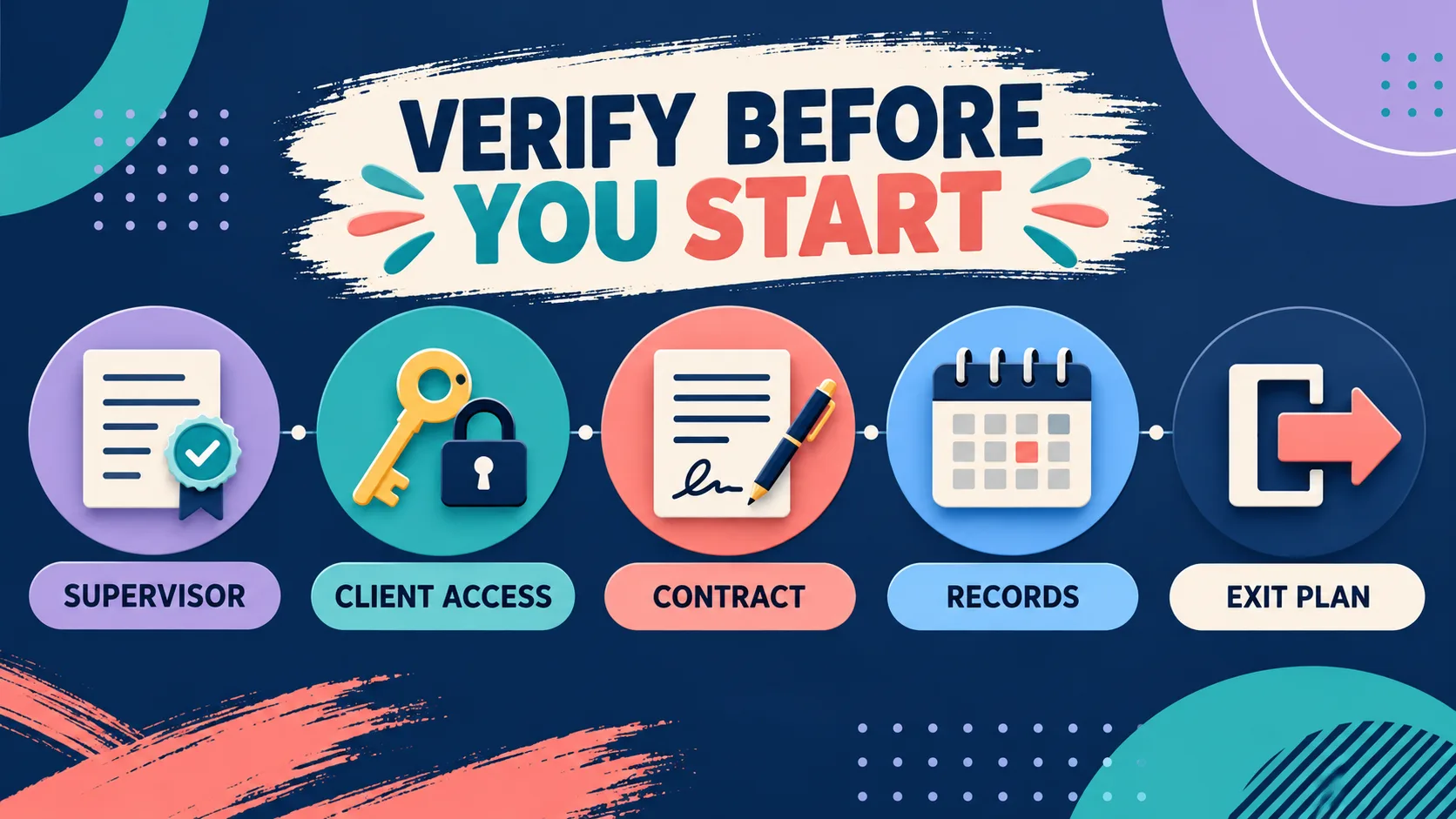
| Exit plan | What happens if the supervisor, client, job, or technology changes? | Notice period, final review, record handoff, fees, and signature expectations. |
If the answers stay vague, pause. A professional provider should be able to explain the arrangement without promising that every hour will count. You can compare the response with the detailed BCBA supervision requirements guide and the current BACB sources.
Check the Contract, Client Access, and Documentation
The BACB Handbook describes a written supervision contract at the outset of the supervisory relationship. Read it as a protection for both sides, not as paperwork to sign after the hours have started. Look for responsibilities, individualized activities and training objectives, documentation and form procedures, conditions related to signatures, payment or employment terms, confidentiality, and how the relationship can end.
Client access deserves its own check. If your plan depends on a school, clinic, home, or telehealth setting, identify who owns the service relationship, who gives permission for observation, how privacy is protected, and what happens if the client is absent. A remote supervisor cannot create access to a client that the site does not authorize.
Keep your own copy of the contract, supervision records, monthly reviews, forms, messages about changes, and the evidence supporting your activities. The BACB’s documentation guidance emphasizes collaboration between trainee and supervisor, but each party should retain relevant records. Your spreadsheet or tracker can support organization; it does not make an ineligible activity eligible.
Build a Monthly Fieldwork Record
Before the first month closes, reconcile the work you actually performed with the plan you signed. A simple record should make it possible to answer what happened, when it happened, who supervised it, what type of activity it was, and which form or review supports it.
| Monthly checkpoint | Record | Who reviews it |
|---|---|---|
| Activity hours | Dates, start/end times, setting, supervisor, and activity category. | Trainee and supervisor before the monthly form is finalized. |
| Supervision | Individual/group contacts, feedback, goals, and observation details. | Supervisor checks the record against the contract and requirements. |
| Gap check | Missed observations, missing signatures, low activity variety, or privacy issues. | Both parties create a correction plan before the next month. |
| File copy | Signed forms, logs, contract changes, and relevant supporting notes. | Trainee and supervisor retain their own copies. |
Evaluate Remote or Paid Supervision Without Guessing
Paid supervision is not automatically invalid, and free supervision is not automatically high quality. Evaluate the service by what it provides and documents. Ask whether the fee covers individual supervision, group supervision, direct observation, case review, data feedback, form review, and ordinary administrative communication. Compare the promised schedule with your actual client and worksite access.
For remote supervision, ask how live observation will occur, whether recording is permitted, who obtains consent, how identifying information is protected, and what happens when the technology fails. If the provider offers “simulated clients,” “guaranteed hours,” or a curriculum with no connection to your actual fieldwork, stop and compare the offer with the current handbook before paying. Use the existing online BCBA supervision guide for deeper remote-work questions, and use the BCBA supervision cost guide to build a budget. Neither guide nor a provider guarantee can replace official eligibility review.
Use a Two-Stage Search Workflow
Make the search manageable by separating discovery from commitment:
- Build a shortlist: contact at least three channels and record location, client population, schedule, supervisor, estimated cost, and whether the source supplies a site.
- Run the evidence call: ask the screening questions, request the contract and blank documentation examples, and verify how observation and monthly review work.
- Compare the total arrangement: include supervision fees, unpaid time, travel, technology, site restrictions, and the cost of changing providers later.
- Start only after alignment: sign the written agreement, confirm permissions, create your record system, and make the first month’s calendar visible to both parties.
The fastest option is not always the shortest path. A supervisor with a clear contract, real client access, regular feedback, and usable records is usually a stronger choice than a listing that promises immediate hours without explaining the evidence.
Red Flags and FAQ
Pause and ask for clarification if a provider:
- guarantees that every hour will count or promises a certification outcome;
- cannot identify the supervisor or the client-linked setting before payment;
- offers only group meetings while avoiding individual feedback or observation questions;
- asks you to backdate logs, sign blank forms, or record activities you did not perform;
- has no written cancellation, transfer, record-retention, or final-signature process.
Can my employer provide BCBA supervision hours?: Often an employer can be a practical source, but the work must still fit the applicable fieldwork and supervision rules. Confirm the responsible supervisor, client access, contract, observations, activities, and records before you rely on the job.
Can I find a supervisor through a university?: Yes, a university or practicum program may connect you with sites or faculty, but ask whether the placement provides actual client-linked fieldwork and who owns the documentation and final verification responsibilities.
Can remote or paid supervision count?: It may, depending on the actual arrangement and the rules that apply to your application. Remote or paid status alone does not answer whether client access, observation, supervisor qualifications, documentation, privacy, and fieldwork activities are acceptable.
How can I use the topic for BCBA exam preparation?: Practice separating a supervision contact, a fieldwork activity, an observation, a contract requirement, and a documentation requirement. The Take the Free BCBA Mock Exam can help you test whether a missed scenario reflects terminology recall or a fieldwork decision error. It is a practice resource, not a guarantee of examination performance.
Sources for Further Study
- Behavior Analyst Certification Board: Supervision, Assessment, Training, and Oversight
- Behavior Analyst Certification Board: BCBA Handbook
- Behavior Analyst Certification Board: Documenting Fieldwork FAQ
- Behavior Analyst Certification Board: Fieldwork—Getting It Right
- BCBA Mock Exam: BCBA Supervision Requirements
This article is for educational and BCBA exam-preparation purposes. Always confirm current BACB rules, state or employer requirements, client permissions, supervisor qualifications, and documentation responsibilities before beginning or counting fieldwork.



