

A practical BCBA exam guide to VR3 ABA: understand the changing response requirement, calculate the average, compare it with FR3 and VI, and recognize the schedule in real scenarios. If you searched for VR3 ABA, the key is the number three. It does not mean that reinforcement arrives after exactly three responses every time. It means that reinforcement is delivered after a changing number of responses that averages three responses per reinforcer. A learner might earn reinforcement after two responses, then four, then three, then one, then five. Across that sequence, the average is three.
Table of Contents
- VR3 ABA: What It Means
- How to Calculate a VR3 Schedule
- A Step-by-Step VR3 Example
- VR3 vs. FR3 and VI 30 Seconds
- How VR3 Fits Into ABA Reasoning
- Common VR3 ABA Mistakes
- Use the Idea on BCBA Questions
- Frequently Asked Questions
- Quick Review Checklist
- Take the Free BCBA Mock Exam
That distinction is small in notation but important in a BCBA question. The examiner is usually asking you to identify what controls delivery: a changing number of responses, a fixed number of responses, or the passage of time. Once you identify that controlling dimension, VR3 ABA becomes much easier to separate from FR3, VI 30 seconds, and other schedules of reinforcement.
Scope note: This is an educational BCBA study guide, not an individualized treatment recommendation. A reinforcement schedule should be selected, monitored, and adjusted by a qualified professional using learner assent, preference information, safety considerations, and data.
VR3 ABA: What It Means
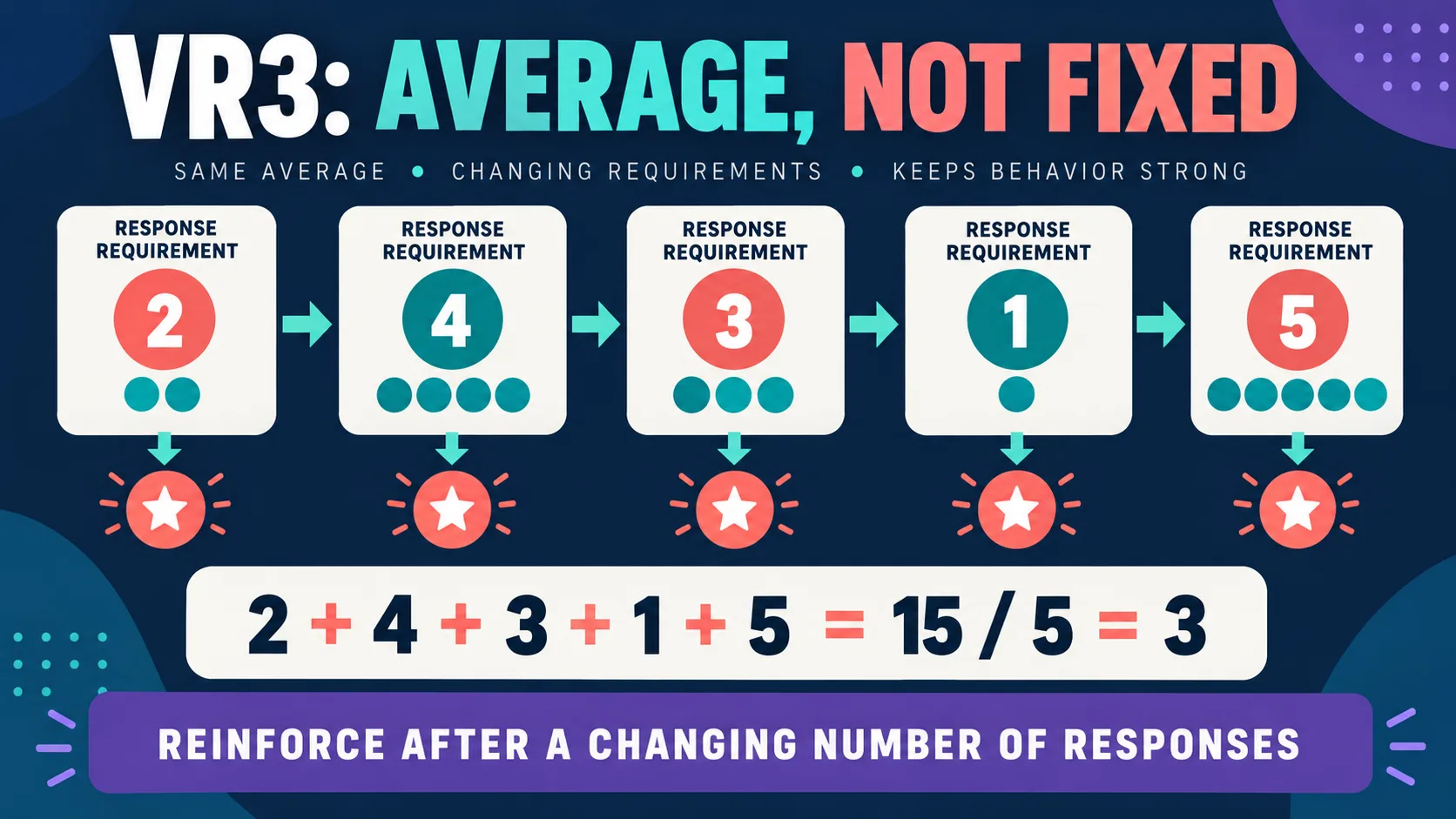
VR3 ABA means a variable-ratio schedule of reinforcement with an average requirement of three responses per reinforcer. “Variable” describes the changing response requirement. “Ratio” tells you that the schedule is based on the number of responses, not seconds or minutes. “3” is the average response requirement.
The number is not a promise that every third response will contact reinforcement. If reinforcement always followed exactly the third response, the schedule would be FR3, or fixed ratio 3. On a VR3 schedule, the sequence can change while the programmed average remains three. The learner therefore cannot know the exact response that will produce the next reinforcer just by counting to three.
The APA Dictionary of Psychology describes the ratio value as the average number of responses per reinforcer. A variable-ratio schedule is therefore defined by two linked features: reinforcement depends on responding, and the required number of responses varies around a planned average. For exam purposes, translate the notation into a sentence:
- VR: the response requirement varies.
- 3: the response requirement averages three.
- ABA: the schedule is being analyzed as an applied behavior-analytic contingency, so identify the response, reinforcer, antecedent arrangement, and consequence rather than relying on a familiar label alone.
How to Calculate a VR3 Schedule
To check whether a short sequence is consistent with VR3, add the response requirements and divide by the number of reinforcement opportunities. For example: (2 + 4 + 3 + 1 + 5) ÷ 5 = 15 ÷ 5 = 3 The sequence is variable because the requirements are not identical. It is ratio-based because each value represents a number of responses. It is VR3 because the mean is three. The sequence does not need to contain the number three in every trial, and it does not need to alternate neatly between low and high values. The relevant question is whether the programmed sequence averages three over the defined set of opportunities.
Do not confuse an average with a fixed rule. If a learner receives reinforcement after response 2, response 4, response 3, response 1, and response 5, the next requirement is not automatically 3. The schedule label describes the programmed distribution, not a guarantee about the next trial. In real programming, the exact sequence should be planned and documented rather than improvised in a way that makes the contingency impossible to interpret. A useful calculation checklist is:
- List the response requirement for each reinforcement opportunity.
- Confirm that the values vary rather than remaining identical.
- Add the values and divide by the number of opportunities.
- Confirm that the average is approximately the schedule value.
- Check that the reinforcer follows the required response, not merely the passage of time.
A Step-by-Step VR3 Example
Imagine a study task in which a learner earns a token after completing the programmed number of correct responses. For illustration, the response requirements are 1, 5, 2, and 4. The average is: (1 + 5 + 2 + 4) ÷ 4 = 12 ÷ 4 = 3
That is a VR3 pattern. The learner experiences reinforcement after a changing number of correct responses, while the mean requirement across the sequence is three. The example is not intended to prescribe a schedule for a real learner; it is a way to see how the notation maps onto a contingency.
| Opportunity | Responses required | What happens next? |
|---|---|---|
| 1 | 1 correct response | Deliver the programmed reinforcer, then begin the next requirement. |
| 2 | 5 correct responses | Reinforcement follows the fifth qualifying response. |
| 3 | 2 correct responses | The response requirement changes again; it is not fixed at three. |
| 4 | 4 correct responses | The sequence totals 12 responses across four opportunities, averaging 3. |
On a multiple-choice question, the sequence is evidence, not decoration. If the answer options include “fixed ratio,” ask whether the response requirement is identical each time. If an option says “variable interval,” ask whether time—not responses—determines when reinforcement becomes available. If an option says “continuous reinforcement,” ask whether every response contacts reinforcement. The schedule name should follow the contingency described in the stem.
VR3 vs. FR3 and VI 30 Seconds
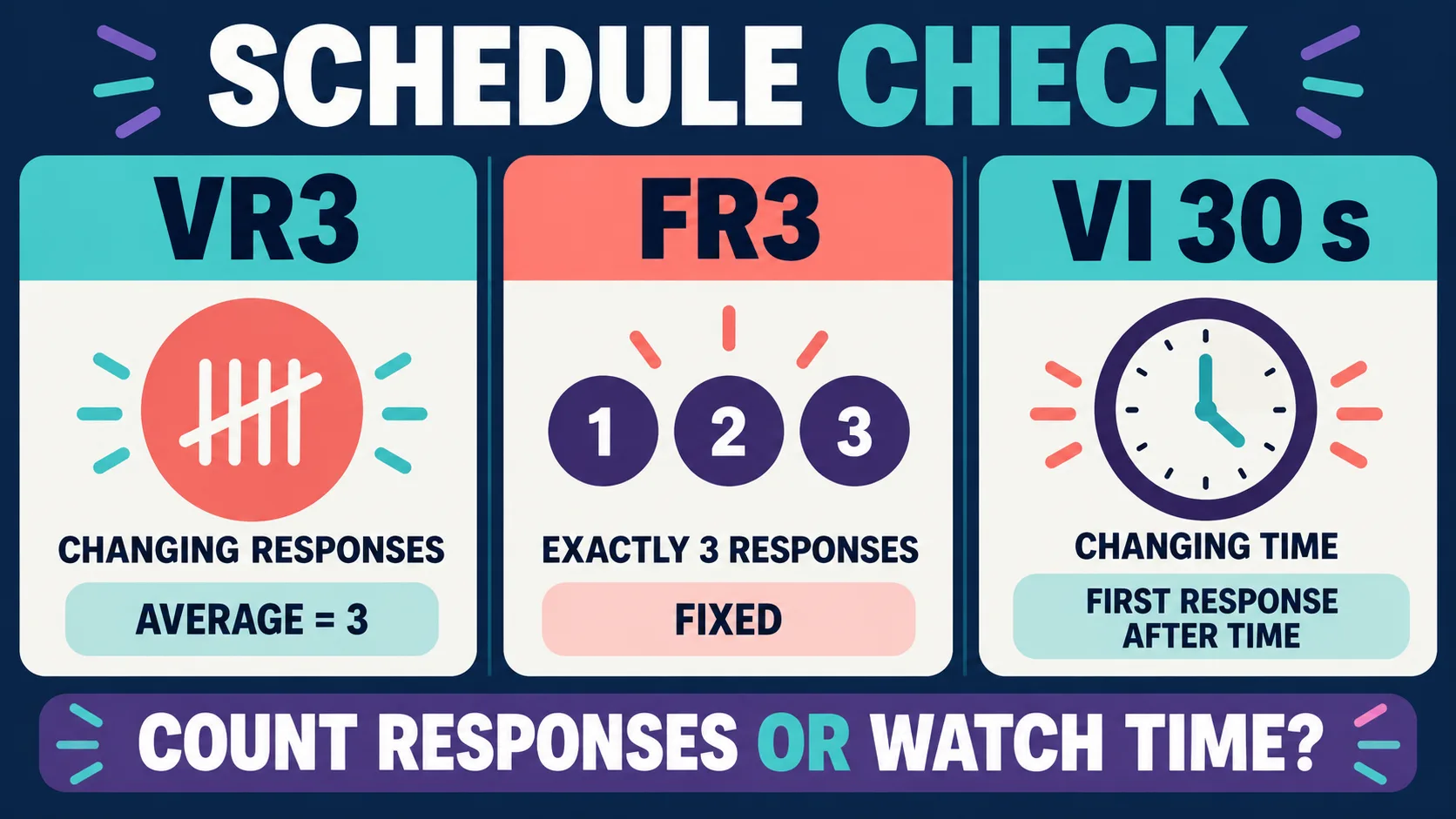
The quickest way to separate schedules is to identify the dimension that changes. A ratio schedule counts responses. An interval schedule measures time. A fixed schedule repeats the same requirement. A variable schedule changes the requirement around an average. The labels are compact, but each letter carries a different decision rule.
| Schedule | Controlling dimension | Meaning of the number | Exam clue |
|---|---|---|---|
| VR3 | Changing number of responses | Average of 3 responses per reinforcer | The response count changes across opportunities. |
| FR3 | Fixed number of responses | Exactly 3 responses per reinforcer | The requirement is the same each time. |
| VI 30 s | Changing time interval | Average interval of 30 seconds | After the interval passes, the first eligible response is reinforced. |
| FI 30 s | Fixed time interval | A 30-second interval | The first eligible response after the fixed interval contacts reinforcement. |
The variable-ratio explanation from Finni gives the same core distinction: the requirement changes around a defined average. For a broader academic example, the classroom reinforcement study available through PMC describes variable-ratio schedules as intermittent schedules used after skills are established in some programming contexts. Those sources can support conceptual study, but they do not replace a learner-specific programming decision.
How VR3 Fits Into ABA Reasoning
A schedule of reinforcement is not a reinforcer by itself. The reinforcer is the consequence that increases future behavior under the relevant conditions. VR3 describes how often that consequence is arranged in relation to responding. In a scenario, therefore, identify both the consequence and the schedule.
Start with the response definition. “The learner works hard” is not a measurable response requirement. “The learner completes a defined task-analysis step independently” is closer to something that can contact reinforcement. Then identify the reinforcer and the delivery rule. If the learner earns access after a varying number of completed steps averaging three, the schedule may be described as VR3. If access follows a changing amount of time and then the first response, it is an interval schedule instead.
Also consider schedule thinning. A dense schedule may be useful while a response is being acquired, whereas an intermittent schedule may be considered when the response is established and the team is evaluating maintenance. Moving to VR3 should never be treated as an automatic “upgrade.” The team should monitor response strength, errors, frustration, preference, assent, and whether the schedule still supports a meaningful outcome. When studying, connect schedule questions to the larger ABA decision chain:
- Define the behavior: What observable response is being reinforced?
- Identify the consequence: What follows the response, and is it actually functioning as reinforcement?
- Identify the dimension: Is the requirement based on responses or time?
- Identify the pattern: Is the requirement fixed or variable?
- Check the data: Does responding remain strong, accurate, and meaningful for the learner?
For a broader overview, see the site’s variable-ratio schedule guide and the VR2 ABA example. This article stays narrower by owning the exact VR3 question: how the number 3 functions as an average and how to classify the schedule against nearby distractors.
Common VR3 ABA Mistakes
- Reading VR3 as “every third response”: that describes FR3, not VR3.
- Forgetting the ratio: if the stem emphasizes seconds, minutes, or a waiting period, investigate an interval schedule.
- Assuming any changing sequence is VR3: the sequence must be response-based and average the stated value over the relevant opportunities.
- Confusing variability with randomness: the schedule can have a planned distribution and average; “variable” does not mean undocumented or uncontrolled.
- Treating the schedule as the reinforcer: VR3 describes the contingency arrangement; it does not tell you whether the consequence is preferred or effective.
- Ignoring the learner: a schedule should be evaluated with data, preference information, assent, access, and ethical safeguards.
- Overextending a textbook example: a study sequence helps identify the schedule; it is not a complete clinical recommendation.
Use the Idea on BCBA Questions
When a question gives a sequence such as 1, 5, 2, and 4, do not choose an answer from the number alone. First ask whether the numbers are response requirements or time values. Next ask whether they stay the same. Finally calculate the average if the question requires you to verify the schedule. In a well-written stem, the correct answer will match the contingency, not merely a familiar abbreviation.
When you are ready to practise schedule discrimination under time pressure, try the Free BCBA Mock Exam. Review whether a missed item came from confusing ratio with interval, fixed with variable, or a schedule label with the actual reinforcer.
Frequently Asked Questions
What does VR3 mean in ABA?: VR3 means variable-ratio 3. Reinforcement follows a changing number of responses, and the response requirement averages three responses per reinforcer. It does not mean that reinforcement follows exactly every third response. Is VR3 the same as FR3?: No. FR3 delivers reinforcement after exactly three responses each time the contingency is met. VR3 changes the response requirement while maintaining an average of three.
How do you calculate a VR3 schedule?: Add the response requirements across the defined reinforcement opportunities and divide by the number of opportunities. A sequence of 2, 4, 3, 1, and 5 totals 15; 15 divided by 5 equals an average of 3. Does VR3 depend on time?: No. VR3 is response-based. If the passage of time is the defining requirement, the schedule is an interval schedule, such as VI 30 seconds, not a variable-ratio schedule.
Why is VR3 important for the BCBA exam?: It tests whether you can identify the controlling dimension of reinforcement. The most common trap is treating the average number as an exact response requirement and confusing VR3 with FR3.
Should every learner be placed on VR3?: No. Schedule selection is individualized. A qualified professional should consider the learner’s current repertoire, preference, goals, access, assent, response patterns, and data before changing a reinforcement schedule.
Bottom line: VR3 ABA means changing response requirements that average three responses per reinforcer. Count responses, check whether the requirement varies, calculate the average when needed, and distinguish the schedule from both the reinforcer and the learner-specific programming decision.
Quick Review Checklist
Use this final checklist to turn vr3 aba into exam-ready reasoning. The goal is not to memorize a label in isolation; it is to identify the relevant evidence and explain why the best answer fits the scenario. Key ideas to review:
- State the central definition or decision point for vr3 aba in your own words.
- Identify the detail that makes vr3 aba different from its closest related ABA term.
- Separate the observable facts in a scenario from assumptions that are not supported by the facts.
- Write one example and one nonexample so you can recognize the concept in a new setting.
Exam application checks:
- Ask what the question is actually requesting before comparing the answer choices.
- Mark the antecedent, response, consequence, or other evidence that supports the selected answer.
- Look for a distractor that describes a related process but does not answer the specific question.
Final self-check:
- Explain how you would verify the interpretation with clear observations or data.
- Change one detail in the scenario and decide whether your answer should change.
- Give a one-sentence rationale that a supervisor or study partner could evaluate.
Take the Free BCBA Mock Exam
When you are ready to apply the idea, use the free practice resource below for additional feedback. Take the Free BCBA Mock Exam



